
Iowa Art History

with an emphasis on representational art
Introduction
This section of our catalogue Topics in American Art is devoted to the topic "Iowa Art History." Articles and essays specific to this topic published in our Resource Library are listed at the beginning of the section. Clicking on titles takes readers directly to the articles and essays.
Following the links to Resource Library articles and essays are a listing of museums in the state which have provided materials to Resource Library for this or any other topic.
Listed after museums are links to online resources outside our website. Following these resources is information about offline resources including DVDs, paper-printed books, journals and articles. Our goal is to present complete knowledge relating to this section of Topics in American Art.
We recommend that researchers always search within Resource Library for additional material. Please see our page How to research topics not listed for more information.
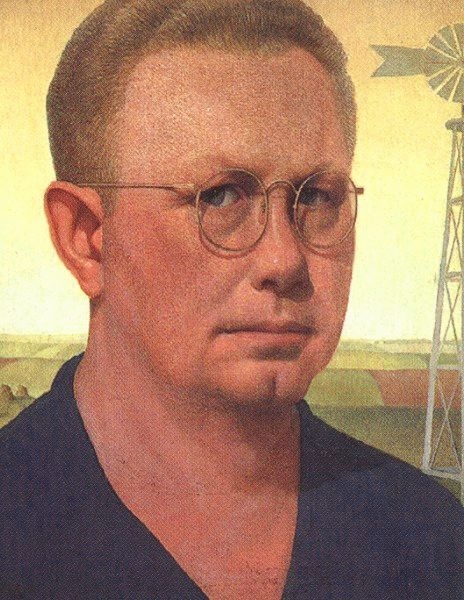
(above: Grant Wood, Self-Portrait, c. 1925, Figge Art Museum. Public domain, via Wikimedia Commons)
Resource Library essays listed by author name in alphabetical order, followed by articles:
None
Museums and other non-profit sources of Resource Library articles and essays:
Des Moines Art Center (2/21/05)
University of Iowa Museum of Art

(above: Grant Wood, Appraisal,
1932, oil on composition board, Dubuque Museum of Art, on long-term loan
from the Carnegie-Stout Public Library. Public domain, via Wikimedia Commons*)
Other online information
Art and Artists in Iowa from Iowa Pathways. Accessed August, 2015.
Chronicle: Paintings by Andonia Giannakouros is a 2022 exhibit at the Dubuque Museum of Art which says: " For Dubuque artist Andonia Giannakouros, portraiture has been the means to explore not only individual identity but how that identity is shaped, like a canyon or a diamond, by social, historical, and cultural pressures over time. In ten large-format oil paintings on panel, presented in the artist's first solo exhibition at the Museum, Giannakouros lays bare this process, wrapping and framing contemporary female subjects in colors, patterns, prints, and motifs that render this invisible development visible." Accessed 6/22
David Plowden's Iowa is a 2012 exhibit at the Figge Art Museum which says: "During his 50-year career, David Plowden sought to capture the once commonplace but now rapidly vanishing scenes of small-town and rural America. David Plowden's Photographs showcases Plowden's photographs of local Iowans and communities during a 20-year period." Accessed 2/17
Drift: Recent Works by E. E. Kono is a 2024 exhibit at the Dubuque Museum of Art which says: "Dubuque artist E. E. Kono returns to DuMA for a solo exhibition of paintings made with traditional techniques like egg tempera and silverpoint to explore history, myth, and legend. Kono is inspired by the Driftless Area. For her, the region is defined by a river that links the land to the sea and the complex past to a shifting present. Ancient limestone bluffs are scattered with fossils from a prehistoric sea and dotted with effigy mounds shaped like bears, birds and serpents by Eastern Woodland Natives. Growing up in such a place taught Kono to perceive the world as full of connections and layered meanings that drift between cultures and time." Accessed 9/24
Ellen Wagener: No Ordinary Moments is a 2016 exhibit at the Dubuque Museum of Art which says: "Ellen Wagener has resided in Arizona for over 15 years but has always retained a fascination with her native Iowa landscape." Accessed 3/17
Grant Wood Iowa's Iconic Artist is a Our Iowa Heritage biography of Grant Wood containing many images of his artwork. Accessed 11/25
Grant Wood and Marvin Cone: Barns, Farms, and America's Heartland was an exhibit held February 6 - May 15, 2016 at Cedar Rapids Museum of Art. CRMA says: "Born in 1891, Wood and Cone began their lifelong friendship in Cedar Rapids in 1906 and attended Washington High School together. The two artists subsequently traveled to Europe in 1920 and, in the summers of 1932 and 1933, were active forces in the Stone City Art Colony, which brought together an important group of regional artists." Also see article titled "Eastern Iowa celebrates 125th anniversary of Grant Wood's birth" By Brian E. Clark, Special to the Journal Sentinel. Accessed August, 2016.
Iowa's Art Story Between 1850 and 1945, a 2025 article by Chat GPT says: "The story of art in Iowa between 1850 and 1945 is not one of flashy avant-garde breakthroughs, but of quiet conviction, of subtle power, of rootedness. It's a story of artists who turned away from Europe's grandeur and big-city glitz, who looked instead to Iowa fields, small towns, local people. They painted not just what they saw -- but what they felt: the dignity of labor, the serenity of landscape, the pride of place. Their brushstrokes remind us that art does not always need to be loud to be resonant, that home -- even in a quiet Midwestern state -- can be the very center of artistry, memory, and meaning." Accessed 12/25
Iowa's Early Art History is a 2025 article by Grok 3.0 which says: "The history of art in Iowa up to 1945, is like uncovering a quiet, steady river carving its way through the heartland -- nothing flashy like the glittering salons of Paris or the bohemian buzz of New York, but something deeply rooted, shaped by the land itself and the people who tilled it. Iowa, with its endless cornfields, rolling prairies, and those sturdy river valleys snaking through the state, has always been a place where art mirrored life: practical, resilient, and tied to the rhythms of the seasons. We're talking about a story that starts with the raw marks of ancient hands on rock faces and evolves into the bold, earthy canvases of the Regionalists, all without veering into those non-representational swirls that would come later. Let's wander through this together, like a road trip across the state, stopping at the key moments and faces that made Iowa's artistic soul so distinct.
John Bloom: Visions of Iowa is a 2009 exhibit at the Figge Art Museum which says: "A native of Iowa and resident of Davenport, John Vincent Bloom (1906-2002) drew inspiration from his immediate surroundings and personal experiences. In so doing, he has left a lasting impression of the small rural communities scattered across the Iowa landscape and the lives sustained by the predominantly agrarian economy." Accessed 2/17
Olson's Art Through the Ages: A Midwestern Perspective is a 2021 exhibit at the Dubuque Museum of Art which says: "Dubuque artist Tim Olson finds inspiration in the people and places around him and uses that inspiration to reimagine historic paintings in his latest series titled, Olson's Art Through the Ages: A Midwestern Perspective. With profound awareness for visual storytelling and irreverent humor, Olson creates a direct dialogue between Midwestern life and historic art. " Also see the website of the artist. Accessed 6/21
Recovered Treasures: Saving Iowa's Painted Past was an exhibition held in 2008-2009 at the State Historical Museum. A 12/23/08 article from the Globe Gazette covers the exhibit. Accessed August, 2016.
The Soil and the Soul: A History of Art in Iowa (1830-1945) is a 2025 article by Gemini 2.5 Pro which says: "To really understand the history of art in Iowa, you have to start with the dirt. It sounds cliché, but in Iowa, the land isn't just a setting; it's the main character. For nearly a century, from the early explorers of the 1830s to the end of World War II, artists struggled with how to look at this place. It wasn't the dramatic verticality of the Rockies or the enclosed, intimate forests of the East. It was a landscape of horizon lines, rolling swells, and a light so sharp it could cut glass. The story of representational art in Iowa is really the story of artists learning to stop looking at the prairie through European eyes and starting to see it for what it actually was." Accessed 12/25
Iowa's Stone City Art Colony is a 2025 article by Grok 3.0 which says: "... it's one of those fascinating blips in American art history that feels like a hidden gem, tucked away in the Midwest during the tough times of the Great Depression. Imagine a bunch of artists converging on this quirky little limestone quarry town, turning old ice wagons into dorms, and painting their hearts out under the guidance of some real heavyweights. It only lasted two summers, from 1932 to 1933, but it left a mark on how we think about regional art and community creativity. Let's through how it all kicked off, what drew people there, what made it so offbeat and vibrant, its lasting ripples in the art world, and spotlight some of the big names who made it shine." Accessed 12/25
Stone City Art Colony from Wikipedia. Accessed August, 2015.
TFAO's Distinguished Artists catalogue provides online access to biographical information for artists associated with this state. Also, Search Resource Library for online articles and essays concerning both individual artists associated with this state's history and the history of art centers and museums in this state. Resource Library articles and essays devoted to individual artists and institutions are not listed on this page.
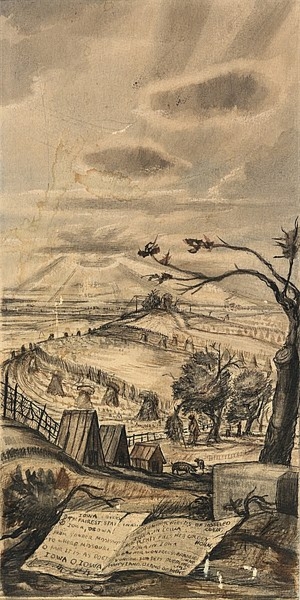
(above: William Palmer, Iowa Study, (mural study, right panel of triptych for Monticello, Iowa Post Office), c. 1940, watercolor and ink on paper, 13 34 x 7 inches, Smithsonian American Art Museum. Public domain, via Wikimedia Commons*)
Books, listed by year of publication, with most recently published book listed first:
Iowa Folk Artists, by Jacqueline Andre Schmeal (Author), Charles Brill (Photographer). 136 pages. Iowa State Press; 1st edition (July 30, 1998). ISBN-10: 0813828899. ISBN-13: 978-0813828893
Portraits in Iowa: Portraits of Americans, Made Before 1900 and Now Located in Iowa, By National Society of Colonial Dames of America in the State of Iowa.. Published by National Society of the Colonial Dames of America in the State of Iowa, 1982. 21 pages
A Catalog of New Deal Mural Projects in Iowa, By Lea Rosson DeLong, Gregg R. Narber. Published by L.R. DeLong, 1982. 80 pages
Art in Iowa: From Private Collections, Des Moines Art Center, Oct. 19-Nov. 24, 1963, By Des Moines Art Center, Des Moines Art Center. Published by The Center, 1963. 16 pages
Iowa Artists of the First Hundred Years, By Zenobia Brumbaugh Ness, Louise Orwig. Compiled by Zenobia Brumbaugh Ness, Louise Orwig. Published by Wallace-Homestead Company, 1939. 253 pages
Brief Information Concerning Iowa Artists, By Jeannette M. Drake, Iowa Federation of Women's Clubs, Published by Iowa Federation of Women's Clubs, 1917. 16 pages

(above: Amana Colony, October 2022. Photo © 2022 John Hazeltine)

(above: Iowa River at Amana Colonies, 2022, Photo © 2022 John Hazeltine)
 Return to Individual States Art History Project
Links to sources of information outside of our web site are provided only as referrals for your further consideration. Please use due diligence in judging the quality of information contained in these and all other web sites. Information from linked sources may be inaccurate or out of date. TFAO neither recommends or endorses these referenced organizations. Although TFAO includes links to other web sites, it takes no responsibility for the content or information contained on those other sites, nor exerts any editorial or other control over them. For more information on evaluating web pages see TFAO's General Resources section in Online Resources for Collectors and Students of Art History.
*Tag for expired US copyright of object image:

 Search Resource Library
© 2025 Traditional Fine Arts Organization, Inc., an Arizona nonprofit corporation. All rights reserved.