Distinguished Artist Series
The Life and Art of Karl Baumann
by Lauri Hoffman, Curator
As Baumann developed into his artistic
maturity, he delved further into the abstract, producing fewer representational
compositions. Landscapes and still lifes of the 1960s are broken down into
geometrical shapes (Untitled Abstract), 1965. Ultimately pure abstract is
celebrated in compositions where multiple colors and juxtaposed shapes stand
on their own, no longer struggling to define a subject (Untitled Abstract),
1967. Perhaps Baumann sensed that order in nature could be more effectively
realized once the artist liberated himself from the object. In 1978, Karl
wrote, "Personally I think in our age we think more in abstractions.
Somehow art has gone back to its original meaning creatively. [There is]
no nice story telling in painting or other arts. It is there for you to
live with. Take it or leave it. If it's art, you will feel and sense it
from within."
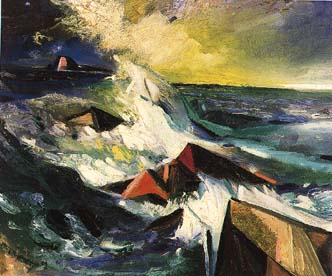
On February 4, 1974, Karl Baumann was diagnosed with lung cancer and given six months to live. In May, he was administered cobalt, which left him sick and weak. Responding to this treatment, Baumann painted "Cobalt," 1974, where shape, line, color and form speak directly to the viewer on an emotional level. In June, Baumann entered the Contrarus clinic in Mexico, where he underwent 21 days of laetril treatment. After the program, Baumann continued with a predominantly vegetarian diet, supplemented with eight to ten apricot pits a day. Two years later, he miraculously showed no signs of cancer. Baumann produced few paintings after 1974. In 1976, his son, Nicholas, was murdered in San Francisco. This affected Baumann so deeply that he lost the desire to paint. Karl Baumann died of a heart attack in 1985. Above Right: Sea Scape, 1949, oil on board, 15 1/2 x 19 1/4 inches
As an artist, Baumann was admired for his handling of color, his understanding of form and his ability to balance the composition. As a man, he was respected for his kind, sincere, and peaceful manner. He has been referred to as both a pessimist and an idealist. While some paintings unveil the macabre plight of modern man in a world of technology and greed, others show that great hope lies in nature. This optimism, which carried Baumann through his gravest misfortunes, continues to live in his paintings and is echoed by his words: "Never give up the ship. The growing up of Universal Man has its own evolution and is a slow process."
Editor's note:
Text and images courtesy of Maxwell Galleries, Ltd., San Francisco, California.
For further information on the life and art of Karl Baumann please call Colleen or Mark Hoffman at (415) 421-5193.
For further biographical information please see America's Distinguished Artists, a national registry of historic artists.
This page was originally published in Resource Library Magazine. Please see Resource Library's Overview section for more information. rev. 10/28/11
Search Resource Library for thousands of articles and essays on American art.
Copyright 2011 Traditional Fine Arts Organization, Inc., an Arizona nonprofit corporation. All rights reserved.