National Museum of American Art
Washington, D.C.
(202) 633-8998
Picturing Old New England: Image and Memory
April 2 - August 22, 1999
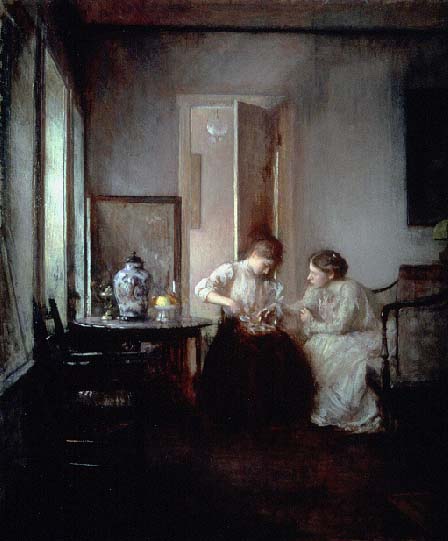
Edmund Tarbell, New England Interior, 1906
"Picturing Old New England: Image
and Memory," a groundbreaking exhibition exploring images of the 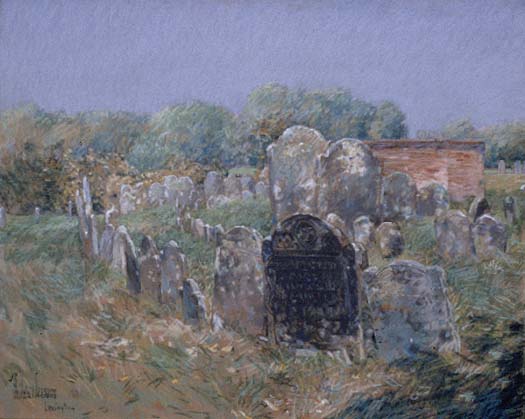 New England
past will be on view through Aug. 22, 1999 at the National Museum of American
Art, Smithsonian Institution. The exhibition features 173 paintings, sculptures,
prints, photographs and illustrated books made from 1865 to 1945 and major
works by such artists as Winslow Homer, Childe Hassam, John Singer Sargent,
Augustus Saint-Gaudens, Maurice Prendergast, George Bellows, Marsden Hartley,
Edward Hopper, Maxfield Parrish and Norman Rockwell. Right:
Childe Hassam, Colonial Graveyard at Lexington, c. 1917
New England
past will be on view through Aug. 22, 1999 at the National Museum of American
Art, Smithsonian Institution. The exhibition features 173 paintings, sculptures,
prints, photographs and illustrated books made from 1865 to 1945 and major
works by such artists as Winslow Homer, Childe Hassam, John Singer Sargent,
Augustus Saint-Gaudens, Maurice Prendergast, George Bellows, Marsden Hartley,
Edward Hopper, Maxfield Parrish and Norman Rockwell. Right:
Childe Hassam, Colonial Graveyard at Lexington, c. 1917
 This
exhibition groups masterworks and popular culture images from numerous museums
and private collections to explore for the first time the ways in which
New England was treated in American art during this important period, and
how New England subjects addressed the broader cultural currents in the
country. The product of several years' research by NMAA senior curator William
Truettner and University of Virginia professor Roger Stein, "Picturing
Old New England" looks at how New England came to embody timeless American
ideals--the "founders' values"--in a period of rapid and disquieting
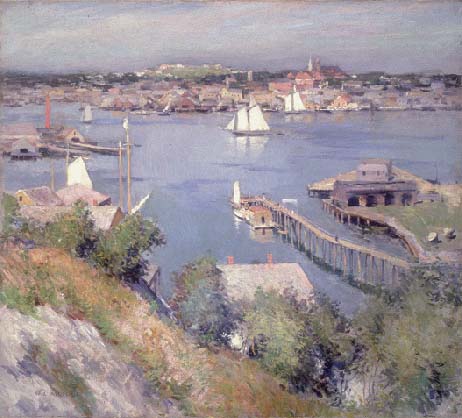
social change. Left: Willard Leroy Metcalf, GIoucester
Harbor, 1895
This
exhibition groups masterworks and popular culture images from numerous museums
and private collections to explore for the first time the ways in which
New England was treated in American art during this important period, and
how New England subjects addressed the broader cultural currents in the
country. The product of several years' research by NMAA senior curator William
Truettner and University of Virginia professor Roger Stein, "Picturing
Old New England" looks at how New England came to embody timeless American
ideals--the "founders' values"--in a period of rapid and disquieting
social change. Left: Willard Leroy Metcalf, GIoucester
Harbor, 1895
"The exhibition presents an intriguing opportunity to bring together many American artists' works to reflect on their relationship to an overarching national theme," said Elizabeth Broun, director of the National Museum of American Art. "Picturing Old New England' links the best art made about this region to a broad interest in national ideals."
"Picturing Old New England" is arranged thematically in six sections, each built around artists with shared stylistic goals: "Constructing the Rural Past," "Gilded Age Pilgrims," "The Discreet Charm of the Colonial," "Small-Town America," "Perils of the Sea" and "Yankee Modernism." In total the featured works reveal how the idea of a never-changing New England came to be writ large in the public imagination.
 The
exhibition shows that scenes of a pastoral New England were much loved by
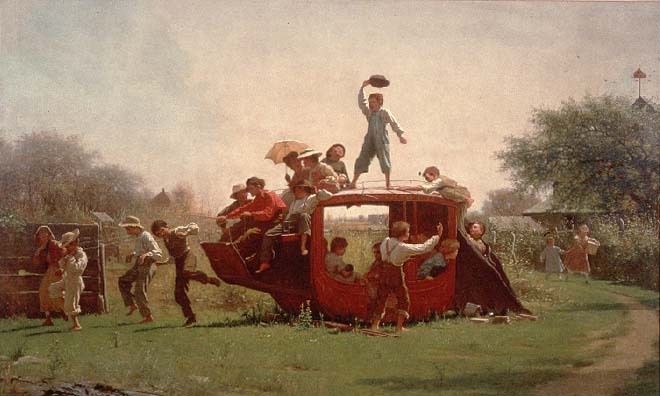
artists and their audiences. Eastman Johnson focused on an innocent, rural
New England evoking earlier days. In "The Old Stage Coach" (1871),
children clamor over a dilapidated wheel-less wreck with "Mayflower"
inscribed over its door, now marooned in a verdant field. Other artists
like Winslow Homer and George Inness turned to such rugged wilderness areas
as the White Mountains of New Hampshire and the rocky coast,creating works
that celebrated the region's unspoiled beauty and grandeur. Left: Eastman Johnson, The Old Stage Coach, 1871
The
exhibition shows that scenes of a pastoral New England were much loved by
artists and their audiences. Eastman Johnson focused on an innocent, rural
New England evoking earlier days. In "The Old Stage Coach" (1871),
children clamor over a dilapidated wheel-less wreck with "Mayflower"
inscribed over its door, now marooned in a verdant field. Other artists
like Winslow Homer and George Inness turned to such rugged wilderness areas
as the White Mountains of New Hampshire and the rocky coast,creating works
that celebrated the region's unspoiled beauty and grandeur. Left: Eastman Johnson, The Old Stage Coach, 1871
 Simultaneously,
New England was born anew as the birthplace of the nation's democratic values.
Howard Pyle's dramatic re-creations of scenes from the American Revolution,
Augustus Saint-Gaudens' bronze sculpture "The Puritan (Deacon Samuel
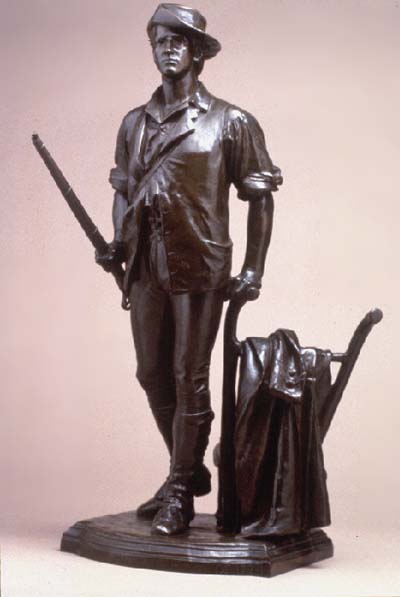
Chapin)" (1887), and "Concord Minute Man of 1775" (1889),
a bronze sculpture by Daniel Chester French, provided a vivid connection
to America's historic pursuit of liberty and equality. Left:
Daniel Chester French, Concord Minute Man of 1775
Simultaneously,
New England was born anew as the birthplace of the nation's democratic values.
Howard Pyle's dramatic re-creations of scenes from the American Revolution,
Augustus Saint-Gaudens' bronze sculpture "The Puritan (Deacon Samuel
Chapin)" (1887), and "Concord Minute Man of 1775" (1889),
a bronze sculpture by Daniel Chester French, provided a vivid connection
to America's historic pursuit of liberty and equality. Left:
Daniel Chester French, Concord Minute Man of 1775
In the 1870s a "new" New England emerged that was shaped by cities, factories and a diverse ethnic population fed by increased immigration. However, in the imagination of Americans undergoing immense political and social change, New England became a touchstone for the past, a spiritual homeland bypassed by progress. Farm and village scenes, family portraiture and historical subjects offered audiences a reassuring look backward and reaffirmation of the founders' values. Printmakers and photographers carried the same themes into the broader currency of popular culture.
Formal portraits of Boston's "Gilded Age Pilgrims"
by John Singer Sargent and Frank Benson recalled the 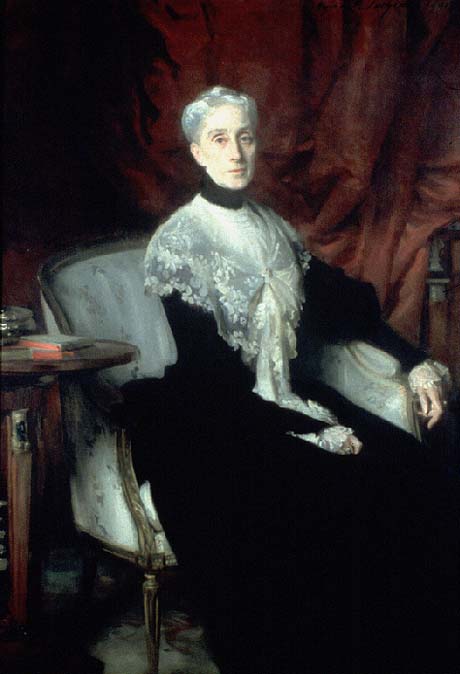 colonial portraits by John Singleton Copley that still
hung in Beacon Hill drawing rooms. Sargent's "Mrs. William C. Endicott"
(1901) presents a figure of patrician elegance, while Benson's "Portrait
of Thomas Wentworth Higginson" (1823-1911) is a more sober study of
this distinguished minister, reformer and writer. Right:
John Singer Sargent , Ellen Peabody Endicott ,1901
colonial portraits by John Singleton Copley that still
hung in Beacon Hill drawing rooms. Sargent's "Mrs. William C. Endicott"
(1901) presents a figure of patrician elegance, while Benson's "Portrait
of Thomas Wentworth Higginson" (1823-1911) is a more sober study of
this distinguished minister, reformer and writer. Right:
John Singer Sargent , Ellen Peabody Endicott ,1901
By the turn of the 20th century, American Impressionists summered in New England artists' communities, both inland and on the coast. Works like "Church at Old Lyme, Connecticut" (1906) and "Gloucester Harbor" (1895) by Childe Hassam and Willard Leroy Metcalf, respectively, portrayed the pasts of small New England towns in softly brushed color that distanced them from the early 1900s.
 In the
early 1920s, Edward Hopper, John Marin, Marsden Hartley, Stuart Davis and
Yasuo Kuniyoshi returned to subjects painted by American artists some 80
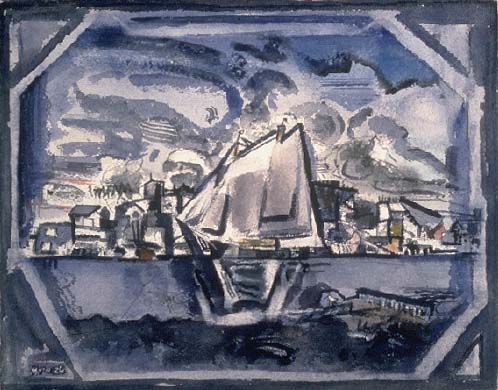
years earlier. Marin's "Pertaining to Stonington Harbor, Maine, # 1"
(1926) uses a cubist vocabulary to suggest the serene days of pre-industrial
seafaring commerce. Davis' views of Gloucester juxtapose modern gas pumps
and traditional fishing schooners in the old fishing port. Left: John Marin, Pertaining to Stonington Harbor, 1926
In the
early 1920s, Edward Hopper, John Marin, Marsden Hartley, Stuart Davis and
Yasuo Kuniyoshi returned to subjects painted by American artists some 80
years earlier. Marin's "Pertaining to Stonington Harbor, Maine, # 1"
(1926) uses a cubist vocabulary to suggest the serene days of pre-industrial
seafaring commerce. Davis' views of Gloucester juxtapose modern gas pumps
and traditional fishing schooners in the old fishing port. Left: John Marin, Pertaining to Stonington Harbor, 1926
With their focus on everyday rural life, Norman Rockwell, Maxfield Parrish, and Grandma Moses portrayed yet another old New England in the 1930s. Rockwell turned New England and its citizens into archetypes for small-town America. "Freedom of Speech" (1943) idealizes the tradition of the New England town meeting. Parrish's "June Skies (A Perfect Day)" (1940) is emblematic of his views of the countryside, while Grandma Moses's "In the Green Mountains" (1946) issues an invitation to a homespun and simple world. Depression-era photographs, like the anonymous "Strawberry Picker, Falmouth, Massachusetts" (ca. 1930), tell a different story. In the foreground workers bend over endless rows of fruit that reach the horizon, capturing the hardship endured by the regional workforce during this period.
"Picturing Old New England" is the latest exhibition
in a series of shows organized by NMAA that examine 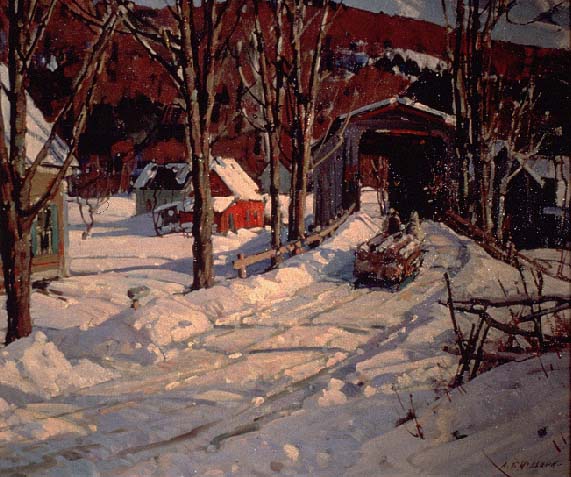 different periods in American art and explore the
meaning of artworks in their own time. Other broad thematic examinations
of important aspects of American culture have included "Revisiting
the White City: American Art at the 1893 World' s Fair," a study of
the ambitions of America at the turn of the century; "The Art of New
Mexico," which explored the continued lure of the West for Americans;
and "Thomas Cole: Landscape into History," an exhibition that
connected the artist with the social and political issues of his day. Right: Aldro T. Hibbard, Covered Bridge in Vermont, c. 1920
different periods in American art and explore the
meaning of artworks in their own time. Other broad thematic examinations
of important aspects of American culture have included "Revisiting
the White City: American Art at the 1893 World' s Fair," a study of
the ambitions of America at the turn of the century; "The Art of New
Mexico," which explored the continued lure of the West for Americans;
and "Thomas Cole: Landscape into History," an exhibition that
connected the artist with the social and political issues of his day. Right: Aldro T. Hibbard, Covered Bridge in Vermont, c. 1920
The exhibition is supported by Fidelity Investments through the Fidelity Foundation; Thelma and Melvin Lenkin; Betty and James F. Sams; and the Smithsonian's Special Exhibition Program.
"Picturing Old New England: Image and Memory," is accompanied by a 200-page catalog published by Yale University Press with a preface by NMAA director Elizabeth Broun, an introduction by Dona Brown and Stephen Nissenbaum, and six chapters by NMAA senior curator William H. Truettner, Roger B. Stein, Thomas Andrew Denenberg and Bruce Robertson. Biographies written by Denenberg and Judith K. Maxwell of the 115 artists featured in the exhibition are also included. The catalog, which was generously supported by the Fidelity Fund through Fidelity Investments is available in the museum shop.
For further biographical information on selected artists cited above please see America's Distinguished Artists, a national registry of historic artists.
Editor's note: RL readers may enjoy these photographs of Vermont covered bridges from the TFAO photo library in relation to Aldro T. Hibbard's, Covered Bridge in Vermont, shown above.
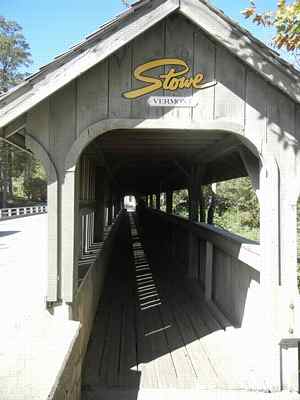
(above: Stowe, VT Covered Pedestrian Bridge, 2013. Photo by Barbara Hazeltine)
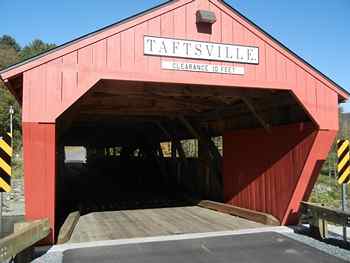
(above: Taftsville Covered Bridge Windsor County, Vermont, 2013. Photo by John Hazeltine)
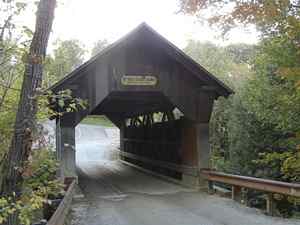
(above: Emily's Bridge, Stowe, VT, 2013. Photo by Barbara Hazeltine)
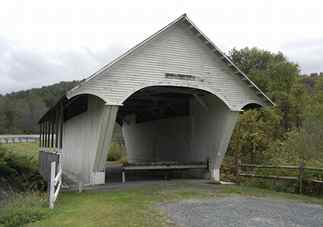
(above: Covered Bridge, Rural Vermont, 2013. Photo by Barbara Hazeltine)
rev. 9/20/10, 10/19/13
Search Resource Library for thousands of articles and essays on American art.
Copyright 2010 Traditional Fine Arts Organization, Inc., an Arizona nonprofit corporation. All rights reserved.