Gibbes Museum of Art
Charleston, SC
843-722-2706
In Pursuit of Refinement: Charlestonians Abroad, 1740 - 1860
Splendours of fine
and decorative art will be featured in the milestone exhibition In Pursuit
of Refinement: Charlestonians Abroad, 1740 - 1860, which comes to the
Gibbes Museum of Art in the spring of 1999. Presented with the cooperation
of Historic Charleston Foundation, In Pursuit of Refinement: Charlestonians
Abroad, 1740 -1860 will feature approximately 145 fine and decorative
art objects associated with eighteenth-century and antebellum aristocratic
life in Charleston. it examines the aesthetics, arts patronage and cultural
history of the South Carolina Lowcountry, including the social, political
and economic issues that encouraged close connections with Europe, particularly
England, long after America's political independence.
Assembled from public and private collections around the
world, In Pursuit of Refinement will bring together for the first
time some of the best known and most representative paintings, furnishings,
textiles and porcelain of Charleston's aristocratic class to be found in
the United States and in European collections. Featured are works from the
Metropolitan Museum of Art in New York; the National Portrait Gallery; Smithsonian
Institution, Washington, D.C.; The Art Museum of Nova Scotia, Canada; the
Detroit Institute of Art, Detroit, Michigan; Musee Fabre, Montpellier, France;
the Fitzwilliam Museum, University of Cambridge, England and more. It will
be on view April 9, through July 3, 1999. 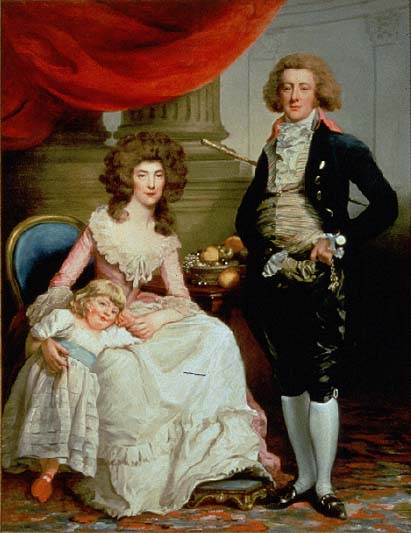
Nowhere in America was a European cultural orientation more evident than in eighteenth-century Charleston, where works from the European periods of John Singleton Copley and Benjamin West, represented in this exhibition by Copley's portrait of Henry Laurens and West's Thomas Middleton (1753 - 1797), graced the drawing rooms of local dwellings. The works of Johann Zoffany, Allan Ramsay, and Sir Joshua Reynolds were surrounded by exquisite settings that included made-to-order English furniture, English silver by Paul Stoor and fine French porcelain.
In 1773, Bostonian Josiah Quincy observed that Charleston,
then the fourth largest urban center in British North America and the largest
seaport in the South, "in grandeur, splendour of building, decorations,
equipages, numbers, commerce, shipping and indeed in almost everything...far
surpasses all I ever saw, or ever expected to see in America." Elite
circles of Lowcountry planters and landowners became standard-bearers of
cultural excellence and elegance through their patronage of the best artists
and craftsmen working abroad. Examples of this in the exhibition include
paintings by Thomas Gainsborough from the Tate Museum in London and the
Metropolitan Museum of Art; English candlesticks owned by Eliza Lucas Pinckney
on loan from a private collection; and French porcelain made by the Comte
de Artois factory once owned by the Frost Family. The propensity to amass
what was considered the finest in the arts and haute couture positioned
Charleston as the cultural capital of America by the early nineteenth century.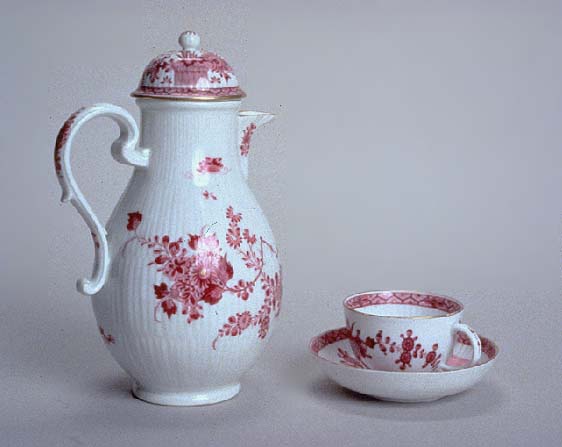
Principal funding provided by Carolina First. Additional
funding provided by the John and Kathleen Rivers Foundation, the Women's
Council of the Carolina Art Association, the Jerry and Anita Zucker Family
Foundation Inc., the Joanna Foundation, and BellSouth. Initial research
made possible with a grant from the Ziff Fund. This exhibition is a part
of Views From the Edge of the Century which is sponsored by the South
Carolina Arts Commission and NationsBank. Additional support for this project
includes funding from South Carolina Humanities Council, a state program
of the National Endowment for the Humanities and the South Carolina department
of Parks, Recreation and Tourism.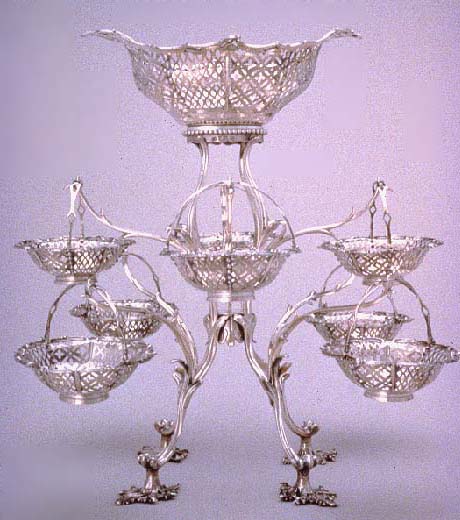
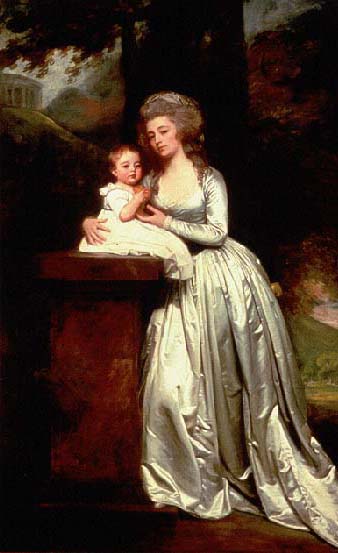
From top to bottom: George Rombey, Mrs. Roger Smith, Historic Charleston Foundation; John Francis Rigaud, John Moultrie III and Family, Gibbes Museum of Art; Rebecca Brewton Motte, Meissen porcelain set, c 1770; Epergne, Middleton Family Silver, Middleton Place Foundation.
Read more about the Gibbes Museum of Art in Resource Library Magazine
For further biographical information on selected artists cited above please see America's Distinguished Artists, a national registry of historic artists.
rev. 9/20/10
Search Resource Library for thousands of articles and essays on American art.
Copyright 2010 Traditional Fine Arts Organization, Inc., an Arizona nonprofit corporation. All rights reserved.