
Religious American Art
Other Online Resources: A to C

(above: William Henry von Herwig, Old Mission, 1924, oil on burlap, 34 x 30 inches. Private Collection. Baptismal font is shown temporarily relocated from present location while conservation underway in Serra Chapel.)
"The 613" - Archie Rand is a 2021 exhibit at the Memorial Art Gallery of the University of Rochester which says: "For over five decades Archie Rand has been regarded as a maverick and rule-breaker, and The 613 is his most ambitious work. An enormous multi-panel painting, it depicts surprising responses to the 613 commandments of the Torah, which is the first five books of the Hebrew Bible (or Old Testament). Yes, there are more than 10 commandments -- the rules that govern ethical and religious behavior in Judaism. Rand's monumental installation fills MAG's Docent Gallery and explores traditions of both biblical interpretation and artistic expression. It exemplifies Rand's groundbreaking achievements in the construction of contemporary Jewish iconography, affirming his position as a relentlessly innovative artist. Accessed 6/21
American Paintings of Jesus Christ: 1855-1955 is a 2026 Gemini 3 Deep Research Report which says: "If a person seeks to understand the cultural and psychological shifts that took place in the United States between 1855 and 1955, looking at how American artists painted Jesus Christ is a good place to start. Over this century, the country went through an unbelievable amount of turmoil and transformation. We' have the devastation of the Civil War, the booming wealth of the Gilded Age, the brutal realities of Jim Crow segregation, the devastation of two World Wars, and the dawn of the atomic age. As the nation struggled to figure out its own identity, American artists were simultaneously trying to figure out how to visualize the divine. Instead of just copying the old Renaissance and Baroque masters from Europe, a diverse group of American painters started creating versions of Jesus that spoke directly to their own unique hopes, traumas, and communities. Looking closely at six of the most highly regarded artists of this era -- John La Farge, Albert Pinkham Ryder, Henry Ossawa Tanner, Horace Pippin, William H. Johnson, and Warner Sallman -- one can see a sweeping, informal history of an American Christ that was constantly being reimagined." Accessed 7/26
A Church Record - Photographs from the Tiffany Studios Ecclesiastical Department was an exhibit held July 23, 2010 through January 15, 2012 at the Charles Hosmer Morse Museum of American Art. The museum says: "Tiffany kept a photographic record of completed ecclesiastical commissions. These records - which include photographs of interior schemes, window designs, and such varied objects as memorial stones and baptismal fonts - constitute an important part of the Morse Museum's Tiffany Studios Study Photograph Collection." Article includes a multi-page Exhibition Object Guide (PDF). Accessed August, 2016.
Acts of Faith: Religion and the American West is a 2023 exhibit at the New York Historical Society which says: "The narrative highlights the experiences and traditions of people who, voluntarily or involuntarily, took part in this chaotic and transformative era - including diverse Native peoples, Protestant missionaries, Mormon settlers, Catholic communities, African American migrants, Jewish traders, and Chinese immigrant workers." Accessed 11/23
Adrian Kellard: The Learned Art of Compassion, an exhibit held September 24 through December 18, 2011 at the Museum of Contemporary Religious Art. MOCRA says: "Despite his artistic training, Kellard remained grounded in his working class upbringing. Working in the stylistic tradition of German Expressionism, Kellard demonstrated expertise with wood carving by creating bold images of Christian subjects in contemporary contexts. Yet he worked with simple pine wood and household latex paint with the screws and hanging hardware fully visible-materials readily available at any local hardware store. He incorporated "high" art with "low" art, combining images quoted from artists such as Giotto and Michelangelo with images from pop culture." Page includes a brochure and podcast. Accessed February, 2016
Andy Warhol: Revelation is a 2019 exhibit at the Andy Warhol Museum which says: "Andy Warhol: Revelation is the first exhibition to comprehensively examine the Pop artist's complex Catholic faith in relation to his artistic production. Christian motifs frequently appear in both explicit and metaphorical forms throughout the body of Andy Warhol's oeuvre." Also see 10/18/19 article in Pittsburgh Post-Gazette Accessed 6/20
American Guild of Jewish Art, based in Alpharetta GA, has as its mission "to promote awareness of fine art and craft objects created "in the Jewish spirit." It would be the first organization to serve the interests not only of Jewish artists but of Jewish art those who sell and promote it as well as it's creators." Accessed 11/13.
Avoda: Objects of the Spirit: Ceremonial art by Tobi Kahn, September 2 - October 12, 2003 from Museum of Contemporary Religious Art. Accessed 3/14.
"California's Religious Awakening" is a 11/19/00 Los Angeles Times article by Mary Rourke written about an exhibit at LACMA. The article says: "California has a reputation for starting trends, and the state gets special credit for its contributions in religion at one local exhibition. "Made in California: Art, Image and Identity, 1900-2000," at the Los Angeles County Museum of Art, traces the uninhibited history of religions, cults and spiritual beliefs that took root here during the past century. Religion is only one of many themes in the show, which focuses on art and culture. But spiritual references offer a lesson in how California artists relate to the sacred." Accessed September, 2016.
CAPIO LUMEN/CAPTURE THE LIGHT Michael Johnson's Digital Illuminated Manuscripts is a 2021 exhibit at The Hilbert Museum of California Art at Chapman University. Mary Platt, Director, says: " Like many of the artist-monks of a millennium ago, Johnson incorporates various elements of nature -- which often have double meanings as Christian symbols -- into his artwork, such as flowers, animals, insects, fruit and birds. He is keenly aware that "the beautiful" reflects the transcendent. Johnson's art, as with most religious art, thus becomes visual theology." Accessed 8/23
ChatGPT generated text about American religious art from 1700 through 2000 in June 2003 based on TFAO prompts.
Chris Sauter, an exhibit focusing on the relationship betweeen science and religion, held February 8th - May 24th, 2014 at the Old Jail Art Center. Includes artist interview by Patrick Kelly, Curator of Exhibitions. Accessed April, 2015.
"Christian art hidden in America's dusty corners" by Marisa Martin, published 8/8/12 in WND.
Christians in the Visual Arts is an organization based in Wenham, MA that is devoted to religious expression in the visual arts. Accessed 11/13.
The Church History Museum of The Church of Jesus Christ of Latter-day Saints Accessed 3/24
Contemporary Santos was a 2015 exhibit at Colorado Springs Fine Arts Center / Taylor Museum which says: "Santos, depictions of saints in both two- and three-dimensional forms, make up a significant percentage of Taylor's original gift; the Fine Arts Center has maintained this legacy through the ongoing acquisition of these objects over the decades. This selection represents some of the most recently acquired santos and demonstrates that the art form is very much alive and is both reverential to tradition as well as innovative to appeal to a contemporary audience. Most of these artists are living santeros/santeras (craftspeople of holy images) and are working in New Mexico or Colorado, many of whom are nationally collected and renowned for their award-winning work." Accessed 10/16
Cooper-Hewitt Museum, The Smithsonian Institution's National Museum of Design, offered freely online as of 2013 over 25 titles highlighting the Museum's collections, published between 1978 and 1987, including Santos from Puerto Rico
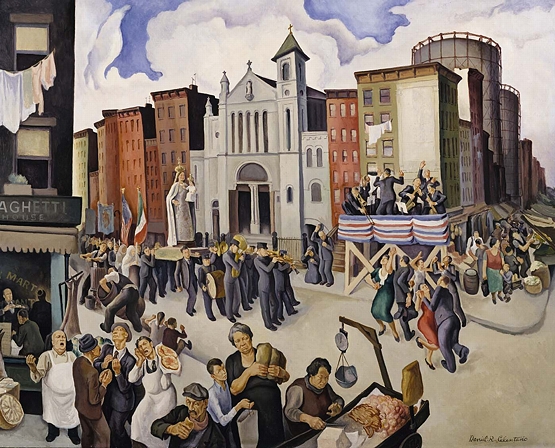
(above: Daniel R. Celentano, Festival, 1934, oil on canvas, 48 1/8 x 60 1/8 inches, Smithsonian American Art Museum. Public domain via Wikimedia Commons*)
 Return to Religious Art
Return to Topics in American Representational Art
Links to sources of information outside of our web site are provided only as referrals for your further consideration. Please use due diligence in judging the quality of information contained in these and all other web sites. Information from linked sources may be inaccurate or out of date. TFAO neither recommends or endorses these referenced organizations. Although TFAO includes links to other web sites, it takes no responsibility for the content or information contained on those other sites, nor exerts any editorial or other control over them. For more information on evaluating web pages see TFAO's General Resources section in Online Resources for Collectors and Students of Art History.
 Search Resource Library
Copyright 2026 Traditional Fine Arts Organization, Inc., an Arizona nonprofit corporation. All rights reserved.