 Click
here to return to catalogue essays
by Julia Armstrong-Totten, Marian Yoshiki-Kovinick, and Will South.
Click
here to return to catalogue essays
by Julia Armstrong-Totten, Marian Yoshiki-Kovinick, and Will South.
A Seed of Modernism: The Art Students League of Los Angeles, 1906-1953
----------
The Legacy of the Art Students League: Defining This Unique Art Center in Pre-War Los Angeles
Essay by Julia Armstrong-Totten
Notes
1. Los Angeles Times, 16 January 1910, III, 10:3.
2. Los Angeles Times, 8 September 1929, III, 14: 7-8.
3. Nancy Moure's numerous publications on Southern California art provided the groundbreaking research into this topic; more recently Sarah Vure discussed the League in her essay found in the exhibition catalog Circles of Influence: Impressionism to Modernism in Southern California Art 1910-1930 (Newport Beach: Orange County Museum of Art, 2000).
4. Everything now known has been painstakingly gathered from a wide variety of sources, but mainly from the families of those who attended the school. This essay is based on those resources, as well as interviews and letters from surviving League members. Furthermore, the interviews conducted by Betty Hoag with those League members who participated in the Works Progress Administration's Federal Arts Project in Southern California have proven invaluable to this project. Consequently, more emphasis has been placed on the atmosphere in the later years of the school. This essay is not intentionally ignoring the earlier history nor should it be seen as any less important; unfortunately, there is just far less primary documentation to work with from that period.
5. The term "pre-war" will be used throughout this essay as a matter of convenience; it is not quite accurate when referring to the League, since the school was revived from 1949-1953. However, the heyday of the institution was during the formative years, from 1906-1913, and under Stanton Macdonald-Wright's leadership, from 1923-1932.
6. The journal is located in the Arthur Millier Papers, reel 3887, frames 272-290, Archives of American Art, Smithsonian Institution. His third and most lengthy essay mentions numerous concerts, operas, and musical and theatrical performances, from Sarah Bernhardt (1844-1923) reading "Phedre" at the Orpheum Theatre during her last World Tour, to the premier of Otto Klemperer (1885-1972) conducting Beethoven's Ninth Symphony in the 1930s, but it is strangely lacking in any information on achievements in visual arts. Presumably he planned to develop something on this topic, because in the side column on page 16 of the journal he wrote down the name of one of his teachers, former League director Rex Slinkard.
7. Ibid., reel 3887, frame 290.
8. Leslie Baird letter to Eva Totten dated 8 February 1988, in possession of the author.
9. Peter Plagens, Sunshine Muse: Contemporary Art on the West Coast (New York: Praeger, 1974), 117. In the introduction to the 1999 reprint of Sunshine Muse Plagens states he did not know very much about the art produced during the pre-war period and in hindsight regrets such generalized statements. It should be noted that Plagens was certainly not alone in his original opinion; this book was chosen to cite mainly because it perpetuated so many of the typical misconceptions about the art world in Southern California in the first half of the twentieth century. Unfortunately, this attitude continues even today, evidenced recently by a writer for the Los Angeles Times who said, announcing an exhibition in July 2003, "Long before there was a burgeoning art scene in Los Angeles, Frederick Hammersley was here": another case of someone assuming the area had very little to offer artistically prior to 1940, when Hammersley arrived as a student. See Los Angeles Times Weekend section, 3 July 2003, E2, "Three-Day Forecast" column.
10. See for example Bram Dijkstra's article "Early Modernism in Southern California: Provincialism or Eccentricity?" in On the Edge of America: California Modernist Art 1900-1950, Paul J. Karlstrom, ed. (Berkeley: University of California Press, 1996).
11. Plagens, Sunshine Muse, 28.
12. Nancy Dustin Wall Moure, Publications in Southern California Art 1, 2 & 3 (Glendale: Dustin Publications, 1984), B-16.
13. There was a significant difference between the California Art Club and the Art Students League: the former was an exhibiting and social club, while the latter was all of that plus a school; despite the fact that many of the earlier artists were members of both, the educational experience was no doubt more stimulating and the League provided an environment that was more open to experimentation.
14. Cherry was in a position to compare the two, as he was part of the "Club" in New York City. Herman Cherry, "Los Angeles Revisited," Arts 30, no. 6 (March 1956): 18.
15. See Paul Karlstrom in Paul Karlstrom and Susan Erlich, Turning the Tide: Early Los Angeles Modernists 1920-1956 (Santa Barbara, Calif.: Santa Barbara Museum of Art, 1990).
16. Dijkstra cited quotes from Lorser Feitelson, Hans Burkhardt, Edward Biberman, and Stanton Macdonald-Wright to illustrate this point; see Karlstrom, On the Edge of America, 158-159.
17. Nicholas Brigante letter to Carl Sprinchorn dated 15 June 1947, reel 3004, frame 203, Carl Sprinchorn Papers, Special Collections, Raymond H. Fogler Library, University of Maine.
18. See, for example, Ruth Westphal's article "The Development of an Art Community in the Los Angeles Area" in her Plein Air Painters of California, the Southland (Irvine, Calif.: Westphal Publishing, 1982) or Margarita Nieto's witty compilation "Mapping of a Decade: Los Angeles during the 1930s" (http://artscenecal.com/ArticlesFile/Archive/Articles1999/Articles1099/MNieto1099.html, 13 April 2007).
19. The diaries of Mabel Alvarez begin in 1909, when she was 18 years old, and continue on and off throughout her lifetime. She briefly logged not only the progress of her own work, but also her social and educational activities, on almost a daily basis. They are on deposit at the Archives of American Art, Smithsonian Institution.
20. See Moure, Publications, part 2, to get an idea of other organizations and their participants. There were other, less formal groups not cited in her publication, such as the one surrounding Sadakichi Hartmann at Marjory Winter's Sargent Court House, which included League artists Ben Berlin and Boris Deutsch, the Mexican muralists Orozco and Siqueiros and their local followers, and Lorser Feitelson's students and his followers of Post-Surrealism.
21. Los Angeles Times, 30 December 1923, III, 19:1-4.
22. This group included Val Costello, Rex Slinkard, Lawrence Murphy, Carl Sprinchorn, and Stanton Macdonald-Wright. Perret Collection, Smithsonian American Art Museum/National Portrait Gallery Library, unpublished autobiography ca. late 1930s or early 1940s written by Brigante for Ferdinand Perret.
23. Letter from Kirby Temple to the author postmarked 4 April 2000.
24. Perhaps in order not to scare off prospective students, Macdonald-Wright is cautiously described as "A young old man speaking a language that you understand. Not radical, not dull, but interesting."
25. The brochure incorrectly claims that the school was in its twenty-first year.
26. Many of the earliest students, like Val Costello and Aaron Kilpatrick, worked professionally as either sign painters or commercial artists.
27. Los Angeles Times, 8 September 1907, II, 2:3-6.
28. Presumably all of the paperwork from the pre-war League was destroyed after Benji Okubo was sent to the Heart Mountain internment camp in 1942; most of what we know about the school, especially its formation, appears primarily in Los Angeles Times articles written by its cofounder Antony Anderson.
29. Raymond J. Steiner, The Art Students League of New York: A History (New York: CSS Publications, 1999), 41.
30. For a more complete history of the New York League see Chapter I, "These Ungrateful Students," of Steiner's Art Students League of New York.
31. Steiner, Art Students League of New York, 29-30.
32. As a member of the New York League, Anderson would have been given a copy of their constitution and been obliged to read and sign a contract as well; consequently he should have been quite familiar with the formal philosophy of the school.
33. The New York manifesto guaranteed that "the League will form and sustain classes for study from the nude and draped model" (Steiner, Art Students League of New York, 30).
34. For further discussions of the early drawing schools in Los Angeles, see Nancy Dustin Wall Moure, Drawings and Illustrations by Southern California Artists before 1950 (Laguna Beach, Calif.: Laguna Beach Museum of Art, 1982), 5-6.
35. Both John Huston and Nicholas Brigante mentioned that they had a plaster cast to work from at the League when necessary, but according to Brigante it disappeared after Macdonald-Wright assumed leadership. See John Huston, An Open Book (New York: Da Capo Press, 1980), 28, and Nicholas Brigante's interview with Fidel Danieli, 28 January 1975, tape 1; tape on deposit at the Archives of American Art, Smithsonian Institution.
36. Thomas Hart Benton, An Artist in America (Columbus, Mo.: University of Missouri Press, 1983), 34.
37. Archie Musick interview with Mrs. Sylvia Loomis, 10 November 1964, Archives of American Art, Smithsonian Institution.
38. These books are housed at the Charles E. Young Library at the University of California, Los Angeles, and include about 50 publications ranging from a 1913 National Geographic Magazine titled "The Wonderland of Peru" to Carlos Carrá's 1925 Giotto.
39. Art Students Leagues appeared in other cities, most of them started by former students of the New York school, but none of them had any official affiliation; some of the others were located in Atlanta, Washington D.C., Toronto, Chicago, and Philadelphia. This information was sent to the author by Stephanie Cassidy, archivist at the Art Students League of New York, in an email dated 20 November 2002.
40. The 1945 date is suggested because the document refers to Mrs. Benji Okubo as the secretary of the Heart Mountain League; Benji Okubo and Chisato Takashima married in Billings, Montana, in June of 1945.
41. "Art Students League" ms., rule 7, "By-Laws," (e). Benji Okubo Papers, Japanese American National Museum.
42. Hideo Date labeled all of them "good friends of the League" in a list of members sent to the author on 26 April 2000. Apparently Stevens did start out taking art classes, but quickly decided it was better to be a patron and dealer, rather than a painter. See his oral interview with Betty Hoag on 2 June 1964, Archives of American Art, Smithsonian Institution.
43. Confirmed by Stephanie Cassidy, ASL-NY, in an email dated 11 July 2003.
44. Henry Clausen recalled the trio as "a colorful updated version of the 'The Three Musketeers,' and their dialectical jousting was quite comparable to the swordplay of the said Musketeers." See Henry Clausen, "Recollections of SMW," in American Art Review 1, no. 2 (January-February 1974): 58.
45. Stanton Macdonald-Wright interview with Betty Hoag on 18 April 1964, Archives of American Art, Smithsonian Institution. This discussion came up because Hoag was horrified by Frank Stevens' treatment of his paintings. Possibly she was referring to a group of Morgan Russell's work that was later unearthed beneath a house Stevens owned around 1970. Stanton Macdonald-Wright recounted their history in Maurice Tuchman's "Morgan Russell: Unknown Paintings," in California, 5 Footnotes to Modern Art History (Los Angeles County Museum of Art, 1977), 11. The circumstances of how and why Stevens had this work were never fully addressed by either Tuchman or by Gail Levin, in her article in the catalog. According to letters that have surfaced between Russell and his sup-porters at the League, he and Macdonald-Wright had a falling-out during his visit to LA from 1931 to 1932. Several League members thought that Macdonald-Wright, who was acting as Russell's agent in Los Angeles, had not been fairly compensating him for his paintings. This is probably why Stevens, instead of Macdonald-Wright, had these pieces and how afterwards Mabel Alvarez became Russell's representative in Los Angeles. Macdonald-Wright, of course, did not mention any of this when he wrote about the history of these paintings. This episode was mentioned in letters of Mabel Alvarez, Chalfant Head, Fred Sexton, and Morgan Russell.
46. Some of the surviving books from the League's library are inscribed by Stevens; for example, inside of Albert André's Renoir is the note "LA 9/1/24 To the Art Students League With Best Wishes F. L. Stevens."
47. Albert King discussed both Wells' and Stevens' generosity in an interview with Betty Hoag on 10 June 1964, Archives of American Art, Smithsonian Institution. Herman Cherry mentions them as patrons of Stanton Macdonald-Wright and Morgan Russell, as well as League students James Redmond, Albert King, and Fred Sexton; see Cherry, "Los Angeles Revisited," 18.
48. This was probably a common practice among the group: Kirby Temple re-called Albert King giving him a porcelain head of Lohan after Temple had posed for and assisted the artist on his mural for the Ventura Community Church in 1930.
49. Telephone interview with Kirby Temple on 21 March 2002.
50. Letter to the author from Hideo Date postmarked 21 May 2001.
51. His roommates included Wylog Fong, Donald Totten, Benji Okubo, James Redmond, Charles Davis, and Henry Clausen. Date actually lived at the League at different times with Fong, Totten, and Okubo; the Spring Street studio had two twin beds, according to a floor plan Hideo Date sent to the author in a letter postmarked 15 September 2001.
52. Date letter, 21 May 2001. Most of this work was returned to Los Angeles in 1999 when the artist donated 190 pieces to the Japanese American National Museum; a retrospective, largely of his pre-war career, was held at the museum in 2001. See Karin Higa, Living in Color: The Art of Hideo Date (Los Angeles: Japanese American National Museum and Berkeley: Heyday Books, 2001).
53. This exhibition was mentioned in "Night and Day" by Ted LeBerthon in the News, Los Angeles, 27 June 1940: Perret Collection, Smithsonian American Art Museum/National Portrait Gallery Library.
54. Los Angeles Times, 22 July 1945, found in the LA Art Association scrapbook, Box 5, 1941-6, Archives of American Art, Smithsonian Institution.
55. Sam Hyde Harris interview with Fidel Danieli, 24 July 1975; tape on deposit at the Archives of American Art, Smithsonian Institution.
56. The trip is mentioned in the Los Angeles Times, 21 June 1925, III, 13:2.
57. Brigante/Danieli interview 28 January 1975, tape 2.
58. Their trip was discussed in The Graphic, 2 October 1909, 2:9.
59. Benton sent students to the Los Angeles League as well, such as Archie Musick, Joe Meert, and Bernard Steffen. Artist model and future rare book dealer Henry Clausen was the conduit of information between Macdonald-Wright and his old friend Benton, as Clausen traveled back and forth from coast to coast modeling for both leagues and worked as a professional wrestler along the way.
60. Los Angeles Times, 8 September 1907, III, 2:3-5.
61. Los Angeles Times, 28 April 1907, VI, 2:3-5 and 13 October 1907, VI, 2:4-6.
62. The Graphic, 20 August 1910, 8.
63. It is presently uncertain if George, a.k.a. Gjura, Stojana (1885-1974) attended the Art Students League, but later he was president of the Modern Art Workers, an association made up of many League artists, and his name was mentioned in a couple of Betty Hoag's interviews in the 1960s, so it seems likely he was somehow associated with the school.
64. Charles P. Austin responded vehemently to Macdonald-Wright's criticism in a subsequent column and a young Arthur Millier, who was then working as a dealer, even got into the act by pointing out all of the unheard-of free publicity the two were generating. See Los Angeles Times 4 March 1923, III, 39:7-8.
65. Los Angeles Times, 18 February 1923, III, 41:3-4.
66. Albert King interview with Betty Hoag on 10 June 1964, Archives of American Art, Smithsonian Institution.
67. Saturday Night, 7 April 1928, from California Art Club album, Vol. 1, 1928, on deposit at the Archives of American Art, Smithsonian Institution.
68. Date letter, 26 April 2000.
69. California Art Club, Bulletin IV, no. 4 (April 1928).
70. Los Angeles Times, 28 February 1932, Los Angeles reel 2, frame 544, Archives of American Art, Smithsonian Institution. What this critic failed to recognize was that the group was now following Macdonald-Wright's more refined Asian-fusion style; see discussion later in this essay.
71. Los Angeles Record, 10 January 1933, 5:7. Herman Cherry discussed his version of how the gallery started in an interview with Judd Tully on 8 May 1989, Archives of American Art, Smithsonian Institution. Lorser Feitelson claimed he designed this gallery for Stanley Rose in 1935. See his interview with Fidel Danieli on 2 March 1974, Oral History Program, University of California, Los Angeles.
72. Los Angeles Times, 24 November 1907, VI, 2:4-5.
73. Stevens/Hoag interview, 2 June 1964.
74. Date letter, 26 April 2000.
75. Henry Clausen, "Recollections of SMW": 56.
76. Date letter, 26 April 2000. The core group during Date's time included Stanton Macdonald-Wright, Lorser Feitelson, Jack Wells, Frank Stevens, James Redmond, Albert King, Wylog Fong, Nicholas Brigante, Henry Clausen, Donald Totten, Lee Jarvis, Benji Okubo, Kirby Temple, and Herman Cherry.
77. Chalfant Head to Morgan Russell, 27 August 1927, reel 4524, frame 714, Morgan Russell Archives and Collection, the Montclair Art Museum, Montclair, New Jersey.
78. Cherry/Tully interview, 8 May 1989. It should be noted that Cherry, too, noted the "sad changes of the League from what it was five years ago" in a letter to Fred Sexton dated 9 August 1932.
79. Date letter, 26 April 2000.
80. Nicholas Brigante letter to Carl Sprinchorn dated 7 March 1952, reel 3004, frame 251, Carl Sprinchorn Papers.
81. Paul Babcock interview with Betty Hoag on 11 May 1965, Archives of American Art, Smithsonian Institution. The transcription of this interview has many errors. For example, in this quote the artist's name is incorrectly given as "McDonald Ray."
82. Clausen, "Recollections of SMW": 56.
83. For example, Feitelson would call Macdonald-Wright a "son of a bitch" behind his back, while Macdonald-Wright referred to Feitelson's work at the time, with its brown palette, as "gravy paintings." Date letter, 26 April 2000.
84. Hideo Date and Benji Okubo, for example, painted similar images of women in the 1930s, the former in watercolors and the latter in oils, in which the subject's face is blue or green and the eyes are an intense red. They were experimenting with Macdonald-Wright's Synchromism, although he never specifically taught it to them. Previous students might have been more directly influenced by Macdonald-Wright's publication A Treatise on Color, written for his League students in 1924; some of them, such as Mabel Alvarez and Chalfant Head, held on to their copies for the remainder of their lives. However, Hideo Date said there were no longer any copies around when he was a student at the school beginning in 1928 (Date letter, 26 April 2006).
85. Work in this style has been identified in oils, pencil drawings, murals, mosaic murals, lithographs, watercolors, and porcelain.
86. Hideo Date said the League artists working in this Asian-fusion style were influenced directly by Macdonald-Wright. Letter to the author postmarked 18 August 2001.
87. See Claudia Colonna, "The Art of Stanton Macdonald-Wright," June 1927, Los Angeles reel 5, frame 222, Archives of American Art, Smithsonian Institution.
88. William H. von Herwig, quoted from the "Independents" catalog for an ex-hibition held at the Palos Verdes Public Library and Art Gallery, 31 October to 31 December 1933, in possession of the author.
89. Archie Musick, Musick Medley: Intimate Memories of a Rocky Mountain Art Colony (Colorado Springs: Jane and Archie Musick, 1971), 52.
90. Letter to the author from Hideo Date postmarked 16 August 2001.
91. The Graphic, 20 August 1910, 8.
92. Everett C. Maxwell mentioned the prints and discussed the screens in great detail, after he visited Slinkard's studio on North Main Street. See The Graphic, 7 September 1912, 9:1-2.
93. The Graphic, 20 August 1910, 8; "Background," Museum Graphic, November-December 1926, 73-75.
94. Lorser Feitelson interview with Molly Saltman, 1965; tape on deposit at the Archives of American Art, Smithsonian Institution. It should be noted that by this time Nicholas Brigante was somewhat removed from the local art scene, after a serious accident kept him housebound. Brigante himself always credited his earlier mentor, Rex Slinkard, with introducing him to Asian art and said that Macdonald-Wright briefly, during one month in 1923, helped him to refine his personal goals concerning Asian art. Another one of Brigante's goals was to raise the watercolor technique to an art form respected on the same level as oil painting. In fact, his efforts may have been the real impetus for the watercolor movement that developed in Southern California in the 1930s and 1940s, an idea that should receive further study. So while Brigante was no doubt always aware of the activities of Macdonald-Wright and his followers, he was probably only indirectly influenced by this movement.
95. See Karin Higa's discussion of the influence of nihonga on this artist, Living in Color, 10-14.
96. This was in the last lecture in the series, dated 24 September 1925, titled "On the Philosophy of Aesthetics as dictated to the Art Students League of Los Angeles," transcribed by Mabel Alvarez and housed at the Metropolitan Museum of Art library.
97. Hideo Date discussed Macdonald-Wright's painting like Renoir, Matisse, and Cézanne in a letter to the author postmarked 16 September 2002.
98. Arthur Millier, "New Developments in Southern California Painting," American Magazine of Art 27, no. 5 (May 1934): 243244.
99. See Los Angeles reel 5, frames 312-315, Archives of American Art, Smith-sonian Institution.
100. For a more complete history of the Project in Southern California, see Marilyn Wyman, "A New Deal for Art in Southern California: Mural and Sculpture under Government Patronage" (PhD dissertation, University of Southern California, 1982).
101. Donald Totten discusses the connections between the League and the Project in his interview with Betty Hoag, 28 May 1964, Archives of American Art, Smithsonian Institution.
102. The work of Jerre Murray (1904-1973) and Tyrus Wong (b. 1910), for example, shows influences from the Asian-fusion movement. Neither one attended the school, although they were both friends with many of the League students.
103. See Rex Slinkard's letters to Carl Sprinchorn reproduced in Contact, number 15, 1920-1924.
104. Brigante letter to Sprinchorn, 15 June 1947.
105. See Will South's essays for an explanation and analysis of this movement in Color, Myth and Music: Stanton Macdonald-Wright and Synchromism (Raleigh, N.C.: North Carolina Museum of Art, 2001).
106. Interview with Hideo Date, 22 February 2003.
107. See Lisa Germany, Harwell Hamilton Harris (Berkeley: University of California Press, 2000), 15-19.
108. Huston, Open Book, 2829.
109. Ibid., 49.
110. Stephen Totten interview with John Hench, July 1998.
111. Author interviews with Chisato Okubo, Benji Okubo's widow and his former student at the Heart Mountain League, 2002 and 2003.
112. Donald Totten papers in the possession of the author, ms. lecture titled "Painting in the 20th Century."
113. See Dorothy Jeakins interview with Betty Hoag on 19 June 1964, Archives of American Art, Smithsonian Institution.
114. Los Angeles Times, 8 September 1907, II, 2:3-6.
115. Telephone interview with Irving Blum, 9 January 2001.
116. Steiner, Art Students League of New York, 41.
essay © Pasadena Museum of California Art
Resource Library editor's note:
Click
here to return to catalogue essays
by Julia Armstrong-Totten, Marian Yoshiki-Kovinick, and Will South.
The above essay was reprinted, without illustrations, in Resource Library on March 4, 2008 with the permission of the Pasadena Museum of California Art. Resource Library wishes to extend appreciation to Jenkins Shannon and Maureen St. Gaudens for their help concerning permissions for reprinting the above text.
Read more articles and essays concerning this institutional source by visiting the sub-index page for the museum in Resource Library.
For further biographical information on selected artists cited above please see Distinguished Artists, a national registry of historic artists.
Page 5
Following are examples of artworks created by artists referenced in the above article. Artworks and/or photographs shown may not be specific to this article and are likely not cited in it. All images were obtained via Wikimedia Commons, which believes the images to be freely available for presentation here. Another source readers may find helpful is Google Images.

(above: Mabel Alvarez, Photograph courtesy of the Archives of American Art, Smithsonian Institution, c. 1915. Public domain, via Wikimedia Commons*)
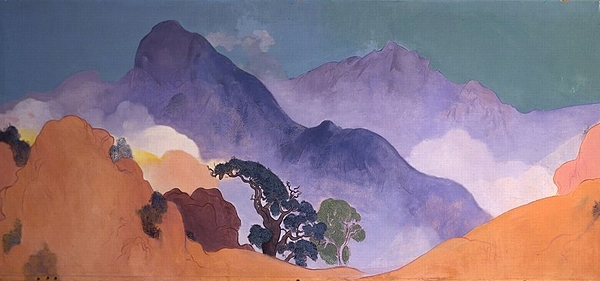
(above: Stanton Macdonald-Wright,
Mural for the Santa Monica Library: Prologue (mountain tops), between
1934 and 1935, 28.5 x 60 inches, Smithsonian American Art Museum. Public
domain, via Wikimedia Commons*)
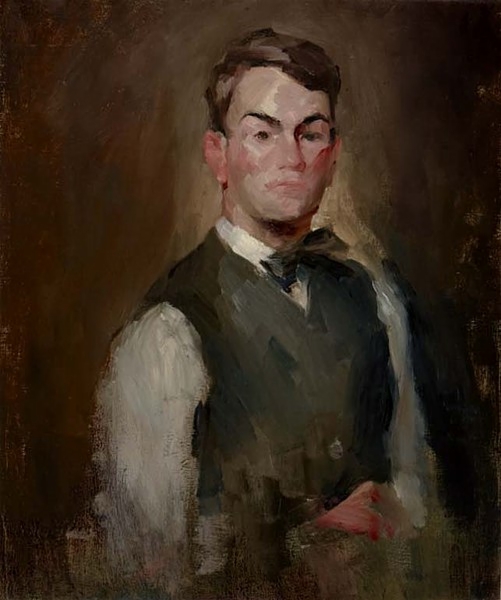
(above: Rex Slinkard, Self-Portrait, c. 1910, oil on canvas, 30 x 25 inches, Iris & B. Gerald Cantor Center for Visual Arts at Stanford University, Bequest of Carl Sprinchorn. Public domain,
Also see:
California Artists: 19th-21st Century
California Regionalism and California School of Painters
This page was originally published in Resource Library Magazine. Please see Resource Library's Overview section for more information. rev. 5/28/11
Links to sources of information outside of our web site are provided only as referrals for your further consideration. Please use due diligence in judging the quality of information contained in these and all other web sites. Information from linked sources may be inaccurate or out of date. TFAO neither recommends or endorses these referenced organizations. Although TFAO includes links to other web sites, it takes no responsibility for the content or information contained on those other sites, nor exerts any editorial or other control over them. For more information on evaluating web pages see TFAO's General Resources section in Online Resources for Collectors and Students of Art History.
*Tag for expired US copyright of object image:

 Search Resource Library

Copyright 2008-2022 Traditional Fine Arts Organization, Inc., an Arizona nonprofit corporation. All rights reserved.