
Getting around in the museum

Imaginary rooms
The museum's rooms are imaginary. We can make them look like anything we want. To make them seem like something familiar, they're shaped like rectangles. Each room has four walls. As we approach a room, we see a wide opening close to the left side of the wall, just like in the photos of the rooms we saw earlier. As we leave a room there's an opening behind us just like the one before us. We'll glide easily from room to room. No walking here!
Since we're dreaming, we can glide around the museum as fast or slow as we want. We may want to zoom though some rooms...
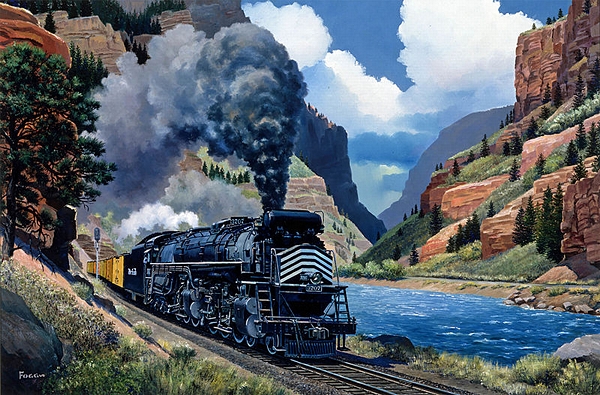
(above: Howard Fogg, Denver and Rio Grande Western No. 3707 along the Colorado River in Glenwood Canyon, Colorado, 1971, oil on canvas, courtesy of Richard Fogg. Public domain, via Wikimedia Commons*)
...or we can really take our time, like floating on a quiet river...

(above: Frederick Carl Frieseke, On the River, 1909-10, oil on canvas, 25.9 x 32 inches. Public domain, via Wikimedia Commons*)
As we look up and down the hallway between the rooms, the openings (we can call them room dividers too) line up instead of being all over the place. Let's imagine they're really wide so lots of us can glide between rooms without getting all bunched up.
Gliding around
For ease of navigation in each room, let's name each of the walls. As we enter a room, let's name the far wall the north wall. In like fashion, the right hand wall becomes the east wall. The near wall is the south wall and the left hand wall is the west wall. We'll tour each room's walls in clockwork motion. For easy gliding in and out of our tour's path, there's a convenient link at the lower right corner of views to a Glide Path.
There's no tough effort in touring this museum and certainly no one gets bunched up while gliding around!

(above: George Biddle, Tenement (mural study, Department of Justice Building, Washington, D. C.), tempera on fiberboard, 40 12 x 31 12 inches, Smithsonian American Art Museum. Public domain, via Wikimedia Commons*)
It's like we have the whole museum to ourselves.
Wall dimensions
Since we're dreaming, why not have rooms fit the number of artworks in it rather than the other way around? Poof! It's like magic. Why not flex wall sizes whenever we want?
While we're at it, let's imagine a lush flower bouquet in each room.
Views along the walls
For each wall there's a series of views. Let's think of them as sequential snapshots. Each view is numbered and is as wide as we want. We glide along the views on each wall from left to right.
We begin our tour of a room with a view of the left side of its north wall, then continue eastward past the hallway going to the next room, and then see more views along the north wall, going from left to right along the wall.
After seeing all of the views along the north wall, we'll turn right to see the series of views along the east wall. After seeing all of the east wall views, we'll turn right again to see the views along the south wall. We continue seeing views left to right, wall by wall, ending our tour at the right hand corner of the west wall. Anyone getting dizzy yet? No problem. It'll all make sense as we go along. And if we get lost, let's keep in mind that it's seeing the beautiful art that counts, not how we get around.
Traffic alert!
The sponsor is bugging us to see some fine print at this point
TFAO Museum of American Art is proudly sponsored by Traditional Fine Arts Organization, Inc., an Arizona nonprofit corporation. All rights reserved. © 2024
Cloud image courtesy of Freepik.com