

The Evolving Canvas: A History of Art in West Virginia, 1800-1940
by Gemini 2.5, June 6, 2025
Page 1
The period from 1800 to 1940 marks a transformative era for West Virginia, witnessing its evolution from a rugged frontier within Virginia to an independent state grappling with industrialization, social shifts, and the forging of a distinct cultural identity. Throughout these profound changes, art, particularly painting and sculpture, served as a vital medium, documenting the nascent landscape, immortalizing prominent figures, and reflecting the broader artistic currents sweeping across America. While West Virginia is widely celebrated for its deep traditions in mountain folk culture, it is essential to recognize that a sophisticated and diverse artistic scene flourished simultaneously. This more nuanced understanding reveals that West Virginia's artistic development was not isolated but rather integrated into broader American artistic trends. This was particularly true in the state's river valleys and the Eastern Panhandle, where established communication and transportation networks facilitated vibrant artistic exchange and supported a ready class of patrons for both portrait and landscape painters. This report delves into this rich and often overlooked artistic heritage, specifically emphasizing the evolution and significance of painting and sculpture within this timeframe, highlighting the contributions of key artists who shaped West Virginia's visual legacy.
Early Strokes: Portraiture and Documentation (1800-1860s)
The earliest artistic endeavors in what would become West Virginia were primarily utilitarian, serving practical needs such as botanical and topographic documentation, alongside decorative arts and crafts essential for a developing frontier region. As the population grew and communities became more established, portraiture emerged as a significant art form. This demand was fueled by a burgeoning gentry and middle class eager to commemorate themselves and their families, reflecting a broader trend across early America where portraiture was a primary artistic expression before the advent of photography.
Early artistic activity was largely sustained by itinerant artists who traveled across the region. John Drinker, a Baltimore portrait artist, was active in the Eastern Panhandle as early as 1788 and eventually settled there, setting a precedent for professional artists in the area. Other notable itinerant portraitists included Joshua Johnson, recognized as the nation's earliest identified professional Black painter, and Charles Peale Polk. By 1816, Swiss immigrant David Boudon was active in Wheeling, which became a significant hub. The Upper Ohio Valley region also fostered pioneer portrait artists such as painters Jarvis Hanks, John Hanna, and Charles Sullivan, alongside sculptor John Airy.

(above, Joshua Johnson, A Baltimore Shipowner, c. 1815, oil on canvas, 19 1/2 x 15 1/2 inches, Bill Hodges Gallery. Public domain, via Wikimedia Commons*)
The mid-19th century witnessed a growing appreciation for the natural beauty of the region. West Virginia's scenic landscapes, particularly Harpers Ferry, became a magnet for painters from outside the state, including George Beck, who visited as early as the 1790s. Harpers Ferry, in fact, became one of the most frequently painted towns in early 19th-century America. The state's rugged interior was further explored by notable members of the Hudson River School of American landscape painters (see Landscape Painting: 18-19th Century, 19-20th Century), such as T. Worthington Whittredge and William L. Sonntag. This progression from utilitarian documentation to the rise of portraiture and then to the prominence of landscape painting directly reflects the socio-economic and cultural development of the region. As the population grew and communities became more established, there was a clear demand for personal commemoration. Subsequently, as the nation began to romanticize its natural wonders and expand westward, West Virginia's unique and dramatic topography naturally became a significant subject for artists, integrating local artistic output into major national movements like the Hudson River School. This causal relationship demonstrates how art forms and subjects evolve in tandem with a region's maturity and its integration into broader national narratives.
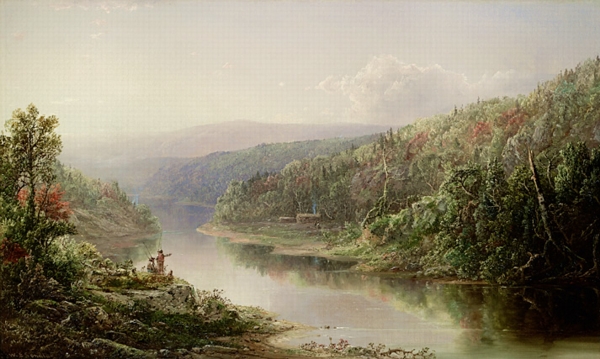
(above: William Louis Sonntag, Sr., Fishing on the Potomac, Eastern Panhandle, West Virginia, c. 1855, Hawthorne Fine Art. Public domain, via Wikimedia Commons*
David Hunter Strother (1816-1888): Chronicler of the Landscape
Born in Martinsburg, Berkeley County, Virginia (now West Virginia) in 1816, David Hunter Strother was a pivotal figure in early West Virginia art. He received early art instruction in Europe and New York, studying drawing, painting, and woodcut illustration. His career began as a portrait painter in the late 1830s and 1840s.
Strother's career took a significant turn in the early 1850s when he gained employment as a writer and illustrator for Harper's New Monthly Magazine, adopting the widely recognized pseudonym "Porte Crayon." His detailed illustrations and humorous travelogues, which often depicted West Virginia landscapes and daily life, made him one of the best-known artists in the nation by the end of the decade. His work was praised for its objective viewpoint and humor. Strother's career trajectory exemplifies how art forms adapted to changing societal needs and technological advancements in the 19th century. His shift from traditional portraiture to illustrative journalism for Harper's Monthly highlights the growing importance of mass media in shaping public perception and the artist's evolving role in documenting contemporary life and landscapes for a national audience.
Strother's active involvement in the Civil War as a Union captain, topographer, and later brevet brigadier general, profoundly influenced his artistic output. He meticulously documented his wartime experiences in a detailed journal, parts of which were published in Harper's Monthly as "Personal Recollections of the War". After the war, he continued to achieve both artistic and political renown, even serving as a U.S. consul in Mexico. His ten-part series The Mountains (1870) was instrumental in introducing Americans to the distinctive character and folkways of West Virginia. Over 700 of his drawings are now available online through West Virginia University. This intertwining of art, journalism, and history demonstrates a powerful connection between major historical events and an artist's subject matter and career trajectory.
Post-Civil War to the Turn of the Century: Landscapes and Emerging National Figures (1860s-1900)
The aftermath of the Civil War, ironically, sparked a renewed and widespread interest in West Virginia's landscapes. The extensive national news illustrations depicting the state during the conflict likely contributed to a new wave of landscape painters visiting the region in the decades following the war. This group included notable artists such as Alexander Wyant and Hugh Bolton Jones, whose works reflected the "newer and more intimate Barbizon esthetic" in landscape art. The Barbizon School, originating in France, championed direct observation of nature and a more naturalistic, less idealized approach than earlier Romantic landscapes, demonstrating West Virginia's artistic connection to international movements.

(above: Alexander Helwig Wyant, Derbyshire Landscape, 1871, oil on canvas, Dayton Art Institute. Public domain, via Wikimedia Commons)
The late 19th century also marked the nascent development of formal art institutions within West Virginia. The establishment of the West Virginia Historical and Antiquarian Society in Charleston in January 1890, followed by the opening of the West Virginia State Museum in April 1894, represented a significant step towards systematically collecting, preserving, and exhibiting the state's cultural and artistic heritage. The museum's collection, initially housed in the Capitol building, was later moved to the Capitol Annex in 1903, a relocation that fortuitously saved it from the 1921 capitol fire. This institutional growth underscores a growing civic pride and a more organized approach to cultural preservation. The emergence of these formal art institutions signifies a crucial shift in the state's approach to art, moving beyond individual artists or private patrons to a collective, organized effort to value, preserve, and make accessible the state's cultural and artistic output. The survival of the museum's collection from the fire highlights a direct positive implication of this institutionalization: it provided a stable and protective infrastructure for art, reflecting a maturing state recognizing the importance of its cultural legacy for future generations.
Thomas P. Anshutz (1851-1912): A National Figure with Wheeling Roots
Thomas Pollock Anshutz, a highly influential figure in American art history, spent his formative years growing up in Newport, Kentucky, and Wheeling, then part of Virginia, now West Virginia. Although his adult career was primarily based in Philadelphia, his early life near the industrial landscape of Wheeling is notably reflected in his early work.

(above: Thomas Pollock Anshutz, A Rose, 1907, oil on canvas, 57.9 x 43.8 inches, Metropolitan Museum of Art, Marguerite and Frank A. Cosgrove Jr. Fund, 1993. Public domain, via Wikimedia Commons*)
See more paintings by Thomas Pollock Anshutz
Anshutz received early art instruction in New York and Philadelphia, most significantly studying under Thomas Eakins at the Pennsylvania Academy of the Fine Arts (PAFA), where he later became a profoundly influential instructor. His most ambitious and widely recognized painting, Ironworkers' Noontime (1880), powerfully depicts workers on break in a foundry yard and was notably painted near Wheeling. This work stands as a significant example of American Realism and vividly captures the industrial character of parts of West Virginia. Anshutz was also a pioneer in integrating photography into his artistic practice and teaching, collaborating with Eakins and Eadweard Muybridge on photographic motion studies. Anshutz's biography reveals a subtle yet profound ripple effect of West Virginia's influence on American art. While he spent the majority of his professional life outside the state, his upbringing in Wheeling directly inspired his seminal work, Ironworkers' Noontime, a key piece in American realism. More significantly, his role as an influential teacher to a generation of artists who would define American modernism means that the very foundations of these national movements were, in a way, indirectly shaped by an artist whose formative years were rooted in West Virginia. This demonstrates that regional experiences, even brief ones, can have far-reaching implications for broader artistic trajectories.
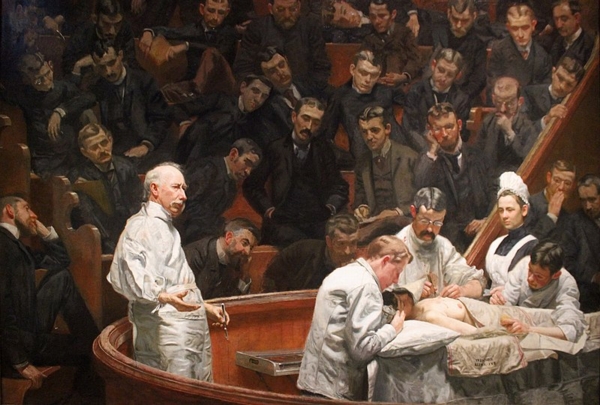
(above: Thomas Eakins, The Agnew Clinic, 1889, 84.2 x 118.1 inches, Philadelphia Museum of Art. Public domain, via Wikimedia Commons*)
Aditional paintings by Thomas Eakins
Anshutz's impact as a teacher is immense; he mentored an impressive roster of American artists who would become central figures in American modernism, including Robert Henri, John Marin, William Glackens, Everett Shinn, John Sloan, Charles Sheeler, Charles Demuth, and George Luks. Despite his experiments with abstract landscapes, he was primarily known by his contemporaries for his portraiture, earning numerous accolades, including a silver medal at the 1904 World's Fair.
 Return to Topics in American Art
TFAO's Distinguished Artists catalogue provides online access to biographical information for artists associated with this state. Also, Search Resource Library for online articles and essays concerning both individual artists associated with this state's history and the history of art centers and museums in this state. Resource Library articles and essays devoted to individual artists and institutions are not listed on this page.
*Tag for expired US copyright of object image:

Links to sources of information outside of our web site are provided only as referrals for your further consideration. Please use due diligence in judging the quality of information contained in these and all other web sites. Information from linked sources may be inaccurate or out of date. TFAO neither recommends or endorses these referenced organizations. Although TFAO includes links to other web sites, it takes no responsibility for the content or information contained on those other sites, nor exerts any editorial or other control over them. For more information on evaluating web pages see TFAO's General Resources section in Online Resources for Collectors and Students of Art History.
 Search Resource Library
Copyright 2025 Traditional Fine Arts Organization, Inc., an Arizona nonprofit corporation. All rights reserved.