

The Evolving Canvas: A History of Art in West Virginia, 1800-1940
by Gemini 2.5, June 6, 2025
Page 2
William Robinson Leigh (1866-1955): From West Virginia to the Wild West
Born in Berkeley County, West Virginia, in 1866, William Robinson Leigh received his foundational art education at the Maryland Institute and the prestigious Royal Academy in Munich, Germany, where he earned multiple medals. Upon returning to the United States, he established a studio in New York City but maintained strong ties to his home state, regularly spending summers in Martinsburg, West Virginia. During these visits, he created numerous masterful landscapes and genre scenes inspired by West Virginia subjects, such as West Virginia Woodchopper, Fishing in the Mill Pond, West Virginia Forest, and Loitering. He also practiced local portraiture, with his life-size 1896 canvas of Sophie H. Colston, now in the Smithsonian American Art Museum, considered a masterpiece of late 19th-century American portraiture.
A pivotal moment in Leigh's career occurred in 1906 when, influenced by artists like Thomas Moran, he traveled to New Mexico. He became deeply captivated by the region and its inhabitants, leading him to dedicate the bulk of his career to depicting the Old West on canvas. His distinctive style, characterized by idealism and meticulous photo-realistic detail, initially faced criticism from Eastern art critics but eventually earned him widespread national recognition as one of the nation's finest realist painters. Leigh's artistic journey exemplifies how an artist's regional origins can serve as a foundational training ground and source of thematic interest that ultimately leads to national prominence. His early mastery of West Virginia landscapes and genre scenes, executed with a realist approach, provided the technical and observational skills that he later applied to his iconic depictions of the American West. This suggests that the local artistic environment was not a constraint but a crucial developmental stage that enabled him to contribute significantly to a broader, nationally recognized artistic narrative, specifically the romanticized view of the American frontier.
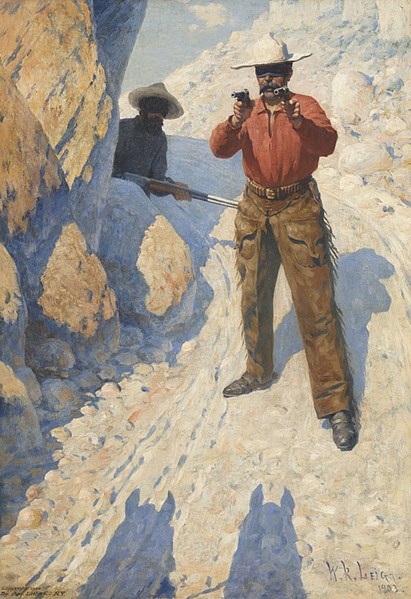
(above: William Leigh, The
Hold Up (The Ambush), 1903, oil on canvas, Sid Richardson Museum, Fort
Worth, Texas. Public domain, via Wikimedia Commons*)
Leigh's adventures extended beyond the American West; in the 1920s and 1930s, he participated in scientific safaris to Africa organized by the American Museum of Natural History. Following these trips, he organized exhibits and painted backdrops for the Museum's African Hall. He was elected to membership in the National Academy of Design shortly before his death in 1955.
Sculpting the State's Identity: Monuments and Memorials (1800-1940)
Sculpture in West Virginia during the 1800-1940 period was predominantly public and commemorative, serving as a powerful medium to honor historical figures, pivotal events, and military conflicts. This emphasis on public memory and civic pride often distinguished sculpture from the more varied subjects explored in painting during the same era.
Early monuments frequently depicted the frontier struggle, such as the life-sized sculptures of Chief Logan at the Mingo County courthouse and Levi Morgan at the Wetzel County courthouse. An 84-foot obelisk, dedicated in 1909, also memorialized the Battle of Point Pleasant. The decades following the Civil War (which concluded in 1865) saw a significant proliferation of freestanding statues dedicated to both Union and Confederate figures. These 15 monuments, often strategically placed near county courthouses, constitute the majority of the state's oldest outdoor sculptures. Notable examples include Moses Ezekiel's statue of Confederate Gen. Thomas J. "Stonewall" Jackson on the Charleston capitol grounds and Fred Martin Torrey's Abraham Lincoln Walks At Midnight. The early 20th century brought nine life-sized monuments, crafted from bronze, metal or stone, to honor World War I soldiers, with some depicted in action. A particularly unique memorial is a seven-foot bronze allegorical figure of an American airman with large bird-like wings on the campus of Linsly School in Wheeling.
Common materials for these public works included bronze, various metals, marble, and other types of stone. The oldest identified sculpture, a nine-foot wood carving of Patrick Henry from 1851 originally in Morgantown, highlights the use of wood in earlier works, while the enduring stone Soldiers and Sailors Monument (1880) in Wheeling showcases a clear shift towards more durable materials for outdoor public art as the century progressed. The overwhelming prevalence of public, commemorative sculpture during this period reveals how West Virginia, like many other states, actively utilized art to construct and reinforce its collective memory and nascent state identity. The chosen themes -- frontier struggle, the Civil War, and WWI -- are direct reflections of pivotal historical moments that shaped the state's narrative and its relationship to national events. The observed shift in materials from wood to more permanent stone and bronze further underscores a desire for enduring expressions of this identity, reflecting a growing sense of established statehood and historical consciousness.
William Rudolf O'Donovan (1844-1920): Master of Memorials
Born in Preston County, Virginia (now West Virginia) in 1844, William Rudolf O'Donovan distinguished himself as a nationally recognized, self-taught sculptor. Following his service in the Confederate army during the Civil War, he established a studio in New York City, where his career flourished.
O'Donovan became particularly renowned for his memorial pieces and public art, frequently depicting historical figures, with George Washington being a favorite subject. He engaged in extensive collaborations with Maurice J. Power, the owner of the National Fine Art Foundry, producing numerous public art works across the nation. His significant contributions include the Irish Brigade Monument at Gettysburg (1888) and various bas-relief panels for prominent monuments, sometimes working alongside fellow artist Thomas Eakins. O'Donovan's self-taught background is a crucial detail that offers a deeper understanding of the artistic landscape of the era. In a time when formal art education was becoming increasingly institutionalized, his success highlights the enduring power of innate talent and practical, hands-on experience, especially pertinent for a field like public sculpture that demanded direct engagement with materials and large-scale commissions. His prolific output of memorial pieces further underscores how individual artists, even outside traditional academic pathways, were instrumental in shaping the visual landscape of national memory and civic identity, demonstrating a practical demand for art that could be met by diverse artistic backgrounds.
Fred Martin Torrey (1884-1967): Lincoln's Sculptor
Born in Fairmont, West Virginia, in 1884, Fred Martin Torrey pursued formal art education, moving from the state in 1909 to study sculpture at the prestigious Art Institute of Chicago under the renowned Lorado Taft. His wife, Mabel Landrum Torrey, was also a recognized sculptor.
Torrey is best known for his monumental sculptures of historic figures. His 1933 statue, Lincoln Walks at Midnight, garnered national attention, with a 42-inch bronze version displayed at the 1939 World's Fair. The enduring significance of this work to West Virginia is evident in the nine-and-a-half-foot bronze casting, executed by Charleston artist Bernard Wiepper, that was erected near the West Virginia state capitol in 1974. Torrey's original 42-inch plaster model of the sculpture is preserved in the possession of the State Museum. Beyond Lincoln, he sculpted other historic figures, including Stephen Douglas, George Washington, and George Washington Carver, with one of his last works being a 1965 bust of John F. Kennedy. Fred Martin Torrey's Lincoln Walks at Midnight is more than just a significant work of art; its prominent placement near the West Virginia State Capitol, decades after its creation, reveals the state's enduring connection to national historical figures and narratives. The fact that his plaster model is carefully preserved in the State Museum further underscores its profound cultural significance within West Virginia. This demonstrates how specific works of art can transcend their immediate period of creation to become powerful symbols of state identity and historical memory, reflecting a continuous engagement with national historical consciousness.
The Modern Era Dawns: Abstraction and Illustration (Early 20th Century)
The early 20th century marked a significant evolution in West Virginia's art scene, as artists, mirroring national trends, began to experiment with the divergent realist and abstract currents then in vogue. This represented a notable departure from the more traditional portraiture and landscape styles that had dominated the 19th century. The explicit mention of West Virginia artists experimenting with "divergent realist and abstract currents" in the early 20th century provides a crucial understanding: it directly refutes any potential perception of the state being artistically isolated or lagging behind. This demonstrates that artists with ties to West Virginia were not merely passive recipients of national trends but were actively engaged with, and contributing to, the broader national and international evolution of art.
This period saw a blossoming of diverse artistic expressions. Artists such as Virginia B. Evans in the Northern Panhandle explored both Impressionist and Abstract Expressionist painting, and was also a skillful designer of art deco glass. Grace Martin Taylor, a cousin of Blanche Lazzell, explored a wide range of modernist currents in her work as an artist and a leading teacher in the Kanawha Valley. Katherine Burnside in Parkersburg also contributed to these emerging trends, and Clarksburg native James Edward Davis pioneered abstract filmmaking. These regional figures collectively contributed to a "flowering of artistic activity" in the state during the mid-20th century. Their exploration of Impressionism, Abstract Expressionism, and even abstract filmmaking highlights a dynamic and forward-looking artistic community that was deeply connected to the avant-garde movements of the era.
Blanche Lazzell (1878-1956): A Pioneer of American Modernism
Born in Maidsville, West Virginia, in 1878, Blanche Lazzell became a prominent printmaker and abstract painter, recognized as a pioneer of American modernism. Her extensive art education included studies at West Virginia University (where she earned a fine arts degree in 1905), the Art Students League in New York (under William Merritt Chase), and two significant trips to Europe. In Paris, she immersed herself in avant-garde movements, notably studying Cubism with Fernand Léger, André Lhote, and Albert Gleizes, which profoundly influenced her shift towards abstraction.
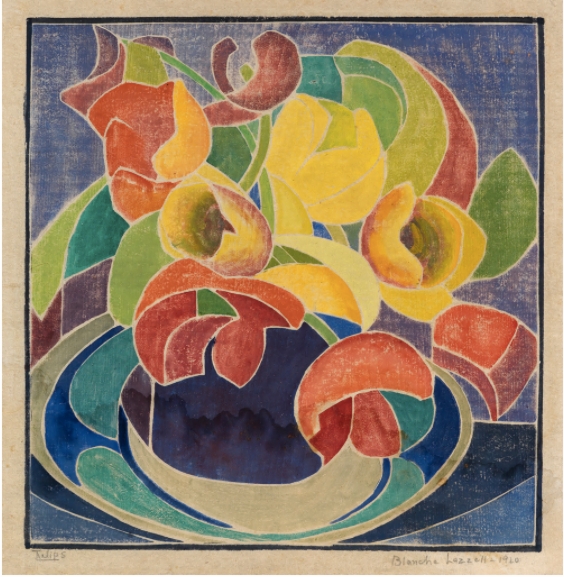
(above: Blanche Lazzell, Tulips, 1920, white line woodblock print (Provincetown Print technique), Swann Auction Galleries. Public domain, via Wikimedia Commons*)
Lazzell eventually settled in the vibrant artist colony of Provincetown, Massachusetts, where she became a leading figure in white-line color woodblock printmaking, co-founding the Provincetown Printers. Despite her primary summer residence being in Provincetown, she frequently returned to Morgantown, West Virginia. Her work included a depiction of the Monongahela River featured in a 1919 exhibition. In 1934, she created the Justice mural for the Morgantown courthouse as part of a Federal Art Project grant through the Works Progress Administration (WPA), demonstrating her commitment to public art and her home state. Lazzell was recognized near the end of her life for her pioneering achievements in abstraction. Blanche Lazzell's life and career, characterized by her deep West Virginia roots alongside her extensive engagement with international modernist movements and prominent art colonies like Provincetown, highlight a recurring and significant theme for West Virginia artists of this period: the negotiation between strong regional identity and participation in broader artistic trends. Her ability to contribute meaningfully to both local initiatives (like the WPA mural) and national artistic dialogues (through her pioneering white-line woodcuts and abstraction) demonstrates a dynamic artistic identity that was not confined by geography but rather enriched by the interplay of her roots and her global artistic explorations.
Leslie Thrasher (1889-1936): The Magazine Cover Maestro
Born in Piedmont, West Virginia, in 1889, Leslie Thrasher rose to become a nationally famous magazine cover illustrator.His artistic training included studies at the Pennsylvania Academy of Fine Arts and in Paris, and he later became a student of the influential Howard Pyle.
Thrasher's work first graced the cover of the Saturday Evening Post in 1912, for which he eventually created twenty-three covers. He achieved significant fame after being hired by Liberty magazine in 1924, where he produced an astonishing 360 covers, demonstrating his prolific output and widespread appeal. His most popular series, "For the Love o' Lil," depicted the relatable life of a typical middle-class woman, resonating with a broad audience. His realist style was often compared to that of Norman Rockwell. Leslie Thrasher's highly successful career as a magazine illustrator highlights a crucial socio-artistic shift in the early 20th century: the democratization of art. Unlike traditional fine art, which was often confined to galleries or private collections, commercial illustration reached millions through popular magazines. This meant that artists like Thrasher, with their accessible realist styles, were directly shaping the visual culture and aesthetic preferences of a mass audience, integrating art much more broadly into daily life. His career demonstrates that recognized artists during this period were not solely those within traditional fine art circles but also those who mastered and excelled in popular, mass-media mediums, broadening the definition of artistic impact.

(above: Norman Rockwell, Fishing Trip, They'll Be Coming Back Next Week, 1919, oil on canvas, 29 x 29 inches, Norman Rockwell Museum. Public domain, via Wikimedia Commons*)
Aditional paintings by Norman Rockwell
Thrasher's illustrations reached a vast audience, appearing prominently not only on magazine covers but also in advertisements for major brands like Chesterfield Cigarettes and Cream of Wheat. His career exemplifies the burgeoning rise of commercial art as a powerful and widely accessible form of artistic expression in the early 20th century, bringing art directly into American homes.
Conclusion: A Legacy in Stone and Canvas
The period from 1800 to 1940 reveals a vibrant and evolving artistic landscape in West Virginia, extending far beyond a singular folk tradition. Art in the state progressed from its utilitarian beginnings and the demand for commissioned portraiture to embrace complex landscape narratives, monumental public commemoration, and eventually, the bold experiments of modernism and the widespread reach of commercial illustration. This trajectory mirrors and contributes to the broader currents of American art history.
The lives and works of artists like David Hunter Strother,
Thomas P. Anshutz, William Robinson Leigh, William Rudolf O'Donovan, Fred
Martin Torrey, Blanche Lazzell, and Leslie Thrasher demonstrate that West
Virginia's artists were not isolated. They were active participants and
significant contributors to national and international artistic movements,
often blending their strong regional identity with universal artistic concerns.
Their stories highlight the enduring influence of West Virginia's landscapes,
history, and communities on their creative output, even as many achieved
national or international renown. The establishment of institutions like
the West Virginia State Museum during this period underscores a growing
and enduring commitment to preserving and celebrating the state's cultural
and artistic heritage. The works of these artists, whether captured in paint
on canvas or sculpted in enduring stone and bronze, continue to tell the
compelling story of West Virginia's past, its resilient people, and its
undeniable place within the rich tapestry of American art.
Please don't rely on this AI-generated text for accuracy. It has been lightly edited, yet may be laden with inaccurate information. Consider it a base for further inquiry.
 Return to page 1 of The
Evolving Canvas: A History of Art in West Virginia, 1800-1940
Return to page 1 of The
Evolving Canvas: A History of Art in West Virginia, 1800-1940
Return to Topics in American Art
TFAO's Distinguished Artists catalogue provides online access to biographical information for artists associated with this state. Also, Search Resource Library for online articles and essays concerning both individual artists associated with this state's history and the history of art centers and museums in this state. Resource Library articles and essays devoted to individual artists and institutions are not listed on this page.
*Tag for expired US copyright of object image:

Links to sources of information outside of our web site are provided only as referrals for your further consideration. Please use due diligence in judging the quality of information contained in these and all other web sites. Information from linked sources may be inaccurate or out of date. TFAO neither recommends or endorses these referenced organizations. Although TFAO includes links to other web sites, it takes no responsibility for the content or information contained on those other sites, nor exerts any editorial or other control over them. For more information on evaluating web pages see TFAO's General Resources section in Online Resources for Collectors and Students of Art History.
 Search Resource Library
Copyright 2025 Traditional Fine Arts Organization, Inc., an Arizona nonprofit corporation. All rights reserved.