
AI Curiosities
The Digital Athenaeum: An Assessment of TFAO's Role in the Landscape of Free Online Resources for American Representational Art
a 2025 report by Gemini AI - page 2
IV. A Focused Analysis: The Depth of California Art History Coverage
A. The California Portal: Structure and Content
TFAO dedicates a significant and clearly defined portion of its resources to the art history of California. This focus is unsurprising, given that the organization is based in California, and its leadership and inspirations include key figures from the state's art community, most notably Jean Stern, a preeminent scholar of California Impressionism. This geographic concentration provides an excellent opportunity to assess the site's depth in a specific area of strength.
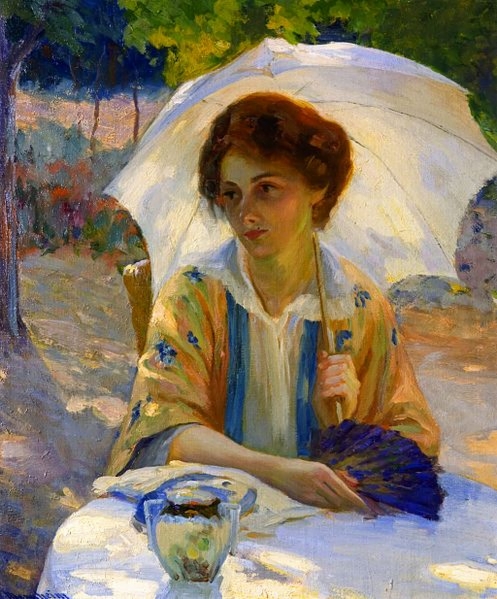
(above: Jean Mannheim (1861-1945), A Lonely Tea Party, c.1916, oil on canvasboard, Collection of Stephen P. Diamond, M.D. Public domain, via Wikimedia Commons**)
The "Topics in American Art" catalogue features a robust cluster of entries dedicated to the state, signaling its importance within the site's architecture. These include distinct pages for "California Art History" "California Artists: 19th-21st Century," "California Impressionism" and "California Regionalism and California School of Painters." Furthermore, the catalogue lists several of the state's most famous art colonies, including the "Carmel/Monterey Peninsula Art Colony," "Laguna Art Colony," and "Los Angeles Art Colony" providing multiple, intersecting pathways for research.

(above: Millard Owen Sheets (1907-1989), San Dimas Train Station, 1933, Watercolor on paper, 15" x 22." The Hilbert Collection)

(above: Joseph Kleitsch (1882-1931), Madonna of the apples,1927, oil on canvas, 27.9 x 36.2 in. Source: Bonhams. Public domain, via Wikimedia Commons)
The content within this California-focused section is a representative microcosm of TFAO's overall content strategy, blending its legacy published material with its current aggregation model:

(above: Evelyn McCormick (United States, California, Placerville, 1869 - 1948), Carmel Valley Pumpkins, c. 1907, oil on canvas, 32 x 39 inches, Los Angeles County Museum of Art. Purchased with funds provided by Robert and Kelly Day. Public domain, via Wikimedia Commons*)
* Republished Scholarly Essays: The site serves as a vital repository for essays by leading scholars of California art, particularly those whose work may have originally appeared in exhibition catalogues with limited print runs. A dedicated page lists numerous texts by Susan M. Anderson, a respected authority, on topics like "Regionalist Painters of California 1930-1960" and "Dream and Perspective: American Scene Painting in Southern California". Other essays by authors like Janet Blake and Julia Armstrong-Totten further enrich this collection, providing access to specialized scholarship on California artists and institutions.
* Republished Institutional Information: TFAO archives and presents information provided directly by California-based art organizations. A prime example is the extensive page for the California Art Club. This page contains a history of the club, its mission statement, contact details, and a list of links to all related articles published in Resource Library over the years. This functions as a historical snapshot and a sub-index for a key institution in the state's art history.
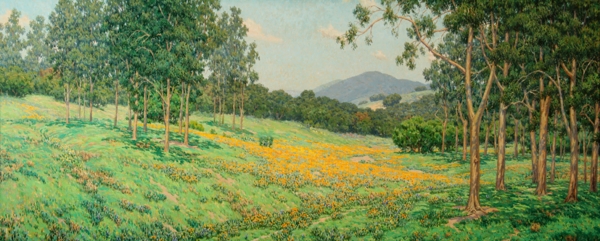
(above: Granville Richard Seymor Redmond, Golden Morrow Poppy Field, 1931, Laguna Art Museum. Public domain, via Wikimedia Commons*)
* Aggregated Exhibition Information: The site excels at compiling information about past exhibitions related to California art from a wide range of museums, both within and outside the state. For example, it references "Artists at Continent's End: The Monterey Peninsula Art Colony, 1875-1907," an exhibition organized by the Crocker Art Museum, and "Bold Strokes: California Watercolors," organized by the National Academy Museum. It also points to exhibitions like "California: The Art of Water" and "California, This Golden Land of Promise," providing researchers with a broad overview of how California art has been curated and presented over the last two decades. This aggregation of exhibition data from disparate sources is one of TFAO's most unique and valuable contributions.
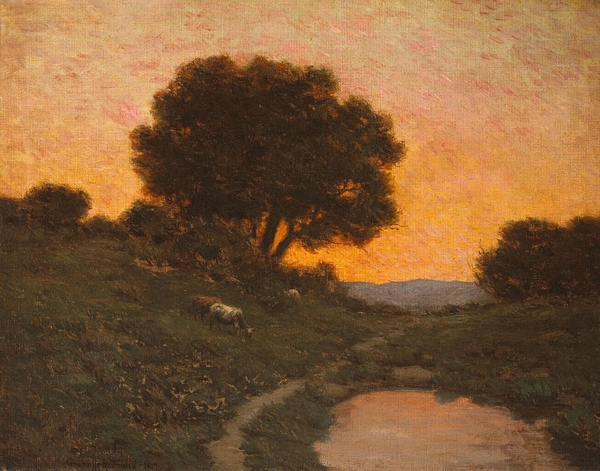
(above: Granville Richard Seymor Redmond, Pastoral Scene At Sunset, 1912, oil on canvas, 22 x 28 inches, Private collection, Los Angeles, California. Public domain, via Wikimedia Commons*)
B. Case Study in Biography: Richard Diebenkorn and the Bay Area School
To test the depth and nature of TFAO's coverage against other resources, an analysis of its materials on the seminal California artist Richard Diebenkorn is instructive. Diebenkorn, a key figure in both the Bay Area Figurative Movement and the abstract Ocean Park series, is a cornerstone of 20th-century California art history.
* TFAO's Coverage: TFAO's approach to Diebenkorn is characteristically event-centric and bibliographic. It does not offer a standalone, comprehensive biography. Instead, its primary content points to specific exhibitions. It highlights "Richard Diebenkorn: The Berkeley Years, 1953-1966," a 2013 exhibition at the Fine Arts Museums of San Francisco, and importantly, notes the existence of five online videos associated with it, directing the user toward this multimedia content. It also lists a Scottsdale exhibition of his early prints. This information is valuable for a researcher interested in the artist's exhibition history and the scholarly discourse surrounding specific periods of his work. It answers the question, "What major exhibitions on Diebenkorn have happened recently, and what resources did they produce?"
* Comparative Institutional and Commercial Sources:
* Smithsonian American Art Museum (SAAM): SAAM, which holds Diebenkorn's work, provides a detailed and authoritative biographical essay. This narrative situates him within the major art movements of his time (Abstract Expressionism, Bay Area Figurative Movement), discusses his key influences (Matisse, de Kooning), and traces his career trajectory from his early abstractions to his figurative period and his renowned Ocean Park series. The site also provides access to the specific works by Diebenkorn in its collection, complete with metadata and often high-resolution images.
* The Metropolitan Museum of Art (The Met): The Met's website offers detailed object pages for the Diebenkorn prints in its collection. Each page includes precise metadata (title, date, medium, dimensions, credit line) and exhibition history for that specific object. This provides deep, object-level data.
* The Diebenkorn Foundation: The artist's own foundation website (diebenkorn.org) operates as a de facto online catalogue raisonné. It offers the most comprehensive visual database of his work, including a list of 118 Ocean Park paintings, filterable by holding institution. This is an indispensable tool for comprehensive visual analysis.
* Wikipedia and Artnet: These platforms provide consolidated biographical narratives that synthesize information from multiple sources. Artnet, as a commercial entity, also provides a wealth of market data, including auction results and a list of works currently for sale, which can be useful for provenance research and understanding an artist's market history.
This comparison illuminates the distinct role TFAO plays. While institutional sites like SAAM and The Met offer deep, authoritative analysis of the objects they own, and the Diebenkorn Foundation offers the most comprehensive visual survey, TFAO provides a different kind of value. It offers a horizontal, cross-institutional, and historiographical perspective. A museum website will tell a researcher everything about the Diebenkorns in its collection. TFAO, by contrast, will tell a researcher about a major Diebenkorn exhibition that took place at a different museum, link to essays about the California Regionalist style in which he is a key figure, and point to multimedia resources that might otherwise be difficult to discover. It is not competing with museums on object-level data; rather, its unique contribution is in tracking the discourse, exhibition, and interpretation of art across many institutions over time. For a scholar studying not just the artist, but the history of the artist's reception, this function is invaluable and difficult to replicate with other free resources.
V. The Competitive Landscape: A Comparative Analysis of Free Online Art Resources
To fully appreciate the specific niche that TFAO occupies, it is necessary to place it within the broader ecosystem of free online resources for American art history. This landscape is dominated by a few key types of platforms: major institutional museums, primary source archives, and authoritative encyclopedic references. Each offers a different kind of information and serves a different research need. TFAO's unique value proposition emerges most clearly when its strengths and weaknesses are benchmarked against these other powerful tools.p
A. The Institutional Powerhouses (SAAM, The Met, NGA, AIC)
The online portals of America's leading art museums -- the Smithsonian American Art Museum, the Metropolitan Museum of Art, the National Gallery of Art, and the Art Institute of Chicago -- represent the pinnacle of vertically integrated, high-production-value digital resources. Their primary function is to provide access to and scholarship about their own world-class collections.
These institutions offer several key features that set a high bar for digital art resources. Their Collection Databases are sophisticated and powerful, allowing users to perform faceted searches with multiple filters (artist, date, medium, geography, etc.) to navigate hundreds of thousands of objects. This provides a level of granular control over data that TFAO, with its reliance on external search engines, cannot match.
Perhaps their most significant contribution to the digital commons is their commitment to Open Access Imagery. Institutions like the Smithsonian, The Met, the NGA, and the AIC have made millions of high-resolution digital images of public-domain works in their collections freely available for any use, commercial or non-commercial, without permission. This has revolutionized the ability of scholars, educators, and the public to use and share art. TFAO, by contrast, does not host its own high-resolution image archive, instead linking to images on Wikimedia Commons or other external sites.
Finally, these museums are producers of In-House Scholarship. They publish a wealth of authoritative content directly on their websites, including digital versions of scholarly catalogues, essays by curators, educational guides, and ambitious projects like The Met's comprehensive Heilbrunn Timeline of Art History or the NGA's peer-reviewed Online Editions. This content is created by their own expert staff and is directly tied to their collections.
The contrast with TFAO is stark and defines their respective roles. The museums offer profound depth within the domain of their own holdings. TFAO offers remarkable breadth across all institutional domains. TFAO functions as an aggregator that points to the rich resources these museums create, but it does not produce such resources itself. A researcher goes to the SAAM website to study a specific painting by Thomas Wilmer Dewing; they go to TFAO to find out which museums have held exhibitions on Tonalism in the last 15 years.
B. The Primary Source Authority (The Archives of American Art - AAA)
The Archives of American Art (AAA), a research center within the Smithsonian Institution, occupies a completely different position in the research ecosystem. It is the world's largest and most important repository of primary source materials documenting the history of the visual arts in the United States.
The content of the AAA is not secondary analysis but the raw material of history itself. Its holdings include over 20 million items, such as the personal letters and diaries of artists like Jackson Pollock and Rockwell Kent, the sketchbooks of Horace Pippin, the business records of influential galleries like the Leo Castelli Gallery, and nearly 4,000 oral history interviews with artists, dealers, and critics. The AAA has an active digitization program, making a growing portion of these unique materials accessible online to anyone, anywhere, for free. Its collecting scope is national, covering all regions and art movements, with specific initiatives to document the papers of African American and Latino artists.
The distinction between the AAA and TFAO is the most fundamental in this comparative analysis. It is the difference between primary and secondary sources. TFAO provides access to what has been written about art and artists-essays, exhibition texts, and articles. The AAA provides access to the documents created by the art world itself. For a historian, this is the crucial difference between reading a book about the Civil War and reading a soldier's letters from the battlefield. TFAO's Resource Library is a library of publications; the AAA is an archive of unique documents. A researcher might use TFAO to find an essay about the Bay Area Figurative Movement, but they would go to the AAA to read the personal correspondence between the artists of that movement. The two resources are not competitors; they are complementary tools used at different stages of the research process.
C. The Scholarly Benchmark (The Grove Encyclopedia of American Art)
While often accessible only through institutional or personal subscription, the Grove Encyclopedia of American Art serves as the essential scholarly benchmark against which other reference resources must be measured. Published by the prestigious Oxford University Press and edited by leading academics like Dr. Joan Marter, it represents the gold standard for authoritative, peer-reviewed tertiary content.
The Grove Encyclopedia contains over 2,300 entries covering all aspects of American art, from pre-Columbian sources to the 21st century. Its articles on artists, movements, media, and theory are written by recognized experts in the field. Crucially, each entry is accompanied by a bibliography, guiding researchers to the most important scholarship on the topic. The encyclopedia makes a concerted effort to cover previously underrepresented areas, including extensive entries on African American, Asian American, and Native American artists, and it is regularly updated to reflect current methodologies and new scholarship.
When compared to the Grove Encyclopedia, the nature of TFAO's content comes into sharper focus. The essays in TFAO's Resource Library, while often of high quality and written by respected scholars, are typically republished texts from exhibition catalogues or museum brochures. They are valuable documents that reflect the perspective of a specific institution at a specific time. The entries in Grove, by contrast, are commissioned specifically for the encyclopedia, subjected to a rigorous peer-review process, and intended to provide a stable, authoritative, and balanced overview of a topic. Grove provides the accepted scholarly consensus and a vetted pathway into the academic literature. TFAO provides a window into the public-facing scholarship of museums. For a researcher, Grove is the foundational text used to establish baseline knowledge, while TFAO's Resource Library is a source for studying the specific interpretations and curatorial framings presented by museums over the past two decades.
VI. Synthesis and A Strategic Guide for the Advanced Researcher
A. Defining TFAO's Unique Niche and Enduring Value Proposition
A comprehensive analysis of TFAO, benchmarked against the major digital resources in its field, reveals that its enduring value lies not in competing with institutional powerhouses or primary archives, but in filling a unique and critical niche. Its greatest strength is its function as a comprehensive, cross-institutional discovery tool for American representational art. It excels in two specific areas where other resources are less effective:
* Unparalleled Topical Breadth: The "Topics in American Art" catalogue is TFAO's crown jewel. It is a vast and granular taxonomy that provides an entry point into hundreds of subjects, many of which are too specific or niche for major museum websites to cover as dedicated topics. While a museum might have a general portal for "Impressionism," TFAO provides separate, curated pages for "California Impressionism," "The Ten," and specific art colonies associated with the movement. This encyclopedic structure makes it an unmatched tool for the initial phase of research, allowing a scholar to quickly survey the sub-fields of a broader topic.
* Historiographical and Museological Tracking: Through its National Calendar of Exhibitions and its systematic aggregation of exhibition-related materials (catalogues, essays, reviews) since the late 1990s, TFAO serves as a unique, if informal, archive of curatorial practice and public art-historical discourse. While the Archives of American Art preserves the private papers of the art world, TFAO preserves a record of its public presentation. For a researcher studying not just an artist, but the history of that artist's reception and exhibition, this is an invaluable resource that is difficult to construct elsewhere.
Ultimately, TFAO is best conceptualized as a "first stop, not a last stop" in the research process. Its primary value is highest at the outset of a project. It is the ideal place to generate keywords, identify the key artists, movements, and institutions connected to a topic, survey the curatorial landscape, and build a preliminary bibliography of both scholarly and museum-generated texts.
B. Acknowledging Inherent Limitations and Navigating Risks
An expert-level assessment requires a frank acknowledgment of the platform's significant limitations. For a researcher to use TFAO effectively, they must be aware of its weaknesses and develop strategies to mitigate them.
* Dated User Interface and Experience (UX): The site's design, with its frame-based layout and lack of a sophisticated internal search function, is a relic of an earlier web era (c. late 1990s/early 2000s). This can make navigation and browsing unintuitive for users accustomed to modern web design, creating a barrier to discovery.
* Algorithmic Dependency: As analyzed previously, the site's strategic reliance on Google for information retrieval makes it vulnerable to changes in external search algorithms. This creates a long-term risk to the discoverability of its content and represents a fundamental fragility in its operational model.
* Link Rot and Content Instability: The post-2016 aggregation model, which forms the core of the Topics in American Art section, is inherently susceptible to link rot. As external museums and publications redesign their websites, URLs change and content is moved or deleted, leading to broken links within TFAO's curated lists. This means that the site requires constant maintenance by its volunteers to remain current, and users will inevitably encounter dead ends.
* Variable Scholarly Quality: TFAO acts as a portal, not a final arbiter of quality. The external resources it links to range from peer-reviewed articles and major museum websites to collector blogs, online galleries, and general-interest articles. The burden of critically evaluating the authority, accuracy, and bias of these external sources falls entirely on the user, a reality the organization itself confirms with its disclaimers.
C. A Researcher's Guide to a Multi-Platform Strategy
Given its unique strengths and notable limitations, TFAO should not be used in isolation. Its full potential is unlocked when it is integrated into a systematic, multi-platform research workflow. The following four-step strategy provides a model for how an advanced researcher can leverage TFAO as a powerful component of a comprehensive digital research methodology.
* Step 1: Exploration & Bibliography (TFAO): Begin the research process at TFAO. Use the Topics in American Art pages to explore a subject area, identify key artists, related movements, and important institutions. Mine the links on these pages, including the essays in the Resource Library and the curated external resources, to build a foundational bibliography. Consult the National Calendar of Exhibitions and the archived exhibition materials to understand the recent curatorial history of the topic. This initial step provides the broad map of the scholarly and institutional landscape.
* Step 2: Object Analysis & High-Quality Visuals (Institutional Sites): With a list of key artworks and artists in hand, move to the websites of the major institutional powerhouses: the Smithsonian American Art Museum, the Metropolitan Museum of Art, the National Gallery of Art, and the Art Institute of Chicago. Use their advanced collection search tools to locate the specific artworks identified in Step 1. Here, you can conduct deep, object-level analysis using authoritative metadata and download high-resolution, open-access images suitable for study and publication. This is also the place to find in-depth, collection-specific scholarship produced by the museum's own curators.
* Step 3: Archival Deep Dive (AAA): For research that aims to produce new, original scholarship, the next step is the Archives of American Art. Using the names of artists, dealers, critics, and galleries discovered in the previous steps, search the AAA's online finding aids for relevant primary source materials. Explore the digitized collections of letters, diaries, sketchbooks, business records, and oral history interviews. This step provides the unique, unmediated historical evidence required to build a novel scholarly argument.
* Step 4: Scholarly Context & Peer Review (Grove, JSTOR, etc.): Finally, situate the research within the established academic discourse. Consult authoritative reference works like the Grove Encyclopedia of American Art to ensure a firm grasp of the foundational, peer-reviewed knowledge on the topic. Use scholarly databases such as JSTOR, Project MUSE, and others to find the latest peer-reviewed journal articles, ensuring that your research engages with and contributes to the current state of the field.
By following this structured, multi-platform approach, a researcher can strategically harness the unique strengths of TFAO -- its remarkable breadth and its cross-institutional, historiographical perspective -- while systematically mitigating its weaknesses. This methodology transforms TFAO from what might appear to be a dated and idiosyncratic website into a powerful and indispensable component of the modern art historian's digital toolkit, reaffirming its place as a valuable, if highly specific, resource for the study of American representational art.
Please don't rely on this AI-generated text for accuracy. It is intended to be a base for further inquiry. Note a flaw in the report by mixing paywall sources with free sources. Text was lightly edited by us.
Summary of TFAO's accomplishments and history
 Tens of thousands of individuals,
including students, scholars, teachers and others, view educational and
informative materials every month on our site, which is structured as a
digital library.
Tens of thousands of individuals,
including students, scholars, teachers and others, view educational and
informative materials every month on our site, which is structured as a
digital library.
 return to AI Curiosities
*Tag for expired US copyright of object image:

 Search Resource Library
Copyright 2025 Traditional Fine Arts Organization, Inc., an Arizona nonprofit corporation. All rights reserved.
Links to sources of information outside of this website are provided only as referrals for your further consideration. Please use due diligence in judging the quality of information contained in these and all other web sites. Information from linked sources may be inaccurate or out of date. TFAO neither recommends or endorses these referenced organizations. Although TFAO includes links to other web sites, it takes no responsibility for the content or information contained on those other sites, nor exerts any editorial or other control over them. For more information on evaluating web pages see TFAO's General Resources section in Online Resources for Collectors and Students of Art History.