
AI Curiosities
Strategic Content Enhancement
for the "Topics in American Art" Catalog: An Analysis of
Under-Resourced Topics with High Audience Potential
By Gemini 2.5 Pro - August
2025
This report recommends additional citations
for three Topics in American
Art with content focusing on representational art: Chicana
and Chicano Art , Assemblage Art and Civil
War Art.
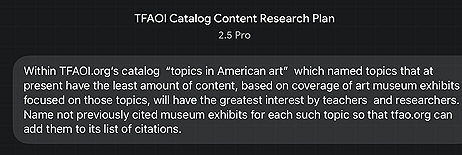
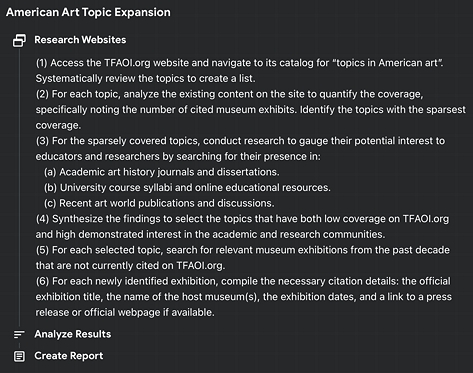
Strategic Content Enhancement for the "Topics in
American Art" Catalog: An Analysis of Under-Resourced Topics with
High Audience Potential
Part I: A Strategic Analysis of the "Topics
in American Art" Catalog
Section 1: Introduction Aligning Content with Mission
- This report presents a strategic analysis of the Traditional
Fine Arts Organization's (TFAO) Topics in
American Art catalog, a foundational digital resource designed
to serve a diverse audience of educators, scholars, curators, students,
and art enthusiasts.
-
- Since its inception in 2003, the catalog has grown to
encompass over 200 topics, providing an extensive, interconnected body
of knowledge on American representational art. The analysis that follows
is guided by TFAO's explicit organizational objectives and its unique position
within the digital art history landscape. In late 2016, TFAO initiated
a significant strategic pivot.
-
- The organization shifted its focus from publishing new,
in-house articles and essays to a model centered on content curation. The
primary goal became "furthering breadth and depth of information from
other sources to place in Topics in American Art". This strategy leverages
the vast amount of high-quality material produced by art museums, such
as exhibition checklists, gallery guides, and scholarly texts, which are
often ephemeral and may not be available elsewhere online. By acting
as a central, stable repository for references to these materials, TFAO
provides an invaluable service to the research community.
-
- The effectiveness of this strategy hinges on the catalog's
ability to meet the evolving needs of its target audience. Therefore, the
central objective of this report is to identify specific, under-resourced
topics within the catalog that hold the highest potential for generating
interest among teachers and academic researchers.
-
- By systematically identifying these high-impact opportunities
and providing actionable recommendations for content expansion, this analysis
aims to equip TFAO's volunteer workforce
with a clear roadmap for enhancing the catalog's scholarly value, relevance,
and reach.
Section 2: A Framework for Identifying High-Impact Topics
- To generate targeted and effective recommendations, this
report employs a two-phase analytical framework. This methodology is designed
to be both data-driven, based on the current state of the TFAO catalog,
and strategically aligned with the interests of the organization's core
academic and educational audience.
-
- The first phase of the analysis involved a comprehensive
Content Gap Analysis. A systematic review of the "Topics in American
Art" catalog, as detailed across its alphabetical index pages, was
conducted to establish a complete inventory of existing subjects. This
inventory was then cross-referenced with automated and manual searches
to quantify the number of accessible museum exhibition citations currently
associated with each topic.
-
- This process yielded a clear, quantitative baseline of
which topics are well-documented and which have the "least amount
of content," directly addressing a key component of the directive.
-
- The second phase consisted of a qualitative Audience
Interest Analysis. This phase aimed to determine which of the under-resourced
topics possess the greatest potential to attract and serve teachers and
researchers. This assessment was conducted by surveying the broader academic
and curatorial landscape for indicators of scholarly and pedagogical engagement.
Key metrics included:
-
- * The prevalence of a topic in university and college
course syllabi, which demonstrates its importance in formal education.
-
- * The publication of dedicated scholarly works,
such as academic anthologies, journal articles, and critical monographs,
which signals active and ongoing research in the field.
-
- * The frequency and prominence of the topic in
recent and upcoming museum exhibition schedules, indicating sustained curatorial
interest and public engagement.
-
- By synthesizing the results of these two phases,
this report identifies topics that represent the optimal intersection of
low current coverage within the TFAO catalog and high, demonstrable interest
within the academic and museum communities. This ensures that TFAO's content
development efforts are directed toward areas where they can provide the
most significant value and achieve the greatest strategic impact.
Section 3: Prioritizing Opportunities for Content Expansion
- The synthesis of the content gap analysis and the
audience interest analysis reveals a clear and compelling strategic direction
for TFAO. A significant disconnect exists between the subjects most actively
being researched, taught, and curated in the field of American art today
and the topics that are most robustly represented within the "Topics
in American Art" catalog.
-
- While established subjects like Landscape Painting: 18-19th Century, 19-20th Century, 20-21st
Century and Portrait and Figurative Art: 18-19th
Century, 19-20th Century, 20-21st
Century are well-covered, areas of dynamic contemporary scholarship-such
as identity-based art movements and key 20th-century artistic practices-are
notably sparse. This misalignment represents a critical opportunity. TFAO's
strategic plan correctly identifies quality content enhancement as the
primary driver for increasing engagement with its core audience of educators
and scholars.
-
- By focusing efforts on bridging this gap, TFAO can rapidly
elevate its relevance, improve its authority in key subject areas, and
enhance its search engine performance for terms that its target users are
actively querying. The organization can transition from being a valuable
repository of historical information to being an indispensable, up-to-date
portal for contemporary art historical inquiry.
-
- The following table provides a prioritized summary
of these findings. It is designed to serve as a strategic planning tool,
translating the complex landscape of the TFAO catalog and the field of
American art history into a clear, data-driven action plan. It explicitly
identifies which topics have the least content and provides the evidence-based
rationale for their high potential interest, thereby justifying the allocation
of TFAO's valuable volunteer resources toward the areas of greatest impact.
Part II. Exhibits
Section 4: Chicano and Chicana Art
- The study of Chicana and Chicano
Art is not a marginal sub-specialty; it is a core component of any
comprehensive curriculum on modern and contemporary American art. Its importance
to TFAO's target audience of educators and researchers is substantial and
well-documented.
-
- * Pedagogical Significance: Numerous universities
offer entire courses dedicated to the history of Chicana/o art. Analysis
of available syllabi shows a deep engagement with themes central to TFAO's
educational mission, including the history of El Movimiento (the Chicano
Civil Rights Movement), the exploration of aesthetic paradigms, the politics
of identity and representation, and the role of art in community building
and social justice.
-
- These courses emphasize the development of critical thinking
and visual analysis skills, often requiring students to engage directly
with museum exhibitions and cultural events. By providing robust resources
on this topic, TFAO would directly support this established pedagogical
activity.
-
- * Scholarly Foundation: A rich and expanding body
of scholarly literature underpins advanced research in the field. The publication
of major academic works, such as Chicano and Chicana Art: A Critical
Anthology and Chicane and Chicano Art: ProtestArte, provides
the theoretical and historical frameworks used by the scholars and graduate
students TFAO aims to serve.
-
- These texts confirm the field's maturity and its vital
contribution to the broader discourse of American art history.
-
- * Institutional and Curatorial Validation: The
significance of Chicana/o art is firmly established within the museum world.
This is most powerfully demonstrated by the founding of The Cheech Marin
Center for Chicano Art & Culture, a major institution affiliated with
the Riverside Art Museum dedicated
solely to the exhibition and study of this work. Furthermore, major museums
across the country, from the Huntington
Library, Art Collections and Botanical Gardens to the Smithsonian
American Art Museum , consistently mount and tour major exhibitions
dedicated to or prominently featuring Chicano/a/x artists, affirming the
subject's deep curatorial relevance.
-
- Redefining "American
representational art" for the 21st Century
-
- TFAO's mission is focused on "representational art".
A narrow, traditional interpretation of this term might seem to exclude
some of the conceptual, performance, or abstract work associated with Chicano
artists. However, such a view would be a strategic misstep. The scholarship
makes it unequivocally clear that Chicano art is fundamentally about the
act of representation in its most profound sense: representing cultural
identity, representing political struggle, representing community histories,
and representing silenced voices.
-
- The visual vocabulary of the movement-from murals
and prints to altars and installations-is employed to make these intangible
concepts visible and tangible. By embracing a more contemporary and intellectually
robust definition of "representation" that includes the depiction
of ideas, experiences, and cultural narratives, TFAO aligns itself with
current art historical practice. This approach avoids the risk of
appearing anachronistic and is consistent with the catalog's existing inclusion
of topics like "Gafffiti Art,"
which also pushes the boundaries of traditional representation.
-
- Recommended Museum Exhibition Citations (2015Present) for
Hispanic American Art
- The following list provides a curated selection of significant,
previously uncited museum exhibitions. Adding these references to the "Chicana
and Chicano Art" topic page will immediately transform it from an
empty placeholder into a valuable scholarly resource.
-
- * Radical
Histories: Chicano Prints from the Smithsonian American Art Museum
* Venue: The
Huntington Library, Art Museum, and Botanical Gardens, San Marino,
CA * Dates: 2025 * Description: An exhibition of 60 works from the Smithsonian American Art Museum spanning
six decades of Chicano printmaking. The works are presented as tools for
resistance, community building, and cultural reclamation, organized into
themes such as labor rights, anti-war resistance, and border politics.
-
- * Cheech Collects IV * Venue: The Cheech
Marin Center for Chicano Art & Culture, Riverside, CA * Dates: June
7, 2025 May 3, 2026 * Description: The fourth iteration of a series
of exhibitions drawn from the extensive collection of Cheech Marin, showcasing
a wide range of Chicano art.
-
- * Soy de Tejas: A Statewide Survey of Latinx
Art * Venue: The Cheech Marin Center for Chicano Art & Culture,
Riverside, CA * Dates: October 4, 2025 January 11, 2026 * Description:
A large-scale survey exhibition focusing on contemporary Latinx artists
from Texas, providing a regional perspective on the broader field.
-
- * Amalia
Mesa-Bains: Archaeology of Memory * Venue: The Cheech Marin Center
for Chicano Art & Culture, Riverside, CA * Dates: March 1, 2025
August 31, 2025 * Description: A major retrospective of the work of Amalia
Mesa-Bains, a pioneering artist and MacArthur Fellow known for her large-scale
installations that explore Chicana identity and history.
-
- * Chicano/a
Art, Movimiento y Más en Austen, Tejas 1960s to 1980s *
Venue: Mexic-Arte Museum, Austin, TX (Virtual Exhibition) * Dates: April
8, 2022 August 21, 2022 * Description: An exhibition featuring works
from the museum's permanent collection that highlights the under-told history
of the Chicano Art movement specifically within Austin, Texas.
-
- * Voces del Pueblo: Artists of the Levantamiento
Chicano in New Mexico * Venue: National Hispanic Cultural Center, Albuquerque,
NM * Dates: April 25, 2025 February 8, 2026 * Description: An exhibition
focusing on the first generation of Chicana and Chicano artist-activists
in New Mexico, showcasing a range of work that captures a distinctly New
Mexican experience within the national civil rights movement.
-
- * Latinx American *
Venue: DePaul Art Museum, Chicago, IL * Dates: Ongoing Initiative (Exhibition
ran 2020-2021) * Description: An exhibition and collecting initiative assessing
the presence of Latinx artists in the museum's collection, reflecting a
commitment to increasing visibility and equity. Includes many artists relevant
to Chicano art history.
-
- * Bajitas y Suavecitas: Women of Lowrider Culture
* Venue: California State University Northridge (CSUN) Art Galleries, Northridge,
CA * Dates: January 21, 2025 March 15, 2025 * Description: Curated
by Dr. Denise M. Sandoval, this exhibition features over 15 women artists
and designers, celebrating their influence in the sphere of Chicana lowrider
culture through painting, photography, and fashion.
-
- * Fragmentos Del Barrio: The Work of Ramses
Noriéga * Venue: Chicano Park Museum and Cultural Center, San
Diego, CA * Dates: Opens August 29, 2025 * Description: An exhibition celebrating
the work of Ramses Noriéga, a pioneering artist and prominent political
activist voice of El Movimiento.
Section 5: Assemblage Art: Materiality, Modernism, and
Meaning
-
- Current Status in TFAO Catalog The TFAO catalog lists
"Assemblage Art" as a topic within its A-C index, but the corresponding
page is devoid of any museum exhibition citations. Similarly, the related
topic of "Collage Art" lacks a dedicated, populated page, although
artists known for the technique are mentioned within the context of broader
exhibitions. This represents a significant gap in TFAO's coverage of a
foundational medium and conceptual approach in 20th-century American art,
limiting the resource's utility for researchers and educators studying
modernism and its aftermath.
-
- Analysis of Academic and Curatorial Relevance Assemblage
is far more than a simple technique; it is a critical artistic strategy
that has been central to many of the most important art movements of the
last century. Its academic and pedagogical value is multifaceted and profound.
-
- * Art Historical Centrality: Assemblage evolved
directly from Cubist collage and became a primary medium for artists associated
with Dada, Surrealism, and Pop Art. It marked a radical shift in the definition
of art, challenging traditional notions of the artist's hand and elevating
found objects and non-art materials to the status of sculpture. Seminal
artists like Louise Nevelson, Robert Rauschenberg, Betye Saar, and Edward
Kienholz used assemblage as their principal mode of expression. Any scholarly
resource on 20th-century American art must substantively address this practice.
-
- * Rich Scholarly Discourse: Academic inquiry into
assemblage is robust. Journals and scholarly texts explore the medium not
just formally, but also for its capacity to engage in social and political
commentary. The Black assemblage movement in Los Angeles, for instance,
is a major field of study, examining how artists like Noah Purifoy, Betye
Saar, and John Outterbridge used found materials to respond to the socio-political
conditions of their communities, particularly in the wake of the Watts
Rebellion. University courses on contemporary art and African American
art history frequently include units on assemblage, focusing on its use
as a tool for subversion, affirmation, and the creation of new meaning
from discarded fragments of society.
-
- * Pedagogical Value: The principles of assemblage
are highly teachable and resonate with contemporary concerns. The medium
provides a direct entry point for discussions on material culture, consumerism,
recycling, and the urban environment. Formal lesson plans exist for various
educational levels, from K-12 to university workshops, that guide students
in creating their own assemblages from "cast-off objects" and
"reclaimed material". This direct applicability to classroom
practice makes it an ideal topic for TFAO to develop in service of its
educator audience. Recommended Museum Exhibition Citations (2015Present)
-
- The following exhibitions and resources offer excellent
starting points for populating the "Assemblage Art" topic page.
Citing them will provide users with access to key artists, historical context,
and contemporary interpretations of the medium.
-
- * Uncanny * Venue: National Museum of Women in
the Arts, Washington, D.C. * Dates: February 28, 2025 August 10,
2025 * Description: While not exclusively an assemblage exhibition, its
focus on the unsettling experience of the familiar-made-foreign is central
to the history of assemblage. The exhibition features numerous artists
who work with found objects, collage, and sculptural assembly, including
modern masters like Louise Bourgeois and Meret Oppenheim and contemporary
artists like Berlinde De Bruyckere and Fabiola Jean-Louis.
-
- * Sometimes a straight line has to be crooked *
Venue: Hauser & Wirth, Downtown Los Angeles, CA * Dates: June 29, 2025
October 5, 2025 * Description: This exhibition places the work of
contemporary painter Henry Taylor in dialogue with his teacher, James Jarvaise.
Crucially for this topic, it will feature Jarvaise's modernist collages
from the 1950s, providing specific examples of mid-century work that bridges
painting and assemblage. COMMERCIAL SOURCE
-
- * Ruth Asawa: A Retrospective * Venue: San Francisco
Museum of Modern Art (SFMOMA), San Francisco, CA (traveling) * Dates: April
5, 2025 September 2, 2025 * Description: Ruth Asawa is renowned for
her intricate looped-wire sculptures. Her practice, which transformed an
industrial material into complex, biomorphic forms, is deeply rooted in
the principles of assemblage. Citing this major retrospective connects
the topic to a key figure in American modernism who redefined the possibilities
of sculptural materials.
-
- *
The Art of Assemblage * Venue: The Museum of Modern Art (MoMA), New
York, NY * Dates: Original exhibition ran in 1961 * Description: Citing
this historical exhibition is essential for providing foundational context.
Organized by William C. Seitz, it was the first major museum show to define
and survey the medium, featuring 144 artists. TFAO's established practice
of retaining historical exhibition data, even when external links are defunct,
supports the inclusion of this seminal event. The accompanying catalog
remains a key scholarly text.
-
- * Awesome Assemblage * Venue: Museum of Craft and
Design, San Francisco, CA (Online Project) * Dates: Ongoing * Description:
While this is an educational project rather than a formal exhibition, its
inclusion would be highly valuable for TFAO's teacher audience. It provides
instructions, inspiration from artists like Ai Weiwei and Ramekon O'Arwisters,
and links to related resources for creating assemblage sculptures from
reclaimed materials. Citing such pedagogical resources directly aligns
with TFAO's mission to foster education.
Section 6: The Visual Culture of the Civil War: An
Enduring Interest
- Current Status in TFAO Catalog The topic "Civil
War Art" is included in the TFAO catalog, acknowledging its place
in American art history. However, the associated page currently lists no
museum exhibition citations, leaving a significant void in the coverage
of one of the most pivotal and transformative periods in the nation's history.
For a resource dedicated to American representational art, this omission
is particularly acute, as the war profoundly impacted how Americans visualized
their nation, their identity, and the realities of conflict.
-
- Analysis of Academic and Curatorial Relevance
-
- The American Civil War is a subject of immense and unflagging
interest for academics, students, and the general public. Modern scholarship
has expanded far beyond traditional analyses of heroic battle paintings
to embrace a more nuanced and comprehensive "visual culture"
approach, making it a rich field for the kind of interdisciplinary research
TFAO's resources can support.
-
- * Evolving Scholarship: Contemporary academic inquiry
examines the full spectrum of wartime imagery. This includes not only paintings
but also the revolutionary impact of photography, the mass distribution
of illustrated newspaper prints, and the personal, often raw, art created
by soldiers in the field. Scholars explore how this visual culture was
used to shape public opinion, construct narratives of heroism and sacrifice,
document the war's unprecedented brutality, and process its trauma. This
interdisciplinary focus, blending art history with social history and material
culture, makes the topic highly relevant for university-level research
and teaching.
-
- * Sustained Curatorial Engagement: American museums
consistently feature the Civil War in their programming, demonstrating
its enduring appeal and historical importance. National institutions like
the Smithsonian's National Portrait Gallery and the American Civil War
Museum, as well as regional museums, regularly mount exhibitions on the
topic. These exhibitions range from large-scale surveys and explorations
of specific themes (like the role of African American soldiers) to focused
presentations on the work of key artists and photographers like Mathew
Brady, Alexander Gardner, and Winslow Homer. Populating TFAO's topic page
would connect researchers to this wealth of curatorial work.
-
- Recommended Museum Exhibition Citations (2015Present)
-
- Adding the following exhibitions to the "Civil War
Art" topic page will provide a strong foundation of scholarly and
curatorial resources for TFAO users.
-
- * A Decade of Collecting Photography: 2015-2025
* Venue: Telfair Museums, Savannah, GA * Dates: August 15, 2025 January
4, 2026 * Description: This exhibition on the growth of Telfair's photography
collection explicitly features post-Civil War photographs of Savannah by
George N. Barnard, a key photographer of the era. This provides a direct
link between the war's aftermath and the visual documentation of the South.
-
- * The Emancipation Proclamation: A Pragmatic Compromise
* Venue: Museum of African American History, Boston, MA * Dates: June 2023
June 2025 * Description: An exhibition focusing on one of the central
documents and themes of the Civil War, offering a critical perspective
on its creation and impact.
-
- * Freedom Rising: Emancipation and the Black Soldier
* Venue: Museum of African American History, Boston, MA * Dates: March
2013 March 2014 * Description: Although slightly preceding the 2015
timeframe, this exhibition's focus on the recruitment and role of Black
soldiers, including the Massachusetts 54th Infantry, is of such high historical
and scholarly importance that its inclusion is strongly recommended. TFAO's
practice of documenting significant past exhibitions supports this.
-
- * Civil War 150 Commemorative Series https://npg.si.edu/exhibit/cw/npgcivilwar.html
Venue: National Portrait Gallery, Smithsonian Institution, Washington,
D.C. * Dates: Concluded in 2015 * Description: A major, multi-year series
of exhibitions commemorating the war's 150th anniversary. Key components
for citation include Mathew Brady's Photographs of Union Generals, Bound
for Freedom's Light: African Americans and the Civil War, Grant and Lee,
and the major retrospective on photographer Alexander Gardner.
-
- * A People's Contest: Struggles for Nation and
Freedom in Civil War America * Venue: American Civil War Museum, Richmond,
VA * Dates: Permanent Exhibition * Description: The museum's core permanent
exhibition, featuring hundreds of original artifacts, photographs, and
documents. It offers a comprehensive overview of the war from multiple
perspectives, making it an essential reference for any researcher.
-
- * Art of the Confederacy * Venue: American Civil
War Museum, Richmond, VA * Dates: Past Exhibition * Description: A significant
thematic exhibition that highlighted art created during the war as well
as post-war pieces reflecting the "Lost Cause" narrative. It
featured paintings by Conrad Wise Chapman, watercolors by William Ludwell
Sheppard, and unique sketches by soldier-artists, providing a crucial perspective
on the Confederate visual experience.
-
- TFAO's catalog can achieve a higher level of scholarly
utility by embracing a broader definition of what constitutes a relevant
"topic." A researcher using the catalog to study 13th-century
Tuscan panel paintings, for example, would find a list of exhibitions useful.
However, their research would be immeasurably enriched if the "Conservation"
topic page could also direct them to studies on the technical analysis
of those very panels, such as the shift from chestnut to poplar supports
or the use of electronic speckle pattern interferometry (ESPI) to assess
their condition. This positions TFAO not merely as a list of exhibition
titles, but as a sophisticated research portal that facilitates deeper,
more holistic inquiry. This directly supports the organization's mission
to "foster education in, and nurturing understanding of, American
representational art".
Section 7: Deleted
Section 8: Expanding the Canon Niche Topics with
High Potential
-
- The Strategic Value of the Long Tail
-
- While prioritizing major academic topics is crucial for
serving the core of TFAO's audience, the comprehensive nature of the "Topics
in American Art" catalog, with its more than 200 distinct subjects,
presents a unique strategic asset. This extensive list allows TFAO to pursue
a "long-tail" strategy.
-
- For highly specialized or niche subjects, there is often
little competition from major academic databases or institutional websites.
By creating even a modestly populated resource page for such a topic, TFAO
can quickly become the number-one, non-sponsored Google search result,
a stated organizational goal.
-
- This strategy builds authority, attracts a dedicated
and often passionate specialist audience, and reinforces TFAO's identity
as a uniquely broad and inclusive resource for American representational
art.
-
- Analysis and Recommendations for "Automobile Mascots
and Hood Ornaments"
-
- A prime example of a high-potential niche topic is "Automobile
Mascots and Hood Ornaments."
-
- * Current Status: The topic is listed in the TFAO
catalog but currently has no exhibition citations. TFAO's own internal
reporting has even highlighted it as an example of the catalog's unique
breadth.
-
- * Evidence of Interest: While not a mainstream
academic subject, there is clear evidence of collector, designer, and public
interest in the artistry of hood ornaments. This is demonstrated by the
existence of specialized museum collections, such as the one at the Key
Museum in Turkey, which features an exquisite display of over 300 mascots
from luxury automobiles of the 20th century. The design history of these
objects is a legitimate field of study within material culture and decorative
arts.
-
- * Recommendation: The "Automobile Mascots
and Hood Ornaments" page can be significantly enhanced with minimal
effort. The first step should be to cite the permanent collection of automotive
mascots at the Key Museum. Following this, volunteers should be tasked
with researching the past and current exhibitions of major automotive museums
in the United States, such as the Petersen Automotive Museum in Los Angeles,
the Auburn Cord Duesenberg Automobile Museum in Indiana, and the Henry
Ford Museum in Michigan. These institutions frequently mount exhibitions
on automotive design and styling that have likely featured hood ornaments,
providing a rich source of potential citations to build out this unique
and valuable topic page.
Part III: Conclusion and Future Strategy
Section 9: Summary of Key Recommendations
- This report has identified a clear, data-driven path
for the strategic enhancement of the Traditional Fine Arts Organization's
"Topics in American Art" catalog. The analysis reveals that the
greatest opportunity for increasing the catalog's value to its core audience
of teachers and researchers lies in addressing the content gap in topics
that are subjects of active contemporary scholarship and curatorial practice.
The four highest-priority topics identified for immediate content enrichment
are:
-
- * Chicana and Chicano Art
-
- * Assemblage Art
-
- * The Visual Culture of the Civil War
-
- * The Art and Science of Conservation
-
- For each of these subjects, this report provides an extensive
and annotated list of previously uncited museum exhibitions and scholarly
resources.. Executing this work will rapidly transform these currently
sparse topic pages into robust scholarly portals, directly aligning the
catalog's content with the needs of its users and advancing TFAO's mission
to foster a deeper understanding of American art.
-
- Furthermore, strategic development of niche topics, such
as "Automobile Mascots and Hood Ornaments," offers a low-effort,
high-reward method for increasing website authority and traffic.
-
Section 10: A Proactive Approach to Content
-
- Curation Creating a "Living" Catalog to Combat
Digital Entropy The current practice of identifying and "graying-out"
defunct links to past exhibition pages is a necessary maintenance task.
However, it is an inherently reactive process that addresses content decay
after it has already occurred.
-
- To ensure the long-term vitality and relevance of the
"Topics in American Art" catalog, a more proactive strategy is
required-one that anticipates user needs and engages with the art historical
field as it evolves.
-
- The research methodology employed for this report-surveying
academic syllabi, scholarly publications, and museum programming-provides
a repeatable model for this proactive work.
-
- By formalizing this process, TFAO can create a "living"
catalog that not only documents the history of American art but also reflects
its dynamic present and future.
-
- Strategic Recommendation: A Framework for Proactive Curation
-
- It is recommended that TFAO establish a structured, ongoing
program for proactive content curation. This program could involve assigning
volunteers to periodically monitor a curated list of key sources to identify
emerging trends and upcoming events. This framework would provide a continuous
stream of high-quality, relevant content for addition to the catalog.
-
- Key sources for monitoring should include:
-
- * Academic Syllabi: The online course catalogs
of influential university art history departments (e.g., those at Yale
University, Columbia University, Stanford University, and the University
of California, Los Angeles). This will reveal which topics, artists, and
movements are being actively taught.
-
- * Museum Schedules: The forward-looking exhibition
calendars of major institutions central to American art, such as the Smithsonian
American Art Museum, the Metropolitan Museum of Art, the Art Institute
of Chicago, the Whitney Museum of American Art, and the National Gallery
of Art. This should be supplemented by monitoring specialized institutions
relevant to identified priority areas, such as The Cheech Marin Center
for Chicano Art & Culture and the National Hispanic Cultural Center.
-
- * Scholarly Publishing: The tables of contents
and new publication announcements from key academic journals (American
Art, Art Journal, Aztlán: A Journal of Chicano Studies) and university
presses known for their art history lists. By adopting this forward-looking,
systematic approach, TFAO will ensure that the "Topics in American
Art" catalog remains an indispensable and authoritative resource.
This strategy will not only serve the current needs of its audience but
will also solidify the organization's position as a vital, central node
in the network of digital art historical research for years to come.
-
Please don't rely on this AI-generated
text for accuracy. It has been lightly edited, yet may be laden with inaccurate
information. A table is deleted becuase of formatting incompatibility. Consider
it a base for further inquiry.
About us:
 Tens of thousands of individuals,
including students, scholars, teachers and others, view educational and
informative materials every month on our site, which is structured as a
digital library.
Tens of thousands of individuals,
including students, scholars, teachers and others, view educational and
informative materials every month on our site, which is structured as a
digital library.
-
- Our website is the world's most valued and visited site
devoted to American representational art. Inspiration for our focus was
provided by a myriad of artists living and deceased, Peter
and Elaine Adams, John and Barbara Hazeltine,
Gerald J. Miller and Jean
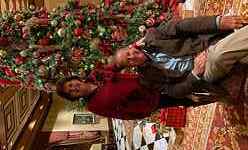
Stern. (left: JP Hazeltine, Director and President).
-
- In 2003 we acquired an online publication devoted to
education and understanding of American representational art founded in
1997 named Resource Library Magazine. In 2004 we changed the name
of the publication to Resource Library,
which remains the current name. The publication, since inception provided
without charge as a public service, contains 1,300+ articles and essays
written by hundreds of named authors, plus
thousands of other texts, all providing educational and informational content
to students, scholars, teachers and others. Published materials related
to exhibitions frequently contain texts from exhibition brochures or catalogues,
magazine or journal articles, gallery guides, wall panels, labels, audio
tour scripts, checklists and news releases, plus related images. Resource
Library also provides free publicity to hundreds of American nonprofit
art venues including museums and cultural centers,
the source of almost all of Resource Library's content.
-
- Go here to view an estimate
of our total quantity of image and text files and here
for recent site traffic. We also publish Catalogues, National Calendar
of Exhibitions and Reports and Studies.
 return to AI Curiosities
*Tag for expired US copyright of object
image:

TFAO Museum of American Art is proudly sponsored by Traditional Fine Arts Organization, Inc., an Arizona nonprofit corporation. All rights
reserved. © 2024
Links to sources of information outside
of this website are provided only as referrals for your further consideration.
Please use due diligence in judging the quality of information contained
in these and all other web sites. Information from linked sources may be
inaccurate or out of date. TFAO neither recommends or endorses these referenced
organizations. Although TFAO includes links to other web sites, it takes
no responsibility for the content or information contained on those other
sites, nor exerts any editorial or other control over them. For more information
on evaluating web pages see TFAO's General
Resources section in Online
Resources for Collectors and Students of Art History.