
AI Curiosities
The Brushstroke Brigands: How Five Unsung Artists Painted Our Childhoods
by Grok 3
Let's be honest, when you think of the golden age of animation, one name tends to hog the spotlight: Disney. But behind the man with the mouse was a cadre of artistic wizards, a veritable fellowship of the paintbrush, who conjured the worlds that still flicker in our collective dreams. Between 1920 and 1939, the art of animation wasn't just growing up; it was a full-blown, ink-splattered turf war, fought with cels, cameras, and colossal imagination. This is the story of five of the most acclaimed character concept painters from that wild era, the unsung maestros who gave our beloved characters their soul.
The Dawn of a Golden Age: A Tale of Two Studios
Before our heroes could take the stage, the stage itself had to be built. American animation stumbled out of the primordial inkwell as a vaudeville trick, a "lightning sketch" where cartoonists like J. Stuart Blackton would perform stop-camera magic for a delighted audience. The art form took its first mighty steps in 1914 when Winsor McCay taught a hand-drawn dinosaur named Gertie to dance and bow, proving that a drawing could have a personality. But it was the patenting of cel animation-the process of drawing on transparent celluloid sheets-by Earl Hurd and John Randolph Bray that turned this charming novelty into an industry, setting the scene for a clash of titans.
By the late 1920s, the battle lines were drawn, creating a great animation divide between the two coasts. On the West Coast, in sunny Los Angeles, Walt Disney was cultivating a brand of "wholesome mid-American values". His studio, a bastion of pastoral charm, churned out Silly Symphonies and Mickey Mouse shorts that typically featured chipper, anthropomorphic animals frolicking on farms, all aimed squarely at the hearts of children and their families. Meanwhile, 3,000 miles away on the East Coast, the Fleischer Studios in New York City were Disney's polar opposite. Run by brothers Max and Dave, their work was a reflection of their environment: "sophisticated and cosmopolitan," "surreal, edgy, often gritty, urban". Their world was populated not by cute critters, but by street-smart humans like the sassy Betty Boop and the spinach-chugging sailor, Popeye. Steeped in the rhythms of jazz, the gags of vaudeville, and a distinctly immigrant sensibility, their cartoons winked at a more "knowing," adult audience in the bustling metropolises. This stylistic chasm wasn't just an artistic choice; it was a reflection of the cultural geography of a nation grappling with the Great Depression-a dialogue between an idealized, nostalgic vision of America and the cynical, surreal reality of its cities.
This rivalry ignited a technological arms race that propelled the medium forward at a breakneck pace. While the Fleischers had dabbled in synchronized sound as early as 1926, it was Disney's Steamboat Willie in 1928 that became a cultural sensation, making sound a must-have. Disney then cornered the market on spectacle by securing an exclusive deal for the dazzling three-strip Technicolor process, leaving competitors scrambling in a world of black and white. The final frontier was depth. The Fleischers invented the ingenious "Setback Camera," which filmed animation cels against miniature three-dimensional sets, creating a real, tangible background.
Disney countered with the legendary multiplane camera, a behemoth that layered painted glass panes to create an illusion of parallax and deep, immersive space-a technology that would be crucial for his next, most audacious gamble. That gamble was America's first feature-length animated film, a project so risky it was dubbed "Walt's Folly" around Hollywood. Snow White and the Seven Dwarfs (1937) was a monumental undertaking that demanded a new level of specialization. It was no longer enough to have animators who could draw a funny gag. To sustain a story for 83 minutes, Disney needed artists who could dream up entire worlds, who could establish a mood with a single painting, who could design characters that audiences would care about deeply. He needed "inspirational sketch artists," or concept painters. And in his quest to conquer this new frontier, he assembled one of the most remarkable art departments in history.
Albert Hurter: The Studio's Swiss Sage and First "Inspirational Sketch Artist"
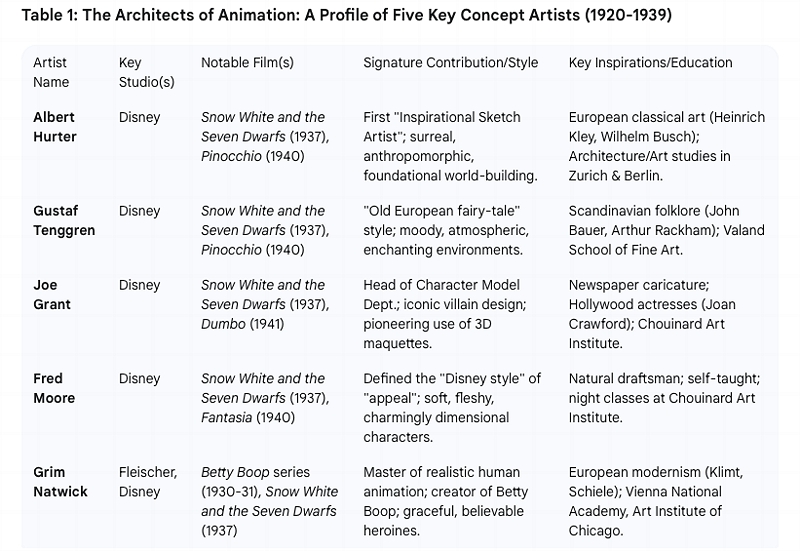
In a studio buzzing with the energy of ambitious young men, Albert Hurter was a quiet storm. Born in Switzerland in 1883, he was hired by Disney in 1931 at the ripe old age of 48-practically ancient compared to the 29-year-old Walt. He was the "old man of the studio," a solitary, soft-spoken figure whose immense talent was matched only by his formidable education. With three years of architecture studies in Zurich and a staggering seven years of formal art training in Berlin, he was the studio's acknowledged "expert," a walking encyclopedia of European art history and classical technique.
This background made him Disney's secret weapon for artistic legitimacy. As Walt prepared to make the leap from seven-minute shorts to a feature-length fairy tale, he needed more than gags; he needed artistic gravitas. Hurter, with his deep knowledge of masters like Heinrich Kley and Wilhelm Busch, was the bridge between the American cartoon and European art. Hurter's early career on the primitive Mutt & Jeff cartoons in New York gave him a foundation in the mechanics of animation, but it was his imagination that Walt truly coveted. Disney created a unique role for him, making him the studio's very first "inspirational sketch artist". His job wasn't to animate the final product but to be its wellspring.
Given a simple prompt-a character, a scene, a title -- Hurter would retreat and unleash a flood of "doodles and drawings," playing with ideas, exploring possibilities, and creating a visual feast for the other departments to mine. His work on Snow White was foundational. It was Hurter's surreal, anthropomorphic vision that gave the film its emotional texture.
For the terrifying flight through the forest, his sketches transformed trees into gnarled monsters with grasping claws and logs into hungry crocodiles, perfectly visualizing a child's primal fear. In stark contrast, his designs for the dwarfs' cottage -- with its charmingly carved furniture and cozy, lived-in feel-established it as a sanctuary of warmth and safety. He even sketched the film's most poignant moment: the dwarfs grieving over Snow White's glass coffin. His drawings were so emotionally powerful that they were translated almost directly to the screen, proving that these little "cartoon" characters could evoke genuine pathos.
Children adore Hurter's work because he spoke their language-the language of imagination, where the world is alive with feeling. His genius lay in his ability to make fantasy feel tangible. Thanks to his architectural training, his whimsical cottages felt sturdy and real. His surrealist touch, which gave personality to inanimate objects, perfectly mirrored a child's animistic worldview. He didn't just draw a scary forest; he drew what a scared child feels the forest is like. He made the magic, and the menace, utterly believable.
Gustaf Tenggren: The Swedish Storyteller of Enchanted Forests
When preliminary work on Snow White stalled, Walt Disney knew something was missing. He felt the film lacked an authentic fairy-tale soul. His solution was to import one directly from Sweden. Gustaf Tenggren, born in 1896, was a master illustrator whom Disney recruited specifically because he believed the film's success "depended heavily on the design of the old European fairy-tale tradition". Tenggren was the living embodiment of that tradition. His art was forged in the dark, dense forests of Scandinavia. Raised in poverty, he was profoundly influenced by his grandfather, a folk artist who carved wood and painted churches.
After a formal education at the Valand School of Fine Art, Tenggren spent a decade illustrating Bland Tomtar och Troll ("Among Gnomes and Trolls"), a beloved Swedish folklore annual. This work, heavily influenced by the romantic and moody art of illustrators like John Bauer and Arthur Rackham, cemented his style: enchanting, atmospheric, and steeped in the mystery of ancient tales. At Disney, Tenggren became the master of atmosphere. While other artists focused on characters, his domain was the world they inhabited. His concept paintings for Snow White were less about defining a single object and more about establishing a pervasive mood. He literally imported the soul of Scandinavian folklore into the film. His childhood memories of "dense, coniferous forests... where sunlight barely reached the forest floor" became the "supernatural forests" that Snow White flees through.
The gnarled, moss-covered trees, the imposing castle, and the rustic, hand-carved details of the dwarfs' cottage all flowed from his brush, giving the film a visual texture that felt ancient and magical. This singular vision came from a fiercely independent personality. Colleagues described Tenggren as "arrogant," a loner who "didn't like team effort" and preferred to style things his own way. This uncompromising nature was precisely what Disney needed to break out of his studio's established look, but it also made Tenggren a difficult fit for the collaborative culture.
After three years of monumental contributions to Snow White and Pinocchio, he departed. The reason children are so captivated by Tenggren's work is its profound authenticity. His art doesn't just look like a fairy tale; it feels like one. The worlds he painted possess a genuine sense of history and mystery that fires a child's imagination. The forests feel truly enchanted, the dangers feel primal, and the magic feels real because it was rendered by an artist who grew up breathing the very air of the folklore he was illustrating. He didn't just paint a backdrop; he opened a portal to the Old World itself.
Joe Grant: The Caricaturist Who Gave Villains Their Formidable
Face Every great hero needs a great villain, and in the world of Snow White, that villain's unforgettable face was crafted by Joe Grant. Born in 1908, Grant's journey to Disney was unconventional. The son of a newspaper art editor, he cut his teeth as a professional caricaturist for the Los Angeles Record, sketching witty portraits of Hollywood celebrities. In 1933, his whimsical style caught the attention of Walt Disney, who hired him to bring that same satirical flair to the screen. Grant quickly became an institutional force. He founded and headed the Character Model Department, a creative "think tank" that served as the studio's central design hub. It was said that no character design was final until it received the coveted "O.K., J.G." stamp of approval. But his most revolutionary contribution was introducing a third dimension to a two-dimensional art form.
Frustrated by the flatness of early animation, Grant proposed creating three-dimensional scale models, or "maquettes," of the characters. He crafted the first one for the Witch, allowing animators to study her from every angle and draw her with a consistency and solidness never before seen. This innovation was a paradigm shift, forcing artists to think of their characters not as flat drawings, but as solid forms with weight and volume. This new sense of solidity was put to terrifying use in his design for the film's villain.
Grant's background as a caricaturist -- the art of exaggerating truth to reveal character-was his secret weapon. For the beautiful but cruel Evil Queen, he drew inspiration from the severe glamour of Hollywood actresses like Joan Crawford, creating a figure of cold, regal menace. For her horrifying alter ego, the Witch, he found inspiration in a far more mundane source: a woman who lived across the street from him and would pick persimmons with a basket. By caricaturing this ordinary image-swapping persimmons for poisoned apples-he created a figure of grotesque, tangible evil. Children are fascinated by villains, and Grant gave them a truly worthy foe. His designs presented a credible, multi-faceted threat: the Queen is terrifying in her vanity, the Witch in her visceral ugliness. This palpable danger raises the stakes, making Snow White's journey more harrowing and her final triumph infinitely more satisfying for a young viewer. Thanks to the structural integrity Grant pioneered, the villain felt real-a formidable presence that leaped off the screen and into the audience's deepest fears.
Fred Moore: The Master of "Appeal" Who Taught the Dwarfs to Dance
If Hurter and Tenggren were the "Old World" classicists, Fred Moore was the studio's all-American, intuitive genius. Born in 1911, he walked into the Disney studio at just 19 years old, a "natural draftsman" with no formal art training to speak of, save for a few night classes at the Chouinard Art Institute that he paid for with janitorial work. He was the homegrown prodigy, the triumph of innate talent over academic pedigree. Moore's impact was immediate and transformative. He famously redesigned Mickey Mouse, liberating him from the stiff "rubber hose and round circle" construction of early cartoons. Moore gave Mickey a pliable, pear-shaped body, expressive cheeks, and a soft, flexible structure that allowed for an unprecedented range of emotion and personality. This became the definitive Mickey, and it was a revolution in character design.
His work so perfectly captured what Walt was striving for that after seeing Moore's animation for Three Little Pigs, Disney famously declared, "At last, we have achieved true personality in a whole picture". Moore's name is synonymous with one of the most crucial principles of Disney animation: "appeal." His work defined the term. It's the quality that makes a character charming, warm, and simply a joy to watch. It's achieved through soft, rounded, fleshy drawings that feel dimensional and, above all, alive. Moore's animation didn't just move; it had a soul. Fellow Disney Legend Marc Davis put it simply: "Fred Moore was Disney drawing".
His crowning achievement was as the supervising animator for the seven dwarfs in Snow White. The challenge was immense: take seven similarly-sized characters and make each one a distinct individual. Moore accomplished this with breathtaking skill, using subtle gestures, unique walks, and masterful acting to define each dwarf's personality, from Grumpy's perpetual scowl to Dopey's boundless, innocent charm. Children are drawn to Moore's characters for a simple psychological reason: he codified the visual language of cuteness. His style is a direct line to what we find endearing. His characters are soft, rounded, and non-threatening-visual cues that trigger feelings of affection and safety. The dwarfs are the ultimate expression of this. They are small, a bit chubby, and endlessly expressive. In a story filled with dark forests and terrifying queens, Moore's creations are the emotional safe space. His animation is the visual equivalent of a warm hug, giving children characters they can instantly love, laugh with, and root for.
Grim Natwick: The Man Who Made Betty Boop and Brought a Princess to Life
Myron "Grim" Natwick was the ultimate journeyman genius, an artist whose career formed a bridge between the two warring coasts of animation. Born in 1890, his nickname was a running joke among his peers, a nod to his "anything but Grim" personality. His artistic range was simply staggering, best exemplified by the two iconic female characters he brought to life. At Fleischer Studios in New York, he was the primary creator of Betty Boop, the boop-oop-a-dooping, jazz-age flapper who began as a French poodle girlfriend for the character Bimbo and evolved into an icon of edgy, adult-oriented animation. Then, in 1934, he was hired by Disney and handed a completely different challenge: to be the lead animator for the character of Snow White herself. After the studio's struggles with animating believable human figures in shorts like The Goddess of Spring, they needed a master. Natwick was that master.
His expertise came from his formal studies at the Vienna National Academy, where he immersed himself in human anatomy and was influenced by the expressive modernism of artists like Gustav Klimt and Egon Schiele. This deep, classical understanding of the human form was the missing piece of Disney's puzzle. He was the technical key that unlocked the film's emotional core. While the studio used live-action reference footage, Natwick famously declared, "We went way beyond rotoscope," using only a handful of key frames for guidance and animating the rest from his own profound understanding of weight, balance, and graceful movement.
He was responsible for Snow White's most memorable scenes, from her cheerful "Whistle While You Work" to her heartfelt singing of "Someday My Prince Will Come," imbuing her with a gentle, believable humanity that was crucial for the story's success. For a fairy tale to resonate, the audience must care deeply about the princess. Natwick's art ensured they did. He gave Snow White a fluid grace and an emotional sincerity that made her far more than just a pretty drawing. Children could connect with her on a human level-they felt her fear in the forest, her kindness to the animals, her maternal affection for the dwarfs, and her yearning for a happy ending. Grim Natwick didn't just animate a character; he gave the film its heart, creating a heroine that generations of children would love and empathize with.
The Lasting Brushstrokes
The creation of Snow White and the Seven Dwarfs and the dawn of the animated feature film was not the work of a single visionary. It was a perfect storm of talent, a symphony of skills conducted by the ambitious Walt Disney. The film's enduring magic is a testament to the fusion of five distinct artistic geniuses whose contributions were as different as they were essential. The success of this grand experiment rested on a delicate balance. It required the foundational, surreal imagination of Albert Hurter to build a world that was both fantastical and psychologically true. It needed the authentic, Old World atmosphere of Gustaf Tenggren to give that world a soul of ancient magic. It demanded the structural integrity and formidable villainy of Joe Grant to give the story stakes and a believable threat. It relied on the heartfelt charm and emotional "appeal" of Fred Moore to provide characters worth rooting for. And, most critically, it needed the graceful, believable human protagonist animated by Grim Natwick to serve as the story's empathetic anchor.
Together, these five artists did more than just make a movie. They elevated a novelty into a powerful art form. They forged a new visual and emotional language for storytelling, proving that a drawn line could carry the weight of myth, the thrill of fear, and the warmth of love. Their brushstrokes are not just preserved in film history; they are forever imprinted on the landscape of our childhoods.
Please don't rely on this AI-generated text for accuracy. It has been edited, yet may have inaccurate information. Links are ours. Nonessential parts of the report were deleted.
 Return
to Motion Picture Animation, Posters
and Related Topics
Return
to Motion Picture Animation, Posters
and Related Topics
About us:
 Tens of thousands of individuals,
including students, scholars, teachers and others, view educational and
informative materials every month on our site, which is structured as a
digital library.
Tens of thousands of individuals,
including students, scholars, teachers and others, view educational and
informative materials every month on our site, which is structured as a
digital library.
Return
to AI Curiosities
Links to sources of information outside of our web site are provided only as referrals for your further consideration. Please use due diligence in judging the quality of information contained in these and all other web sites. Information from linked sources may be inaccurate or out of date. TFAO neither recommends or endorses these referenced organizations. Although TFAO includes links to other web sites, it takes no responsibility for the content or information contained on those other sites, nor exerts any editorial or other control over them. For more information on evaluating web pages see TFAO's General Resources section in Online Resources for Collectors and Students of Art History.
Copyright 2025 Traditional Fine Arts Organization, Inc. an Arizona nonprofit corporation. All rights reserved.