
AI Curiosities
Gatekeepers and Gardeners: A Comparative Analysis of Pre-Publication Peer Review and TFAO's Long-Term Content Vetting
By Gemini 2.5 Pro - August
2025
Introduction
In the vast and complex ecosystem of knowledge dissemination, the mechanisms that ensure the quality, accuracy, and integrity of information are of paramount importance. These systems of validation, however, are not monolithic; they are diverse philosophies of quality assurance, each shaped by the specific goals, risks, and epistemological assumptions of the domain they serve. This report undertakes a comprehensive comparative analysis of two profoundly different paradigms of content vetting. The first is the traditional academic peer review process, a system of proactive gatekeeping that has served as the bedrock of scholarly communication for centuries. Its primary function is to rigorously filter, scrutinize, and validate new knowledge claims before they are published, thereby constructing a canon of trusted research.
The second paradigm is the unique content quality challenge process employed by Traditional Fine Arts Organization (TFAO) for its digital publication, Resource Library. In stark contrast to the pre-publication model, TFAO employs a system of reactive, perpetual gardening. This model is designed not to filter new claims, but to maintain the archival integrity of an existing repository of scholarly and museum-sourced texts after publication. It operates over a multi-decade lifespan, leveraging a time-enhanced, worldwide user review process that prioritizes preservation of the original record while allowing for public, attributed challenges to its factual accuracy.
By dissecting the foundational principles, operational mechanics, and systemic implications of these two models, this report will illuminate the fundamental tension between pre-publication validation and post-publication annotation. It will demonstrate that these are not merely different methodologies but are expressions of divergent goals: the journal as a crucible for forging new knowledge versus the archive as a repository of historical record. Through this analysis, a nuanced understanding emerges of how "authority" and "truth" are constructed, maintained, and contested in different intellectual and institutional contexts, offering critical perspectives on the past, present, and future of information validation.
Section 1: The Academic Peer Review Paradigm: A System of Pre-Publication Validation
The academic peer review process stands as the central pillar of modern scholarly communication. It is the principal mechanism through which research is evaluated, refined, and ultimately legitimized for entry into the collective body of scientific and humanistic knowledge. Its structure and philosophy are designed to function as a rigorous, expert-driven filter, ensuring that published work meets the accepted standards of a discipline before it reaches its intended audience.
1.1 The Philosophy of Scrutiny: Establishing a Foundation of Trust and Quality Control
At its core, academic peer review is defined as the independent assessment of scholarly work by experts in the same field. Its purpose is twofold: to evaluate a paper's quality and suitability for publication, and to provide constructive feedback to the author. This process serves as a critical form of quality control for academic journals, functioning to encourage authors to meet the high standards of their discipline and to prevent the dissemination of unwarranted claims, unacceptable interpretations, or unsubstantiated personal views. The system is so foundational that a scientific hypothesis is generally not accepted by the academic community unless it has been published in a peer-reviewed journal, making it the "bedrock of academic publishing" and the primary method by which research quality is judged.
The peer review process aims to achieve two primary goals. First, it acts as a filter to determine the validity, significance, and originality of a study, preventing low-quality manuscripts from reaching the scientific community. This function is particularly important because scientific knowledge is cumulative and builds upon itself; therefore, the trust established through peer review is essential for the advancement of science. Second, the process is intended to improve the quality of manuscripts that are deemed suitable for publication. Reviewer feedback can alert authors to errors in their work, gaps in the literature they may have overlooked, or issues with writing style and clarity. At its best, this creates a collaborative dialogue between authors and their peers, a process that researchers consistently report makes their final published article better than the version they initially submitted.
1.2 The Mechanics of the Gate: A Forensic Examination of the Peer Review Workflow
The idealized philosophy of peer review is operationalized through a highly structured, multi-stage workflow designed to move a manuscript from submission to a final editorial decision. While minor variations exist between journals, the core process is remarkably consistent across disciplines.
Submission and Initial Screening: The process begins when an author submits a manuscript to a journal, typically through a dedicated online portal. The submission first undergoes a preliminary check, often called a "desk review". This initial phase consists of two main parts. First, the journal's editorial office performs a technical pre-check to ensure the manuscript adheres to formatting guidelines, such as word count, referencing style, and inclusion of all necessary components. Second, an academic editor -- usually the Editor-in-Chief (EIC) or a section editor -- conducts an editorial pre-check. At this stage, the editor assesses the manuscript's suitability for the journal, considering its scope, originality, and overall scientific merit. A substantial number of submissions are rejected at this early stage without being sent for external review, as they may not fall within the journal's specialization or meet its standards for novelty.
Reviewer Selection and Invitation: If the manuscript passes the initial screening, the handling editor's next critical task is to select and invite peer reviewers. Reviewers are chosen based on their subject-matter expertise, which should closely match the manuscript's topic. Editors typically aim to secure two or three independent reviewers for each paper. This stage can be a significant bottleneck in the publishing process, as finding qualified experts who are available and willing to review is a persistent challenge for journals. Potential reviewers assess the invitation based on their expertise, availability, and any potential conflicts of interest before accepting or declining.
The Review and Recommendation: Once reviewers accept the invitation, they conduct a thorough evaluation of the manuscript. This involves a critical reading to assess the validity of the science, the quality of the experimental design, the appropriateness of the methodology, and the originality of the research. Reviewers are expected to provide a detailed, point-by-point report that offers constructive criticism to the authors. Based on their assessment, they provide a recommendation to the editor, which typically falls into one of several categories: "accept," "accept pending minor revisions," "reconsider after major revisions," or "reject".
Editorial Decision and Author Revision: The handling editor considers all the returned reviews before making a final decision. The editor's role is to synthesize the, at times, conflicting advice from the reviewers and exercise their own judgment. The final decision rests with the editor, not the reviewers. This decision, along with the anonymized reviewer comments, is communicated to the author. If revisions are requested, the author must address the reviewers' and editor's concerns, modify the manuscript, and resubmit it. This revision process may involve multiple rounds of review before a final decision is reached.
Anonymity Models: To facilitate candid and objective feedback, the process traditionally employs anonymity. In a "single-blind" review, the reviewers know the author's identity, but the author does not know the reviewers' identities. In a "double-blind" review, both the author and reviewers are anonymous to each other. This model, common in the humanities and social sciences, is intended to ensure that papers are evaluated solely on their academic merit, free from biases related to the author's reputation, institution, or background. However, in response to criticisms about transparency, some journals are experimenting with "open review" models where identities are known.
1.3 The Expert Adjudicator: The Role, Responsibilities, and Influence of the Peer Reviewer
The entire peer review system hinges on the voluntary contributions of subject-matter experts who act as reviewers. These individuals are the indispensable agents of quality control, serving a dual function: they advise editors on a manuscript's suitability for publication, and they provide authors with guidance on how to improve their work. Scholarly publishing depends on their careful evaluation, as editors cannot possess the specialized expertise to assess every manuscript that crosses their desks.
The responsibilities of a reviewer are significant and multifaceted. They are expected to provide written, unbiased, and constructive feedback in a timely manner. This feedback should focus on the scholarly merits and scientific value of the work, indicating whether the writing is clear, concise, and relevant, and rating the work's composition, scientific accuracy, and originality. Personal comments or criticism are to be avoided. A core ethical obligation is to maintain the confidentiality of the review process, not disclosing information from the manuscript to third parties. Furthermore, reviewers must alert the editor to any potential conflicts of interest -- be they personal, financial, or professional -- and decline to review when such a conflict exists.
The peer review system operates on a principle of professional reciprocity and community service. The prevailing ethos is that those who submit their own work for publication have a responsibility to contribute to the system by reviewing the work of others. As one source puts it, "if you write papers, you should review papers". This service is typically performed without financial compensation, motivated by a sense of obligation to the scientific community, a desire to stay current with the latest research, and the opportunity to improve one's own critical and writing skills.
1.4 Strengths and Stresses of the Model: Efficacy, Criticisms, and the Challenge of Bias
Despite its central role in scholarly communication, the academic peer review system is not without significant flaws and is the subject of ongoing debate and criticism. Its function as a pre-publication filter, while essential for quality control, introduces a host of challenges related to subjectivity, efficiency, and bias.
The system is explicitly designed to be a "gatekeeper in the scientific process," determining which papers are deemed "good enough" to be published in academic journals. This gatekeeping role, however, is inherently subjective. The decision of whether a paper is sufficiently novel, significant, or interesting rests on the judgment of a small number of human reviewers and an editor. This introduces a fundamental paradox at the heart of the system: it strives to achieve an "objective degree of fairness" by relying on the subjective evaluations of a few individuals. The very expertise that makes reviewers qualified to judge a paper is also the source of potential bias, as they may be resistant to innovative or dogma-shattering work, favor established theories, or hold personal biases against competing research. Even a single negative opinion, however subjective, can be enough to "destroy a very good paper" in a highly competitive journal.
Beyond subjectivity, the peer review process is frequently criticized for its inefficiency. The timeline from submission to publication can be exceedingly long, often taking many months and sometimes more than a year. These delays are caused by the difficulty in finding willing reviewers, the time it takes for them to complete their evaluations, and the potential for multiple rounds of revision. For the reviewers themselves, the work is often described as a "thankless job". It is typically anonymous, unpaid, and provides little direct reward for career advancement, siphoning valuable time away from their own research.
These systemic stresses have prompted the exploration of alternative and complementary models of scholarly vetting. The rise of preprint servers allows researchers to disseminate their work immediately, without waiting for the lengthy peer review process to conclude. This model often incorporates forms of post-publication peer review, where comments and critiques are posted publicly on forums like PubPeer https://pubpeer.com. These emerging systems aim to accelerate the pace of science, increase transparency, and shift the locus of evaluation from a closed, pre-publication process to an open, ongoing post-publication dialogue.
Section 2: The TFAO Model: Archival Integrity and Perpetual Post-Publication Review
In a striking departure from the pre-publication, revision-focused paradigm of academic peer review, the Traditional Fine Arts Organization (TFAO) https://tfaoi.org/index.htm has implemented a distinct model for its publication, Resource Library https://tfaoi.org/resourc.htm . This system is fundamentally archival in its philosophy, prioritizing the preservation of original source material and employing a long-term, public-facing mechanism for correcting factual errors. It is a model built on initial trust in authoritative sources, followed by a perpetual opportunity for community-driven annotation.
2.1 Foundational Principles: Preservation, Fidelity to the Source, and Public Access
The core philosophy governing the TFAO's Resource Library is one of archival fidelity. The central tenet, as stated in its guidelines, is that "written facts and accompanying images provided by sources are not materially altered by Resource Library at the time of publication". This principle establishes a clear divergence from the academic model, where the express purpose of review is to prompt revision and transformation of the submitted text. TFAO's objective is not to edit or improve upon the source material, but to preserve and present it as accurately as possible.
This commitment to preservation is further demonstrated by the organization's stated concern for protecting the "integrity of the author's content". When a potential error in a named author's work is flagged by a third party, TFAO exercises "extensive caution" to respect the original text. The organization's technical standards also reflect this dedication to fidelity. TFAO strives to maintain a 99.995% individual character accuracy rate in its online publishing of scholarly texts, a high standard achieved through a combination of software and human proofreading. This focus on near-perfect transcription underscores that the primary goal is to create a reliable digital surrogate of the original document.
The authority of the content is established at the point of acquisition, not through a subsequent review process. TFAO's materials are provided "almost exclusively by nonprofit art museum, gallery, and art center sources". The published content includes a wide range of institutional documents, such as whole exhibition catalogues, gallery guides, scholarly articles, wall panels, and audio tour scripts. By relying on these established cultural and scholarly institutions as its primary sources, the TFAO model operates on a principle of high initial trust. The vetting is implicit in the reputation and scholarly standing of the source institution itself.
2.2 The Content Quality Challenge Process: A Mechanism for Long-Term, Public Correction
While TFAO's model begins with trust in its sources, it acknowledges that factual errors may exist in the original publications. To address this, it has developed a highly structured and transparent "Content Quality Challenge Process" https://tfaoi.org/aa/4aa/4aa338g.htm that allows any third party to flag potential inaccuracies. This process, however, is not a form of peer review; it is a formal, public, and legally conscious mechanism for appending the archival record.
The mechanics of the challenge are precise and demanding:
· Initiation: Any third party who believes they have identified a factual error in a Resource Library article can initiate a challenge. The challenge must pertain to the "accurateness of content at the time of original publication".
· Submission Requirements: The challenger must send an email to Resource Library that specifies the exact URL of the article containing the disputed fact. The email must also include "express permission" for Resource Library to publish the challenge letter publicly.
· Publication of Challenge: TFAO retains "sole discretion" over whether to publish the challenge. If it elects to do so, the challenge is posted as an "editor's note" directly below the text of the original article. Crucially, the original text remains unaltered. This act is one of annotation, not revision.
· Challenger Accountability: In a radical departure from the anonymity of academic review, any challenger whose letter is posted MUST have their full contact information published alongside it. This information is stipulated to be "no less than the contact information posted for the original source" and may include the challenger's name, street address, postal box address, email, website, and phone number.
· Assumption of Risk: The system is designed to place the full burden of liability on the challenger. TFAO explicitly warns potential challengers to "carefully consider legal risks, including actions by third parties against them as a result of the publication of a challenge letter." The organization states unequivocally that "TFAO and Resource Library assume no responsibility for the content of challenge letters".
· Permanence: Once a challenge letter is published, it "may be permanently retained on its site" at TFAO's discretion. This creates a lasting, public record of the scholarly dispute, accessible to all future readers of the original article.
The structure of this process reveals a system that is not primarily designed as a collaborative scholarly dialogue, but rather as a carefully constructed legal framework. The use of legalistic language ("sole discretion," "express permission," "no responsibility," "legal risks") and the stringent requirements for public identification and assumption of liability serve to insulate TFAO from legal and scholarly disputes. By refusing to alter the original text and instead appending a publicly attributed challenge, TFAO avoids the role of arbiter. It does not rule on the "truth" of the matter, which would expose it to conflicts with its source institutions. Instead, it acts as a neutral platform that documents a disagreement, effectively outsourcing the labor of error correction to its user base while simultaneously shifting the associated risks onto the individual challenger. It is a highly effective model for risk mitigation in the context of maintaining a large, free, public archive.
2.3 A Unique Vetting Philosophy: Trust in the Source and the Wisdom of the Engaged Community
Synthesizing its principles and mechanics, the TFAO vetting philosophy can be described as a system of "time enhanced, worldwide user review" (User Query). It is a post-publication model that operates on a foundation of initial trust in established scholarly and museum sources, followed by a perpetual, open-ended opportunity for public correction that can span the entire lifespan of the content, which may be up to 25 years or more.
This approach represents a fundamentally different understanding of a published text compared to the academic model. In academic publishing, the peer review process aims to produce a single, definitive, validated version of an article at a discrete point in time. The TFAO model, by contrast, treats the text as a historical artifact that can be annotated over time. It allows for multiple viewpoints to coexist publicly: the original text from the source institution and the countervailing claim from a named challenger. The system does not seek to resolve the dispute or produce a revised "correct" version. Instead, its function is to document the discourse surrounding a potential error, presenting both the original claim and the challenge to future readers, who are then empowered to evaluate the evidence for themselves. It is a system that values transparency and public accountability over the creation of a single, authoritative narrative.
Section 3: A Comparative Framework: Contrasting Two Models of Quality Assurance
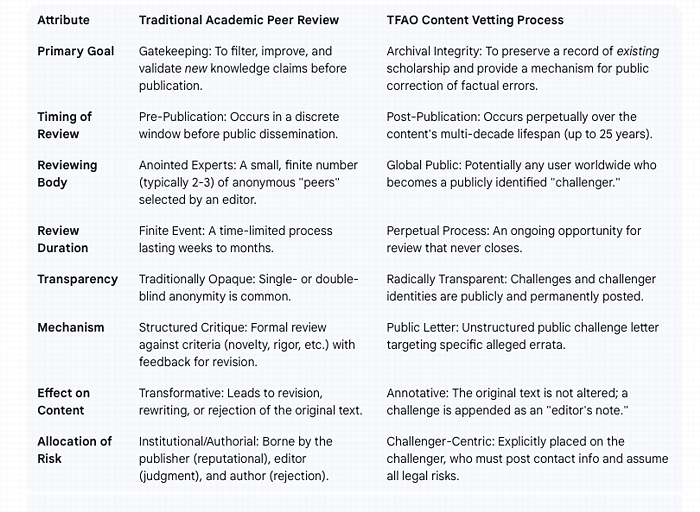
The profound differences between the traditional academic peer review process and the TFAO content vetting model become most apparent when they are subjected to a direct, point-by-point comparison. These systems are not merely variations on a theme; they are fundamentally distinct paradigms of quality assurance, each with its own goals, actors, timelines, and outcomes. The following table provides a concise summary of their core attributes, setting the stage for a more detailed analysis of their contrasting features.
3.1 Locus of Control: Pre-Publication Filtering vs. Post-Publication Correction
The most fundamental distinction lies in the locus of control over content quality. Academic peer review is a system of pre-publication filtering. It functions as a "gatekeeper", exercising control over what enters the public scholarly record. An editor and a small group of reviewers hold the power to accept, reject, or mandate changes to a manuscript before it is ever seen by a wider audience. The control is proactive and centralized.
In contrast, the TFAO model employs post-publication correction. It grants initial access to its platform based on the reputation of the source institution, effectively delegating the primary quality check to established museums and galleries.The control it exerts is reactive and decentralized. Quality is not enforced at a single gateway but is maintained over time through a public mechanism that allows any user to flag a potential error. The control is not over initial publication, but over the long-term integrity of the published record through annotation.
3.2 The Reviewing Body: The Anointed Few vs. The Global Many
The nature of the reviewing body in each system is starkly different. Academic peer review relies on a small, select group of "anointed" experts -- typically two or three individuals per manuscript -- who are chosen by an editor for their specific subject-matter knowledge. This body is finite, exclusive, and its authority is derived from credentials and expertise. The judgment of this small cohort determines the fate of the manuscript.
The TFAO model opens the review function to a potentially limitless body: the "global many." Any user, anywhere in the world, can become a "challenger". This approach resembles a form of crowdsourcing, where the collective vigilance of a worldwide audience is harnessed to identify errors over a long period. Authority in this system is not pre-determined by credentials but is established by the act of making a public, attributed claim and backing it with evidence. The power to review is democratized.
3.3 Temporality and Finality: The Discrete Judgment vs. The Living Document
The two systems operate on entirely different timescales. Academic peer review is a discrete, time-bound event. It occurs within a finite window of weeks or months leading up to a publication decision. Once a paper is published, the formal review process is concluded, and the text is considered a "final" version, a fixed artifact in the scholarly record. While post-publication corrections or retractions can occur, they are exceptional events.
The TFAO process is defined by its perpetuity. A document in its Resource Library is never truly "final." It is a living document, subject to review and annotation for its entire, multi-decade lifespan on the site. The opportunity for a quality challenge never closes. This temporal structure reflects its archival purpose: to maintain an accurate record over the long term, allowing new information and corrections to be appended as they emerge.
3.4 Transparency and Accountability: Anonymity vs. Public Identity
The approaches to transparency and accountability are diametrically opposed. The tradition in academic peer review is one of opacity, with single-blind or double-blind models designed to protect reviewer anonymity. This anonymity is intended to foster candid, unvarnished criticism by shielding reviewers from potential retribution from authors. Accountability is indirect, enforced by the editor who selected the reviewers and who is ultimately responsible for the decision.
The TFAO model embraces radical transparency and direct accountability. There is no anonymity; a challenger must agree to have their full name and contact information published permanently alongside their claim. This requirement serves as a powerful mechanism for accountability, deterring frivolous or malicious challenges and forcing the challenger to stand publicly behind their critique. Accountability is not mediated by an editor but is borne directly by the individual making the challenge in the court of public and scholarly opinion.
3.5 The Nature of the "Correction": Improving a Manuscript vs. Appending the Record
The ultimate effect on the content itself reveals a core philosophical divide. The goal of academic peer review is transformative; it is intended to improve the manuscript. Reviewer feedback is provided so that the author can revise, clarify, and strengthen their work. The process directly alters the text that will be published. The final product is a synthesis of the author's original work and the intellectual input of the reviewers and editor.
The TFAO process is strictly annotative. It does not change the original text in any way. The principle of not materially altering the source material is paramount. A successful challenge results in an "editor's note" being appended to the document, creating a new layer of information. The system does not produce a "corrected" version; it produces a version with a documented dispute. Its purpose is to preserve the historical record of the original publication while simultaneously providing readers with information about its potential inaccuracies.
3.6 Allocation of Risk: Institutional Burden vs. Challenger Liability
Finally, the two systems allocate risk in fundamentally different ways. In academic publishing, the risk is borne primarily by the institution (the journal or publisher) and the author. A journal that publishes flawed research suffers reputational damage, which can affect its standing and impact factor. The editor bears the risk of making a poor judgment call. The author bears the risk of rejection or having their work publicly retracted.
The TFAO model, as identified previously, is structured to transfer nearly all risk to the challenger. By requiring public identification and an explicit warning about legal action, TFAO places the full burden of liability -- both legal and reputational -- on the individual making the claim. The organization itself remains a neutral conduit, assuming "no responsibility for the content of challenge letters". This challenger-centric risk model is a pragmatic solution for a non-profit archive seeking to maintain a vast public resource with minimal exposure to litigation and scholarly controversy.
Section 4: Deeper Insights and Systemic Implications
The comparison of academic peer review and the TFAO content vetting process reveals more than just a difference in methodology. It exposes two distinct epistemologies -- theories of how knowledge is created, validated, and preserved. These systems are not arbitrary constructs; they are highly specialized tools, each shaped by the economic, legal, and intellectual realities of its domain. Understanding their deeper, systemic implications provides a more nuanced perspective on the diverse ways in which we establish and maintain intellectual authority.
4.1 Divergent Epistemologies: How "Authority" and "Truth" Are Constructed in Each System
The two models represent fundamentally different approaches to constructing "authority" and representing "truth." Academic peer review operates on a model of validated truth. In this system, authority is constructed prior to publication through a rigorous, consensus-building process among credentialed experts. A manuscript is submitted as a claim, and through the crucible of peer review, it is tested, refined, and ultimately certified by the scholarly community's designated representatives. The "truth" of the matter, or at least the version deemed most credible at the time, is embodied in the final, peer-reviewed article that has successfully passed through the gates. This published article becomes an authoritative statement, a building block upon which future research can be based.
The TFAO model, in contrast, constructs authority and truth through a process of documented discourse. Authority is not conferred through a pre-publication review but is derived from the reputation of the original source institution -- a museum, a university gallery, or a scholarly press. The text is presented as a historical artifact, presumed to be accurate based on its provenance. The system's representation of "truth" is not a single, validated statement but a layered record. It presents the original claim from the authoritative source and, if a challenge is made, appends the public, attributed counter-claim. The TFAO system does not arbitrate the dispute to produce a final, singular truth. Instead, it preserves the discourse itself, making the disagreement transparent and permanent. It trusts the end-user -- the student, the scholar, the reader -- to weigh the evidence presented by both the original source and the challenger.
4.2 Fitness for Purpose: The Journal as a Crucible for New Knowledge vs. The Archive as a Repository of Record
A critical conclusion from this analysis is that these systems are not direct competitors but are highly specialized tools designed for different purposes and information environments. Their structures are a direct reflection of their function.
Academic peer review is designed for the high-stakes, high-risk environment of new knowledge creation. Its purpose is to vet novel claims, untested hypotheses, and original research before they are accepted into the scientific and scholarly canon. The potential for error or misconduct to lead an entire field astray necessitates a robust, albeit imperfect, filtering mechanism. The journal, therefore, acts as a crucible, a place where new ideas are subjected to intense heat and pressure to see if they are sound. The system's slowness, rigor, and gatekeeping function are features, not bugs, in a context where the cost of error is high.
The TFAO system is optimized for a different purpose: the preservation and long-term stewardship of existing cultural and historical records. Its primary goal is not to vet new discoveries but to ensure the enduring accuracy and utility of its digital archive. For a repository containing thousands of texts spanning decades, a pre-publication review model would be logistically impossible and philosophically inappropriate. The TFAO model is, therefore, perfectly adapted to its role as a library with a dynamic, public card catalog of errata. It ensures the stability of the original record while providing a perpetual mechanism for annotation and correction, fulfilling its archival mission.
This fitness for purpose is also a direct reflection of the underlying economic and risk models of each domain. Academic journals, whether commercial or society-run, treat their reputation as a primary asset, often measured by metrics like the Journal Impact Factor https://en.wikipedia.org/wiki/Impact_factor . Publishing flawed or fraudulent research poses a significant reputational and financial risk. Consequently, they invest heavily in the costly, labor-intensive, pre-publication system of peer review as a form of risk mitigation. TFAO, as a non-profit digital archive, faces a different set of risks, primarily related to copyright infringement and liability for factual inaccuracies within its vast collection. Its vetting model is therefore economically efficient: it outsources the labor of error-checking to its global user base and mitigates its legal risk by shifting liability directly onto the challengers. Each system is a rational adaptation to the economic and legal realities of its specific operational context.
4.3 Locating TFAO in the Modern Landscape: Parallels with Preprints, Open Review, and the Future of Scholarly Vetting
While the TFAO model is unique, it resonates with several emerging trends in modern scholarly communication that seek to address the limitations of traditional peer review. There are clear parallels between TFAO's post-publication review and the burgeoning ecosystem of preprint servers combined with public commenting platforms (like PubPeer). Both models shift the locus of review from a closed, pre-publication stage to an open, post-dissemination dialogue. They both leverage a wider community of experts and interested readers to evaluate and improve scholarly work, accelerating the pace of scientific communication.
However, there are also crucial differences that highlight the distinctiveness of the TFAO approach. The review that occurs on preprint servers is often informal, pseudonymous, and ephemeral. The TFAO process, by contrast, is highly formalized, structured, and permanent. Its requirement for full, public identification and its explicit legal framework create a much higher bar for participation and a more durable record of the resulting discourse. In this sense, the TFAO model can be viewed as a highly structured, institution-centric precursor to the more decentralized and informal models of post-publication review that are gaining traction today. It offers a potential blueprint for how to balance the benefits of open, public review with the need for accountability and risk management, a challenge with which the broader scholarly community continues to grapple.
Conclusion: Synthesizing Two Worlds of Vetting
The comparative analysis of the traditional academic peer review system and the Traditional Fine Arts Organization's content challenge process reveals two sophisticated, highly evolved systems of quality assurance. They are not simply different methods but are expressions of fundamentally different goals, epistemologies, and risk-management strategies, each precisely tailored to its specific information environment.
Academic peer review is a system of proactive gatekeeping, a crucible designed for the high-stakes world of new knowledge creation. It functions to filter, refine, and validate novel claims through the subjective but expert judgment of a select few, thereby constructing an authoritative record of validated truth before public dissemination. Its strengths lie in its rigor and its role in building a trusted foundation for cumulative knowledge, while its weaknesses are rooted in its inefficiency, opacity, and inherent susceptibility to bias.
The TFAO model is a system of reactive, perpetual gardening, a framework designed for the long-term stewardship of cultural heritage in a digital archive. It prioritizes archival fidelity, preserving the original record while enabling a transparent, permanent, and public process of annotation and correction. It constructs authority through institutional provenance and represents truth as a documented discourse, empowering users to evaluate claims and counter-claims. Its innovative structure effectively outsources the labor of error detection while mitigating institutional risk, offering a robust model for public accountability.
Ultimately, this investigation demonstrates that there
is no single, universally superior model for vetting information. The journal
as a crucible and the archive as a library with a living catalog of errata
are both valid and necessary functions within the broader knowledge ecosystem.
The future of information validation lies not in a monolithic system, but
in a diverse and adaptable ecology of specialized models. The enduring principles
of traditional peer review and the innovative, transparent framework of
the TFAO model both offer invaluable lessons as we continue to navigate
the challenges of ensuring quality and integrity in an increasingly complex
information age.
Please don't rely on this AI-generated text for accuracy. It has been edited, yet may have inaccurate information. A table is deleted becuase of formatting incompatibility. Consider it a base for further inquiry. Links are ours. Nonessential parts of the report were deleted.
About us:
 Tens of thousands of individuals,
including students, scholars, teachers and others, view educational and
informative materials every month on our site, which is structured as a
digital library.
Tens of thousands of individuals,
including students, scholars, teachers and others, view educational and
informative materials every month on our site, which is structured as a
digital library.
 return to AI Curiosities
*Tag for expired US copyright of object image:

TFAO Museum of American Art is proudly sponsored by Traditional Fine Arts Organization, Inc., an Arizona nonprofit corporation. All rights reserved. © 2024
Links to sources of information outside of this website are provided only as referrals for your further consideration. Please use due diligence in judging the quality of information contained in these and all other web sites. Information from linked sources may be inaccurate or out of date. TFAO neither recommends or endorses these referenced organizations. Although TFAO includes links to other web sites, it takes no responsibility for the content or information contained on those other sites, nor exerts any editorial or other control over them. For more information on evaluating web pages see TFAO's General Resources section in Online Resources for Collectors and Students of Art History.