
AI Curiosities
The American Canvas: A Century of Artistic Revolution Forged by Cultural and Psychological Upheaval
By Gemini 2.5 Pro - August 2025
An Idealized Past, An Industrial Future
The trajectory of American art in the 20th century is a dramatic narrative of rupture, rebellion, and reinvention. To comprehend the seismic shifts that propelled artistic emphasis from the tranquil pastorals of Impressionism to the chaotic canvases of Abstract Expressionism and back again to the cool surfaces of Pop Art, one must first understand the cultural and psychological landscape from which they erupted. The story begins not with a revolution, but with a retreat. American Impressionism, which flourished in the final decades of the 19th century, represents the last eloquent expression of a pre-modern, agrarian worldview, an idealized vision of America that was rapidly becoming untenable in the face of profound industrial and social change. Its aesthetic choices were not merely stylistic; they constituted a collective psychological defense against the disorienting forces that would soon demand a new and more radical visual language.
Inspired by its European antecedent, American Impressionism adopted the revolutionary techniques of the French masters. Artists like Childe Hassam, Mary Cassatt, and John Henry Twachtman embraced a brighter palette, painterly, broken brushstrokes, and the practice of painting en plein air to capture the fleeting emotion, or "impression," of a scene.They explored new compositional devices such as asymmetrical balance, plunging perspectives, and cropped forms, breaking with the staid, balanced compositions of academic tradition. Yet, in a crucial departure, American practitioners applied this modern technique to a pointedly anti-modern subject matter.
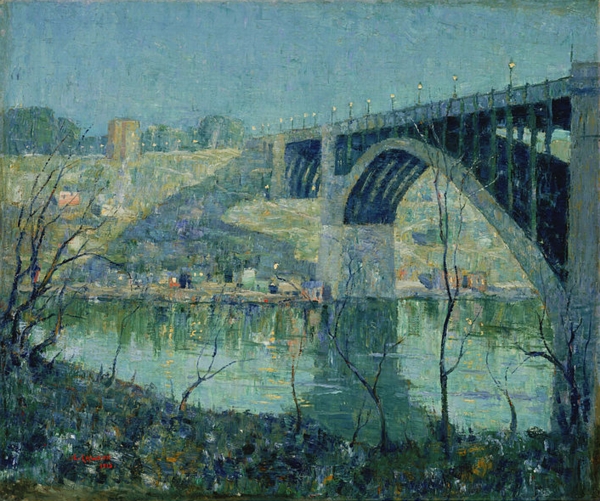
(above: Ernest Lawson, Spring Night, Harlem River, 1913, oil on canvas mounted on panel, 25 x 30 inches, The Phillips Collection. Public domain, via Wikimedia Commons*)
While French Impressionists like Monet and Pissarro depicted the dynamism of a modernizing Paris, with its railway stations, wide boulevards, and mixing of social classes, their American counterparts systematically edited the harsher realities of industrialization out of the frame. Their canvases emphasized the "pleasantries of small town life," serene upper-class domesticity, and bucolic landscapes, deliberately omitting the factories, automobiles, and telephone poles that were actively reshaping the nation. This curated vision offered what one analysis calls "fairy tale views of an elegant American yesteryear," a pastoral respite from the modern world.

This artistic choice was a direct response to the profound cultural shifts of the post-Civil War era. The Second Industrial Revolution had transformed the United States into a global economic power, creating a new class of fabulously wealthy patrons who had amassed fortunes in manufacturing, railroads, and finance. These patrons, eager to display their newfound sophistication, traveled abroad and developed a taste for European culture, furnishing their opulent homes with art that fused continental refinement with identifiably American subjects. American Impressionism, flourishing in idyllic art colonies like Old Lyme, Connecticut, and Shinnecock, New York -- themselves physical retreats from the burgeoning cities -- perfectly fulfilled this need. It provided a visual and psychological sanctuary, an affirmation of a tranquil, ordered, and beautiful America rooted in a fading agrarian past, precisely at the moment when an urban, industrial future was becoming overwhelmingly present and chaotic.
The defining characteristic of American Impressionism, therefore, is not only what it depicted, but what it so carefully refused to depict. This act of deliberate omission created a profound tension between the nation's artistic representation and its lived reality, a tension that the succeeding generations of artists would be forced to confront and, ultimately, to resolve.
Part I: The Shock of the New: Industrialization, Urbanization, and the Dawn of Modernism
The aesthetic consensus represented by American Impressionism could not hold. Its carefully constructed vision of a tranquil, rural nation was being rendered obsolete by one of the most rapid and profound societal transformations in history. The dawn of the 20th century brought a dual shock to the American consciousness: the shock of the new American city as a lived reality, and the shock of new European ideas about the very nature of art. Together, these forces fractured the old artistic languages and compelled artists to forge a new, more confrontational modernism.
The Fractured Landscape: America's Industrial Revolution and the Urban Psyche
Between 1870 and 1920, the United States was radically remade. The Second Industrial Revolution propelled a massive demographic shift, as 11 million Americans migrated from the countryside to the cities, joined by an additional 25 million immigrants from abroad. This torrent of humanity swelled urban centers at an astonishing rate; by 1920, for the first time in its history, the nation's population was majority urban. This new environment was unlike any that had come before. The modern city was a landscape of unprecedented scale, speed, and sensory overload. New technologies like the Bessemer steel process and the electric grid allowed buildings to soar into the sky, while electric streetcars and, soon, automobiles, filled the streets with a new, mechanical rhythm. The air was filled with the sounds of factories and the glow of artificial light, which extended the day and transformed the nature of work and leisure.
This physical transformation engendered a new urban psychology. The city was a paradox of intense physical proximity and profound emotional distance. Millions of people were compressed into small areas, yet this density often produced not community but a sense of anonymity and alienation. The impersonality of factory work and the sheer scale of the metropolis could leave individuals feeling disconnected and adrift, their lives governed by the rigid, mechanical schedules of industrial capitalism. This new experience of modern life -- fragmented, dynamic, and often disorienting -- fostered a growing disillusionment with the staid morality and easy optimism of the Victorian era, creating a psychological state that traditional art forms seemed ill-equipped to address.
A Grittier Realism: The Ashcan School's Confrontation with the City
The first artistic movement to directly confront this new urban reality was the Ashcan School. Spearheaded by the charismatic painter and teacher Robert Henri, this group of New York artists, including John Sloan, George Luks, and George Bellows, explicitly rebelled against the genteel traditions of the National Academy of Design and the sanitized world depicted by the American Impressionists. They rejected the "posh, haute bourgeoisie New York" of Fifth Avenue socialites in favor of what they saw as the "raw, visceral day-to-day reality of the city". Their subject matter was, for the time, revolutionary and shocking. They turned their gaze to the city's alleys, tenements, crowded markets, and saloons, depicting the vibrant, culturally rich, and often difficult lives of working-class and immigrant communities. For this, the conservative art establishment branded them the "revolutionary black gang" and the "apostles of ugliness".

(above: John Sloan, Sunday, Women Drying Their Hair, 1912, oil on canvas, 26.1 x 32.1 inches, Addison Gallery of American Art, Phillips Academy, Andover, MA, museum purchase, 1938.67. Public domain, via Wikimedia Commons*)
Many of the Ashcan artists had begun their careers as newspaper illustrators, and they brought a reportorial immediacy to their painting. They sought to capture the "spectacle of common life" with authenticity and energy, employing a dark, earthy palette and vigorous, sketchy brushwork that stressed the materiality of the paint and conveyed the dynamism of the modern metropolis. Their work was not just an aesthetic choice but a moral and political one. By turning their focus to the urban poor, they performed a crucial act of cultural validation, challenging the class-based mores of the Gilded Age. Robert Henri, who famously referred to the National Academy as "a cemetery of art," led a rebellion that was fundamentally about redefining what reality was worthy of artistic representation. They asserted that the truth of the American experience was to be found not in manicured gardens, but in the chaotic, striving, and intensely human streets of the industrial city.

(above: George Bellows, The Teamster, 1916, oil on canvas, 38 ? 44 inches, Farnsworth Art Museum, Bequest of Mrs. Elizabeth B. Noyce, 1997. Public domain, via Wikimedia Commons*)
See more paintings by George Bellows
The Armory Show of 1913: A Rupture in the American Aesthetic
If the Ashcan School changed the subject of American art, the 1913 International Exhibition of Modern Art -- better known as the Armory Show -- shattered its form. Organized by a group of young, anti-academy artists, the exhibition was conceived as a massive survey of new art, with the explicit goal of introducing the European avant-garde to an American public largely accustomed to realism. While two-thirds of the works were by American artists, it was the European contingent that caused a sensation and a scandal.
The paintings of Henri Matisse, Pablo Picasso, and Paul Cézanne, and the sculptures of Constantin Brancusi, were disorienting enough, but it was Marcel Duchamp's Cubist-inspired Nude Descending a Staircase, No. 2 that became the symbol of the show's radicalism. Critics and the public alike reacted with a mixture of ridicule and outrage. Duchamp's painting was famously derided as "an explosion in a shingle factory," and the fragmented, non-representational, and intensely colored styles of Fauvism and Cubism were widely dismissed as insane, immoral, and anarchic. Yet the show's impact was transformative. It starkly revealed that American artists were decades behind their European counterparts in aesthetic innovation. More profoundly, it legitimized the revolutionary notion that "art need not be beautiful to be considered good".
The initial shock of the Armory Show gave way to a powerful realization among American artists. They were already living in and attempting to depict a modern world that was itself chaotic, fast-paced, and fragmented. The Ashcan painters had captured the modern subject, but they were still using a fundamentally traditional artistic language. The Armory Show introduced a visual vocabulary that, while alien, was psychologically resonant with the lived experience of modernity. The "spatial decomposition" of Cubism, for example, mirrored the psychological fragmentation and sensory overload of life in the industrial city.
The exhibition provided American artists with both the psychological permission and the technical tools to express the modern condition. It demonstrated that the very structure of a painting could reflect the fractured structure of modern consciousness, shifting the goal of art from depicting the world as it looked to depicting it as it felt. The Armory Show served as a powerful catalyst, inspiring a generation of American artists, including John Marin, Marsden Hartley, and Stuart Davis, to break free from the constraints of realism and begin the vital work of forging their own modern "artistic language".
Part II: The Search Within: Psychoanalysis and the Subjective Turn
The dual shocks of urbanization and the European avant-garde had forced American art to confront the external realities of the modern world. The next major shift, however, would be an inward one. Propelled by the widespread cultural dissemination of Freudian psychoanalysis, the focus of the American avant-garde turned decisively from the streets of the city to the corridors of the mind. Psychoanalysis offered a new, seemingly scientific map of a vast and unexplored human territory-the unconscious-and in doing so, provided both the subject matter and the justification for a new, radically subjective art.
Freud in America: The Unconscious as a New Frontier
The early 20th century witnessed a revolution in the understanding of the human mind, and its epicenter was the work of the Austrian neurologist Sigmund Freud. Though his theories were controversial, they had a tremendous and undeniable impact on 20th-century thought, profoundly influencing not only the fields of psychology and psychiatry but also art, literature, and popular culture. Following his landmark lectures in the United States in 1909, his ideas spread rapidly; by the 1920s, "Freud was on the lips of every educated American," his concepts absorbed into the intellectual mainstream.
Freud's most radical contribution was his model of the psyche. He proposed that the mind was not a unitary, rational entity, but a dynamic battleground of competing forces: the primitive, desire-driven id; the reality-oriented ego; and the moralistic, socially-conditioned superego. Most importantly, he argued that the primary drivers of human behavior were located not in our conscious awareness but in the unconscious mind -- a deep reservoir of repressed memories, primal urges, and unresolved childhood conflicts. These hidden forces, he theorized, constantly sought expression, emerging in coded form through dreams, jokes, slips of the tongue, and neurotic symptoms. This conceptual framework was a revelation for artists. It suggested that the visible, objective world was merely a surface, and that a deeper, more potent, and more authentic reality existed within the individual psyche. This legitimized a turn away from external observation and toward internal exploration, opening up the vast, mysterious landscape of the unconscious as a new and compelling subject for art.
Surrealism's Echo: European Methods for an American Mind
The first artistic movement to systematically mine this new psychological territory was European Surrealism. Led by the writer and poet André Breton, the Surrealists were captivated by Freudian theory, particularly his 1899 magnum opus, The Interpretation of Dreams. They embraced Freud's belief that dreams were the "royal road to the unconscious," revealing our innermost, often erotic and violent, desires that were suppressed by civilized society. The Surrealists sought to create an art that would liberate these repressed forces, bypassing the censorship of the rational mind.
To achieve this, they developed a set of specific techniques designed to tap directly into the wellspring of the unconscious. The most important of these was psychic automatism, the act of writing, drawing, or painting without conscious control or preconceived plan. Other methods included recording and analyzing dream imagery, practicing free association, and employing chance-based techniques like collage and frottage (rubbings). The goal, as Breton defined it in the Manifesto of Surrealism, was to express the "actual functioning of thought... in the absence of any control exercised by reason, exempt from any aesthetic or moral concern".
This European movement became a direct and powerful influence on American art, primarily through the historical accident of World War II. As the Nazis swept across Europe, New York City became a refuge for a remarkable number of leading avant-garde artists. This wave of émigrés included many of the central figures of Surrealism, such as Max Ernst, Salvador Dalí, André Masson, and Breton himself. Their arrival created an unprecedented concentration of artistic talent and radical ideas in Manhattan. Galleries like Peggy Guggenheim's Art of This Century and the Julien Levy Gallery became crucial meeting places and exhibition venues, showcasing Surrealist art to a new generation of American painters and providing a direct infusion of psychoanalytically-driven methods into the nascent New York School.
This confluence of theory and practice proved to be a decisive catalyst. Freudianism as a cultural phenomenon had already provided American artists with the philosophical justification for an art of the interior world; it made the unconscious a valid and compelling subject. The lingering question, however, was a practical one: how does one actually paint the unconscious? The Surrealist exiles provided the answer in the form of a methodological toolkit. They demonstrated how to translate abstract psychological theory into concrete artistic practice.
Techniques like automatism and an emphasis on the gestural, improvisational process of creation itself -- rather than on a finished, preconceived image -- were eagerly absorbed by American artists like Jackson Pollock, Willem de Kooning, and Robert Motherwell. Pollock's signature drip technique, for example, can be understood as a form of full-body automatism, a radical method for allowing the unconscious to guide the rhythmic application of paint, free from the traditional control of the brush. The Surrealists thus served as an essential bridge, providing the vehicle that would carry American art from the depiction of the external world to the charting of the internal landscape of the psyche, setting the stage for the psychologically charged canvases of Abstract Expressionism.
Part III: The Apex of Abstraction: Post-War Trauma and Existential Triumph
Abstract Expressionism was more than just another movement; it was the moment American art came of age, seizing the mantle of the international avant-garde and establishing New York as the undisputed center of the art world. This ascendancy was not accidental. The movement was forged in a unique historical crucible, shaped by the geopolitical realignment of the post-war era, the collective psychological trauma of global conflict, and a profound philosophical search for individual meaning in the atomic age. It was an art form that perfectly captured the anxieties and ambitions of a nation grappling with its new, and often terrifying, role as a world superpower.
From Paris to New York: The New Center of the Art World
The Second World War redrew the map of the world, and with it, the map of art. While Europe was left physically and economically devastated, the United States emerged from the conflict as the world's dominant economic, political, and military power. This dramatic geopolitical shift was mirrored in the cultural sphere. Paris, the long-reigning capital of modern art, ceded its position to New York City. The city, already a vibrant hub energized by the influx of European émigré artists fleeing the war, now became the nexus for artistic innovation.

(above: Jon Whitcomb, I'm Proud of YOU FOLKS too!, c. 1944, produced for the US Government, National Archives at College Park, Still Picture Records Section, Special Media Archives Services Division (NWCS-S). Public domain via Wikimedia Commons*)
A new and robust ecosystem of support rapidly developed. Visionary gallerists like Peggy Guggenheim, whose Art of This Century gallery was a crucible for European and American artists , and later Betty Parsons, championed the new, radical painting. Influential critics gave the movement a powerful theoretical voice, and major institutions, most notably the Museum of Modern Art (MoMA), actively promoted Abstract Expressionism through exhibitions at home and abroad. This institutional support, combined with the unparalleled prosperity of the post-war American economy, created a booming art market and a climate in which a uniquely American avant-garde could thrive.
The Anxious Object: The Psychological Crucible of Abstract Expressionism
The artists who would become known as the Abstract Expressionists -- a loose-knit group including Jackson Pollock, Willem de Kooning, Mark Rothko, Barnett Newman, and Clyfford Still -- were a generation profoundly marked by trauma. Their formative years had been defined by the economic despair of the Great Depression, which had highlighted the failures of capitalism and led many to engage with leftist politics. This was followed by the unprecedented global cataclysm of World War II, the horrifying revelations of the Holocaust, and the dawn of the nuclear age with the bombing of Hiroshima and Nagasaki. This sequence of historical events precipitated a deep crisis of meaning. For many artists, the traditions of representational art, and even the earlier forms of modernism, seemed "absurdly inadequate" to express the brutal realities of this new world. The old subjects and forms felt trivial in the face of such immense suffering and existential threat.
In this spiritual and aesthetic void, artists turned inward, seeking a more fundamental, universal, and authentic basis for art. They largely moved beyond the Freudian focus on individual psychopathology that had animated Surrealism, embracing two other philosophical frameworks that better suited the gravity of the times:
· Jungian Psychology: The theories of Swiss psychologist Carl Jung offered a compelling alternative to Freud. Jung posited the existence of a "collective unconscious," a universal layer of the human psyche shared by all people, which contained primordial images and patterns he called "archetypes". This idea was immensely attractive to artists seeking to create an art that could transcend personal biography and speak to a universal human experience of myth, spirituality, and primal emotion. ·
· Existentialism: The philosophy of European thinkers like Jean-Paul Sartre and Martin Heidegger, which gained widespread currency after the war, resonated deeply with the artists' sense of dislocation and anxiety. Existentialism's core tenets -- that the world is inherently without meaning or purpose, and that individuals are therefore radically free and condemned to create their own meaning through their actions and choices -- provided a powerful philosophical justification for the artist's creative act. The physical struggle with paint on a canvas could be seen as a profound existential gesture, a testament to the artist's existence and a creation of meaning in a meaningless void. ·
An Arena for Action vs. The Flatness of Being: Rosenberg, Greenberg, and the Battle for Meaning
The profound and complex nature of this new abstract art gave rise to two powerful, competing interpretations, articulated by the era's most influential critics. Their theories provide two distinct lenses for understanding the movement's psychological and formal ambitions.
· Harold Rosenberg and "Action Painting": In his landmark 1952 essay, "The American Action Painters," Harold Rosenberg framed the movement in explicitly existential terms. He famously declared: "At a certain moment the canvas began to appear to one American painter after another as an arena in which to act... What was to go on the canvas was not a picture but an event". For Rosenberg, the artwork was not an aesthetic object to be contemplated, but the physical residue of a dramatic, biographical struggle. The meaning of the painting was inseparable from the authentic act of its creation, a heroic confrontation between the artist and their materials that was a gesture of liberation from all political, aesthetic, and moral values. This interpretation placed the emphasis squarely on the artist's subjective process and their journey of self-creation. ·
· Clement Greenberg and Formalism: Clement Greenberg offered a starkly different, formalist reading. In essays like "'American-Type' Painting" (1955), he argued that Abstract Expressionism was not a radical break with the past but the logical culmination of modernism's historical trajectory, which he traced back to Édouard Manet. For Greenberg, the defining project of modernist painting was a process of self-purification, in which it shed all conventions not essential to its specific medium. The most fundamental and unique quality of painting, he argued, was its "flatness". He championed Jackson Pollock not because his paintings were a record of his psyche, but because their "all-over," dripped compositions obliterated the illusion of three-dimensional space and emphatically asserted the two-dimensional reality of the canvas. ·
The fierce debate between Rosenberg's existential interpretation and Greenberg's formalist one is not a question of which was "correct." Rather, the debate itself reflects the essential duality of Abstract Expressionism. The artists were simultaneously engaged in a profound psychological and philosophical quest for meaning (the process Rosenberg described) and a rigorous, historically-aware engagement with the formal problems of painting (the result Greenberg analyzed). The enduring power of their work lies precisely in this unresolved tension between the painting as a subjective "event" and as an objective "object."
The Unpopular Front: Abstract Expressionism as a Cold War Weapon
In a final, remarkable twist of history, this deeply personal, anarchic, and spiritually fraught art was co-opted and deployed as a potent cultural weapon by the U.S. government in the Cold War. As the ideological struggle with the Soviet Union intensified, American policymakers recognized the propaganda value of an art form that so vividly embodied principles of freedom and individualism.
Through covert channels, including the CIA-funded Congress for Cultural Freedom, the U.S. government secretly sponsored international traveling exhibitions of Abstract Expressionist work. The explicit goal was to present this art to a global audience, particularly to skeptical European intellectuals, as a powerful symbol of the creative liberty possible in a capitalist democracy. The raw, gestural freedom of a Pollock or a de Kooning was positioned as the direct antithesis of the rigid, state-controlled, and propagandistic Socialist Realism mandated by the Soviet Union. Nelson Rockefeller even dubbed the style "Free Enterprise Painting".
The strategy was cynically effective, contributing to the perception of America as a culturally dynamic, as well as politically free, society. This deployment was all the more remarkable given that the art was often reviled at home. President Harry Truman dismissed it as "the vaporings of half-baked lazy people," and many in Congress and the public viewed it with suspicion and hostility. Paradoxically, this very unpopularity became part of its strength as a tool of foreign policy. The fact that such rebellious, non-conformist art could exist and be celebrated proved, better than any speech, the reality of American cultural freedom.
Part IV: The Return of the Real: Pop, Pictures, and Postmodern Reactions
The cultural dominance of Abstract Expressionism, with its high-minded seriousness and heroic individualism, was bound to provoke a reaction. By the end of the 1950s, a new generation of artists, who had come of age not in a world of depression and war but in one of unprecedented post-war prosperity, mass media, and burgeoning consumerism, began to find the movement's existential angst to be exhausted and alienating. The inevitable swing of the pendulum began, moving American art away from the hermetic, interior world of the psyche and back toward a direct, if often ironic, engagement with the external, socially-constructed world. This return to the figure and the recognizable object was not a retreat to traditionalism, but a multi-faceted postmodern reaction that fundamentally questioned the nature of art, reality, and the self in a media-saturated age.
The Mirror of Mass Culture: Pop Art's Ironic Embrace
By the late 1950s, Abstract Expressionism had transitioned from a radical avant-garde into the established, institutionalized style, its once-rebellious gestures now commanding high prices and critical acclaim. For younger artists, its emotional intensity and perceived elitism felt like a dead end. The reaction, when it came, was swift and total. Pop artists like Andy Warhol, Roy Lichtenstein, James Rosenquist, and Claes Oldenburg engineered one of the most dramatic shifts in 20th-century art history. They turned their gaze away from the artist's inner world and looked outward to the ubiquitous, commercialized, and relentlessly mundane landscape of post-war American life: advertising, product packaging, comic books, Hollywood celebrities, and supermarket shelves.
The psychological stance of the Pop artists was the diametrical opposite of their predecessors. They replaced the "hot," emotionally charged, and deeply personal expression of the "action painters" with a "cool," detached, impersonal, and ironic tone. Andy Warhol, the movement's central figure, epitomized this shift. He adopted commercial techniques like silkscreening to mechanically reproduce images of Campbell's Soup cans and Coca-Cola bottles, deliberately downplaying the artist's hand. He famously named his studio "The Factory" and expressed a desire to "be a machine," a direct and total repudiation of the heroic, individualistic gesture that Harold Rosenberg had celebrated. By elevating the most banal objects of consumer culture to the status of high art, Pop artists blurred the long-held distinction between "high" and "low" culture, challenging the seriousness and exclusivity of the art world with humor, wit, and a deadpan embrace of the superficial.
This radical change in subject and style reflected a fundamental shift in the psychological understanding of the self. The Abstract Expressionists had pursued an authentic, interior self through a heroic, existential struggle, seeking to create a unique and personal visual language. The Pop artists, in contrast, recognized that in the new, media-saturated environment of post-war America, identity was becoming less a matter of a unique inner essence and more a product of the commercial images and brands one consumed.
The self was now a social construct, a performance assembled from external sources. Warhol's twin obsessions with consumer goods and celebrity portraits were a profound commentary on this new reality. His work suggests that a Campbell's Soup can is as significant a cultural symbol as a Jungian archetype, and that Marilyn Monroe's mass-produced public image is a more potent "reality" than her private, interior self. Pop Art proposed that in the modern world, truth was no longer to be found in the depths of the individual psyche, but on the shimmering, commercialized surface of culture.
Reclaiming the Image: The Rise of Photorealism
Evolving from Pop Art in the late 1960s and early 1970s, Photorealism represented another powerful reaction against the dominance of abstraction, but it followed a different path. Artists such as Chuck Close, Richard Estes, and Audrey Flack returned to realism with a vengeance, using the photograph as their primary source material and attempting to reproduce it in paint with astonishing, often superhuman, technical precision.
Where Pop Art had treated commercial imagery with irony and a sense of parody, Photorealism approached the photographic image with a cool, objective, and non-emotional neutrality. The movement was less a reaction against Abstract Expressionism's emotionalism and more a counter to its painterly looseness. Using tools like projectors and airbrushes, Photorealists sought to eliminate the visible brushstroke and the trace of the artist's hand, creating a smooth, slick surface that mimicked the mechanical nature of the photograph.
Their subjects were often the mundane landscapes of American life -- gleaming diners, reflective shop windows, city streets, and portraits based on snapshots. The goal was not to express emotion, but to explore the complex and increasingly blurry relationship between human perception, mechanical reproduction, and the nature of reality itself in an age saturated with photographic images. It was a return to representation, but one that was deeply conceptual and self-aware, questioning the very act of seeing.
The Figure Re-Figured: Neo-Expressionism and the Return of Narrative
By the late 1970s, the pendulum swung once more. Another generation of artists began to feel constrained by the cool, detached, and seemingly impersonal intellectualism of Pop Art, Minimalism, and Conceptual Art. This dissatisfaction fueled the rise of Neo-Expressionism, a movement that marked a dramatic and passionate return to the human figure, raw emotion, and narrative storytelling.
Artists like Julian Schnabel in the United States, and Georg Baselitz and Anselm Kiefer in Germany, revived the vigorous, violent, and emotionally charged brushwork of German Expressionism and Abstract Expressionism. They created large-scale canvases that were intensely subjective and often incorporated found objects like broken plates, straw, and sand, further emphasizing a raw materiality. The movement was a hybrid, synthesizing the painterly expression of the past with a postmodern sensibility.
Neo-Expressionists re-infused painting with the subjects that modernism had sought to purge: history, mythology, sexuality, and personal biography. The American artist Philip Guston, a first-generation Abstract Expressionist who later turned to a raw, cartoonish figuration and became a key precursor to the movement, articulated the impulse perfectly: "I got sick and tired of all that purityI wanted to tell stories". Neo-Expressionism represented a powerful desire to reclaim the emotive power, narrative potential, and sheer visceral pleasure of painting after decades of abstraction, irony, and intellectual critique.
Conclusion: Cycles of Seeing in the American Century
The tumultuous evolution of American art throughout the 20th century cannot be understood as a simple, linear progression from representation to abstraction and back again. It was, rather, a dynamic, dialectical cycle -- a series of powerful actions and reactions driven by the seismic shifts in the nation's cultural mores and psychological landscape. Each major movement emerged as a necessary response to the perceived limitations, excesses, or omissions of its predecessor, creating a continuous and often contentious dialogue about the purpose of art and the nature of reality in the modern age. The century's artistic trajectory can be seen as a pendulum swinging between an intense focus on the interior, subjective world of the psyche and a critical engagement with the exterior, objective world of society.
The pastoral idealism of American Impressionism, in its deliberate refusal to acknowledge the realities of industrialization, created a cultural and psychological vacuum. The gritty urban realism of the Ashcan School rushed to fill this void, asserting the artistic validity of the modern city and its working-class inhabitants. Yet, the Ashcan School's traditional realist vocabulary proved insufficient for expressing the chaotic, subjective experience of modernity. This limitation was shattered by the formal innovations of the European avant-garde, introduced to a shocked America at the 1913 Armory Show. This event provided artists with a new language of abstraction and propelled them on an inward journey-a journey given a conceptual map by the popularization of Freudian psychology and a practical method by the émigré Surrealists.
This inward turn reached its apex in Abstract Expressionism. Forged in the crucible of post-war trauma, it was an art of profound existential meaning-making, a heroic attempt to create a universal, spiritual art in a seemingly godless, meaningless world. Its radical subjectivity and formal power established New York as the center of the art world and became, ironically, a symbol of American freedom in the Cold War. However, the perceived hermeticism and emotional elitism of Abstract Expressionism in turn provoked a powerful counter-movement.
A new generation, immersed in a culture of mass media and consumption, rejected existential angst in favor of Pop Art's cool, ironic embrace of the commercial surface and Photorealism's detached, technical analysis of the photographic image. Finally, the exhaustion with irony and intellectualism led to Neo-Expressionism's passionate, raw, and deeply personal re-engagement with the figure, emotion, and narrative.
Ultimately, the story of 20th-century American art is the story of a nation's artists forging, breaking, and reforging their visual tools to grapple with the unprecedented experience of modernity. It is a vast and varied canvas that reflects a century of profound social upheaval, a relentless search for meaning in a world constantly being made new, and an enduring, cyclical dialogue between the reality within and the reality without.

(above: John Henry Twachtman, Court of Honor, World's Columbian Exposition, Chicago, 1893, oil on canvas, 25 x 30 inches, Columbus Museum of Art, bequeathed by Frederick W. Schumacher. Public domain, via Wikimedia Commons*)
Please don't rely on this AI-generated text for accuracy. It has been edited, yet may have inaccurate information. A table is deleted becuase of formatting incompatibility. Consider it a base for further inquiry. Links are ours. Nonessential parts of the report were deleted.
About us:
 Tens of thousands of individuals,
including students, scholars, teachers and others, view educational and
informative materials every month on our site, which is structured as a
digital library.
Tens of thousands of individuals,
including students, scholars, teachers and others, view educational and
informative materials every month on our site, which is structured as a
digital library.
 return to AI Curiosities
*Tag for expired US copyright of object image:

TFAO Museum of American Art is proudly sponsored by Traditional Fine Arts Organization, Inc., an Arizona nonprofit corporation. All rights reserved. © 2024
Links to sources of information outside of this website are provided only as referrals for your further consideration. Please use due diligence in judging the quality of information contained in these and all other web sites. Information from linked sources may be inaccurate or out of date. TFAO neither recommends or endorses these referenced organizations. Although TFAO includes links to other web sites, it takes no responsibility for the content or information contained on those other sites, nor exerts any editorial or other control over them. For more information on evaluating web pages see TFAO's General Resources section in Online Resources for Collectors and Students of Art History.