
AI Curiosities
20th Century American Modernist to Abstract Expressionist and Back to Representational Art
by Grok 3
In the early 20th century, American modernist art emerged as a diverse response to rapid industrialization, urbanization, and European artistic influences, blending representational elements with emerging abstraction. This period, roughly from the 1910s to the 1940s, was characterized by several key themes that reflected America's evolving identity. Artists associated with the Stieglitz Circle, such as Georgia O'Keeffe and Marsden Hartley, focused on the American landscape with spiritual intensity, often magnifying natural forms or capturing rugged terrains like Maine's coastline through bold, expressive brushstrokes that hinted at future abstraction.

(above: Georgia O'Keeffe, Lake George Reflection, c. 1921-22, oil on canvas, 58 x 34 inches, Christie's. Public domain, via Wikimedia Commons*)
Precisionism, exemplified by Charles Sheeler and Joseph Stella, depicted industrial landscapes and urban scenes with hard-edged, geometric precision, emphasizing the anonymity and mechanical beauty of factories and cities.
Regionalism, led by figures like Thomas Hart Benton and Grant Wood, celebrated rural American life through narrative, figurative paintings of Midwestern scenes, often as a counterpoint to urban modernism. Many artists drew from European movements like Cubism and Fauvism-experienced firsthand by Americans in Paris, such as Stuart Davis -- while adapting them to distinctly American subjects, like abstracted cityscapes or folk-inspired motifs.
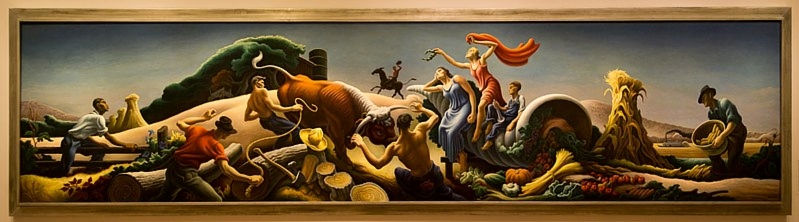
(above: Thomas Hart Benton, Achelous and Hercules, 1947, tempera and oil on canvas mounted on plywood, 62.8 x 159.7 inches, Smithsonian American Art Museum, Gift of Allied Stores Corporation, and museum purchase through the Smithsonian Institution Collections Acquisition Program, 1985.2. Public domain, via Wikimedia Commons*)
Paintings by Thomas Hart Benton
By the late 1930s, groups like the American Abstract Artists and Park Avenue Cubists pushed toward non-objective art with primary colors and geometric shapes, influenced by Mondrian and Picasso, but still rooted in representational foundations for many. Overall, early American modernism maintained a strong representational core, using recognizable imagery to explore national themes, though it increasingly experimented with stylization and abstraction amid the Great Depression and the Works Progress Administration's support for artists.
The drift toward Abstract Expressionism in the 1940s and 1950s represented a profound shift away from these representational and narrative tendencies, driven by the traumas of World War II, existential anxiety, and a desire to express universal human emotions through non-objective means. Emerging primarily in New York -- earning the label "The New York School" -- this movement involved artists like Jackson Pollock, Willem de Kooning, Mark Rothko, and Lee Krasner, who prioritized spontaneity, improvisation, and the painting process itself over depicting the external world.
Influences included Surrealism's emphasis on the unconscious and psychic automatism, brought by European exiles like Salvador Dalí and Max Ernst fleeing Nazi-occupied Europe, as well as Jungian psychology's ideas of collective myths and archetypes. Many Abstract Expressionists had roots in 1930s movements like Regionalism and Social Realism but rejected their provincialism and explicit politics, seeking instead a more introspective, socially responsible art free from literal representation.
The post-war context amplified this: the atomic bomb, Holocaust revelations, and Cold War tensions fostered a mood of human vulnerability and irrationality, prompting artists to create large-scale, abstract works that tapped into inner psyches and aimed for sublime, universal resonance. Styles diverged into "action painting" (gestural, energetic marks, as in Pollock's drip techniques) and Color Field painting (expansive, meditative color planes, as in Rothko's luminous rectangles), both emphasizing emotional authenticity over recognizable forms. This marked America's artistic coming-of-age, shifting the global art center from Paris to New York and symbolizing individual freedom amid geopolitical tensions.
By the late 1950s and into the 1960s, a pendulum swing back toward representational formats occurred, largely as a reaction against Abstract Expressionism's introspective intensity, perceived elitism, and emotional abstraction. Pop Art, emerging in Britain and the U.S. with artists like Andy Warhol, Roy Lichtenstein, and Richard Hamilton, epitomized this return by embracing hard-edged, recognizable imagery drawn from mass media, consumerism, and popular culture -- such as comic strips, advertisements, and celebrity icons.
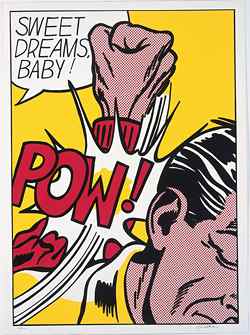
(above: Roy Lichtenstein (American, 1923-1997), Sweet Dreams, Baby! from the portfolio 11 Pop Artists, vol. II, 1965, Silk screen 137/200, 27 x 23 inches. Memphis Brooks Museum of Art - from The Pop Environment (5/27/08)
Unlike Abstract Expressionism's focus on personal symbolism and gestural looseness, Pop Art adopted an impersonal, mundane aesthetic, celebrating (and critiquing) everyday commercialism in a detached, ironic manner. This shift reflected broader cultural changes, including the rise of television, advertising, and post-war prosperity, which made abstraction seem out of touch with contemporary life.

(above: Robert Dowd, Fire at U.S. Treasury, 1968, acrylic on canvas, 14 x 34 inches, collection of Joan and Jack Quinn - from Robert Dowd: Pop Art Money; text by Michael Zakian (2/24/09)
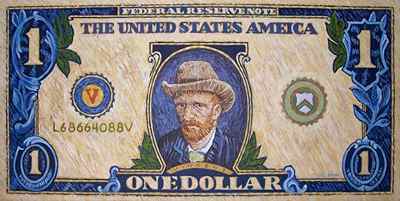
(above: Robert Dowd, Vincent Dollar, 1965, acrylic on canvas, 18 x 36 inches, collection of Joni and Monte Gordon, courtesy of Newspace Resales, Los Angeles - from Robert Dowd: Pop Art Money; text by Michael Zakian (2/24/09)
Subsequent movements like Photorealism in the 1970s further reinforced representation through hyper-detailed depictions of ordinary scenes, while postmodernism in the 1980s revived figurative elements in Neo-Expressionism, blending them with earlier abstract influences. Overall, this cycle -- from representational modernism to abstract emotionalism and back to figurative pop culture -- illustrates art's dialogue with societal shifts, balancing inner exploration with external realities.
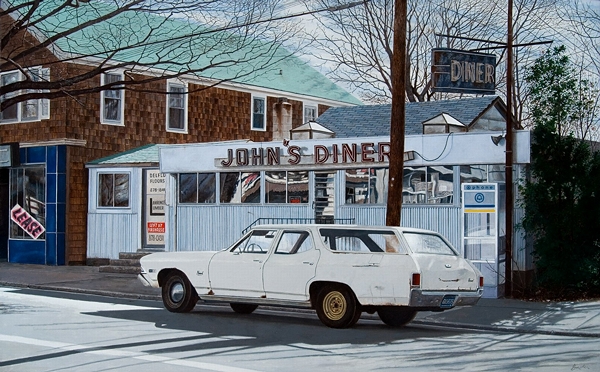
(above: John Baeder, John's Diner with John's Chevelle, oil on canvas, 30 x 48 inches, 2007, email to photosubmission@wikimedia.org by John Baeder. Public domain, via Wikimedia Commons)
Please don't rely on this AI-generated text for accuracy. It has been edited, yet may have inaccurate information. A table is deleted becuase of formatting incompatibility. Consider it a base for further inquiry. Links are ours. Nonessential parts of the report were deleted.
 return to AI Curiosities
About us:
 Tens of thousands of individuals,
including students, scholars, teachers and others, view educational and
informative materials every month on our site, which is structured as a
digital library.
Tens of thousands of individuals,
including students, scholars, teachers and others, view educational and
informative materials every month on our site, which is structured as a
digital library.
*Tag for expired US copyright of object image:

TFAO Museum of American Art is proudly sponsored by Traditional Fine Arts Organization, Inc., an Arizona nonprofit corporation. All rights reserved. © 2024
Links to sources of information outside of this website are provided only as referrals for your further consideration. Please use due diligence in judging the quality of information contained in these and all other web sites. Information from linked sources may be inaccurate or out of date. TFAO neither recommends or endorses these referenced organizations. Although TFAO includes links to other web sites, it takes no responsibility for the content or information contained on those other sites, nor exerts any editorial or other control over them. For more information on evaluating web pages see TFAO's General Resources section in Online Resources for Collectors and Students of Art History.