
AI Curiosities
Maine Art History, The Call of the Coast: A Century of Painting in Maine (1840-1940)
by Gemini 2.5 Pro
A Land of Granite and Light
For centuries, the coast of Maine has presented a paradox: a landscape of serene beauty forged by violent, elemental power. It is a place of granite and light, of dense spruce forests that meet the cold Atlantic in a "primal drama of the ocean". This formidable character has made Maine a unique and enduring muse for American artists. (For example, see Winslow Homer's Maine Coast,1896) More than a passive backdrop, the state has been an active force in the evolution of American art, a crucible where the nation's changing identity was tested and forged in paint. From 1840 to 1940, artists came to Maine seeking different truths. The first wave sought God in the sublime wilderness. They were followed by painters who captured the flickering light of a new, leisurely age. Finally, a generation of rebels arrived, who found in Maine's ruggedness the raw material for a distinctly American modernism. This century-long artistic dialogue, anchored by the careers of six pivotal artists, reveals how the call of the coast shaped not just a regional style, but the very trajectory of American painting.
In the 19th century, as industrialization transformed the nation, the New England coast itself underwent a metamorphosis in the cultural imagination. It shifted from being an economic resource to a "therapeutic shelter" where a growing middle class could find respite and connect with a mythic, pre-industrial past. Artists were at the vanguard of this movement, their canvases serving as windows into this idealized world. The story of painting in Maine is therefore a microcosm of America's evolving self-perception. The art created there mirrors the nation's changing relationship with nature -- from a divine wilderness to be revered, to a place of communal leisure, and finally to a source of raw, elemental force for a new, modern artistic expression.
Part I: The Age of Discovery -- Romanticism and the Hudson River School (1840-1890)
Capturing the Sublime
The first organized wave of artists to venture into Maine's interior and along its shores were associated with the Hudson River School, America's first native art movement. For these painters, the American landscape was a manifestation of the divine, and its depiction a source of profound national pride. Artists like the movement's founder, Thomas Cole, and his celebrated pupil, Frederic Edwin Church, traveled to the remote island of Mount Desert, drawn by its dramatic scenery.Their goal was not merely to record topography but to capture the sublime -- a sense of awe and spiritual terror before the untamed power of nature. Jervis McEntee's 1864 painting, Mount Desert Island, Maine, is a quintessential example, portraying the rugged landscape with a somber, poetic grandeur.
The allure of Maine's wildness spread. In 1858, Aaron Draper Shattuck, a second-generation Hudson River School painter, became the first artist to document a visit to Monhegan Island, a remote outpost twelve miles off the coast. He described it in a letter as a place of "wonderful things," with "grand cliffs rising high out of the sea" and "surf dashing terribly on the Eastern shore". His words and paintings, along with those of his contemporaries, presented an image of Maine as a pristine, unpopulated Eden -- a landscape whose primary significance lay in its majestic separation from the works of man.

(above: Jervis McEntee (1828-1891). Mount Desert Island, Maine, 1864, oil on canvas, John Wilmerding Collection. Picture from National Gallery of Art (Washington, D.C.) Source: Wikimedia Commons - public domain*)
A Bridge to the Human Scene -- Eastman Johnson, The Native Son
While visiting artists saw Maine as a divine wilderness, Jonathan Eastman Johnson saw it as home. Born in Lovell in 1824 and raised in Fryeburg and Augusta, Johnson possessed a deep, native understanding of the state that set him apart. His career began not in the wilderness but in a Boston lithography shop, and his artistic vision was forged in the great studios of Europe. He trained in Düsseldorf and spent four transformative years in The Hague, where his intensive study of 17th-century Dutch masters like Rembrandt earned him the nickname "The American Rembrandt". This rigorous training imbued his work with a technical sophistication and a profound respect for the dignity of everyday life, qualities he would bring to his depictions of quintessentially American subjects. A co-founder of the Metropolitan Museum of Art, Johnson became one of the nation's foremost genre painters, influencing a generation that included the young Winslow Homer.
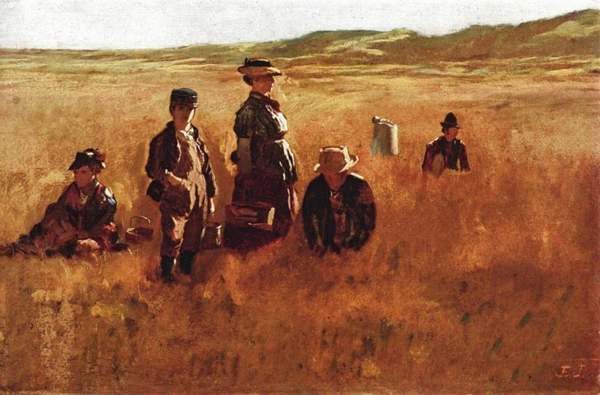
(above: Eastman Johnson, In the Fields, c. 1878-80, oil on cardboard,17.7 x 27.5 inches, Detroit Institute of Arts, Founders Society Purchase, Dexter M. Ferry Fund. Public domain, via Wikimedia Commons*)
The Maple Sugar Camp series (c. 1861-1867)
During the Civil War, Johnson returned to his native Fryeburg, Maine, to begin what was perhaps the most ambitious project of his career: a series of studies for a grand panoramic painting of a maple sugar camp. Though the final large-scale canvas was never realized, the dozens of sketches and finished oil studies he produced, such as Sugaring Off, stand as a major achievement. These works depict the quintessential New England ritual of making maple sugar, a communal activity that brought together townspeople and farmers, young and old, in a festive atmosphere of shared labor.
The importance of this series extends far beyond its charming depiction of rural life. For Johnson, an ardent abolitionist, these scenes of his Maine homeland carried a powerful political and moral weight. At a time when the nation was torn apart over the issue of slavery, the production of maple sugar -- a northern product made by free labor -- stood in stark contrast to the cultivation of cane sugar, which was inextricably linked to the slave economy of the South. Johnson's paintings are a celebration of Yankee independence, egalitarianism, and the virtue of free work. In the quiet woods of Maine, he found a subject that allowed him to create a subtle but potent visual argument for the Union cause, articulating a vision of America founded not on sublime wilderness, but on the strength of its democratic, working communities.
Part II: The Age of Community -- Impressionism and the Art Colony (1890-1910)
A New Coast, A New Light
Toward the end of the 19th century, a new generation of artists began arriving in Maine. Propelled by the expansion of rail and steamer lines that made the coast more accessible, they came not for solitude but for "camaraderie, creativity, and commerce". They brought with them a new style: Impressionism. Inspired by their French counterparts, these artists sought to capture the fleeting effects of light and atmosphere, working en plein air (outdoors) with a brighter, more vibrant palette. They were less interested in the sublime grandeur of the wilderness than in the gentle, civilized landscapes of coastal villages, harbors, and gardens, which they rendered with a new sensitivity to the shimmering, transient qualities of Maine's coastal light.
The Founder of Ogunquit -- Charles Herbert Woodbury
No single figure was more instrumental in establishing this new artistic culture in Maine than Charles Herbert Woodbury. Though born in Massachusetts, Woodbury's life and legacy are inseparable from the state. After marrying Marcia Oakes of South Berwick, Maine, he settled in the small fishing village of Ogunquit in 1896. Two years later, he established the Ogunquit Summer School of Drawing and Painting, the first of its kind in the town. The school was an immediate success and, over the next four decades, would train thousands of students, putting Ogunquit "on the map as an art colony" of national importance.
Woodbury's artistic approach was as unique as his background. He held a degree not in art, but in mechanical engineering from MIT. This scientific training profoundly shaped his vision. He was a marine painter obsessed with a single subject: the sea. But he was not interested in painting static scenes. His famous maxim, taught to legions of devoted students, was "Paint in verbs, not nouns". He urged his pupils to see and depict the forces of nature in motion -- the push of the current, the crash of the wave, the swirl of the tide. His own paintings, rendered with quick, sure brushstrokes, were analytical yet expressive studies of the ocean's dynamic energy.
This powerful oil painting exemplifies Woodbury's mature style and core artistic philosophy. It depicts the dramatic, rocky coast of Ogunquit, but its true subject is the relentless action of the sea upon the land. The brushwork is energetic and fluid, capturing the ephemeral play of light on the churning water and the solid, enduring mass of the cliff. The painting is a masterclass in his theory of "painting in verbs." It does not simply show a seascape; it visualizes the forces of collision and erosion, making the viewer feel the weight and motion of the water. It is the culmination of a lifetime spent observing and deconstructing the mechanics of the ocean, a perfect fusion of scientific analysis and artistic expression.
The Eclipse Series (1932) (See Charles H. Woodbury and the 1932 Solar Eclipse in Ogunquit, Maine)
Woodbury's innovative mind is perhaps best illustrated by the series of paintings he created during the total solar eclipse visible from Ogunquit in 1932. While other artists focused on the spectacle in the sky, Woodbury turned his back on the sun. Instead, he set up six small canvases and, in a burst of rapid-fire painting, captured the dramatic and otherworldly changes in light and color on the cliffs and sea at various stages: before, during, and after totality.
This series is a radical and brilliant demonstration of his principles. It is a scientific study of light translated into art. By focusing on the effects of the eclipse on the landscape, he captured the "drama that drenches the landscape in unbelievable colors" without depicting the celestial event itself. The series is a testament to his emphasis on keen observation and his unique, analytical approach to his subject, cementing his legacy as one of America's most original and influential teachers.
Part III: The Age of Rebellion -- Modernism on Monhegan and Beyond (1900-1940)
Monhegan -- A Rugged Muse
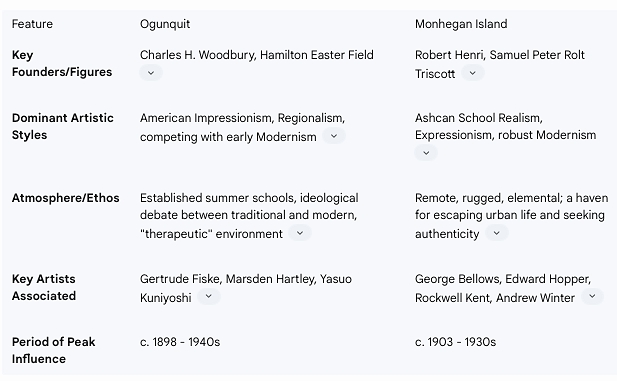
If Ogunquit was the center of a refined, Impressionist-influenced art community, the island of Monhegan was its wild, rebellious counterpart. Its "remoteness and rugged landscape" attracted a different kind of artist-one who sought not gentle leisure but elemental truth. The catalyst for Monhegan's transformation into an outpost of modernism was Robert Henri, the charismatic leader of the Ashcan School. Henri visited in 1903 and urged his students from New York -- a group that included Rockwell Kent, George Bellows, and Edward Hopper -- to join him there, to escape the "grittiness of the city" and paint with a new honesty and vigor. For these artists, Monhegan was not a place of quiet contemplation but a battleground of natural forces, a place to capture the "relentless struggle between sea and shore".
The Modern Romantic -- Rockwell Kent
Rockwell Kent's artistic identity was forged on Monhegan. Arriving in 1905 at the encouragement of his teacher, Robert Henri, Kent did not just visit; he immersed himself. He built his own house and stayed year-round until 1910, working alongside the islanders as a carpenter and lobsterman. This experience on Monhegan became the "foundation of his lasting reputation as an early American modernist." Taught by Henri and Abbott Handerson Thayer, Kent developed a powerful, sculptural style that fused the gritty realism of the Ashcan School with a profound, almost mystical reverence for nature. His work pares the landscape down to its essential, monumental forms, which he rendered with a clean, dramatic light that evokes the sublime. An adventurer and socialist, Kent was driven by a romantic spirit, seeking out the world's most remote and forbidding landscapes -- from Maine to Greenland to Tierra del Fuego -- in a lifelong quest to confront the wilderness and find his place within it.

(above: Rockwell Kent, Toilers of the Sea, 1907, oil on canvas, 37.9 ? 44 inches, New Britain Museum of American Art. Public domain, via Wikimedia Commons*)
Winter, Monhegan Island (1907)
A seminal work of early American modernism, this painting depicts the stark, snow-covered view of neighboring islands from Kent's Monhegan studio. The composition is bold and simplified, with broad masses of icy blues, whites, and dark greens applied with the energetic, painterly brushwork favored by the Henri circle. The painting is a brilliant synthesis of his influences: it has the bleak power of a Winslow Homer seascape, the robust realism of his Ashcan School training, and the spiritual awe for nature instilled by his teacher Thayer. It was the standout work of his first solo exhibition in New York and, though it did not sell, it announced the arrival of a major new voice in American art.
Part of a series of paintings depicting Monhegan's dramatic headlands, this work is considered the most abstract of the group. Here, Kent pushes representation to its limits, reducing the snow-laden trees, cliffs, and sea to powerful, simplified shapes and fields of color. The work demonstrates his genius for distilling a landscape to its emotional and structural core. In its raw power and bold forms, the painting solidifies Kent's position in the vanguard of American modernism and reveals the profound influence of Monhegan's rugged character on the development of his art.
The Illustrator's Escape -- N. C. Wyeth
While Rockwell Kent found his voice in the harshness of Monhegan, another giant of American art, Newell Convers Wyeth, found his refuge in the quieter fishing village of Port Clyde. In 1920, Wyeth purchased a seaside home he named "Eight Bells," a direct homage to his artistic hero, Winslow Homer. This home became the creative sanctuary for three generations of the Wyeth dynasty. Wyeth's career was defined by a central conflict. As a student of the legendary Howard Pyle, he became America's most beloved and successful illustrator, his dramatic and romantic images for classics like Treasure Island shaping the imagination of millions. Yet he desperately yearned to be recognized as a serious painter, free from the constraints of commercial commissions. Maine was the place where he could pursue this ambition, giving him the "precious time" to explore his own vision through landscapes, seascapes, and still lifes that expressed his deep reverence for nature.
Bright and Fair -- Eight Bells (1936)
This luminous oil painting is a portrait of Wyeth's Port Clyde home, his creative haven, set against a brilliant summer sky filled with billowing clouds. The work is a quintessential example of his personal painting. Devoid of the swashbuckling narrative of his illustrations, its subject is simply the quiet beauty of a Maine summer day. It is a deeply felt response to the specific light and atmosphere of the coast, showcasing his considerable skill as a landscape painter. The title's reference to Homer is significant, as it consciously places Wyeth within the great tradition of Maine painting, asserting his identity not as an illustrator, but as an artist grounded in the enduring legacy of the place.
Arguably Wyeth's masterpiece, this painting marked the triumphant realization of his ambition to be seen as a major American artist. The work was inspired by a real event: the funeral of a local patriarch on Teel's Island, which Wyeth witnessed from his home. Using a dramatic bird's-eye perspective, he depicts a flotilla of boats converging on the island. The human figures are rendered as tiny specks against a vast, stylized landscape of sea and rock, creating a powerful sense of both community and individual insignificance in the face of nature and mortality. The painting's striking, intense colors were achieved with experimental pigments supplied by the DuPont Company.
Island Funeral was the centerpiece of Wyeth's only solo gallery exhibition, which was organized specifically to establish his reputation as a fine artist. The painting brilliantly merges his illustrator's sense of drama with a sophisticated modernist aesthetic. The high vantage point, flattened space, and profound emotional depth create a work that is at once a specific local ritual and a universal meditation on life and death. With this painting, Wyeth proved he could create a complex, multi-layered modern work that transcended the boundaries of illustration.
The Pinnacle of Modernism -- Marin and Hartley
For two of the most important figures in American modernism, John Marin and Marsden Hartley, Maine was not a starting point but a destination. After absorbing the lessons of the European avant-garde, both artists returned to Maine to forge the mature, culminating works of their careers. They found in the state's rugged character the perfect raw material to create a modernism that was not derivative of European styles, but was uniquely and powerfully American.
John Marin
A key member of Alfred Stieglitz's influential circle, John Marin was a modernist from the start. After studying in Philadelphia and Paris, he first visited Maine in 1914 and returned nearly every summer for the rest of his life, eventually settling at Cape Split. For Marin, the Maine coast was the ultimate subject, a place that embodied the "power and dynamism of nature". His style was a unique and energetic form of Cubism, using fractured planes, bold lines, and explosive brushwork to capture the conflicting forces and rhythms of the landscape. He sought to paint not just what he saw, but the vibrating energy he felt, whether in the skyscrapers of New York or the crashing waves of the Atlantic.
This iconic watercolor is a quintessential expression of Marin's mature style. Painted from a hilltop in Stonington, it depicts a view of distant islands through what he called an "internal frame" -- a device derived from Cubism in which bold, diagonal lines at the edges of the paper contain and energize the central image. This frame is not merely decorative; it is a visual metaphor for the act of perception itself, what Marin called a "repetition of glimpses". The lines seem to both shatter and structure the view, conveying a sense of dynamic movement and the raw energy of the landscape. The work perfectly achieves his goal of creating a painting that is simultaneously a "celebration of the visible world and a flat, two-dimensional object," a landmark of American modernist expression.
Marsden Hartley
Marsden Hartley's relationship with his native state was complex and deeply personal. Born in Lewiston in 1877, he had a difficult childhood and spent much of his career as a restless wanderer. Also a member of the Stieglitz circle, his artistic journey took him to the heart of the European avant-garde, most notably to Berlin, where he created a groundbreaking series of abstract paintings inspired by German military pageantry. After decades of travel, in the late 1930s, Hartley returned to Maine for good, consciously reinventing himself as "the painter from Maine". In the state's austere landscapes and hardy people, he found a subject that allowed him to synthesize his modernist training with his deep spiritual roots in American Transcendentalism. His late style is characterized by a "primitive" power, with bold forms, strong outlines, and a profound emotional intensity that often reflects his own experiences of love, loss, and loneliness as a gay man in an intolerant age.
Lobster on Black Background (1940-41) & The Mount Katahdin Series (1939-40)
These late works represent the triumphant culmination of Hartley's long and often difficult career. They are the ultimate expression of his hard-won identity as "the painter from Maine." Paintings like Lobster on Black Background are what Hartley called "sea signatures" -- stark, powerful emblems of the region's rugged character. His series of paintings of Mount Katahdin, Maine's highest peak, function as a spiritual pilgrimage on canvas. Much like Cézanne's paintings of Mont Sainte-Victoire, Hartley's images of Katahdin treat the mountain as a sacred, totemic presence, which he painted repeatedly in different seasons and moods. In these final, powerful works, Hartley achieved the authentic voice he had sought his entire life, successfully fusing the formal innovations of European modernism with a deeply personal, spiritual, and regional American subject matter.
An Enduring Legacy
The century of artistic production in Maine from 1840 to 1940 charts a remarkable journey. It begins with the reverential, almost photographic transcription of a divine wilderness and ends with the raw, subjective, and deeply personal expression of the modernist masters. Throughout this evolution, Maine was more than a backdrop; it was a catalyst. Its unique character -- the rugged coast, the clear, unforgiving light, the independent spirit of its people -- challenged, shaped, and inspired generations of artists. The call of the coast was a summons for painters to discover not just a landscape, but a new way of seeing, and in doing so, to define what it meant to create American art.
Please don't rely on this AI-generated text for accuracy. It has been edited, yet may have inaccurate information. Links are ours. Nonessential parts of the report were deleted.
See our editor's notes which
explain how this article was generated.
 Return to Maine Art History
Return to AI Curiosities
*Tag for expired US copyright of object image:

Links to sources of information outside of our web site are provided only as referrals for your further consideration. Please use due diligence in judging the quality of information contained in these and all other web sites. Information from linked sources may be inaccurate or out of date. TFAO neither recommends or endorses these referenced organizations. Although TFAO includes links to other web sites, it takes no responsibility for the content or information contained on those other sites, nor exerts any editorial or other control over them. For more information on evaluating web pages see TFAO's General Resources section in Online Resources for Collectors and Students of Art History.
 Search Resource Library
Copyright 2025 Traditional Fine Arts Organization, Inc., an Arizona nonprofit corporation. All rights reserved.
