
AI Curiosities
Nature's Nation: The Rise, Reign, and Legacy of American Romanticism
By Gemini 2.5 Pro
American Romanticism was the foundational cultural language of an optimistic, expansionist young nation. It provided a framework for understanding the American landscape as a source of divine truth and national destiny. Its artistic arm, the Hudson River School, created a powerful visual mythology that both celebrated the unique beauty of the American wilderness and justified its settlement. This optimistic vision, however, was ultimately rendered inadequate by the national trauma of the Civil War, which desecrated the sacred landscape and shattered the faith in a divinely guided future.
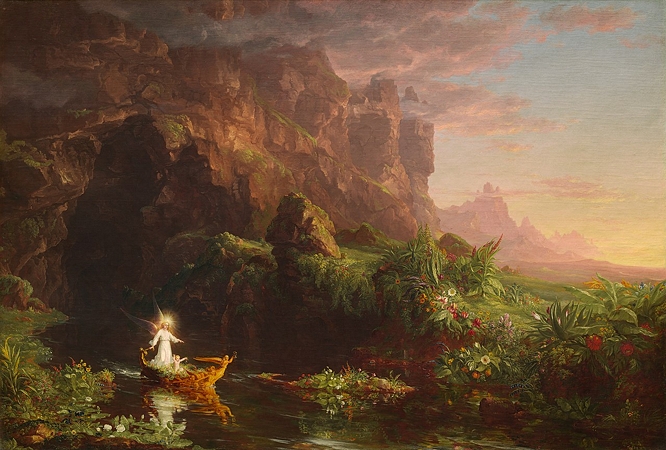
(above: Thomas Cole, The Voyage of Life Childhood, 1842. Picture from National Gallery of Art (Washington, D.C.) Source: Wikimedia Commons - public domain*)
This artistic movement was defined and animated by a profound and productive paradox. On one hand, it cultivated a spiritual, almost mystical reverence for the untamed American wilderness, viewing the landscape as a divine manifestation and a source of moral truth. On the other hand, this very reverence was co-opted to create a powerful visual mythology that justified the nation's aggressive territorial expansion and the "taming" of that same wilderness under the ideological banner of Manifest Destiny.
The Genesis of an American Vision: Defining Romanticism
The intellectual DNA of American Romanticism reveals a complex inheritance, tracing its philosophical origins to Europe but demonstrating a unique and powerful adaptation to the political and geographical realities of the American continent.
A Revolt Against Reason
At its core, Romanticism was an international intellectual current that emerged in the late 18th and early 19th centuries as a direct reaction against the Enlightenment's "Age of Reason". It championed a new set of values, establishing a foundational opposition between its ideals and those of the preceding era. Romanticism celebrated imagination over calculation, intuition over reason, emotion over objective fact, and revolutionary individualism over social conformity.This movement originated in Europe, with philosophical roots in Germany's Sturm und Drang ("Storm and Stress") movement and the visionary works of English poets and artists like William Blake, who pitted the innocence of childhood against the corruption of industrial London. It was a reaction against industrialism and aristocratic norms, calling for a renewed attention to nature and the emotional life of the individual.
The American Adaptation
While the philosophical seeds were European, the soil in which they grew was uniquely American. The movement's delayed flourishing in the United States, roughly from 1830 to 1860, was a crucial distinction from its European counterpart, which peaked between 1800 and 1850. This later emergence was not a sign of cultural immaturity but a prerequisite for its distinct character. The movement's core tenets could only be fully leveraged into a national mythology once the United States had developed a sufficiently strong sense of its own exceptionalism and a political project -- westward expansion -- to which these ideals could be applied. It needed a national narrative before it could create a national art. This timing allowed Romanticism to align with a period of intense national self-definition, becoming the nation's "first, full-fledged literary movement".
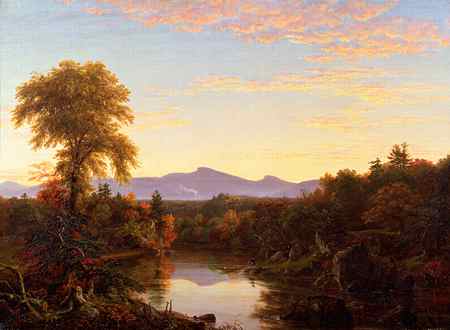
(above: Thomas Cole (American, 1801-1848), Catskill Creek, N.Y., 1845, Oil on canvas, 26 1/2 x 36 inches (67.3 x 91.4 cm). The Robert L. Stuart Collection, S-157) - from Nature and the American Vision: Masterpieces of the Hudson River School)
A key transformation occurred in the perception of nature. The earlier Puritan view of the wilderness as a fallen, demonic space to be feared and conquered was supplanted by the Romantic conception of nature as a divine sanctuary. For American Romantics, the landscape was a sanctum of non-artificiality, a place for spiritual renewal and self-fulfillment where one could connect directly with God.
Unlike European Romanticism, which often looked to an idealized medieval past for its inspiration, American Romanticism looked to a seemingly limitless future embodied by the frontier. The "great unknown" of the West became the physical manifestation of Romantic ideals -- a tangible landscape promising freedom, growth, and boundless opportunity. Furthermore, the Romantic "high regard for individual ego" found a natural home in the political culture of American democracy, which prized individualism and egalitarianism.
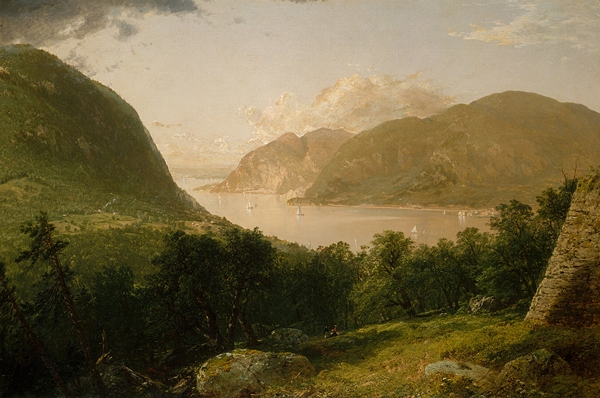
(above: John Frederick Kensett (American, 1816-1872). Hudson River Scene, 1857. Oil on canvas, 32 x 48 inches. The Metropolitan Museum of Art, New York, Gift of H. D. Babcock, in memory of his father, S. D. Babcock, 1907. Public domain, via Wikimedia Commons*)
Transcendentalism: The Philosophical Core
The most potent philosophical expression of American Romanticism was Transcendentalism, a movement centered in New England that lasted from about 1830 to 1860. Led by seminal figures such as Ralph Waldo Emerson, Henry David Thoreau, and Margaret Fuller, Transcendentalism articulated the core belief that divinity permeates all of nature and humanity. It held that ultimate spiritual truth is discovered through individual intuition and experience rather than through the established doctrines of institutional religion. Key texts like Emerson's influential essay Nature (1836), which laid out the movement's main tenets, and Thoreau's Walden (1854), which chronicled his experiment in self-reliant living, provided the intellectual framework for the spiritual reverence of nature that would become central to the writers and painters of the era.
The Landscape as Ideology: Westward Expansion and Manifest Destiny
The Romantic landscape was not merely a subject for aesthetic contemplation; it was the primary ideological canvas upon which the drama of American expansion was justified and glorified, transforming political ambition into a providential quest.
Manifest Destiny: A Doctrine of Providence and Progress
"Manifest Destiny" was the pervasive 19th-century belief that the United States' expansion across North America was not only inevitable but divinely ordained. This ideology, which drove American foreign policy from 1830 to 1860, was a potent fusion of romantic nationalism and a sense of American exceptionalism. The doctrine rested on three core tenets: the assumption of the unique moral virtue of the United States, the assertion of its mission to redeem the world by spreading republican government, and an unshakeable faith in the nation's divinely ordained destiny to succeed in this mission.
This belief system was translated into concrete political and military actions. The ideology of Manifest Destiny served as the rationale for policies such as the Indian Removal Act of 1830, the annexation of Texas in 1845, and the Mexican-American War of 1846-1848. The justification for the forced removal of Native American tribes -- that they were not cultivating the land to its "full potential" and were thus "wasting" it -- was a key argument used to rationalize the seizure of their native homelands.
The Landscape as Justification
The aesthetic of the sublime -- the feeling of awe mixed with terror before the power of nature -- served a dual and contradictory ideological function in this context. On one hand, it fostered a genuine, spiritual reverence for the wilderness that contained the seeds of a future environmentalist movement, a call for preservation in the face of industrial encroachment. Simultaneously, it framed that wilderness as a chaotic, formidable force that required the heroic, ordering hand of American civilization to tame it. This provided an aesthetic rationalization for the very expansion that would ultimately destroy the wilderness being celebrated.
The terrifying storm in a Romantic painting is not just an aesthetic effect; it is a dramatic challenge. The pastoral, settled landscape that often appears in the same frame is the visual representation of the successful answer to that challenge. Thus, celebrating the sublime power of the wilderness was also a way of celebrating the even greater power of the American spirit destined to domesticate it. The paintings of the Hudson River School, while celebrating nature, simultaneously presented the American landscape in a way that aligned perfectly with the tenets of Manifest Destiny. They depicted a vast, majestic, and, crucially, empty continent -- a new Eden or "Promised Land" seemingly untouched by civilization and awaiting American settlement.
Please don't rely on this AI-generated text for accuracy. It has been edited, yet may have inaccurate information. Consider it a base for further inquiry. Links are ours. Nonessential parts of the report were deleted.
*Tag for expired US copyright of object image:

See our Museum of American Art, sponsored by Traditional Fine Arts Organization, Inc., an Arizona nonprofit corporation. All rights reserved. © 2025
Links to sources of information outside of this website are provided only as referrals for your further consideration. Please use due diligence in judging the quality of information contained in these and all other web sites. Information from linked sources may be inaccurate or out of date. TFAO neither recommends or endorses these referenced organizations. Although TFAO includes links to other web sites, it takes no responsibility for the content or information contained on those other sites, nor exerts any editorial or other control over them. For more information on evaluating web pages see TFAO's General Resources section in Online Resources for Collectors and Students of Art History.