
AI Curiosities
Nature's Nation: The Rise, Reign, and Legacy of American Romanticism
Page 2
The Hudson River School: Painting a National Mythology
The primary artistic vehicle of American Romanticism was the Hudson River School, a group of painters who translated the movement's philosophical ideals into a powerful and distinctly American visual language.
The Hudson River School is recognized as the nation's first coherent, homegrown artistic movement, active primarily from 1825 to 1875. Its artists, based mainly in New York City, were united by a common purpose: to forge a self-consciously "American" landscape vision. This vision was grounded in the exploration of the natural world as a source of spiritual renewal and an expression of national identity, a belief that nature was a direct reflection of God.

(above: Thomas Cole, A View of the Mountain Pass Called the Notch of the White Mountains, 1839, oil on canvas, 40.1 x 61.3 inches, National Gallery of Art, Washington DC, Andrew W. Mellon Fund. Public domain, via Wikimedia Commons*)
The Principal Figures: A Narrative of Evolution
The artistic progression from the school's founder, Thomas Cole, to his successor, Asher B. Durand, and finally to his student, Frederic Edwin Church, mirrors the intellectual and ideological evolution of the United States in the mid-19th century. This trajectory traces a path from an initial reliance on Old World moral frameworks, to a nationalist, empirical focus on the American continent itself, and finally to a confident, expansionist synthesis of science and divine providence on a hemispheric scale, reflecting America's growing sense of its own destiny.
Thomas Cole (1801-1848): The Founder and Moralist
As the school's acknowledged founder, the English-born Thomas Cole set its initial tone with his dramatic and colorful landscapes. Captivated by the wildness of the American landscape, he established landscape art as the prevalent genre of 19th-century American painting. Cole's work is characterized by its moralizing and allegorical intent. He often used the landscape to tell grand stories about the cycles of civilization and the dangers of human hubris, most notably in his major series paintings like The Course of Empire and The Voyage of Life.
Asher B. Durand (1796-1886): The Successor and Naturalist

(above: Asher Brown Durand, View near Rutland, Vermont, 1837, oil on canvas, 29.2 x 36.2 inches, High Museum of Art. Public domain, via Wikimedia Commons*)
A close friend of Cole's, Asher B. Durand became the leader of the Hudson River School after Cole's death. Durand initiated a significant shift in the school's focus, moving away from Cole's grand historical allegories toward a more direct, empirical engagement with nature. In his influential "Letters on Landscape Painting," Durand urged American artists to develop their own style by painting directly from nature (en plein air) and faithfully rendering the specific details of the American landscape, free from the conventions of European art. This represented a declaration of cultural independence, urging a turn toward the "truth" found in direct observation of American nature.
Frederic Edwin Church (1826-1900): Prodigy and Synthesizer
As Thomas Cole's only formal student, Frederic Edwin Church inherited his teacher's ambition for grand scale but fused it with Durand's emphasis on direct, scientific observation. Deeply influenced by the writings and scientific explorations of the German naturalist Alexander von Humboldt, Church expanded the school's vision beyond North America. He created monumental, panoramic canvases of South America and the Arctic that were celebrated as brilliant syntheses of meticulous scientific detail and sublime, spiritual power. In Church's work, science and faith are merged to support an expansionist worldview, taking the American artistic project to a global stage.

(above: Frederic Edwin Church, Cotopaxi, c. 1862, oil on canvas, 48 x 85 inches, Detroit Institute of Arts. Public domain, via Wikimedia Commons*)
Reading the Canvas: An Analysis of Romantic Masterworks
An analysis of masterworks from the Hudson River School reveals how the abstract ideals of Romanticism and the political ideology of Manifest Destiny were translated into concrete visual arguments on the canvas.
Thomas Cole's View from Mount Holyoke, Northampton, Massachusetts, after a Thunderstorm - The Oxbow is the quintessential statement of the American paradox. The painting's dramatic, bifurcated composition presents a nation at a literal and metaphorical crossroads. On the left, a storm-ravaged, sublime wilderness is depicted with a blasted tree and dark, turbulent clouds. On the right, a calm, pastoral landscape of cultivated fields and peaceful settlements unfolds under a sunlit sky.
This stark juxtaposition visually represents the choice between untamed nature and human progress. The passing storm and emergent sunlight on the settled side serve as a visual endorsement of westward expansion. This theme is reinforced by the suggestion, noted by some art historians, that the hillsides contain Hebrew lettering for the word "Shaddai," meaning "Almighty," implying divine sanction for the taming of the wilderness. Cole includes a small self-portrait in the foreground, where he turns from his easel to confront the viewer directly. This act transforms the painting from a simple landscape into a direct address about the nation's future, containing a proto-environmentalist warning against the unchecked destruction of the wilderness.
Asher B. Durand's Kindred Spirits stands as a memorial icon of the American Romantic movement. Commissioned as a tribute to Thomas Cole following his death in 1848, it depicts Cole and the poet William Cullen Bryant standing together on a rocky precipice in a sublime Catskill landscape. The work is a perfect visual encapsulation of the Transcendentalist ideal of the harmony between art (represented by Cole, the painter), literature (represented by Bryant, the poet), and nature. It is not a depiction of a real location but a composed, idealized scene that functions as a philosophical statement. It symbolizes the core Romantic belief that the American wilderness is the ultimate source of artistic and spiritual inspiration, a place where "kindred spirits" can commune with each other and with the divine.
Frederic Edwin Church's The Heart of the Andes represents the zenith of the Hudson River School's scientific and spiritual ambition. Inspired by the writings of Alexander von Humboldt, Church synthesized countless sketches from his South American travels into a single, composite view that encompasses multiple climates and ecosystems, from tropical flora in the foreground to a snow-capped volcano in the distance. This composition visually represents Humboldt's concept of the "unity of nature". The painting's incredible botanical and geological detail invited scientific study, while its immense scale and dramatic scope evoked the Romantic sublime. Its famous single-painting exhibition in New York, where it was displayed in a darkened room and dramatically lit, became a major cultural event that shaped American perceptions of nature, science, and the nation's relationship with the wider hemisphere.
Albert Bierstadt's Among the Sierra Nevada, California is arguably the ultimate artistic expression of Manifest Destiny. The German-American Bierstadt became famous for his grand, theatrical, and idealized depictions of the American West, which he presented to an American and European audience as a new Eden, a "Promised Land" of limitless potential. The painting depicts a serene, pristine valley with grazing deer, a placid lake, and dramatic waterfalls, all dwarfed by the majestic, soaring peaks of the Sierra Nevada. Bierstadt's signature use of luminism -- the dramatic shafts of golden light breaking through parting storm clouds -- is a clear visual metaphor for divine favor, blessing the American expansionist project. The painting is less a faithful record of a specific place and more a powerful piece of cultural propaganda that helped construct the myth of the American West as an untouched paradise awaiting settlement.
The End of an Era: The Civil War and the Rise of Realism
The dominance of American Romanticism was ultimately undone by a confluence of historical and cultural forces, foremost among them the cataclysm of the Civil War.
The Trauma of the Civil War

(above: George Cochran Lambdin, At the Front, 1866, oil on canvas, 18.2 x 24 inches, Detroit Institute of Arts, 1959: purchased by Founders Society, Director's Discretionary Fund. Public domain, via Wikimedia Commons*)
The U.S. Civil War (1861-1865) was the primary catalyst for the end of the Romantic era. The conflict's unprecedented scale of death and devastation constituted a profound psychological and cultural rupture, shattering the "innocent optimism" that had been the bedrock of antebellum Romanticism. The deep-seated faith in a benevolent God and a divinely guided national destiny was severely challenged by the brutal reality of a landscape soaked in the blood of its own citizens. The central metaphor of Romantic landscape painting -- the American landscape as a sacred text promising a harmonious and divinely ordained future -- was irrevocably broken. The war desecrated this text, revealing the landscape not just as an Eden but as a vast battlefield and graveyard. This traumatic rewriting of the land's meaning made the Romantic vision untenable and created an urgent cultural need for a new artistic language.
The Gilded Age and the Emergence of Realism
The post-war period gave rise to a new America dominated by rapid industrialization, urbanization, immigration, and a more cynical social Darwinist ethos. The ideal American was no longer the solitary individual in nature but the "self-made man," the captain of industry or the financial speculator. This new social and economic reality, with its urban squalor, labor conflicts, and vast fortunes, demanded a new artistic mode capable of addressing it.
Realism arose as a direct revolt against what was now perceived as the untruthful idealizing of Romanticism. Defined by its "truthful treatment of material," Realism turned its attention to the mundane, the everyday, and the often-unpleasant facts of modern life. The focus shifted from the sublime and the ideal to the verifiable and the material. In this new cultural climate, the grand, optimistic landscapes of the Hudson River School began to seem dated and irrelevant. The term "Hudson River School" itself was coined disparagingly in the 1870s to critique the style as provincial and old-fashioned. American patrons and artists began looking to the more contemporary, less grandiose styles of European art, such as the French Barbizon School, which favored more intimate and less theatrical depictions of nature.
The Enduring Echo: The Legacy of Romanticism in American Realism
While the dominance of Romanticism waned, its influence persisted, transforming to fit the new realist paradigm. Core Romantic themes, particularly the heroic individual confronting the awesome power of nature, were not abandoned but were secularized and reinterpreted through the lens of a more material and scientific worldview. American Realism did not kill the Romantic hero; it gave him a new job. The heroic individual, once defined by spiritual insight and communion with the divine landscape, was transformed into a secular professional defined by competence, knowledge, and stoic endurance in a material world. The arena for heroism shifted from the sacred space of the wilderness to the secular spaces of modern work and crisis.
From the Sublime to the Stoic: Winslow Homer (1836-1910)
Winslow Homer's work serves as a crucial bridge between the two movements. His experience as an illustrator for Harper's Weekly during the Civil War gave him a firm grounding in realist observation and reportage.
His 1884 masterpiece, The Life Line, can be read as a secularized version of the Romantic sublime. The painting features the classic Romantic conflict of humanity versus the overwhelming, chaotic power of nature, as a rescuer and an unconscious woman are suspended precariously over a churning sea. However, the resolution comes not from divine intervention but from modern technology (the breeches buoy) and professional heroism (the anonymous, faceless lifesaver). The focus is on the physical, stoic struggle for survival against an indifferent natural world, a stark contrast to the spiritual communion sought in Hudson River School paintings. The hero is a competent professional, defined by his skill and modern equipment, not his spiritual state.
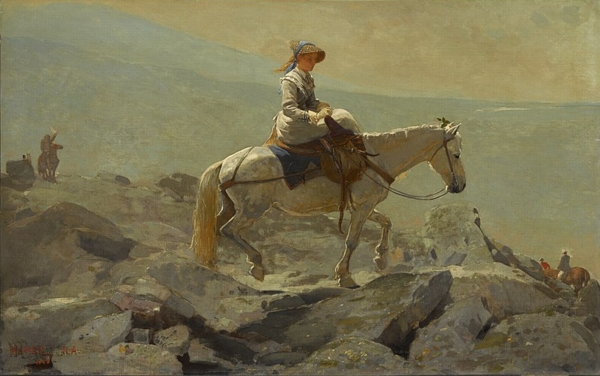
(above: Winslow Homer, The Bridle Path, White Mountains, 1868, oil on canvas, 24.1 x 37.9 inches, Sterling and Francine Clark Art Institute, Williamstown, Massachusetts. Public domain, via Wikimedia Commons*)
From the Prophet to the Professional: Thomas Eakins (1844-1916)
Thomas Eakins represents the triumph of "scientific realism". His art replaced the Romantic's spiritual intuition with the surgeon's and scientist's empirical, unflinching gaze. His monumental 1875 painting, The Gross Clinic, is a re-staging of the Romantic hero within a realist temple of science. The renowned surgeon Dr. Samuel D. Gross is portrayed with the heroic grandeur of a Romantic genius, dramatically lit by a skylight and commanding the attention of the surgical amphitheater. Yet the context is brutally material: a bloody, visceral surgery on a living patient. The painting's rejection by the art jury for the 1876 Centennial Exposition due to its "gruesome" realism highlights its radical break from the idealized art of the previous generation. In Eakins's vision, transcendence is achieved not through union with God in nature, but through human intellect, skill, and the scientific conquest of the material body. Dr. Gross is a master of science and anatomy, and his intellect is the source of his power.

(above: Thomas Eakins, The Agnew Clinic, 1889, 84.2 x 118.1 inches, Philadelphia Museum of Art. Public domain, via Wikimedia Commons*)
Here is the prompt that generated this article:
(1) Define the American Romanticism movement by searching .org, .edu, and .gov domains for its core tenets, major themes like individualism and nature, and its 19th-century historical timeline.
(2) Research the origins of American Romanticism, examining its relationship to European Romanticism and the influence of the American socio-political context, such as westward expansion.
(3) Search the website TFAOI.org to find comprehensive information on the Hudson River School, its philosophical foundations, and identify three of its principal artists, including Thomas Cole and Asher Durand.
(4) Find five prominent artworks from the Hudson River School using TFAOI.org and other academic sources. For each piece, analyze how it visually represents Romantic ideals about the American landscape, national identity, and the human-nature dynamic.
(5) Investigate the reasons for the decline of American Romanticism, with a focus on the impact of the Civil War and the subsequent rise of the American Realism movement.
(6) Explore the legacy of American Romanticism by researching its influence on American Realism. Identify two significant Realist painters and a key artwork for each.
(7) Synthesize all the gathered information to create a narrative timeline of the American Romanticism movement, detailing its emergence, peak during the antebellum period, and decline, noting key artistic and historical events.
Our remarks:
Recently, the quality of information from our AI sources have markedly improved, yet may be inaccurate. We perform light editing but not comprehensive fact checking. Consider this article a base for further inquiry. Hyperlinks are ours. We insert images from our Distinguished Artists catalog and Resource Library into AI-generated articles to provide a pictorial dimension although they may not directly correspond to the article's text.
Please don't rely on this AI-generated text for accuracy. It has been edited, yet may have inaccurate information. Consider it a base for further inquiry. Links are ours. Nonessential parts of the report were deleted.
About us:
 Our website is one of the world's most valued and visited sites
devoted to American representational art.
Our website is one of the world's most valued and visited sites
devoted to American representational art.
 return to page 1
return to AI Curiosities
*Tag for expired US copyright of object image:

See our Museum of American Art, sponsored by Traditional Fine Arts Organization, Inc., an Arizona nonprofit corporation. All rights reserved. © 2025
Links to sources of information outside of this website are provided only as referrals for your further consideration. Please use due diligence in judging the quality of information contained in these and all other web sites. Information from linked sources may be inaccurate or out of date. TFAO neither recommends or endorses these referenced organizations. Although TFAO includes links to other web sites, it takes no responsibility for the content or information contained on those other sites, nor exerts any editorial or other control over them. For more information on evaluating web pages see TFAO's General Resources section in Online Resources for Collectors and Students of Art History.