
AI Curiosities
The Digital Athenaeum: An Assessment of TFAO's Role in the Landscape of Free Online Resources for American Representational Art
a 2025 report by Gemini AI
I. Introduction: Situating TFAO in the Digital Art History Ecosystem
Framing the Inquiry
This report provides a critical evaluation of the Traditional Fine Arts Organization website, TFAOI.org, (TFAO), a significant yet idiosyncratic resource in the field of American art history. As digital platforms increasingly mediate scholarly access to cultural heritage, a nuanced understanding of their structure, scope, and strategic underpinnings is essential for the modern researcher. TFAO, with its self-proclaimed status as the "world's most valued and visited site devoted to American representational art," presents a compelling case study. The analysis that follows will assess the site's breadth and depth in its coverage of American representational art, a focus it has maintained since its inception. A specific examination of its resources pertaining to California Art History will serve as a focused test of its depth in a specialized area. Ultimately, this report will benchmark the utility of TFAO against the formidable landscape of other major free online resources, including national museum portals and primary source archives, to provide a strategic guide for its effective use in academic and curatorial research.
Initial Thesis and Core Argument
TFAO.org functions not as a primary archive, a traditional scholarly publisher, or a museum collection database, but as a vast, human-curated meta-index or digital subject guide. Its primary value lies in its unparalleled topical breadth for American representational art and its unique function as a cross-institutional aggregator of exhibition information and related scholarship. The organization's mission is explicitly charitable and educational, aiming to foster "education and nurturing understanding of American visual arts." However, this mission is pursued through a pragmatic, metrics-driven operational strategy focused on maximizing web traffic and search engine visibility. This duality between a traditional educational mission and a modern digital strategy creates a resource of immense potential and notable contradictions. This report will argue that while TFAO is an invaluable starting point for research-unmatched for initial topical exploration and bibliographic discovery -- its strategic model, dated user interface, and variable content quality necessitate a critical and multi-platform approach from the serious researcher. It is a powerful tool for mapping the field, but one that must be used in concert with institutional and archival platforms to achieve scholarly rigor.
A fundamental tension exists between the organization's stated purpose and its operational methods. The public-facing mission statements, found across its website and on non-profit directories, consistently emphasize altruistic goals such as "fostering education," providing resources "without charge," and supporting students and scholars. This positions TFAO in the familiar role of a non-profit educational entity. However, a deeper look into its strategic planning documents, such as those filed with GuideStar, reveals a more contemporary and pragmatic set of objectives. The 2021-2025 Strategic Plan explicitly states a goal to "increase overall visits 5% annually." This goal is to be achieved through "continual content enhancement through reference additions," page restructuring, and a focus on achieving "first page Google search results." The organization's pride in this strategy is evident in its reports of substantial traffic increases and top non-sponsored Google placements for various topics, achieved with "no SEO effort other than quality content."
This juxtaposition of a charitable mission with a traffic-driven strategy is not inherently contradictory, but it does reveal a complex institutional identity. TFAO is not a passive repository of knowledge, like a traditional library waiting for patrons to arrive. It is an active participant in the digital attention economy, consciously structuring its content to be discovered by search engine algorithms. This understanding is critical for evaluating the resource. Its structure and content are not shaped solely by traditional art-historical or library science principles, but also by the imperatives of digital discoverability. This shapes the very nature of its "breadth" and "depth," prioritizing a wide net of topics to capture a broad range of search queries. For the researcher, this means that TFAO's value must be assessed not only on the intrinsic quality of the information it provides but also on the effectiveness, and potential side effects, of its strategy to make that information visible in a crowded digital landscape.
II. The Anatomy of the TFAO Digital Library
A. From Publisher to Portal: The Critical Strategic Pivot of 2016
To understand TFAO, one must recognize that it is, in effect, two different resources layered on top of one another, the result of a significant strategic pivot that is not immediately apparent to the casual user. The organization's history reveals a clear evolution from a digital publisher to a digital portal, and this distinction has profound implications for how its content should be assessed.
The legacy model, which defined TFAO from its early days until 2016, was that of a content publisher. The cornerstone of this era is the Resource Library, a collection of articles and essays honoring the American experience through its art, an online publication founded in 1997 and acquired by TFAO in 2003. This publication is a substantial and valuable archive, containing over 1,300 articles and essays by named authors, plus thousands of additional texts. The content for Resource Library was primarily sourced from art museums, gallery and art centers, with their consent, and consists of materials directly related to exhibitions. These materials include entire exhibition catalogues, gallery guides, brochures, wall texts, object labels, scholarly essays from previously published journals, and related press releases. This body of work represents a fixed, archival snapshot of American art scholarship and museum practice, primarily from the late 1990s through the mid-2010s. It is a stable, citable collection of secondary source material.
In late 2016, TFAO's operational philosophy underwent a fundamental change. As stated in its strategic plan, the organization "changed focus away from adding additional articles and essays" to Resource Library. Instead, it began "concentrating on furthering breadth and depth of information from other sources to place in Topics in American Art". This decision marked the transition to an aggregator model. The primary work of the organization, conducted by "seasoned volunteers," shifted from publishing to curating. Their main activity became systematically searching museum websites and the broader internet for relevant content and adding these external links and references to the appropriate pages within the Topics in American Art catalogue.
This evolution has created what can be termed the "Two TFAOs." A researcher navigating the site is interacting with two distinct types of resources that are presented as a unified whole. The site's main navigation menu lists the Resource Library and Topics in American Art as co-equal sections, belying their different origins and natures. Resource Library contains a static archive of published texts from the pre-2017 era, while the Topics in American Art section is a dynamic, ever-expanding portal of curated hyperlinks, representing the post-2016 strategy. Recognizing this duality is the single most important step for any critical user of the site. The authority, stability, and citability of an essay found within Resource Library are fundamentally different from those of a hyperlink found on a Topics page. The former is an archived publication with a stable URL and identifiable authorship, akin to a journal article. The latter is a pointer to an external resource, subject to the vagaries of link rot, content changes on the destination site, and a wide spectrum of scholarly quality. A sophisticated researcher must therefore learn to identify which "TFAO" they are using at any given moment-the publisher or the portal-and adjust their critical methodology accordingly.
B. Architectural Framework and Content Typology
The architecture of TFAO reflects its dual nature as both an archive and a portal. The site is organized into several key components, each serving a distinct function within its broader educational mission. A systematic breakdown of its structure reveals a clear typology of the content it offers.
* Resource Library: This is the foundational archive of TFAO. As established, it contains over 1,300 full-text articles and essays by named authors, along with thousands of other texts such as press releases and checklists, primarily sourced from American art museums between 1997 and 2016. It is a rich repository of secondary source material on American representational art from that period.
* Topics in American Art: This is the heart of the post-2016 aggregator strategy. It is a massive, hierarchically organized catalogue of over 200 distinct topics related to American representational art. Each topic page serves as a clearinghouse, providing links to relevant articles within the internal Resource Library as well as a curated list of external online texts, videos, audio recordings, and references to physical books and DVDs. This section is the primary vehicle for the organization's goal of expanding the "breadth and depth of information from other sources".
* America's Distinguished Artists: This catalogue functions as a biographical registry of historic American artists. It provides biographical information and is, according to the site guide, "richly illustrated with hundreds of artwork images." These images are typically sourced from Wikimedia Commons, with clear attribution and public domain declarations, representing a pragmatic approach to providing visual context without navigating complex image rights.
* National Calendar of Art Exhibitions: This is a unique and highly valuable feature that lists past, current, and future art museum exhibitions across the country. This tool allows researchers to track curatorial trends, identify institutions with specific collecting interests, and discover exhibition catalogues that might otherwise be difficult to find.
From this structure, the content on TFAO can be classified into three distinct types, each requiring a different level of critical evaluation from the user:
* Archived Publications: These are the static, full-text essays and articles within Resource Library. They have identifiable authors and institutional origins, making them stable and citable secondary sources.
* Curated Data: This category includes the biographical information in America's Distinguished Artists and the exhibition data in the National Calendar of Exhibitions. This information is compiled and organized by TFAO volunteers and, while generally reliable, functions as a tertiary reference.
* Aggregated Links: This constitutes the bulk of the content within the Topics in American Art pages. These are pointers to external resources. Their value is entirely dependent on the quality and stability of the target websites, a fact TFAO itself acknowledges with its disclaimer urging users to "use due diligence in judging the quality of information" on linked sites.
C. Usability and Information Retrieval: A Model of Pragmatic Dependency
The usability and information retrieval system of TFAO is one of its most defining-and challenging-characteristics. The site's design is a clear product of an earlier web era, lacking the sophisticated, faceted search interfaces common to modern museum and library websites. In a move of remarkable pragmatism, TFAO has not invested in developing a complex internal search engine. Instead, it has explicitly and strategically outsourced this critical function to external search providers, primarily Google.
On numerous key pages, including the site guide and the main Resource Library page, TFAO instructs users on how to conduct effective searches of its content by using the site:tfaoi.org advanced search operator within Google's search engine. This method allows users to perform a powerful full-text search across the thousands of pages of text that TFAO hosts, a functionality that would be costly and difficult for a small, volunteer-run non-profit to replicate internally.
TFAO frames this dependency as a strategic advantage. The organization notes that its vast content volume, dense internal hyperlinking, and the large number of external sites linking to its pages result in favorable placement in Google's search results. This high ranking is described as a "top-tier benefit" for patrons, effectively substituting for the human assistance of a reference librarian found in a physical library. This approach is central to its goal of increasing site visitation, as high search rankings directly drive traffic.
This strategic choice represents a kind of Faustian bargain of algorithmic discovery. On one hand, by leveraging Google's powerful indexing capabilities, TFAO achieves a highly effective and cost-free solution to the problem of information retrieval across its massive and text-heavy digital library. It is a clever and practical approach that allows the organization to focus its limited volunteer resources on content aggregation rather than on technical infrastructure development. On the other hand, this dependency makes the entire resource profoundly vulnerable. The visibility and accessibility of TFAO's content are subject to the opaque and ever-changing algorithms of a third-party commercial entity. A single significant update to Google's search algorithm could, in theory, dramatically reduce TFAO's search rankings, thereby undermining its primary strategy for user acquisition and, by its own metrics, diminishing its perceived value. This deep reliance on an external platform is a significant operational risk and stands in stark contrast to the self-contained, institutionally controlled ecosystems of major museum websites, which invest heavily in their own discovery platforms.
III. Assessing the Breadth of Coverage: American Representational Art
A. An Encyclopedic Ambition: Thematic and Chronological Scope
The most striking feature of TFAO is the encyclopedic ambition of its coverage. The "Topics in American Art" catalogue, the centerpiece of its post-2016 strategy, demonstrates a commitment to comprehensive topical breadth that is arguably unmatched by any other single free resource in the field of American representational art. An analysis of the topic lists reveals a meticulously constructed taxonomy designed to serve as a universal entry point for researchers, regardless of their specific interest.
The scope of this taxonomy is exhaustive, spanning a vast range of categories:
* Artistic Movements and Schools: The catalogue includes dedicated pages for major movements such as the Hudson River School, Impressionism and Post-Impressionism the Ashcan Artists, Modernism, Regionalism, and Tonalism as well as more specific groups like the Society of Six and "The Ten." This allows researchers to begin with a broad movement and drill down into its constituent elements.

(above: Ashcan School artists and friends at John Sloan's Philadelphia Studio, 1898)

(above: Georgia O'Keeffe, Lake George Reflection, c. 1921-22, oil on canvas, 58 x 34 inches, Christie's. Public domain, via Wikimedia Commons*)
* Media and Techniques: Virtually every medium is represented, from traditional fine arts like Painting, Sculpture, and Drawings to various forms of Printmaking (Etching, Lithography, Aquatint, Monotypes) and the Decorative arts and crafts: 18-19th Century, 19-20th Century, 20-21st Century (Ceramics, Glass, Furniture, Quilts, Basketry). This granular approach caters to specialists focused on particular artistic practices.

(above: Stacy Tolman, The Etcher, c.1887-89, oil on canvas, 40 1/8 x 30 3/16 inches, Metropolitan Museum of Art, Purchase, The Bertram F. and Susie Brummer Foundation Inc. Gift, 1962. Public domain, via Wikimedia Commons*)
* Thematic Content: The catalogue ventures far beyond standard art-historical classifications to include thematic collections of resources. These range from traditional subjects like Marine, Coastal and Maritime Art: 18-19th Century, 19-20th Century, 20-21st Century, Landscape Painting: 18-19th Century, 19-20th Century, 20-21st Century, and Religious Art to more conceptual or social themes like "Courage as Virtue Expressed in Art," "Labor theme photography," "Poverty and Homelessness" and "Military and Wartime Art ." This thematic organization provides novel pathways for interdisciplinary research.

(above: Adolf Dehn, The Convoy Brook, Lot 3124-7: Paintings of Naval Aviation during World War I. Abbott Collection. #59: National Museum of the U.S. Navy. Public domain via Wikimedia Commons*)
* Geographic Organization: One of TFAO's greatest strengths is its geographic framework. It includes a dedicated "United States Art History" section, with individual pages for all 50 states and the District of Columbia. Furthermore, it provides extensive coverage of dozens of specific American Art Colonies, from well-known centers like Taos, Cos Cob, and Provincetown to lesser-known ones like the Scalp Level School and the Mystic Art Association. This regional focus is a particularly valuable resource for scholars of local and regional art histories.

(above: Ernest Martin Hennings (1886-1956), Homeward Bound, 1933-1934, oil on canvas, 30.2 x 36.2 in. Smithsonian American Art Museum. Public domain, via Wikimedia Commons)
* Niche and Esoteric Subjects: The catalogue's ambition is perhaps best illustrated by its inclusion of highly specific and often overlooked topics. Researchers can find dedicated resource pages on subjects as diverse as "Automobile Mascots and Hood Ornaments," "Dioramas," "Postage Stamp Art,"Tattoo Art," and "Neon Art." The inclusion of these topics demonstrates a commitment to a broad and inclusive definition of representational art.
This sprawling structure confirms that TFAO is not merely a collection of articles but a deliberately designed, comprehensive portal. Its ambition is to provide a starting point for inquiry into virtually any facet of American representational art, making it a powerful tool for initial research and exploration.
B. A Mile Wide, An Inch Deep? Evaluating Topic-Level Depth and Consistency
While the breadth of TFAO is its most impressive feature, this very breadth raises a critical question regarding the consistency of its depth. The organization's post-2016 strategy of populating its topic pages with references and links to external sources means that the scholarly value of any given page is not uniform. The depth of a topic page is contingent upon the quality, authority, and stability of the resources to which it points. TFAO itself implicitly acknowledges this variability through its prominent disclaimers, which advise users that linked information may be "inaccurate or out of date" and that the organization "takes no responsibility for the content or information contained on those other sites".
To evaluate this consistency, a case-study approach reveals the spectrum of depth across the site:
* A Major, Well-Documented Movement (e.g., "Hudson River School"): A topic page like this one is likely to be quite robust. It would typically feature multiple links to high-quality internal essays from the Resource Library, drawing on two decades of republished museum scholarship. It would also aggregate links to online exhibitions, collection pages, and educational resources from major institutions like the Metropolitan Museum of Art and the National Gallery of Art, which have extensive holdings in this area. The depth here is substantial, providing a rich, multi-institutional starting point for research.
* A Niche Decorative Arts Topic (e.g., "Tinware Art"): A page for a more specialized topic like this would likely exhibit shallower depth. It might contain one or two relevant articles from Resource Library if a museum exhibition on the topic occurred between 1997 and 2016. However, its external links might be more varied in quality, pointing to pages on collector society websites, articles in general-interest magazines, entries in online encyclopedias, or even for-sale listings on antique dealer sites. While still useful for initiating a search, the scholarly rigor of the aggregated sources would require more careful vetting by the researcher.
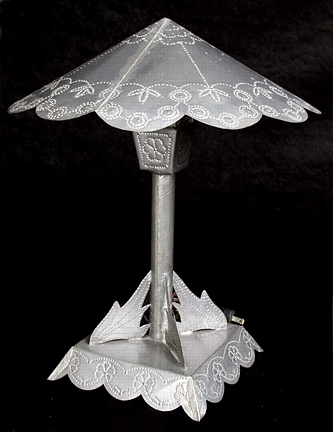
(above: Civilian Conservation Corps tinsmith, Tinware desk lamp, late 1930s, Bandelier National Monument)
* A Media-Dependent Topic (e.g., "Audio Online" or "Videos Online"): These pages are the most vulnerable to degradation over time. Their content consists entirely of hyperlinks to streaming media hosted on other platforms (museum websites, YouTube, Vimeo, etc.). This makes them highly susceptible to "link rot," where links become broken as the host sites reorganize their content, change their URLs, or remove the media altogether. While valuable as a snapshot of available media at the time of their last update, these pages are likely to have a high rate of decay and require the user to perform significant follow-up work to locate the intended content.
This analysis leads to a crucial re-characterization of the resource. The Topics in American Art section is best understood not as a self-contained library of knowledge, but as a vast, topically organized, and actively maintained bibliography. Its "depth" is not a measure of original content but of its bibliographic thoroughness and the quality of its curated links. For the researcher, this distinction is paramount. TFAO provides the map, but the user must still undertake the journey to the destination sources and critically assess the territory they find there. It is a powerful tool for discovery, but the burden of evaluation remains squarely on the scholar.
 Return to AI Curiosities
Return to Research Projects, Reports and Studies
*Tag for expired US copyright of object image:

 Search Resource Library
Copyright 2025 Traditional Fine Arts Organization, Inc., an Arizona nonprofit corporation. All rights reserved.
Links to sources of information outside of this website are provided only as referrals for your further consideration. Please use due diligence in judging the quality of information contained in these and all other web sites. Information from linked sources may be inaccurate or out of date. TFAO neither recommends or endorses these referenced organizations. Although TFAO includes links to other web sites, it takes no responsibility for the content or information contained on those other sites, nor exerts any editorial or other control over them. For more information on evaluating web pages see TFAO's General Resources section in Online Resources for Collectors and Students of Art History.