
Henry Worrall, Bard of the Plains
by Gemini 3
December, 2025
When we picture the artists of the Old West, we usually imagine rugged adventurers wrestling easels up mountain peaks or sketching from the back of a galloping horse. We think of Remington or Russell, men who seemed to embody the very dust and grit of the frontier. But if you look closely at the history of Kansas, the man who arguably did the most to shape its visual identity wasn't a cowboy at all. He was a guitar-playing glass cutter from Liverpool named Henry Worrall. His story is one of the most delightful oddities of Western history -- a tale of how a British immigrant with a wicked sense of humor and a knack for woodcuts helped invent the popular image of the Great Plains.
Henry Worrall's journey to the American frontier began a long way from the buffalo grass. Born in Liverpool, England, in 1825, he crossed the Atlantic as a ten-year-old boy. His family didn't stop at the coast; they pushed inland to Buffalo and then to Cincinnati, which was then a bustling western boomtown in its own right. It was there, in the "Queen City," that Worrall started collecting the eclectic set of skills that would define his later career. He didn't go to a fancy art academy in Paris or London. Instead, he worked as a glass cutter. If you look at his later illustrations, you can almost see the influence of this trade. His style relies on sharp, precise lines and clear contrasts -- the kind of confident hand you need when one slip means ruining a sheet of glass.
But Worrall wasn't just cutting glass; he was also cutting tracks, to use a modern phrase. He was a highly respected guitar teacher and composer in Cincinnati. He even published instruction books like The Eclectic Guitar Instructor. This musical side of him wasn't just a hobby; it was a huge part of his personality. He was a performer, a prankster, and the kind of guy who would serenade a roomful of friends just for the laugh. He co-founded the Cincinnati Sketch Club, rubbing shoulders with the city's artistic elite, but he was essentially self-taught as an artist. He learned by doing, by observing, and by hanging out with other creative souls.
In 1868, at the age of forty-three, Worrall decided to head further west. He packed up his family and moved to Topeka, Kansas. Now, you have to understand what Kansas was like in the popular imagination at that time. People called it the "Great American Desert." They thought it was a parched wasteland where nothing would grow. Worrall's friends back in Cincinnati actually teased him about it, warning him that he was moving to a place where he'd dry up and blow away. But Worrall, with his unshakeable optimism and that "puckish humor" he was famous for, decided to prove them wrong. In fact, he was known to be the only regular subscriber to the British satirical magazine London Punch in the entire state of Kansas, which tells you a lot about his worldview. He saw the absurdity in everything.
This sense of humor led to his most famous and controversial creation. In 1869, to clap back at his skeptical friends in Ohio, Worrall drew a charcoal sketch titled "Drouthy Kansas." The title was sarcastic -- "drouthy" being a dialect word for thirsty or dry. The image was a masterpiece of visual hyperbole. It depicted a Kansas farmyard that was positively drowning in abundance. In the sketch, the corn stalks are so tall that men have to climb ladders to harvest the ears. The watermelons and pumpkins are the size of boulders, dwarfing the livestock. Sweet potatoes are so heavy they have to be hoisted out of the ground with cranes. In the background, just to really drive the point home, a river is flooded and washing a house away. It was a visual joke, a way of saying, "You think it's dry here? Look at this!".
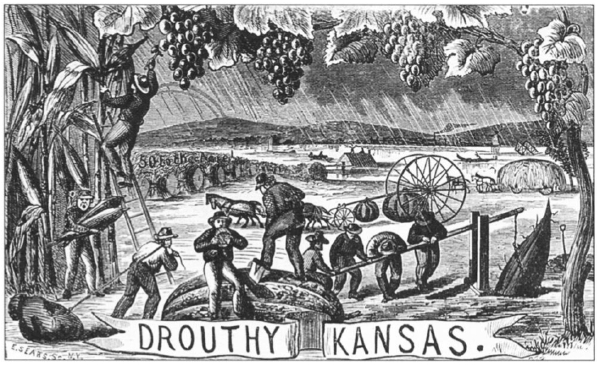
(above: Henry Worrall, Drouthy Kansas, 1869, oil on canvas. Public domain, via Wikimedia Commons*)
The sketch became a sensation. It wasn't just a joke between friends anymore; it became the ultimate propaganda tool. The Kansas State Board of Agriculture loved it. They turned it into a poster and plastered it everywhere to lure settlers to the state. It worked, too. Thousands of people moved to Kansas with visions of giant vegetables dancing in their heads. But there was a dark side to this success. When a real drought hit in 1874, followed by a devastating plague of grasshoppers that ate everything in sight, those settlers weren't laughing. Some of them actually cursed Worrall, blaming his "diabolical seductiveness" for tricking them into moving to a disaster zone. It's a rare artist who can claim their work actually changed the population demographics of a state, for better or worse.
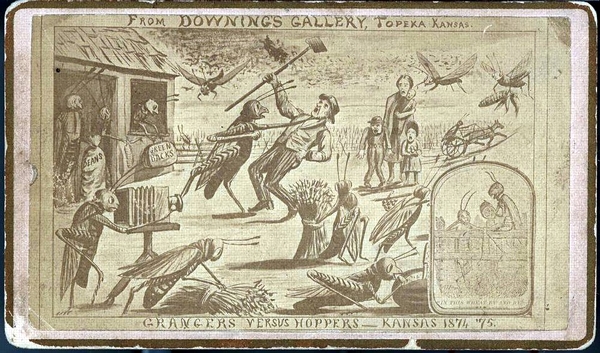
(above: Henry Worrall, Cartoon
showing Kansas farmers battling locusts, 1874-1875. Public
domain, via Wikimedia Commons*)
Despite the backlash, Worrall kept drawing. He became the go-to illustrator for the realities of the frontier. When Joseph McCoy, the famous cattle baron of Abilene, wrote his book Historic Sketches of the Cattle Trade of the West and Southwest in 1874, he hired Worrall to do the illustrations. This is where Worrall's value as a historian really shines. He went out to the cow towns and the railheads and sketched what he saw. He drew the branding of the calves, the chaotic river crossings, and the layout of the shipping pens. He didn't just romanticize the cowboys; he documented their industry. He drew the "Dance-House" where the drovers spent their pay, capturing the rowdy social life of the frontier without necessarily judging it. His background as a draftsman meant he cared about the mechanics of things, so his drawings of cattle chutes and fences are so accurate that historians can use them to understand how the business actually worked.
He also illustrated a book called Buffalo Land by W.E. Webb. This book was a humorous account of a "scientific and sporting party" exploring the plains, and it was the perfect vehicle for Worrall's wit. One of his funniest illustrations from this book is called "Taking and Being Taken." It shows a photographer out on the prairie, trying to get a majestic shot of a buffalo. But the tables turn, and the buffalo charges the photographer, sending him and his equipment flying. It's a "topsy-turvy" moment where nature fights back against the observer, and it shows that Worrall understood the ridiculousness of Easterners trying to tame the Wild West with their cameras and tripods.
But Worrall wasn't just about jokes and cows. He was also a witness to deep social change. In 1879, he documented the "Colored Exodus," a massive migration of African Americans fleeing the post-Reconstruction South for the free soil of Kansas. Worrall sketched the scene at the fairgrounds in Topeka, where temporary barracks had been set up to house the refugees. He drew the "Religious Services in the North Wing of Floral Hall," capturing the community and faith of these "Exodusters" in a respectful and documentary way. For a man who spent so much time making caricatures, he knew when to shut up and record history as it happened.
Later in his life, he was there for the closing act of the frontier: the opening of the Cherokee Strip in 1893. He sketched the "Grand Rush at Noon," capturing the kinetic madness of thousands of people racing to claim land. It was a fitting subject for him. He had spent his career inviting people to the empty spaces of the West, and now he was documenting the moment those spaces finally filled up.
Critically, Worrall is admired today not because he was a master painter in the classical sense -- you won't find his oil portraits hanging in the Louvre -- but because he was the ultimate "pictorial recorder." He was there. He saw the transition from buffalo herds to wheat fields, and he drew it all with a sharp, observant eye. Critics value his work because it is a primary source. If you want to know what a Kansas farm looked like in 1870, or how a cattle drive actually moved, you look at Worrall. His art wasn't about high-minded aesthetics; it was about utility, storytelling, and persuasion.
There is one final, fascinating twist to Henry Worrall's legacy that has nothing to do with drawing. Remember that guitar tune he wrote back in Cincinnati? It was called "Sebastopol," named after the siege in the Crimean War. He composed it in an "Open D" tuning to make it easier for parlor musicians to play martial-sounding chords. Well, that sheet music circulated widely across America for decades. Eventually, it found its way into the hands of African American musicians in the Deep South. They found that Worrall's open tuning was perfect for playing slide guitar with a knife or a bottleneck. They adapted it, slowed it down, and it became a foundational tuning for the Delta Blues. So, in a strange ripple of history, the same British immigrant who drew the promotional posters for Kansas farmers also accidentally provided the harmonic toolkit for the Blues. It's just one more layer to the story of Henry Worrall, a man who played the guitar, cut glass, and drew the American West into existence with a wink and a smile.
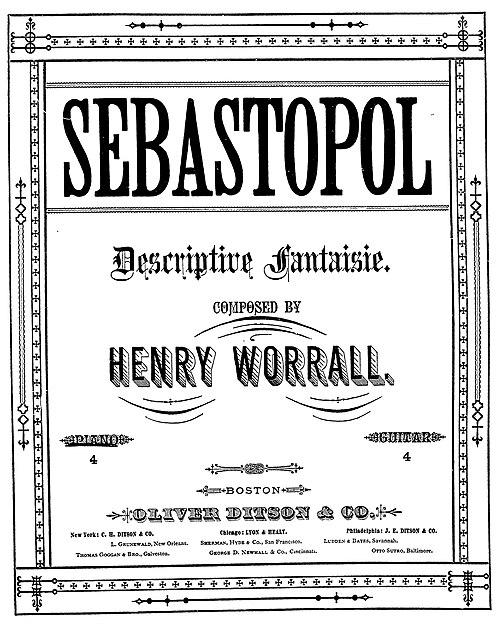
(above: Henry Worrall, Sebastopol, 1880, Piano music. Public domain, via Wikimedia Commons*)
We lightly edited this article, added images and provided links to other materials to enhance it. AI is rapidly improving in accuracy, yet the article may have inaccurate information.
 Return to Kansas Art History
*Tag for expired US copyright of object image:

Links to sources of information outside of our web site are provided only as referrals for your further consideration. Please use due diligence in judging the quality of information contained in these and all other web sites. Information from linked sources may be inaccurate or out of date. TFAO neither recommends or endorses these referenced organizations. Although TFAO includes links to other web sites, it takes no responsibility for the content or information contained on those other sites, nor exerts any editorial or other control over them. For more information on evaluating web pages see TFAO's General Resources section in Online Resources for Collectors and Students of Art History.
Copyright 2025 Traditional Fine Arts Organization, Inc. an Arizona nonprofit corporation. All rights reserved.