
Kansas Art History

with an emphasis on representational art
Introduction
This section of our catalogue Topics in American Art is devoted to the topic "Kansas Art History." Articles and essays specific to this topic published in ourResource Library are listed at the beginning of the section. Clicking on titles takes readers directly to the articles and essays.
Following the links to Resource Library articles and essays are a listing of museums in the state which have provided materials to Resource Library for this or any other topic.
Listed after museums are links to online resources outside ourwebsite. Following these resources is information about offline resources including DVDs, paper-printed books, journals and articles. Our goal is to present complete knowledge relating to this section of Topics in American Art.
Resource Library essays listed by author name in alphabetical order, followed by articles:
40 Years of the Prairie Water Color Painters by Cori Sherman North
Vanished Voices: The Legacy of Northeast Kansas Indians
We recommend that researchers always search within Resource Library for additional material. Please see our page How to research topics not listed for more information.

(above: Birger Sandzén, Creek at Twilight, 1927, oil on canvas, 48 x 60 inches. Google Images)
Museums and other non-profit sources of Resource Library articles and essays:
Birger Sandzén Memorial Gallery
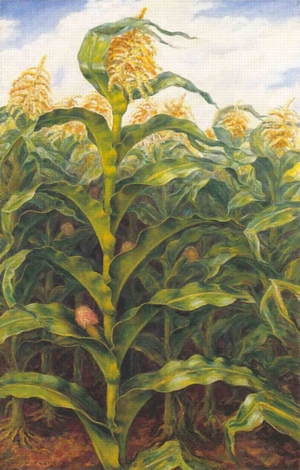
(above: John Steuart Curry, Kansas Cornfield, 1933, oil on canvas, 60 3/8 x 38 3/8 inches, Wichita Art Museum, Roland P. Murdock Collection. Public domain, via Wikimedia Commons*)
Kansas State Historical Society
Spencer Museum of Art / University of Kansas

(above: Henry Varnum Poor (1887-1970), The Luncheon, 1913, oil on canvas, 36 x 48 in. Birger Sandzén Memorial Gallery. Public domain, via Wikimedia Commons*)
Other online information:
"Art in Kansas has a long and varied history," by Denise Neil, March 13, 2011, The Wichita Eagle. Accessed August, 2015.
Artists from Kansas, from Kansas Historical Society. Includes biographies and list of well known Kansas Artists. Accessed May, 2015.
Biographical Dictionary of Kansas Artists (active before 1945) by Craig, Susan V., issued in 2006; from KU ScholarWorks. Accessed August, 2015.
Birger Sandzén: American Van Gogh is a 2025 article by Gemini 3 Pro which says: "When you think of the great landscape painters of the American West, your mind might go straight to the sweeping, dramatic vistas of Albert Bierstadt or the romanticized, golden-lit horizons of Thomas Moran. But there is another name that belongs in that pantheon, though his story starts in a place you might not expect -- a tiny, Swedish-flavored town in the middle of the Kansas plains. That man was Birger Sandzén, and if you have ever seen one of his paintings, you know they don't just sit on the wall; they practically vibrate with energy. " Accessed 1/26
C.A. Seward: Graphic Architect Of The Plains is a 2025 article by Gemini 3 Pro which says: "...Ultimately, C.A. Seward is remembered as the "Graphic Architect" of the plains. He proved that you didn't need to live in a metropolis to create world-class art or to foster a vibrant cultural scene. By mastering the tools of his trade and sharing his secrets generously, he ensured that the landscape of the American West was recorded with dignity and distributed to the world.." Accessed 1/26
Charles Merrick "Chili" Capps: Creative Kansas Print Maker is a 2025 article by Gemini 3 Pro which says: "If you spend enough time looking into the art history of the American Midwest, you are bound to run into a group of friends who decided that art shouldn't just be for the wealthy elite in big cities. Among this group, known as the Prairie Print Makers, was a man named Charles Merrick Capps. But to his friends, colleagues, and the art community in Wichita, he was simply known as "Chili." Accessed 1/26
Embracing Nature, an exhibit held September 9 through October 19, 2014 at the Birger Sandzén Memorial Gallery. Includes exhibit catalog. Accessed May, 2015
The Halcyon Daze of the 'Borg: a photographic memoir by Ray Troll of Ketchikan, Alaska is a 2021 exhibit at the Birger Sandzén Memorial Gallery in which the artist says: "As we age and lose people around us, facing our own mortality, I think of the adage that the closer you are to becoming history yourself, the more you appreciate history. I felt the urgency to share this body of work to commemorate their memories. I also want to acknowledge how much my time in Kansas transformed my own artistic DNA and the roots of my artistic style." Accessed 12/21
Herschel Logan: Kansas Master of the "Prairie Woodcut" is a 2025 Gemini 3 Deep Research Report which says: "So, why do people still care about Herschel Logan? It's mostly because he was authentic. When you look at his art, you aren't seeing a fantasy of the American West. You're seeing the real thing, recorded by a guy who lived it, survived the dust storms, and loved the landscape enough to carve it into wood. Whether he was documenting a tornado or drawing a diagram of a Civil War bullet, he was obsessed with getting the details right. That's a legacy worth admiring." Accessed 1/26
Horizons of the Plains: A Century of Artistic Expression in Kansas (1860-1960) is a 2025 article by Gemini 3 Pro which says: "The history of artistic expression in Kansas is a chronicle of adaptation, resilience, and the relentless search for beauty within a landscape that is often harsh and unforgiving. From the turbulent days of the Territorial period, marked by the violence of "Bleeding Kansas," to the mid-twentieth century, when the state's artists had firmly established a regional identity recognized across the globe, the visual arts in Kansas have served as both a mirror and a mold for the state's cultural consciousness. You're reading here this century-long evolution, covering the diverse mediums of painting, sculpture, pottery, textiles, and furniture. We're exploring how the distinct geography of the Great Plains -- the rolling Flint Hills, the gypsum-rich Red Hills, and the expansive high plains -- shaped the artistic psyche." Accessed 11/26
Henry Worrall, Bard of the Plains is a 2025 article by Gemini 3 which says: "When we picture the artists of the Old West, we usually imagine rugged adventurers wrestling easels up mountain peaks or sketching from the back of a galloping horse. We think of Remington or Russell, men who seemed to embody the very dust and grit of the frontier. But if you look closely at the history of Kansas, the man who arguably did the most to shape its visual identity wasn't a cowboy at all. He was a guitar-playing glass cutter from Liverpool named Henry Worrall. His story is one of the most delightful oddities of Western history -- a tale of how a British immigrant with a wicked sense of humor and a knack for woodcuts helped invent the popular image of the Great Plains." Accessed 12/25
In the Center of It All: Prairie Print Maker 90th anniversary exhibition is a 2020 exhibit at the Birger Sandzén Memorial Gallery in which Ron Michael, Director, says: The Prairie Print Makers started 90 years ago about a block from the Birger Sandzén Memorial Gallery -- in the studio of our namesake. They set lofty parameters on a very tight Depression- era budget and started with a core group of just eleven. From there, the group grew to over 100 members and gained national attention." Accessed 12/21
John Steuart Curry is a 2025 article by Gemini 3 which says: "Imagine a farmhouse in Dunavant, Kansas, at the turn of the twentieth century. Inside, the walls aren't covered with the usual calendars from feed stores or grain elevators that you might expect in a rural home of that era. Instead, there are framed reproductions of European masterworks: the swirling, muscular dramas of Peter Paul Rubens and the pious peasants of Jean-François Millet. This was the childhood home of John Steuart Curry, a boy who would grow up to define the visual language of the American Midwest. Born in 1897 to parents who were Covenanters -- strict Reformed Presbyterians -- Curry was raised in an environment of intense duality. On one hand, there was the "Shorter Catechism" https://covenantervillagevoice.org/shorter-catechism/ and the rigorous demands of farm labor; on the other, there was a window into the world of high art provided by his mother, who had traveled to Europe on her honeymoon." Accessed 1/26
Kansas Artists from George Laughead. Accessed August, 2015.
Kansas Heartland Virtues: Kindness, Kinship, and Community in Kansas Art (1850-1950) is a 2026 Gemini 3 Conversational Deep Research Report which says: "When we look back at the art of Kansas from 1850 to 1950, we see more than just landscapes and portraits. We see a moral infrastructure. We see Birger Sandzén teaching us that generosity means giving more than is asked, even if it's just a painting of a mountain stream. We see the Prairie Print Makers proving that kindness can be delivered in an envelope for the price of a membership fee. We see John Steuart Curry showing us that true love often involves forgiveness, both of our families and our communities. We see Aaron Douglas reminding us that gratitude for our heritage is the foundation of our future. And we see the WPA artists demonstrating that the state itself has a duty to be kind to its children's imaginations. These artists didn't just paint Kansas; they painted a vision of how to live well in Kansas. They showed that in a land of vast distances, the most important connection is the one between human hearts." Accessed 2/26
Kansas "Pioneer Baroque" Furniture is a Gemini 3 Conversational Deep Research Report which says: "In the end, what makes Kansas pioneer baroque so special is that it's a physical map of a cultural collision. It's got the DNA of German artisans, the raw materials of the American plains, and the "dazzle" of international exhibitions all wrapped into one solid black walnut package . Herman Richter might have spent his later years on a farm in the Beman community, but the work he and his contemporaries left behind -- those huge, ornate, indestructible pieces of furniture -- still tells the story of a frontier that was determined to be more than just a wild wilderness They carved their history right into the heart of the wood, and that's why, whether you're a critic or just someone who appreciates a good chair, you can't help but admire the honesty and the sheer ambition of what they built." Accessed 1/26
Kansas Quilter Rose Kretsinger: The Modernist with a Needle is a 2025 article by Gemini 3 which says: "If you were to take a stroll through the quiet, tree-lined streets of Emporia, Kansas, in the late 1920s, you might not suspect that you were walking through the epicenter of a textile revolution. We tend to think of the American quilt revival of that era as a cozy, nostalgic affair -- a time when women across the country were stitching up cheerful, pastel patterns from the Sunday newspaper to keep busy during the Great Depression. But behind the doors of a house on Market Street, something entirely different was happening. There, a woman named Rose Good Kretsinger was dismantling the barrier between "craft" and "fine art," one invisible stitch at a time. She wasn't just making blankets; she was painting with fabric, and her story forces us to rethink everything we assume about the humble American quilt." Accessed 1/26
Kansas Regionalism is a Gemini 3 Deep Research Report which says: "In the end, the legacy of the American Regionalist movement in Kansas is a complex tapestry of pride, prejudice, myth, and memory. These artists did not simply paint what they saw; they constructed an identity for a state that was often suffering from an inferiority crisis. John Steuart Curry gave Kansas its history, repackaged as a tragic epic of Biblical proportions, forcing the state to confront its violent past and dangerous weather. Birger Sandzén gave Kansas its color, teaching the eye to see the violet shadows in a sandstone bluff and the turquoise shimmer of a dry creek. The Prairie Print Makers gave Kansas its democracy, putting a piece of the American Scene on the wall of the farmhouse and the schoolroom." Accessed 1/26
Kansas State Capitol Artwork - from Kansas Historical Society. Accessed August, 2015.
Kansas State Capitol Murals - from Kansas Sampler Foundation. Accessed August, 2015.
Made to be Used: the Pottery of Ray Kahmeyer (1930-2007) is a 2020 exhibit at the Birger Sandzén Memorial Gallery in which Ron Michael, Sandzén Gallery Director, says: "His works are meant for everyday use, hence the exhibition title, but each still hold something special beyond that. They have a quality that's impossible to label or categorize. His "simple" pots reflect Ray's commitment to the craft of handwork, his fondness for rustic design, beauty, and nature. Ray was unique, inspiring, and generous, and I feel very fortunate to have known him." Accessed 12/20
No Mountains in the Way: Photographs from the Kansas Documentary Survey, 1974 is a 2016 exhibit at the Smithsonian American Art Museum which says: "In the 1970s, the National Endowment for the Arts (NEA) conceived a series of photo survey projects, inspired by the epic documentary photography program undertaken by the federal government in the 1930s and 1940s." Accessed 8/18
Norma Bassett Hall, Kansas Artist and Prairie Print Makers Founder is a 2025 article by Gemini 3 which says: "In Scotland, they met an artist named Mabel Royds. Royds was doing something different -- she was using the traditional Japanese method of woodblock printing. Instead of heavy oil paints, she used dry pigments mixed with water and a paste made from rice flour. She applied it with brushes and printed it by hand-rubbing the paper with a bamboo pad called a baren. This was the game-changer Norma had been looking for. This technique allowed the image to soak into the paper rather than sitting on top of it, creating a soft, luminous texture that was perfect for atmospheric landscapes. When Norma came back to Kansas, she brought this Japanese technique with her, applying it to the American prairie. She didn't just work in isolation, though. In 1930, she was one of the founders of the Prairie Print Makers, a group that became incredibly influential in bringing affordable art to everyday Americans. It's worth noting that in a room full of men, she was the only woman among the charter members. She wasn't just a participant; she was a driving force, even designing the group's logo" Accessed 12/25
The Prairie Print Makers: Art for Everyone is a 2025 article by Gemini 3 which says: "It was a chilly Sunday in late December 1930 when a group of artists gathered in Lindsborg, Kansas, a small town with a distinctly Swedish heritage and an outsized reputation for culture. They met in the studio of Birger Sandzén, a painter and printmaker whose vibrant, impasto landscapes had already made him a legend in the Midwest. The mood outside was grim; the Great Depression was settling in, tightening its grip on the economy, and the ecological catastrophe of the Dust Bowl was just around the corner. Yet, inside that studio, the mood was optimistic, even entrepreneurial. This gathering marked the birth of the Prairie Print Makers, an organization that would go on to define the artistic identity of the region for decades. Their mission was simple but radical: they wanted to make fine art accessible to everyone, not just the wealthy elite in New York or Paris, but the farmers, teachers, and shopkeepers of the American plains." Accessed 12/25
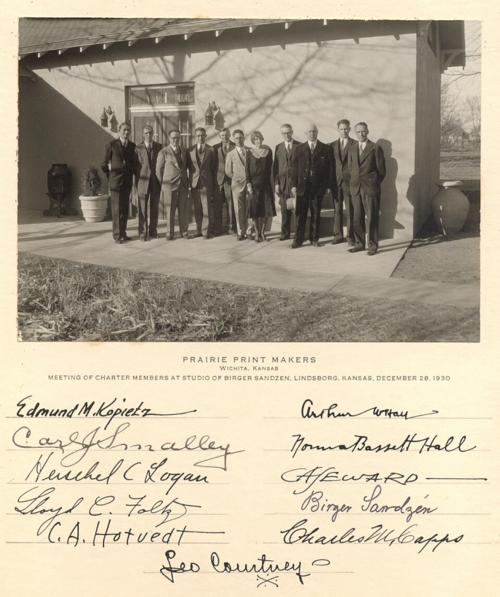
(above: Initial meeting of the founding members of the Prairie Print Makers in Lindsborg, Kansas, December 28, 1930. Birger Sandzén Memorial Gallery Archives, Lindsburg, Kansas. Public domain, via Wikimedia Commons*)
Prairie Print Makers, a Kansas artists' group founded in the 1930s from University of Kansas / Spencer Museum of Art. Accessed August, 2015..
Printmaking in Kansas City: The Moffett Collection is a 2016-17 exhibit at the Albrecht-Kemper Museum of Art which says: "In the 1930s and '40s, printmaking enjoyed a new popularity across the nation, and Kansas City proved no exception. The Kansas City Art Institute's (KCAI) curriculum added print courses in lithography first under Ross Braught (1898-1983) around 1931 through 1935." Accessed 2/17
Sloyd Furniture: pyrography pieces by Birger Sandzén, Amalia Maria Rabenius and G. N. Malm is a 2019 exhibit at the Birger Sandzén Memorial Gallery for which Marlysue Holmquist says: " Amalia Maria Rabenius was hired in 1900 to teach in the Model School at Bethany College. More specifically, she started a new program in Sloyd, a curriculum of manual training that teaches the use of a sloyd knife to make a variety of structured projects, usually in wood." Accessed 12/21
Steve Scott is Steve Scott: paintings by former Lindsborg artist Steve Allan Scott (1947-2017) is a 2020 exhibit at the Birger Sandzén Memorial Gallery which says: "Scott earned art degrees first at Emporia State University (1969) and then an MFA from Wichita State University (WSU, 1972). His graduate school classmate Michael Jilg, now retired from the art department of Fort Hays State University, remembers that when they met Scott already had his signature style well established. He exclusively used Liquitex Acrylic Artist Colors mixed out of the tube for his paintings on canvas and paper, continuing the practice throughout his career. " Accessed 12/21
A Story About John Steuart Curry is a 2025 article by Grok 4 which says "... His subjects? The rural life of Kansas and the Midwest -- farm scenes teeming with animals, devastating tornadoes and prairie fires, religious rituals, historical upheavals like Bleeding Kansas, and even critiques of social ills like lynching and soil erosion during the Dust Bowl. It wasn't just pretty pictures; John's art carried moral authority, highlighting life's cycles of fertility and death, community ethics, and the indomitable spirit of ordinary folks facing nature's wrath ..." Accessed 12/25
Symbolism Packed Into John Steuart Curry's Tragic Prelude is a 2025 article by Grok 4 which says: "Let's dive into the symbolism packed into John Steuart Curry's Tragic Prelude, that massive mural he painted between 1937 and 1942 for the Kansas State Capitol in Topeka. This isn't just a historical snapshot; it's a swirling, chaotic vision of Bleeding Kansas as the fiery lead-up to the American Civil War, with John Brown looming like a biblical prophet at its heart. Curry, as a Regionalist artist, infused the piece with layers of meaning, blending real events from the 1850s -- like the Kansas-Nebraska Act that turned the territory into a battleground over slavery -- with dramatic, almost apocalyptic imagery. The overall theme screams inevitability: how fanaticism, violence, and national division spiraled into catastrophe, much like a natural disaster you can't escape. To really grasp it, picture this: a towering figure dominates the center, arms outstretched, with soldiers clashing, fires raging, and storms brewing in the background -- it's raw, emotional, and unapologetically intense." Accessed 12/25
A Symphony of Rock and Light: The World of Birger Sandzén is a 2025 article by Grok 4 which says "If you've ever stood in front of a Birger Sandzén painting, you know the feeling -- it's not just something you see; it's something you almost feel. The paint is piled on so thick it looks like it was carved with a trowel rather than brushed on, creating a rugged, tactile surface that seems to mimic the very geology it depicts. They called him the "American Van Gogh," and while that's a catchy nickname, it doesn't quite do justice to the man who traded the soft, misty light of Sweden for the blazing, relentless sun of the Kansas plains. Sandzén wasn't just a painter of landscapes; he was a builder of them, using "more vermillion in his color box than nature herself can afford to spend on sunsets" to capture the raw, vibrant energy of the American West." Accessed 12/25
Wilbur Niewald: The Studio Portrait is a 2012 exhibit at the Kemper Museum of Contemporary Art which says: "Well known for his plein air painting, Niewald can often be found with easel and brushes at his favorite Kansas City locations, including Loose Park and Penn Valley Park. However, the artist has a long history of studio painting that includes both still lifes and portraits." Also see artist's website Accessed 2/19
Books sampler listed by year of publication, with most recently published book listed first:
Kansas Murals: A Traveler's Guide, by Lora Jost (Author), Dave Loewenstein (Author), Saralyn Reece Hardy (Foreword). 278 pages. Publisher: University Press of Kansas (October 3, 2006). ISBN-10: 0700614699. ISBN-13: 978-0700614691. Product Description: Travelers in Kansas in search of fine art needn't restrict themselves to the state's many excellent museums. They need look no further than the walls of their own communities to discover a remarkable array of murals--artistic creations that are striking, democratic, and easily accessible. Depicting Civil War history, the fruits of agriculture, Kansas' diverse cultural roots, and much more, these long-neglected works are now the subject of Lora Jost and Dave Loewenstein's fine new book. Jost and Loewenstein, artists themselves, have crisscrossed Kansas researching and documenting over 600 murals to promote, preserve, and celebrate this vibrant public art. Theirs is the first and only book devoted exclusively to Kansas murals--a striking visual travelogue that offers a new perspective on the state's culture and history. From unique small-town creations like Dennis Burghart's The Saga of the Santa Fe outside the Offerle Cafe to the world-famous John Steuart Curry painting of John Brown in the state capitol, murals constitute an enormous public art gallery. Some are socially compelling or were once the focus of intense controversy. Many are group projects in which artists have served as coordinators; these murals represent true expressions of their communities. All show the state as it has been seen through the eyes of Kansas artists over the past hundred years. The authors focus on ninety exemplary murals--including mosaics and friezes--organized by region and featuring full-color photographs, brief descriptions, and notes on the artists. From Sacred Heart Cathedral to the Early Childhood Education Center on the Potawatomi Prairie Band Reservation, the artworks selected represent some of the most enduring and powerful images to be found throughout the state. The book also provides regional locator maps for travelers and a list of all 600-plus murals with their locations. A unique resource that attests to the rich diversity of the mural tradition, this book is an open invitation to visit the open-air museum of Kansas murals and appreciate the stories they tell and their place in public life. They may be tucked into urban landscapes or require travel to out-of-the way locales; some may even be stained by years of exposure to the elements; but these expressions of public art are there for the viewing--and now, thanks to this book, there for the finding." (text courtesy of Amazon.com)
Kansas Quilts and Quilters, by Barbara Brackman (Author), Jennie A. Chinn (Author), G. R. C. Davis (Contributor). 216 pages. Publisher: University Press of Kansas (September 1993). ISBN-10: 0700605843. ISBN-13: 978-0700605842. Product Description: "Mary Ellison came to Kansas in 1870, keeping house for her father and numerous siblings before raising her own family. By the age of 92, she estimated, she'd made more than three hundred quilts. Rose Kretsinger studied design at the turn of the century in Europe and at the Art Institute of Chicago. Quilts made from her award-winning designs are now in an art museum collection. Kay McFarland sold quilts to put herself through law school in the 1960s. Today she is the first woman on the Kansas Supreme Court. These three women, along with thousands of other Kansans from a variety of backgrounds, have pursued quiltmaking for economic and artistic purposes. The result of their efforts: a treasury of quilts, from plain to fancy, utilitarian to decorative. In 1986 the Kansas Quilt Project began an ambitious effort to find and document Kansas quilts. Aided by legions of volunteers, this group catalogued 13,107 quilts and quilt tops made in Kansas or brought to the state. From this cataloguing, from interviews with quilters and their descendants, and from extensive historical research, the six authors of this book have produced the first comprehensive discussion of quilts and quiltmaking in Kansas. They focus on specific types of quilts and fabrics, such as red-and-green appliqué quilts and conversation prints; regional and ethnic quiltmaking communities, including Mennonites, African-Americans, and an unusually prolific and talented group of quilters in Emporia a half-century ago; and present-day quilting groups. Featuring 165 photographs, 68 in full-color, this volume is a visually rich mosaic that illuminates the enduring community of quiltmakers in Kansas and chronicles its relation to the historical and cultural heritage of the state. This 9 x 6" book contains 99 color photographs, 4 black-and-white photographs, and 8 color maps." (text courtesy of Amazon.com)
The Prairie Print Makers, By Barbara Thompson O'Neill, George C. Foreman, Howard W. Ellington. Published by Kansas Arts Commission, 1981. ISBN 0960797807, 9780960797806
For the Sake of Art: The Story of an Art Movement in Kansas, By Cynthia Mines, Salvador Estrada. Published by Mines, 1979. 79 pages
Bethany in Kansas: The History of a College, By Emory Kempton Lindquist. Published by Bethany College, 1975. ISBN 0916030032, 9780916030032. 309 pages
The Kansas Portrait Index, By National Society of the Colonial Dames of America in the State of Kansas Historical Activities Committee, Published by Historical Activities Committee of the National Society of the Colonial Dames of America, 1970. 40 pages
Kansas: The First Century, edited by John D. Bright. Published by Lewis Historical Pub., 1956
Development of Art in Kansas, By Gertrude Dix Newlin. Published by s.n, 1951
Arts and Crafts in Kansas; Catalog of an exhibition held in Lawrence, University of Kansas, February, 1948
Kansas Art and Artists, By Florence Lydia Snow. Published by Watson Library, 1942
Articles:
Brett Beatty: "Regional Art from Kansas Public Schools" American Art Review March-April 2002 (Volume XIV, Number 2)
Edna Reinbach. "Kansas Art and Artists" Collections of the Kansas State Historical Society 17 (1926-1928) 371-85
 Return to Individual States
Art History Project
Return to Individual States
Art History Project
*Tag for expired US copyright of object image:

Links to sources of information outside of our web site are provided only as referrals for your further consideration. Please use due diligence in judging the quality of information contained in these and all other web sites. Information from linked sources may be inaccurate or out of date. TFAO neither recommends or endorses these referenced organizations. Although TFAO includes links to other web sites, it takes no responsibility for the content or information contained on those other sites, nor exerts any editorial or other control over them. For more information on evaluating web pages see TFAO's General Resources section in Online Resources for Collectors and Students of Art History.
Copyright 2025 Traditional Fine Arts Organization, Inc. an Arizona nonprofit corporation. All rights reserved.