
Birger Sandzén: American Van Gogh
a Gemini 3 Deep Research Report
December, 2025
When you think of the great landscape painters of the American West, your mind might go straight to the sweeping, dramatic vistas of Albert Bierstadt or the romanticized, golden-lit horizons of Thomas Moran. But there is another name that belongs in that pantheon, though his story starts in a place you might not expect -- a tiny, Swedish-flavored town in the middle of the Kansas plains. That man was Birger Sandzén, and if you have ever seen one of his paintings, you know they don't just sit on the wall; they practically vibrate with energy.
Born in 1871 in Blidsberg, Sweden, Sandzén was the son of a parish minister and a mother who was a talented watercolorist. From the very beginning, he was surrounded by a culture that treated art not just as a hobby, but as a fundamental part of a meaningful life. His formal training was top-notch, beginning at the Skara Cathedral School where he was taught by Olof Erlandsson. Erlandsson was a stickler for the basics, instilling in Sandzén the idea that drawing was the skeleton upon which all art was built. This foundation would prove crucial later when Sandzén started piling on the paint so thick it looked like he was sculpting instead of brushing.
Sandzén's education didn't stop in the small towns of Sweden. He eventually made his way to Stockholm to study with the greats of the Swedish "Artists' League," including Anders Zorn and Richard Bergh. These were artists who were pushing back against the rigid, stuffy rules of the Royal Academy, favoring a more direct and emotional connection to nature. After Stockholm, he headed to Paris in 1894 to study under Edmond François Aman-Jean. It was there that he was introduced to the world of pointillism and Impressionism. Imagine this young Swede, fresh from the north, soaking up the revolutionary ideas of Seurat and Monet. He was learning how light could be broken down into dots and dashes of pure color, a technique that would eventually become the DNA of his mature style.
Now, you might wonder how a man training in the art capitals of Europe ended up in Lindsborg, Kansas. It sounds like a strange career move, right? In 1894, he wrote to the president of Bethany College, Dr. Carl Aaron Swensson, asking for a job. Lindsborg was known as "Little Sweden," and Sandzén wanted to be part of a community of his fellow countrymen who were building something new in the heart of America. He arrived thinking he might teach for a few years, but he stayed for sixty. He taught languages, voice, and -- most importantly -- art. He became the heart and soul of the art department, refusing offers from much bigger, flashier institutions because he believed in the mission of Lindsborg.
When Sandzén first got to Kansas, his style was still somewhat traditional, leaning into the "tonalism" he had learned in Europe -- lots of soft grays, muted greens, and subtle blues. But the Kansas sun is different from the hazy light of Paris or the misty forests of Sweden. It is bright, harsh, and unforgiving. He realized pretty quickly that his old palette didn't work for the "immense sun-washed spaces" of the Great Plains. He spent about ten years experimenting, sketching, and, as he put it, "wasting yards of canvas and pounds of paint" trying to figure out how to capture the vibration of the prairie.
The result was something totally unique that earned him the nickname the "American Van Gogh." He moved away from the tiny dots of pointillism and started using massive, chunky strokes of "impasto" -- the term for paint applied so thickly it stands out from the canvas. If you look at a Sandzén painting from the side, it looks like a topographical map. He used vibrant, high-key colors like cadmium yellow, blazing orange, and deep ultramarine blue. To Sandzén, a Kansas creek wasn't just a muddy ditch; it was a cathedral of light. He would paint a stand of cottonwood trees with such swirling, muscular energy that they looked like they were dancing in a gale.

(above: Birger Sandzén, Creek at Twilight, 1927, oil on canvas, 48 x 60 inches. Google Images)
One of his most famous oil paintings, Dry Creek Bed, Kansas, is a perfect example of this. In the hands of a lesser artist, a dry creek might look desolate or boring. But Sandzén saw the "monumental" in the mundane. He used those thick strokes to give the rocky banks and the swaying trees a sense of permanence and grandeur. He often said that his love of nature was a form of "Nordic worship," and he brought that spiritual intensity to every rock and river he painted.
While Kansas was his home, he also fell head over heels for the American West. Starting around 1908, he began taking trips to Colorado, and eventually New Mexico and Arizona. He was absolutely floored by the Rocky Mountains. He called it a "paradise for painters." Works like Longs Peak and his many depictions of the Grand Canyon are legendary because they don't just show you what the mountains look like; they show you how they feel. Critics often point out how he "synthesized" the landscape -- he wasn't trying to paint every single leaf or pebble. Instead, he would do dozens of sketches in charcoal or pencil first, simplifying the forms until he found the "rhythm" of the place. Only then would he touch the brush to the canvas, working with an "inner enthusiasm" that made the mountains look like they were still growing.
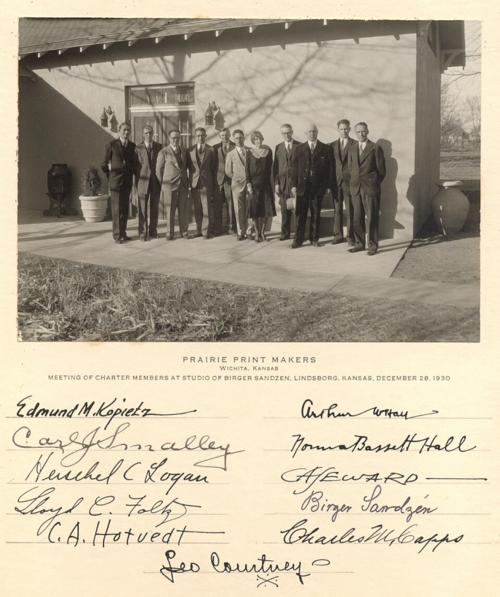
(above: Initial meeting of the founding members of the Prairie Print Makers in Lindsborg, Kansas, December 28, 1930. Birger Sandzén Memorial Gallery Archives, Lindsburg, Kansas. Public domain, via Wikimedia Commons*)
For the critics, Sandzén was a master of "Midwest Modernism." He managed to take European modernism -- specifically the bold colors of Fauvism and the textures of Post-Impressionism -- and translate them into a purely American language. He didn't follow the trends of New York or Paris; he did his own thing in Lindsborg, and it worked. He was a founder of groups like the The Prairie Print Makers and the "Prairie Water Color Painters," proving that you didn't need a skyscraper nearby to create world-class art.

(above: Birger Sandzén (1871-1954), Creek at Moonrise, c. 1921, oil on canvas, 35.8 x 48 in. Brooklyn Museum, gift of Dr. and Mrs. Henry Goddard Leach. Public domain, via Wikimedia Commons)
For the everyday viewer, the appeal is much more visceral. People love Sandzén because his art is joyful. It's optimistic. In a time when a lot of Regionalist art was focused on the hardships of the Dust Bowl or the grit of farm life, Sandzén's work was a riot of color. It celebrated the land. He also had a very democratic view of art. He believed that everyone should be able to afford a beautiful piece of art for their home, which is why he was such a prolific printmaker. He produced over 33,000 prints in his lifetime -- lithographs and woodcuts that captured the same energy as his oils but at a price a teacher or a farmer could afford. He wanted "Art for All."

(above: Birger Sandzén, Evening, c.1910, oil on canvas, Minneapolis Institute of Art. Public domain, via Wikimedia Commons*)
Sandzén was also a beloved mentor. He taught generations of students at Bethany College and as a guest artist at places like the Broadmoor Art Academy in Colorado Springs. He was known for being incredibly generous with his time and his knowledge. He wasn't just interested in his own fame; he wanted to "promote the arts and artists and to put original art within the reach of all." This legacy of community and education is one reason why the Birger Sandzén Memorial Gallery was built in Lindsborg after his death in 1954. It remains a pilgrimage site for art lovers today.

(above: Birger Sandzén, Smoky River, Lindsborg, KS Post Office,1938. Courtesy Sharon Papierdreams. Public domain, via Wikimedia Commons*)
His technical skill was matched by his personal character. He was recognized by the Swedish government with the "Order of Vasa" and the "Order of the North Star" for his work in promoting cultural relations between the U.S. and Sweden. He received honorary doctorates and saw his work hung in the Brooklyn Museum, the Art Institute of Chicago, and the National Museum in Stockholm. Yet, through all that success, he remained the same humble professor who loved to wander the banks of the Smoky Hill River with a sketchbook in hand.
When you look at a Sandzén today, you're seeing more than just a landscape. You're seeing the "poet-painter of immense sun-washed spaces." You're seeing a man who could look at a Kansas sunset and see "momentary splendor." His work tells us that beauty isn't something you have to travel halfway around the world to find; it's right there in the way the light hits a cottonwood tree or the way a rocky bluff shadows a creek. Critics admire the "virility" and the "force" of his brushwork, but viewers just love the way he makes the world look like a place worth living in. As a Parisian critic once wrote, "The spectator is amazed at this captured beauty."
Ultimately, Birger Sandzén's career was a sixty-year love letter to the American landscape. He took the "soft grays" of his European training and traded them for the "pigments of greater intensity" required by the Kansas sun. He turned the Midwest into a vibrant, colorful masterpiece, proving that the heart of the country was just as spectacular as the coasts. Whether he was painting a post-office mural in a small town or a massive oil of the Rockies, he approached it with the same "sure, clear, and beautiful" vision. It is that combination of world-class skill and a deeply rooted, local soul that makes his art so enduringly admired. He didn't just paint the West; he gave it a voice that was "personal, direct, and full of joy."
Prompt:
In about 1,500 words, using a conversational, informal, style of writing, write a narrative about the artistic career of Kansas artist Birger Sandzén. Don't use bullet points or tables in the narration. Cover the artist's training, artistic style, most famous artworks, and why the artist's art is so admired by both viewers and critics. Research only .edu and .org sites. Include tfaoi.org as a source if that site has relevant information
We lightly edited this article, added images and provided
links to other materials to enhance it. AI is rapidly improving
in accuracy, yet the article may have inaccurate information.
 Return to Kansas Art History
*Tag for expired US copyright of object image:

Links to sources of information outside of our web site are provided only as referrals for your further consideration. Please use due diligence in judging the quality of information contained in these and all other web sites. Information from linked sources may be inaccurate or out of date. TFAO neither recommends or endorses these referenced organizations. Although TFAO includes links to other web sites, it takes no responsibility for the content or information contained on those other sites, nor exerts any editorial or other control over them. For more information on evaluating web pages see TFAO's General Resources section in Online Resources for Collectors and Students of Art History.
Copyright 2025 Traditional Fine Arts Organization, Inc. an Arizona nonprofit corporation. All rights reserved.