
American Lithography
Online information from sources other than Resource Library
Lithography
C.A. Seward: Graphic Architect Of The Plains is a 2025 article by Gemini 3 Pro which says: "...Ultimately, C.A. Seward is remembered as the "Graphic Architect" of the plains. He proved that you didn't need to live in a metropolis to create world-class art or to foster a vibrant cultural scene. By mastering the tools of his trade and sharing his secrets generously, he ensured that the landscape of the American West was recorded with dignity and distributed to the world.." Accessed 1/26
Charles Merrick "Chili" Capps: Creative Kansas Print Maker is a 2025 article by Gemini 3 Pro which says: "If you spend enough time looking into the art history of the American Midwest, you are bound to run into a group of friends who decided that art shouldn't just be for the wealthy elite in big cities. Among this group, known as the Prairie Print Makers, was a man named Charles Merrick Capps. But to his friends, colleagues, and the art community in Wichita, he was simply known as "Chili." Accessed 1/26
Change Agent: June Wayne and the Tamarind Workshop is a 2019 exhibit at the ASU Art Museum which says: "Wayne was a catalyst for the revival of fine art lithography in the United States, a medium which had all but vanished by the 1950s. She championed lithography as an art form as vital as painting after studying the technique in Paris with the printer Marcel Durassier." Also see Tamarind: Forty Years from Resource Library Accessed 2/20
Crow's Shadow Institute of the Arts at 25 is a 2017 exhibit at the Hallie Ford Museum of Art at Willamette University which says: "Organized by the Hallie Ford Museum of Art in partnership with the Crow's Shadow Institute of the Arts (CSIA), the exhibition chronicles the history of Crow's Shadow over the past 25 years as it has emerged as an important printmaking atelier located on the Confederated Tribes of the Umatilla Indian Reservation near Pendleton, Oregon." Accessed 11/17
Drawn from Nature and From Stone: The Lithographs of Fitz Henry Lane is a 2017 exhibit at the Cape Ann Museum which says: "The exhibition will offer scholars and lay people alike the opportunity to explore the intersection of Lane's work as a printmaker and a painter, to learn more about the art of lithography and to consider the enduring effects printing has on American culture from the early 19th century through today." Also see press release Accessed 12/17
In the Center of It All: Prairie Print Maker 90th anniversary exhibition is a 2020 exhibit at the Birger Sandzén Memorial Gallery in which Ron Michael, Director, says: The Prairie Print Makers started 90 years ago about a block from the Birger Sandzén Memorial Gallery -- in the studio of our namesake. They set lofty parameters on a very tight Depression- era budget and started with a core group of just eleven. From there, the group grew to over 100 members and gained national attention." Accessed 12/21
Jean Charlot: Visions of Mexico, 1933 is a 2022 exhibit at the Nasher Museum of Art which says: "Jean Charlot: Visions of Mexico, 1933 investigates Charlot's relationship to Mexico's Indigenous past and its colonial legacy by presenting his lithographs alongside prints by Posada and sculpture from the Nasher's Art of the Americas collection. Charlot's vivid, dynamic prints draw from biblical narratives, local textile traditions, and the arts of Mexico, both ancient and modern." Accessed 6/22
The Lithographs of Carroll Cloar, an exhibit held May 17, 2014 - August 10, 2014 at the Georgia Museum of Art. Includes news release. Accessed August, 2015.
Norma Bassett Hall, Kansas Artist and Prairie Print Makers Founder is a 2025 article by Gemini 3 which says: "In Scotland, they met an artist named Mabel Royds. Royds was doing something different -- she was using the traditional Japanese method of woodblock printing. Instead of heavy oil paints, she used dry pigments mixed with water and a paste made from rice flour. She applied it with brushes and printed it by hand-rubbing the paper with a bamboo pad called a baren. This was the game-changer Norma had been looking for. This technique allowed the image to soak into the paper rather than sitting on top of it, creating a soft, luminous texture that was perfect for atmospheric landscapes. When Norma came back to Kansas, she brought this Japanese technique with her, applying it to the American prairie. She didn't just work in isolation, though. In 1930, she was one of the founders of the Prairie Print Makers, a group that became incredibly influential in bringing affordable art to everyday Americans. It's worth noting that in a room full of men, she was the only woman among the charter members. She wasn't just a participant; she was a driving force, even designing the group's logo" Accessed 12/25
Pictures on Stone: American Color Lithography was a 1994 exhibit at the Sheldon Museum of Art which says: "The chromolithograph is a printed-color lithograph in which the image is composed of at least three colors, and often more than a dozen, each applied to the print from a separate stone. Unlike tinted lithographs, with their second and third colors casting hues across the print, chromolithography is technically very complex, because it requires perfect registration and a sophisticated understanding of color." Viewers may download the exhibition brochure. Accessed 1/17
The Prairie Print Makers: Art for Everyone is a 2025 article by Gemini 3 which says: "It was a chilly Sunday in late December 1930 when a group of artists gathered in Lindsborg, Kansas, a small town with a distinctly Swedish heritage and an outsized reputation for culture. They met in the studio of Birger Sandzén, a painter and printmaker whose vibrant, impasto landscapes had already made him a legend in the Midwest. The mood outside was grim; the Great Depression was settling in, tightening its grip on the economy, and the ecological catastrophe of the Dust Bowl was just around the corner. Yet, inside that studio, the mood was optimistic, even entrepreneurial. This gathering marked the birth of the Prairie Print Makers, an organization that would go on to define the artistic identity of the region for decades. Their mission was simple but radical: they wanted to make fine art accessible to everyone, not just the wealthy elite in New York or Paris, but the farmers, teachers, and shopkeepers of the American plains." Accessed 12/25
Yellowstone and the West: The Chromolithographs of Thomas Moran, an exhibit held June 8, 2013 - September 8, 2013 at the Gilcrease Museum. Includes images of selected works in the exhibit. Accessed 12/14.
Yellowstone and the West: The Chromolithographs of Thomas Moran, an exhibit held 6/7/2014 - 9/7/2014 at the Joslyn Art Museum. Accessed February, 2015
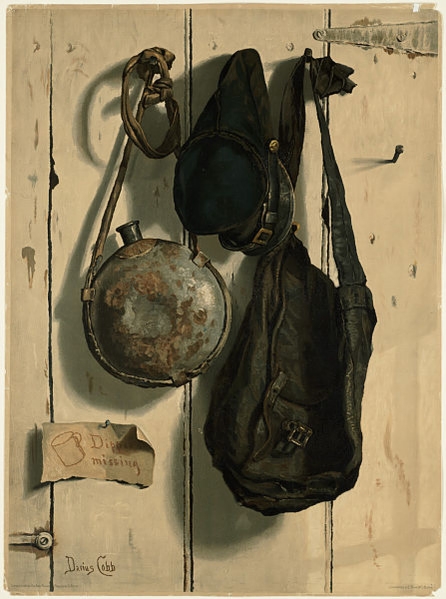
(above: Cobb, Darius, 1834-1919, Civil
War trompe l'oeil, 1888, Chromolithograph, Location:
Boston Public Library, Print Department. Image and text source: Wikimedia
Commons - public domain)
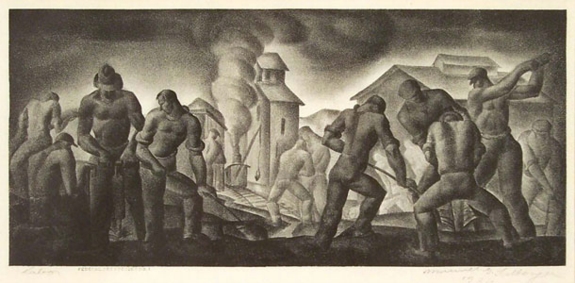
(above: Manuel G. Silberger, Labor?, 1936, lithograph, Federal Art Project, Works Progress Administration (WPA) MO 1956.286, courtesy of Franklin D. Roosevelt Library & Museum)
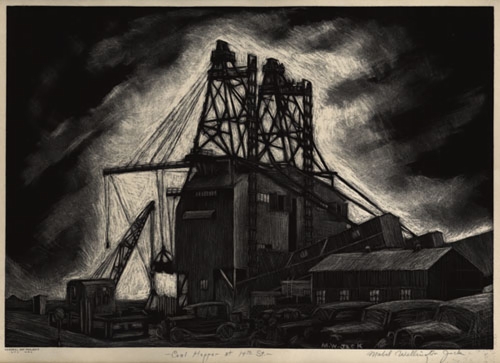
(above: Mabel Wellington
Jack, Coal Hopper at 14th Street, 1937, lithograph, New York City
Federal Art Project, Works Progress Administration (WPA), MO 1956.261, courtesy
of Franklin D. Roosevelt Library & Museum)
 Return to American Art Prints and Printmaking - online information
from sources other than Resource Library
Return to American Art Prints and Printmaking - online information
from sources other than Resource Library
Return to American art prints and printmaking
*Tag for expired US copyright of object image:

Links to sources of information outside of our web site are provided only as referrals for your further consideration. Please use due diligence in judging the quality of information contained in these and all other web sites. Information from linked sources may be inaccurate or out of date. TFAO neither recommends or endorses these referenced organizations. Although TFAO includes links to other web sites, it takes no responsibility for the content or information contained on those other sites, nor exerts any editorial or other control over them. For more information on evaluating web pages see TFAO's General Resources section in Online Resources for Collectors and Students of Art History.
 Search Resource Library
Copyright 2026 Traditional Fine Arts Organization, Inc., an Arizona nonprofit corporation. All rights reserved.