
Charles "Chili" Capps: Creative Kansas Print Maker
a Gemini 3 Deep Research Report
December, 2025
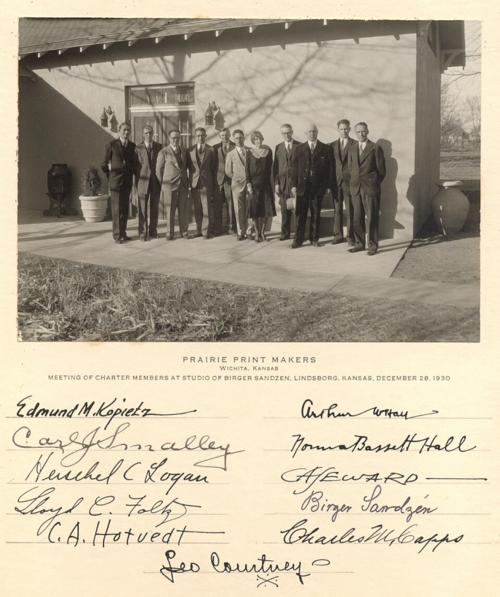
(above: Initial meeting of the founding members of the Prairie Print Makers in Lindsborg, Kansas, December 28, 1930. Birger Sandzén Memorial Gallery Archives, Lindsburg, Kansas. Public domain, via Wikimedia Commons*)
If you spend enough time looking into the art history of the American Midwest, you are bound to run into a group of friends who decided that art shouldn't just be for the wealthy elite in big cities. Among this group, known as the Prairie Print Makers, was a man named Charles Merrick Capps. But to his friends, colleagues, and the art community in Wichita, he was simply known as "Chili."
While some artists of his era were chasing abstract theories or trying to mimic European trends, Capps was busy capturing the quiet, dusty beauty of a Kansas grain elevator or the moonlit adobe walls of New Mexico. He wasn't just an artist; he was a craftsman who mastered one of the most notoriously difficult printmaking techniques. -- aquatint -- and used it to tell the story of the American landscape.
Capps didn't start out as a Kansan. He was born in Jacksonville, Illinois, in 1898. His path to the art world was relatively traditional at first. He graduated from Illinois College in 1920 and then went on to study at the Chicago Academy of Fine Arts and the prestigious Pennsylvania Academy of the Fine Arts in Philadelphia. These schools gave him a solid grounding in the fundamentals of drawing and composition, skills that would later define his meticulous prints.
However, the pivotal moment in his career wasn't a class in Philadelphia, but a job offer in Wichita. In the 1920s, Wichita was becoming a surprising hub for commercial and fine art, largely due to the Western Lithograph Company. C.A. Seward, a dynamic artist and arts organizer, recruited Capps to come work for him. Capps accepted, bringing his training to the Great Plains. Although he briefly left to try his hand at advertising in San Francisco and Springfield, the pull of the Kansas art community was too strong. He returned to Wichita, eventually becoming the art director for the McCormick-Armstrong Company, where he stayed until his retirement in 1965.
When Capps first arrived in Wichita, he wasn't yet the master printmaker we recognize today. He was surrounded by artists who were obsessed with ink and paper. Influenced by his mentor C.A. Seward and the Lindsborg artist Birger Sandzén, Capps began experimenting. He started with woodcuts, which are bold and graphic, but he soon found his true calling in intaglio printing -- specifically etching and aquatint.
He didn't figure this out entirely on his own. He became good friends with Doel Reed, a professor at Oklahoma A&M (now Oklahoma State University) who is often credited with being the master of the aquatint technique in the Midwest. Capps bought an etching press from Reed and set it up in his home studio. It was here, away from the commercial demands of his day job, that Capps began to develop his signature style.
What made Capps stand out wasn't just that he made prints; it was how he made them. Aquatint is a process that uses acid to eat away at a metal plate to create broad areas of tone rather than just lines. It is incredibly difficult to control. If you leave the plate in the acid bath for a few seconds too long, the image is ruined. Capps, however, seemed to have an intuitive understanding of the chemistry and the art. He became famous for his ability to render texture and light. Critics and viewers often admire his work for its "mood." He loved nocturnal scenes-moonlight hitting a stucco wall, or the long shadows of a late afternoon in the Flint Hills.
His style was firmly rooted in Regionalism. He wanted to depict the world he saw around him. But unlike some Regionalists who focused on the hardship of the Dust Bowl or the nobility of the farmer, Capps was often interested in architecture and silence. His prints are rarely crowded. They are quiet, contemplative, and deeply atmospheric.
Capps found his inspiration in two main locales: the rolling plains of Kansas and the high desert of New Mexico. Like many artists of his generation, he traveled to Taos and Santa Fe, drawn by the stark light and the geometric shapes of the adobe buildings. One of his famous works, "Mission at Trampas," perfectly illustrates his skill. In this print, he uses the aquatint technique to give the adobe walls a physical texture that you can almost feel with your eyes. Another celebrated piece, "Mexican Barber Shop," showcases his ability to find beauty in the mundane. He didn't need a grand canyon or a towering mountain; a simple storefront bathed in the right light was enough. Back in Kansas, he applied that same eye to the local scenery. He turned grain elevators into monuments. In works like "Into the Hills," he captured the rhythmic beauty of the landscape that many people might drive past without a second thought.
We cannot talk about Chili Capps without talking about the Prairie Print Makers. Founded in 1930 at a meeting in Birger Sandzén's studio, this group had a mission: "to further the interest of both artists and laymen in printmaking and collecting." Capps was one of the charter members, along with Seward, Sandzén, and others. He was the group's president for twenty-three years. Under his leadership, the group circulated exhibitions to small towns, schools, and libraries, selling prints for affordable prices (often just a few dollars). They believed that owning original art shouldn't be a luxury. Capps was instrumental in keeping this vision alive. His dedication to the organization helped sustain the art market in the Midwest during the Great Depression and beyond.
By all accounts, Capps was a man with a dry wit and a lack of pretension. He famously hung a sign over his studio door that read, "Phooey to the Louvre." It was a perfect summary of his philosophy: art didn't have to be validated by a French museum to be valuable. It could be made in a basement in Wichita, depicting a barn in Kansas, and be just as significant. He was known to "puncture a balloon of self-important pomposity," as one friend described him. This down-to-earth attitude endeared him to his peers. He wasn't trying to be a celebrity; he was trying to make good pictures.
Today, Charles M. Capps is admired because he managed to
elevate the regional to the universal. When you look at his print "Kiva"
or "Moonlight," you aren't just seeing a historical document of
the 1940s Southwest; you are seeing a master study in light and shadow.
Museums like the Wichita Art Museum and the
Smithsonian American Art Museum hold
his work not just because he was a Kansas artist, but because he was a virtuoso
of the aquatint medium. In an era before digital manipulation, he created
images with a tonal range that rivals black-and-white photography, yet retains
the warmth of the human hand. His legacy is that of a man who loved his
craft and his community. He proved that you could stay in the Midwest, paint
and print what you knew, and still create world-class art. He taught us
that there is profound beauty in a shadow stretching across a dirt road,
if only we take the time to look.
Prompt:
In up to 1,500 words, using a conversational, informal, style of writing, write a narrative about the artistic career of Kansas artist Charles "Chili" Capps. Don't use bullet points or tables in the narration. Cover the artist's training, inspiration, artistic style and innovations, most famous artworks, and why the artist's art is admired by viewers and critics. Research only .edu and .org sites. Include tfaoi.org as a source if that site has relevant information
We lightly edited this article, added images and provided
links to other materials to enhance it. AI is rapidly improving
in accuracy, yet the article may have inaccurate information.
 Return to Kansas Art History
*Tag for expired US copyright of object image:

Links to sources of information outside of our web site are provided only as referrals for your further consideration. Please use due diligence in judging the quality of information contained in these and all other web sites. Information from linked sources may be inaccurate or out of date. TFAO neither recommends or endorses these referenced organizations. Although TFAO includes links to other web sites, it takes no responsibility for the content or information contained on those other sites, nor exerts any editorial or other control over them. For more information on evaluating web pages see TFAO's General Resources section in Online Resources for Collectors and Students of Art History.
Copyright 2025 Traditional Fine Arts Organization, Inc. an Arizona nonprofit corporation. All rights reserved.