
Norma Bassett Hall, Kansas Artist and Prairie Print Makers Founder
a Gemini 3 Deep Research Report
December, 2025
If you look back at the art history of the early 20th century in America, you often hear about the big, boisterous personalities -- usually men -- who defined the era. But while they were making noise, a woman named Norma Bassett Hall was quietly revolutionizing how we see the American landscape, armed with little more than some cherry wood blocks, rice paste, and an incredible eye for color. Her story isn't just about making pretty pictures; it's about a relentless pursuit of the perfect way to capture light, a journey that took her from the rainy coasts of Oregon to the stark high deserts of New Mexico.
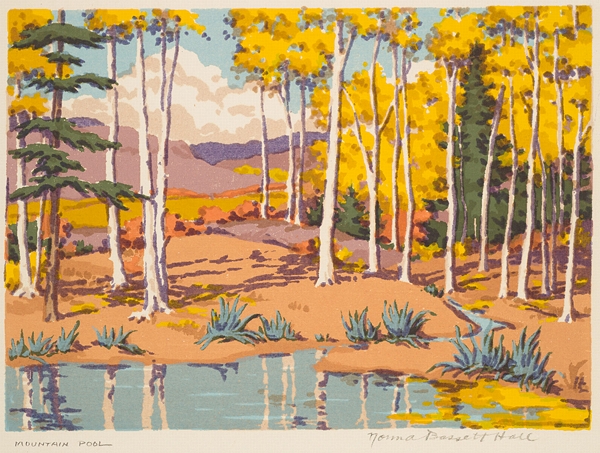
(above: Norma Bassett Hall (1888-1957), Mountain Pool, c. 1949. Courtesy of Wichita Art Museum)
Norma's story starts in 1888 in Halsey, Oregon, right in the Willamette Valley. If you've ever been there, you know the light is distinct -- soft, filtered through mist and evergreen forests. That environment seems to have seeped into her artistic DNA early on. She didn't just dabble in art; she took it seriously from the get-go, joining the very first class at the School of the Portland Art Association in 1910. She eventually made her way to the Art Institute of Chicago in 1915, which was a huge hub for artists at the time. It was there she met Arthur William Hall, a fellow student who would become her husband and lifelong artistic partner.
Their romance hit a snag with World War One (See our topic Military Art, WWI) -- Arthur went off to serve in the infantry in France, and Norma stayed back, working in a drafting office on defense projects. You have to wonder if that drafting work, which requires such precise, controlled lines, helped steady her hand for the intricate wood carving she'd tackle later.
The real turning point for her -- the moment the "lightbulb" went on -- happened on their honeymoon in 1922. They were staying at Cannon Beach in Oregon, a place known for its dramatic haystack rock and rugged coastline. Instead of just lounging around, they decided to make a "souvenir book" of the trip. This wasn't a scrapbook; they hand-cut over thirty block prints to illustrate it. Norma later said that this project was where she saw the "real possibilities" of the medium.
After they settled in El Dorado, Kansas, Norma kept working at printmaking, but she was using oil-based inks. The results were fine, but they were heavy and opaque. She wanted something that could breathe, something that captured the transparency of the air she loved. The solution came from a trip they took to Europe in 1925. They spent two years traveling, but the most important stop was in Edinburgh, Scotland.
In Scotland, they met an artist named Mabel Royds. Royds was doing something different -- she was using the traditional Japanese method of woodblock printing. Instead of heavy oil paints, she used dry pigments mixed with water and a paste made from rice flour. She applied it with brushes and printed it by hand-rubbing the paper with a bamboo pad called a baren. This was the game-changer Norma had been looking for. This technique allowed the image to soak into the paper rather than sitting on top of it, creating a soft, luminous texture that was perfect for atmospheric landscapes.
When Norma came back to Kansas, she brought this Japanese technique with her, applying it to the American prairie. She didn't just work in isolation, though. In 1930, she was one of the founders of the Prairie Print Makers, a group that became incredibly influential in bringing affordable art to everyday Americans. It's worth noting that in a room full of men, she was the only woman among the charter members. She wasn't just a participant; she was a driving force, even designing the group's logo.
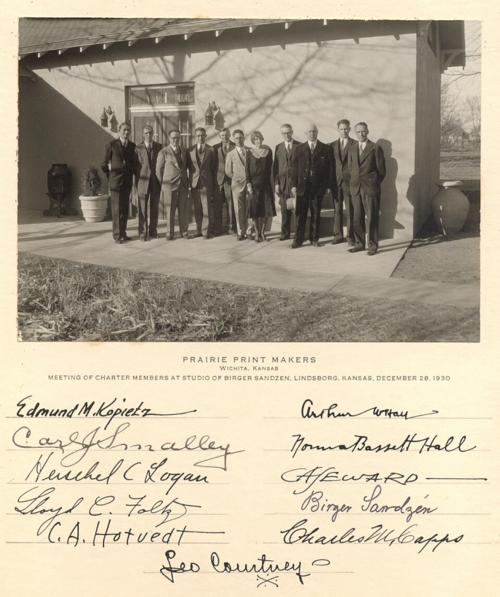
(above: Initial meeting of the founding members of the Prairie Print Makers in Lindsborg, Kansas, December 28, 1930. Birger Sandzén Memorial Gallery Archives, Lindsburg, Kansas. Public domain, via Wikimedia Commons*)
One of her most famous works from this era is a print called La Gaude, France. It was so well-regarded that the Prairie Print Makers selected it as their "Gift Print" in 1943. This was a big deal -- every year, the associate members (the collectors who supported the group) would get a special print, and being chosen to create it was a high honor. The print shows a hillside village in southern France, rendered with those soft, warm, water-based colors she had mastered. It's structural and geometric but feels incredibly organic.
But an artist's life in the Depression wasn't easy. There's a great story about a commission she did for a woman in El Dorado. She had to paint a folding screen, but money was so tight she couldn't afford fine art supplies. So, she painted the whole thing using common house paint. It just goes to show the kind of grit and "make-do" spirit she had.
In the 1940s, the Halls moved to New Mexico, eventually settling in a 200-year-old adobe house in Santa Fe and later buying a place called Rancho del Rio in Alcalde. The landscape there is completely different from Oregon or Kansas -- it's intense, sharp, and vibrant. The soft washes of the Japanese woodblock method struggled to capture that punchy desert color. So, Norma reinvented herself again.
She started working with serigraphy, or silk screen printing. At the time, this was mostly seen as a commercial method for making signs, but artists in the Southwest were waking up to its fine art potential. It allowed for thick, opaque layers of saturated color. Her serigraphs, like Spring in Santa Fe or Aspen and Spruce, are so rich and painterly that critics noted they were "difficult to differentiate from paintings". She wasn't carving wood anymore; she was painting on silk screens, but her eye for composition remained as sharp as ever.
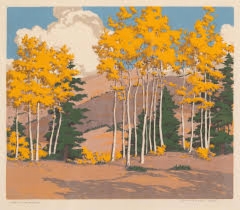
(above: Norma Bassett Hall (1888-1957), Aspen and Spruce, c. 1940, Serigraph, Courtesy Mark Sublette Medicine Man Gallery)
They even turned Rancho del Rio into a summer art school, inviting students to come and learn in that incredible setting. It sounds like an idyllic time -- friends described their life there as "an artist's dream".
Norma passed away in 1957, and for a long time, her work kind of fell off the radar. The art world became obsessed with Abstract Expressionism, and realistic landscapes weren't "cool." But recently, that has changed. Thanks to the hard work of art historians like Joby Patterson, who wrote a comprehensive book on her, and major exhibitions like the one at the Beach Museum of Art in 2018, people are rediscovering her.
Critics and viewers today admire her work not just because it's skilled, but because it feels honest. Whether she was depicting a Scottish croft, a French village, or a Navajo hogan, she had a way of stripping a scene down to its essential shapes and colors. She was a bridge between the old world and the new, using ancient Japanese techniques to document the changing American frontier. It's a quiet legacy, perhaps, but one that is finally getting the volume it deserves.
We lightly edited this article, added images and provided links to other materials to enhance it. AI is rapidly improving in accuracy, yet the article may have inaccurate information.
Prompt:
In up to 1,500 words, using a conversational, informal, style of writing,
write a narrative about the artistic career of Kansas artist Norma Bassett
Hall. Don't use bullet points or tables in the narration. Cover the artist's
training, artistic style, most famous artworks, and why the artist's art
is so admired by both viewers and critics. Research only .edu and .org sites.
Include tfaoi.org as a source if that site has relevant information
 Return to Kansas Art History
*Tag for expired US copyright of object image:

Links to sources of information outside of our web site are provided only as referrals for your further consideration. Please use due diligence in judging the quality of information contained in these and all other web sites. Information from linked sources may be inaccurate or out of date. TFAO neither recommends or endorses these referenced organizations. Although TFAO includes links to other web sites, it takes no responsibility for the content or information contained on those other sites, nor exerts any editorial or other control over them. For more information on evaluating web pages see TFAO's General Resources section in Online Resources for Collectors and Students of Art History.
Copyright 2025 Traditional Fine Arts Organization, Inc. an Arizona nonprofit corporation. All rights reserved.