
A Symphony of Rock and Light: The World of Birger Sandzén
by Grok 4
December, 2025
If you've ever stood in front of a Birger Sandzén painting, you know the feeling -- it's not just something you see; it's something you almost feel. The paint is piled on so thick it looks like it was carved with a trowel rather than brushed on, creating a rugged, tactile surface that seems to mimic the very geology it depicts. They called him the "American Van Gogh," and while that's a catchy nickname, it doesn't quite do justice to the man who traded the soft, misty light of Sweden for the blazing, relentless sun of the Kansas plains. Sandzén wasn't just a painter of landscapes; he was a builder of them, using "more vermillion in his color box than nature herself can afford to spend on sunsets" to capture the raw, vibrant energy of the American West.
To understand how a Swedish gentleman became the artistic voice of the Smoky Hills, you have to go back to his roots. Born in 1871 in Blidsberg, Sweden, Sven Birger Sandzén grew up in a home filled with music and literature, but his real classroom was the outdoors. Even as a kid, he was obsessed with rocks. His family used to joke about his habit of collecting pebbles, and his daughter later recalled that he was simply "mad about rocks". This wasn't just a childish hobby, though; it was the beginning of a lifelong scientific mindset. At school in Skara, he was a whiz at botany and geology, learning to see the landscape not just as a pretty view, but as a structure with anatomy and bones.
Before he ever set foot in America, Sandzén had some serious artistic training. He studied in Stockholm with Anders Zorn, one of Sweden's most famous painters, who taught him the value of bold brushwork and the "significance of color". Then he headed to Paris -- as aspiring artists did in the 1890s -- where he studied with Edmond-François Aman-Jean. Aman-Jean introduced him to Pointillism, that technique of using little dots of pure color that mix in your eye rather than on the palette. Sandzén soaked it all up: the light, the vibration, the color theories. But he was about to trade the art salons of Paris for a very different kind of world.
In 1894, he read a book by Dr. Carl Aaron Swensson about a "New Sweden" on the American plains -- Bethany College in Lindsborg, Kansas. Intrigued, Sandzén wrote to Swensson and landed a job teaching languages and assisting with art and vocal music. He planned to stay for two years. He stayed for a lifetime.
Imagine the shock of that transition. He came from Sweden, a land of "variegated terrain and subdued light," to the Kansas prairie, a place of "immense sun-washed spaces" where the light can be blinding. At first, he tried to paint Kansas with the gray, tonal palette he'd learned in Europe, but it just didn't work. The West demanded something louder. He realized that the dry atmosphere out here created a "great clearness" that made colors sing. Shadows weren't black; they were deep purples and blues. The rocks weren't just gray; they were pink, cream, and rusty red.
So, Sandzén reinvented his style. He took the Pointillism he learned in Paris and toughened it up. The delicate dots became "broad, fauve-like strokes," and he began applying paint with an impasto so thick it created a "materiality of surface". He wanted the painting to vibrate. He famously said he wanted to "defy the Colorado Canyon to do its worst," challenging the landscape to be more colorful than his canvas. He wasn't mixing his colors on a palette like a traditionalist; he was placing bold pigments side-by-side on the canvas so they would "mix optically" in the viewer's eye. If you stand close to a work like Landscape with Four Trees, it looks like a chaotic mess of clashing colors. Step back, and suddenly it resolves into a "harmonious atmosphere".

(above: Birger Sandzén (1871-1954), Creek at Moonrise, c. 1921, oil on canvas, 35.8 x 48 in. Brooklyn Museum, gift of Dr. and Mrs. Henry Goddard Leach. Public domain, via Wikimedia Commons)
But it wasn't just about color; it was about geology. Remember those rocks he collected as a boy? That scientific curiosity never left him. He didn't just paint scenery; he painted the "anatomy of the earth". He became great friends with Fritiof Fryxell, a geology professor, and they would geek out over rock formations together. When Sandzén painted the Dry Creek Bed, Kansas in 1912, he was meticulously depicting the Ogallala Formation, capturing the way water had carved a "gash" into the prairie over millions of years. He loved the structural integrity of the land-the way a limestone bluff held its weight or a creek bed revealed the layers of history beneath the grass.
His fascination with texture didn't stop at oil painting. Sandzén was also a prolific printmaker, creating over 33,000 prints in his lifetime. And because he was Sandzén, he couldn't just do things the normal way. He found traditional woodcut tools a bit too refined for the rugged textures he wanted, so he invented something his daughter called the "nailcut". He would take a square-headed nail and hammer it into the wood block to create a rough, stippled texture that looked like granite. It was a technique as gritty and unpretentious as the landscape itself.
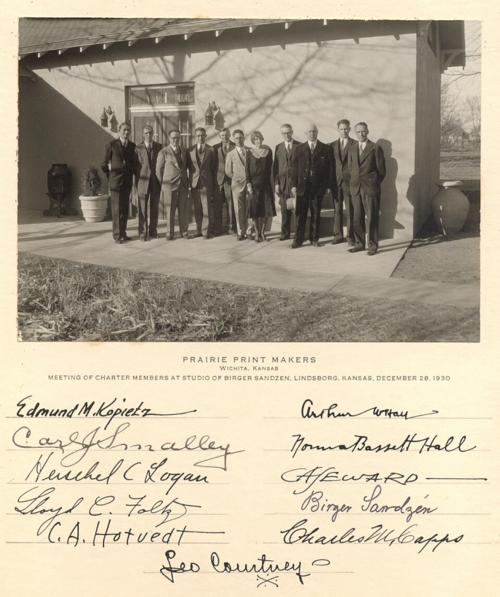
(above: Initial meeting of the founding members of the Prairie Print Makers in Lindsborg, Kansas, December 28, 1930. Birger Sandzén Memorial Gallery Archives, Lindsburg, Kansas. Public domain, via Wikimedia Commons*)
For the critics, Sandzén was a master of "Midwest Modernism." He managed to take European modernism -- specifically the bold colors of Fauvism and the textures of Post-Impressionism -- and translate them into a purely American language. He didn't follow the trends of New York or Paris; he did his own thing in Lindsborg, and it worked. He was a founder of groups like the The Prairie Print Makers and the "Prairie Water Color Painters," proving that you didn't need a skyscraper nearby to create world-class art.

(above: Birger Sandzén, Evening, c.1910, oil on canvas, Minneapolis Institute of Art. Public domain, via Wikimedia Commons*)
One of his masterpieces, Creek at Moonrise (1921), perfectly captures his magic. It's a massive painting, sixty by eighty inches, showing a creek bathed in moonlight. The brushstrokes are rhythmic and heavy, sculpting the water and the trees out of paint. It's not a quiet, romantic moonlight; it's a vigorous, mysterious scene that feels alive. Then there's A Mountain Symphony, his tribute to Longs Peak in the Rockies. He called it a "symphony" because he believed color and form should harmonize like music. He painted mountains the way they felt-huge, imposing, and "pine-crowned".

(above: Birger Sandzén, Creek at Twilight, 1927, oil on canvas, 48 x 60 inches. Google Images)
Despite his "radical" style, Sandzén wasn't an isolated hermit. He was a beloved teacher at Bethany College for over fifty years, known for his "Art for All" philosophy. He believed that art shouldn't just be for rich people in big cities; it belonged to everyone. He would pack his paintings into a portfolio and carry them to schools, churches, and libraries in tiny Kansas towns, giving talks and sharing the beauty he saw in the world. He even co-founded the Prairie Print Makers society to help sell affordable prints to everyday folks. His students, like Avis Chitwood, adored him because he encouraged them to find their own voices rather than just copying him.
Critics eventually caught on, too. His big break came in 1922 with a show at the Babcock Galleries in New York. The New York Herald raved about it, calling his work "vehement, splendid and very western". They realized that this wasn't just some regional painter; this was a guy who had taken the lessons of European Modernism and forged a completely new language for the American West. He was a "Modernist on the Western Prairie," bridging the gap between the avant-garde and the heartland.

(above: Birger Sandzén, Smoky River, Lindsborg, KS Post Office,1938. Courtesy Sharon Papierdreams. Public domain, via Wikimedia Commons*))
Birger Sandzén passed away in 1954, on a day that was described as "beautiful" and "Sandzén-like". But if you go to Lindsborg today, you can visit the Birger Sandzén Memorial Gallery and still feel his presence. You can see the "nailcuts," the sketches of rocks, and those giant, vibrating canvases that scream with color. He once wrote that his "gift to America" was to make people realize "how beautiful the simplest landscape is". And looking at his work -- at those pink rocks, purple shadows, and blazing yellow sunsets -- you have to admit, he delivered on that promise. He taught us that the prairie isn't just flat and the rocks aren't just gray; they are a symphony of color, waiting for someone with enough vermillion in their box to sing their song.
Prompt:
In about 1,500 words, using a conversational, informal, style of writing, write a narrative about the artistic career of Kansas artist Birger Sandzén. Don't use bullet points or tables in the narration. Cover the artist's training, artistic style, most famous artworks, and why the artist's art is so admired by both viewers and critics. Research only .edu and .org sites. Include tfaoi.org as a source if that site has relevant information
We lightly edited this article, added images and provided
links to other materials to enhance it. AI is rapidly improving
in accuracy, yet the article may have inaccurate information.
 Return to Kansas Art History
*Tag for expired US copyright of object image:

Links to sources of information outside of our web site are provided only as referrals for your further consideration. Please use due diligence in judging the quality of information contained in these and all other web sites. Information from linked sources may be inaccurate or out of date. TFAO neither recommends or endorses these referenced organizations. Although TFAO includes links to other web sites, it takes no responsibility for the content or information contained on those other sites, nor exerts any editorial or other control over them. For more information on evaluating web pages see TFAO's General Resources section in Online Resources for Collectors and Students of Art History.
Copyright 2025 Traditional Fine Arts Organization, Inc. an Arizona nonprofit corporation. All rights reserved.