
Herschel Logan: Kansas Master of the "Prairie Woodcut"
a Gemini 3 Deep Research Report
December, 2025
If you ever find yourself looking through a stack of old prints from the 1930s, you might stumble across a woodcut signed with a simple, distinctive "L." If that image happens to depict a massive, terrifying cloud of dust swallowing a Kansas farmhouse, or a tornado snaking its way across the horizon, you've likely found a Herschel Logan. To art critics and museum curators, Logan is the guy who mastered the "prairie woodcut," but if you dig a little deeper into his life, you realize he was a man of fascinating contradictions. He was a fine artist who spent most of his life in commercial printing, a quiet observer of nature who created a loudmouth cartoon alter ego, and a man who could carve a masterpiece out of wood yet spent his retirement making books so small you could fit them in the palm of your hand.
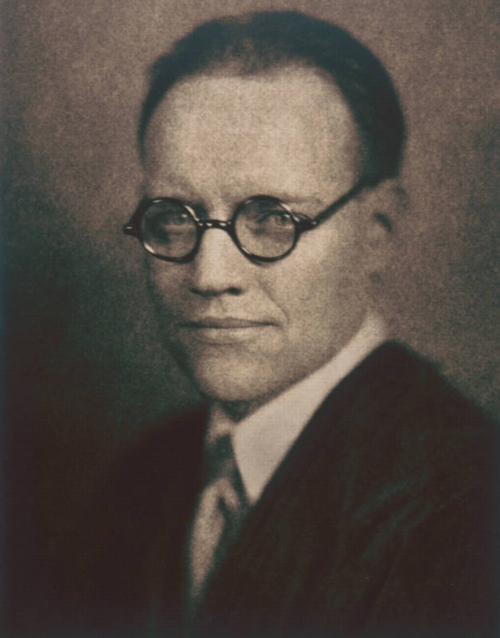
(above: Frederick O. Magerkurth, Herschel C. Logan. Portrait photo by of Salina Kansas, early 1930s.)
Logan's story really starts in the dirt -- specifically, the soil of a farm near Winfield, Kansas. Although he was born in Missouri in 1901, his family moved to Kansas when he was young, and that agrarian upbringing stuck with him. You can see it in his art; he didn't look at a barn or a wheat shock like a tourist passing through. He looked at them like someone who knew how much sweat it took to build that barn or harvest that wheat.
But Logan wasn't just a farm boy with a sketchbook. He took his training seriously. He headed up to the Chicago Academy of Fine Arts and later studied at the Federal School in Minneapolis. These schools were interesting places because they didn't just teach you how to paint pretty pictures; they taught commercial illustration. They taught you how to make an image "pop" on a printed page. That training was crucial for Logan because it taught him the power of black and white -- what art folks call "chiaroscuro," or the bold contrast between light and dark. When you're carving a woodblock, you don't have gray paint to hide your mistakes. You have the wood you leave (which prints black) and the wood you cut away (which stays white). It's an unforgiving medium, and Logan loved it.
When he came back to Kansas, he landed in Wichita and met a man named C.A. Seward. If you study Kansas art at all, Seward's name comes up everywhere. He was like the godfather of the local art scene. Seward took Logan under his wing and basically told him, "Look around you." He encouraged Logan to find beauty in what they called the "Coyote Road" -- the grain elevators, the dusty trails, and the river bends of the Midwest. This mentorship was the spark Logan needed. In 1930, right as the Great Depression was sinking its teeth into the country, Logan joined Seward and a handful of others to form the Prairie Print Makers. They met in Lindsborg, Kansas, with a very democratic idea: art shouldn't just be for rich people with oil paintings in their parlors. They wanted to make affordable prints that regular folks could own.
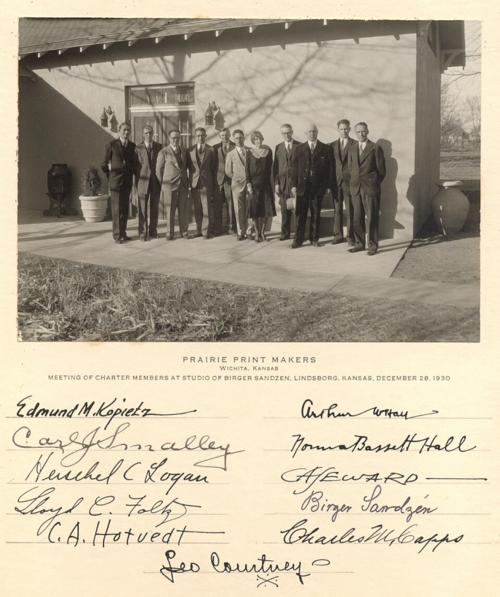
(above: Initial meeting of the founding members of the Prairie Print Makers in Lindsborg, Kansas, December 28, 1930. Birger Sandzén Memorial Gallery Archives, Lindsburg, Kansas. Public domain, via Wikimedia Commons*)
This is the period, roughly from 1921 to 1938, where Logan did his most famous work. He produced about 140 woodcuts, and they are something to behold. Critics admire them today because they have this "forceful visual impact". Take a look at his 1938 print Dust Storm. It's not a happy picture. It shows the environmental apocalypse of the Dust Bowl with a heavy, suffocating use of black ink. It's a historical document as much as it is art. Then there's Tornado, also from 1938, which captures that specific Midwestern dread of a funnel cloud dropping out of the sky. He wasn't trying to make the prairie look like a garden; he was showing it as it was -- beautiful, yes, but also dangerous.
It's interesting to note that his style often gets compared to J.J. Lankes, another famous woodcut artist of that era. They both used that "L" monogram, and they both loved rural subjects, but while Lankes was capturing the East Coast, Logan was defining the visual language of the Plains.
Then, something strange happened. In 1939, his mentor C.A. Seward died, and Logan basically stopped making fine art prints. He said he just "lost interest" without his friend. But his creative energy had to go somewhere. By this time, he was working as the art director for the Consolidated Printing and Stationery Company in Salina, Kansas, and he birthed a character named "The Colonel."
The Colonel was a cartoon mash-up of Abraham Lincoln, Will Rogers and Teddy Roosevelt -- a dapper gentleman with a goatee and a frock coat. For nearly 30 years, The Colonel appeared in the Salina Journal, offering "homespun philosophy" and sage advice. He wasn't just a drawing, though; he became Logan's alter ego. Logan was actually commissioned as a Kentucky Colonel in 1934, and he'd sometimes dress up like the character. It's a funny pivot, right? The guy who carved the ominous Dust Storm was now the local celebrity drawing a friendly cartoon colonel.
But Logan wasn't done reinventing himself. He was also a massive history buff, specifically when it came to firearms. And we aren't talking about a casual hobbyist; he became a nationally recognized authority. He wrote and illustrated books like Cartridges and Hand Cannon to Automatic, using those incredible drafting skills to draw precise diagrams of ammunition and gun mechanisms. He was so respected in this field that he served as the president of the American Society of Arms Collectors in the late 50s.
Finally, when he retired and moved to California in the late 60s, you'd think he'd just relax. Instead, he bought a "Baby Reliance" hand press and started the Log-Anne Press (named after himself and his wife, Anne). He started publishing miniature books-tiny little volumes, some no bigger than a couple of inches high. He published about 50 of these, covering everything from portraits of famous Americans to his old Colonel cartoons. It was like he was returning to his roots with the Prairie Print Makers-making small, precious things that people could hold in their hands.
So, why do people still care about Herschel Logan? It's mostly because he was authentic. When you look at his art, you aren't seeing a fantasy of the American West. You're seeing the real thing, recorded by a guy who lived it, survived the dust storms, and loved the landscape enough to carve it into wood. Whether he was documenting a tornado or drawing a diagram of a Civil War bullet, he was obsessed with getting the details right. That's a legacy worth admiring.
Prompt:
In up to 1,500 words, using a conversational, informal, style of writing, write a narrative about the artistic career of Kansas artist Herschel Logan. Don't use bullet points or tables in the narration. Cover the artist's training, artistic style, most famous artworks, and why the artist's art is so admired by both viewers and critics. Research only .edu and .org sites. Include tfaoi.org as a source if that site has relevant information.
We lightly edited this article, added images and provided
links to other materials to enhance it. AI is rapidly improving
in accuracy, yet the article may have inaccurate information.
 Return to Kansas Art History
*Tag for expired US copyright of object image:

Links to sources of information outside of our web site are provided only as referrals for your further consideration. Please use due diligence in judging the quality of information contained in these and all other web sites. Information from linked sources may be inaccurate or out of date. TFAO neither recommends or endorses these referenced organizations. Although TFAO includes links to other web sites, it takes no responsibility for the content or information contained on those other sites, nor exerts any editorial or other control over them. For more information on evaluating web pages see TFAO's General Resources section in Online Resources for Collectors and Students of Art History.
Copyright 2025 Traditional Fine Arts Organization, Inc. an Arizona nonprofit corporation. All rights reserved.