
Kansas Heartland Virtues: Kindness, Kinship, and Community in Kansas Art (1850-1950)
a Gemini 3 Conversational Deep Research Report
December, 2025
When we think of the art history of Kansas between 1850 and 1950, the mind often drifts to the Dust Bowl, the stark horizons, or the austere faces of Regionalism. We picture a landscape that is hard, unforgiving, and vast. But if you look closer -- past the tornadoes and the gray wood of weathered barns -- you find a story that is surprisingly tender. It is a story not just of survival, but of the specific human virtues that make survival possible: kindness, generosity, forgiveness, familial love, and an abiding gratitude.
The artists working in Kansas during this century weren't just documenting the frontier or the farm; they were actively building a culture. Through their brushstrokes, etchings, and woodblocks, they codified a set of values that defined what it meant to be a Kansan. They created "mutual aid" societies for beauty, treated art as a gift to be given rather than a commodity to be sold, and used their canvases to work through the complex dynamics of family and faith. From the Swedish-infused generosity of Lindsborg to the communal uplift of Topeka's Black neighborhoods, and from the democratic print shops of Wichita to the schoolrooms of Newton, this report explores how Kansas art became a vessel for the state's highest virtues.
If you want to understand the virtue of generosity in Kansas art, you have to start in Lindsborg, a small town settled by Swedish immigrants that became an unlikely epicenter of American culture. And at the center of this cultural whirlwind was Birger Sandzén, a painter whose heart was arguably as large as his impasto brushstrokes.

(above: Birger Sandzén, Evening, c.1910, oil on canvas, Minneapolis Institute of Art. Public domain, via Wikimedia Commons*)
Sandzén arrived at Bethany College in 1894, and for the next half-century, he didn't just teach art; he practiced a radical form of cultural philanthropy. His philosophy was simple: art belongs to everyone. In a world where high culture was often gated behind the doors of coastal museums, Sandzén believed that a farmer in McPherson County needed beauty just as much as a banker in New York. Sandzén's generosity wasn't passive; it was kinetic. He organized the Smoky Hill Art Club in 1913, a group that functioned like a "mutual aid" society for the soul. The premise was incredibly democratic: members paid dues of just one dollar a year. In the art world of the early 20th century, this was revolutionary. That single dollar bought you a stake in a growing collection of masterpieces. The funds pooled from these modest subscriptions were used to purchase art for Bethany College, but the mechanism of purchasing was itself an act of kindness. Sandzén used the club's treasury to buy works from his contemporaries -- artists who were often struggling to make ends meet during the lean years of the early 20th century and the Great Depression. By buying their work, the club provided a lifeline to the creators while enriching the community.
But Sandzén went further. He was known to load his car with paintings and drive to schoolhouses, libraries, and small-town civic centers, turning gymnasiums into galleries. He wanted to ensure that no child in Kansas grew up without seeing an original oil painting. This wasn't about ego; it was about sharing the "spiritual food" of art. Sandzén's personal life was peppered with acts of giving that border on the legendary. He was a close friend of the famous Swedish sculptor Carl Milles. The friendship was so warm that Milles gifted a sculpture, the "Little Triton," to Sandzén. Rather than hoarding this treasure in a private vault, the "Triton" was placed on the Sandzén lawn, and later, plans were made to center it in a fountain for a gallery that would serve the entire community. His generosity extended to the natural world as well. There is a delightful, humorous anecdote about Sandzén's relationship with his "livestock." Unlike the industrial farmers surrounding him, Sandzén kept a small flock of a dozen chickens he affectionately dubbed the "Grasshopper Patrol". These Rhode Island Reds and Barred Rocks weren't just for eggs; they were a part of his gentle ecosystem, a nod to the simple, unpretentious life he advocated. It's a small detail, but it paints a picture of a man who found joy and kinship in the humblest of creatures.
Perhaps the most telling story of his generosity involves a transaction with the students of Gustavus Adolphus College in 1942. The graduating class wanted to leave a legacy, so 100 students each chipped in exactly one dollar to buy a Sandzén painting. One hundred dollars was a modest sum for an established artist, but Sandzén didn't turn them away. He accepted the $100 for a painting of the Smoky River -- but then, in a characteristic twist, he threw in a second painting, Mountain Stream, Eldora, Colorado, as a personal gift to the college.

(above: Birger Sandzén, Smoky River, Lindsborg, KS Post Office,1938. Courtesy Sharon Papierdreams. Public domain, via Wikimedia Commons**)
He couldn't just meet the requirement; he had to exceed it. He had to be generous. This behavior taught generations of students that art was not a transaction, but a relationship-an exchange of gratitude between the artist and the audience. Finally, Sandzén's art itself was an act of gratitude. At a time when many viewed the Kansas landscape as flat, dreary, or desolate, Sandzén looked at the Smoky Hill River and saw a "paradise for the painter". He painted the creeks and cottonwoods in vibrating purples, pinks, and turquoises.
By rendering the "ordinary" landscape with such exuberant color, he was teaching his neighbors to love their home. He was practicing the virtue of gratitude for the land, refusing to see it as barren, and instead choosing to see it as a jewel box of light. His 1931 gift print, A Kansas Creek, is a perfect example -- taking a muddy, overlooked waterway and elevating it to the status of high art. If Sandzén established the spirit of generosity, the Prairie Print Makers industrialized it. Founded in Sandzén's studio in 1930, right at the onset of the Great Depression, this group of artists decided that art should be affordable, accessible, and intimate. Led by the indefatigable C.A. Seward of Wichita, they launched a movement that brought "museum quality" art into the living rooms of the middle class.
The Prairie Print Makers operated on a brilliant model of democratic kindness. They solicited "associate members" -- regular folks, not wealthy patrons -- who paid small annual dues. In return, every year, each member received a "Gift Print" in the mail.Think about that for a moment. In the 1930s, when the news was full of dust storms, bank failures, and breadlines, thousands of Kansans would open their mailboxes to find an original lithograph, etching, or woodcut, signed by the artist. It was a tangible delivery of beauty during an ugly time.
The artists who created these prints -- legends like William Dickerson, Norma Bassett Hall and Charles Merrick "Chili" Capps -- accepted flat fees that were far below their market rate. They did this because they believed in the mission. They believed in the virtue of sharing their talent with the widest possible audience. The subjects of these prints were often comforting and grounding: Mexican Barber Shop (1938), Church at Canyoncito (1942), or The Far Shore (1957). They were windows into other worlds, gifted to people who might never travel past the county line.
Norma Bassett Hall, one of the charter members of the group, specialized in a kind of art that celebrated the domestic and the serene. Her color woodcuts and serigraphs, such as Persimmons and Sumac (1933) and Road to the Village (1948), depicted the world with a gentleness that feels almost protective. There is a wonderful irony in the story of a modern-day shopper who found one of Hall's color woodcuts at a Goodwill store for exactly $1.49. The shopper bought it simply because she thought "the colors were very beautiful" and that it was "lovely." She had no idea she had purchased a valuable piece of art history.
When the appraisal came in on Antiques Roadshow, it was valued much higher, but the expert noted something profound: The Prairie Print Makers "prided themselves on making affordable art for ordinary people." The fact that this print ended up in a thrift store, still charming a stranger with its beauty for the price of a cup of coffee, proves that their mission succeeded. They released kindness into the world, and it was still working eighty years later. Hall's work, with titles like Cottage in Skye and Spring in Santa Fe, focused on the virtue of shelter. In a tumultuous era, she painted homes, gardens, and quiet paths-visual sanctuaries that offered the viewer a place to rest.
We must also pause to appreciate C.A. Seward, the organizer. In any group, there is usually one person who does the heavy lifting-the paperwork, the correspondence, the nagging. Seward was that person for Kansas art. He spent his life promoting others. He used his influence to get Kansas artists into exhibitions in New York and Chicago. His virtue was service. He understood that for the community to thrive, someone had to tend the garden, and he took that role on with a generosity of spirit that defined the organization.
While Sandzén and the Print Makers were focused on distributing art, John Steuart Curry -- the Kansas-born giant of the Regionalist movement -- was using his canvas to wrestle with the deep, often painful dynamics of family and community. Curry's relationship with Kansas was complicated. He loved the state, but the state didn't always love him back. His work is a testament to the virtues of familial love and the hard road to forgiveness. There is perhaps no greater act of filial piety in American art than Curry's 1929 painting, The Stockman. The subject is his father, Smith Curry. In the painting, Smith stands amidst his Hereford cattle, a concrete silo rising behind him like a castle tower. Art historians have noted that this is not a sentimental portrait. Smith Curry is not smiling; he is stern, formidable, and commanding. But this is exactly where the virtue lies. Curry painted his father not as a simple dirt farmer, but as a King of the Plains. He endowed his father with immense dignity, celebrating the "proud individual" who claims the right to live as a free citizen on his own unmortgaged land. The concrete silo in the background isn't just scenery; in 1929, it was a symbol of modernity, success, and stability. By placing his father in front of it, Curry was saying, "Look at what he built." It is a painting of profound gratitude and respect. It acknowledges the hard labor of the parent that allows the child to dream.
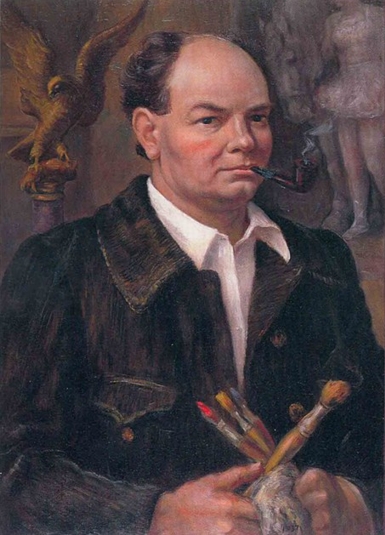
(above: John Steuart Curry, Self Portrait, 1937. Public domain, via Wikimedia Commons*)
Curry revisited this theme in The Old Folks (c. 1929), a portrait of his mother and father sitting in their parlor. Between them is a window, and through that window, you see the farm. The composition is telling: the farm is the bond that connects them. It is the third partner in their marriage. This painting captures the virtue of endurance. It honors the long, often silent partnership of marriage on the frontier. It's a quiet "thank you" to the stability of his home life, painted by a man who spent much of his adult life in the chaotic art worlds of New York and Connecticut. Curry's most famous work, Baptism in Kansas (1928), is often misunderstood. At the time, some critics thought he was making fun of the "religious fanaticism" of the Midwest. But if you look with a virtuous eye, you see something else entirely.
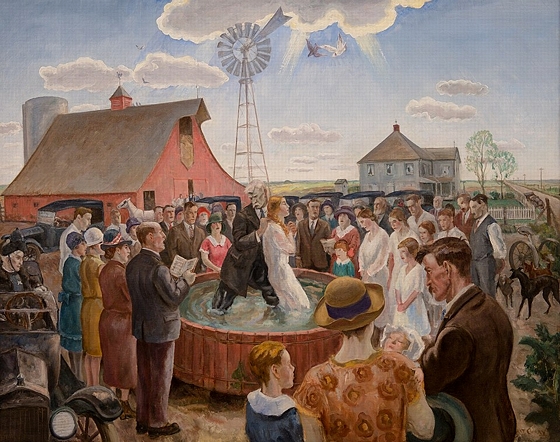
(above: John Steuart Curry, Baptism in Kansas, 1928. Public domain, via Wikimedia Commons*)
The painting depicts a baptism in a horse tank, surrounded by a circle of Model T Fords and neighbors. The dove descending (symbolized by the light and the birds) represents the Holy Spirit. The central action is the washing away of sin -- the ultimate act of forgiveness. But look at the crowd. They are arranged in a circle, a "henge" of community. They are there to witness the redemption of one of their own. In the harsh reality of rural life, where you relied on your neighbor to put out fires or harvest crops, this religious ritual was also a social one. It was a mechanism for reintegrating people into the community, for forgiving their pasts and welcoming them into a shared future. Curry wasn't mocking this; he was documenting the way a community heals itself through faith.
Curry's own need for forgiveness and acceptance from Kansas was palpable. When he returned to paint the murals in the State Capitol, he was met with criticism. People called his work "uncivic," "drab," and "freakish" because he dared to paint tornadoes and John Brown rather than just sunny wheat fields. Elsie J. Nuzman Allen, a prominent local voice, wrote scathing letters asking why he painted such "freakish subjects." Even William Allen White, the famous Kansas editor who defended Curry, had to plead with the public to see the beauty Curry saw -- comparing Kansas to the "Steppes of Russia" or France to try and validate the artist's vision. Despite the rejection, Curry kept painting Kansas. He idealized it in works like Kansas Pastoral, where he imagined a farm life of leisure and plenty. His persistence was an act of love. Like a prodigal son who returns home only to be misunderstood, he continued to offer his gifts to his home state, forgiving its rejection and leaving behind a masterpiece in the Capitol that defines the state to this day.
The final chapter of this story takes place during the Great Depression, when the virtue of kindness became a matter of public policy. Through New Deal programs like the Works Progress Administration (WPA), the government and artists collaborated to ensure that culture didn't die when the economy collapsed.In Kansas, this manifested beautifully in the Museum Extension Program (MEP). The goal was simple and noble: if rural schools couldn't afford to take children to a museum, the government would build a museum and send it to the schools. Artists were hired to create visual aids -- dioramas, dolls, maps, and prints. In Marysville, Kansas, the schools received a collection that included Native American dolls dressed in authentic costumes and watercolors of agricultural tools. In Newton, at Washington Elementary School, students learned from the "Kansas History Diorama No. 1" depicting Coronado's March and "Indian Diorama No. 4" showing Pawnee Pottery Making. These objects -- meticulously crafted by artists like Phil Epp (who later rediscovered them) -- were acts of civic love. They were a declaration that the imagination of a child in a small Kansas town mattered. They taught students to respect the history of the land and the diverse peoples (like the Pawnee) who had lived there. It was a curriculum of gratitude for the past.
When we look back at the art of Kansas from 1850 to 1950, we see more than just landscapes and portraits. We see a moral infrastructure. We see Birger Sandzén teaching us that generosity means giving more than is asked, even if it's just a painting of a mountain stream. We see the Prairie Print Makers proving that kindness can be delivered in an envelope for the price of a membership fee. We see John Steuart Curry showing us that true love often involves forgiveness, both of our families and our communities. We see Aaron Douglas reminding us that gratitude for our heritage is the foundation of our future. And we see the WPA artists demonstrating that the state itself has a duty to be kind to its children's imaginations. These artists didn't just paint Kansas; they painted a vision of how to live well in Kansas. They showed that in a land of vast distances, the most important connection is the one between human hearts.
Prompt:
In 1,500 to 2,500 words, using an informal style, write about highly regarded artists painting from 1850 to 1950 in Kansas known for their art emphasizing one or more of the following virtuous behaviors: kindness, generosity, forgiveness, familial love and gratitude. Research only .edu and .org sites
We lightly edited this article, added images and provided links to other materials to enhance it. AI is rapidly improving in accuracy, yet the article may have inaccurate information.
 Return to Kansas Art History
Return to Quilts and Quilting
*Tag for expired US copyright of object image:

and
**Tag for some rights reserved:

Links to sources of information outside of our web site are provided only as referrals for your further consideration. Please use due diligence in judging the quality of information contained in these and all other web sites. Information from linked sources may be inaccurate or out of date. TFAO neither recommends or endorses these referenced organizations. Although TFAO includes links to other web sites, it takes no responsibility for the content or information contained on those other sites, nor exerts any editorial or other control over them. For more information on evaluating web pages see TFAO's General Resources section in Online Resources for Collectors and Students of Art History.
Copyright 2025 Traditional Fine Arts Organization, Inc. an Arizona nonprofit corporation. All rights reserved.