
A Story About John Steuart Curry
by Grok 4
December, 2025
Let me tell you about a Kansas
artist whose brushstrokes captured the raw heartbeat of the American Midwest,
turning everyday rural struggles into epic tales that still resonate today.
Picture this: it's November 14, 1897, and in the tiny farming hamlet of
Dunavant, Kansas, with barely 85 souls calling it home, a boy is born to
Thomas Smith Curry and Margaret Stueart Curry. They weren't your typical
dirt-poor farmers; both had college educations, which was rare back then,
and they raised their eldest son, John, amid the endless golden fields and
the relentless chores of farm life.
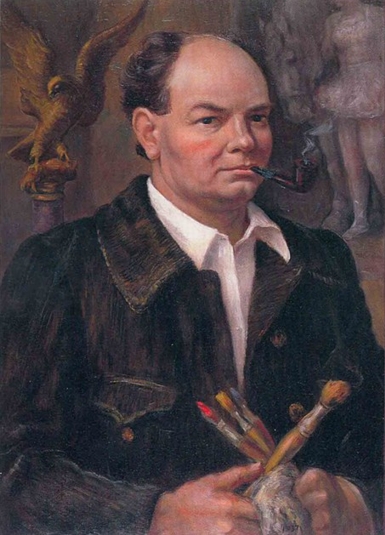
(above: John Steuart Curry, Self Portrait, 1937. Public domain, via Wikimedia Commons*)
From a young age, John was out there tending to the animals -- milking cows, feeding hogs -- but his mind wandered to the sketches he scribbled of horses and barns instead of shoveling manure. His parents' home was adorned not with the usual grain calendars but with reproductions of grand masters like Peter Paul Rubens and Gustave Doré, whose dramatic scenes of biblical fury and swirling compositions planted seeds in young John's imagination. You can imagine how that mix of Midwestern grit and artistic inspiration shaped him early on. By age twelve, he was encouraged to paint the farm animals, and the religious fervor of his family seeped into his motifs, setting the stage for a lifetime of portraying life's profound moments with a touch of the divine.
As John grew into his teens, he balanced the physical demands of high school athletics -- excelling in football -- with a budding passion for art that couldn't be ignored. He dropped out in 1916 to chase that dream, heading first to the Kansas City Art Institute for a brief stint, then transferring to the prestigious Art Institute of Chicago, where he honed his skills for two years. From there, it was off to Geneva College in Beaver Falls, Pennsylvania, graduating in 1919 or so, but art was his true calling.
In 1920, he apprenticed with the illustrator Harvey Dunn in New Jersey, learning the ropes of bold figural compositions that would later define his narrative style. By 1921, John had moved to New York, scraping by as a commercial illustrator for magazines like Boys' Life, St. Nicholas, The Country Gentleman, and even The Saturday Evening Post. Those years sharpened his ability to tell stories through images, but they were just a stepping stone. In 1923, he married Clara Derrick, and they settled in Westport, Connecticut, where he set up a studio -- infested with skunks, mind you, which sometimes snuck into his paintings. But John yearned for more depth, so in 1925, inspired by fellow artist James Daugherty, he and Clara packed up for Paris.
Ah, Paris in 1926 -- that magical year abroad changed everything. While the city buzzed with avant-garde experiments from Matisse and Picasso, John turned his back on abstraction, declaring it "good but not good for me." Instead, he dove into the Old Masters: Rubens' dynamic energy, Titian's rich colors, Gustave Courbet's realism, and Honoré Daumier's satirical bite. At 29, he felt he'd "grown up" and discovered his true tradition. Returning to the U.S., he remarried after Clara's tragic death in 1932 -- tying the knot with Kathleen Gould in 1934 -- and threw himself into painting the heartland he knew so well.
This is where his style truly blossomed: a Regionalist approach, shared with contemporaries like Thomas Hart Benton and Grant Wood, that celebrated the American vernacular over European modernism. John's work pulsed with dynamic movement -- free brushwork creating energized forms that evoked raw emotions like fear, despair, and unyielding perseverance. He used spirals and triangles in his compositions to build tension between chaos and stability, often blurring into near-abstraction, with scratched canvases adding texture and a phantasmagorical qualityHis subjects? The rural life of Kansas and the Midwest -- farm scenes teeming with animals, devastating tornadoes and prairie fires, religious rituals, historical upheavals like Bleeding Kansas, and even critiques of social ills like lynching and soil erosion during the Dust Bowl. It wasn't just pretty pictures; John's art carried moral authority, highlighting life's cycles of fertility and death, community ethics, and the indomitable spirit of ordinary folks facing nature's wrath. that blended the bucolic with the sinister.
Take his breakthrough piece, Baptism in Kansas, painted in 1928. Imagine a scorching 1915 drought in rural Kansas, where a community gathers around a farmyard stock tank for an open-air baptism. The pastor immerses a white-robed woman, her hair swirling like the birds overhead, while spectators -- men in overalls, women in bonnets -- and animals look on with a mix of reverence and curiosity. The composition spirals upward from the tank to the vast fields under a sunny sky, symbolizing rebirth and core American values, with subtle nods to encroaching modernity like a distant motorcar. This oil on canvas catapulted John to fame when Gertrude Vanderbilt Whitney bought it for her museum, praising its sincere portrayal of the heartland. Viewers admire it for its emotional depth -- the way it captures communal faith as a bulwark against hardship, making the everyday sacred. It's no wonder it was exhibited at the Corcoran Gallery's Biennial and established him as a Regionalist star.
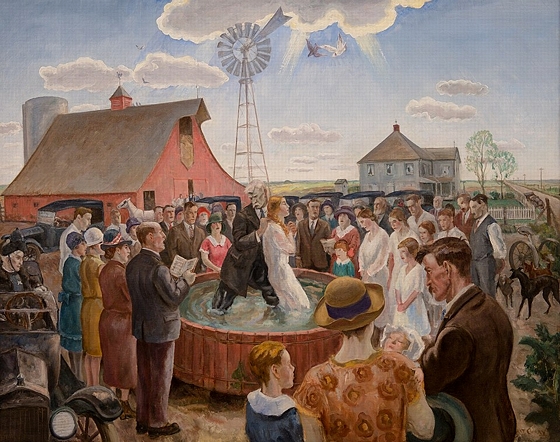
(above: John Steuart Curry, Baptism in Kansas, 1928. Public domain, via Wikimedia Commons*)
Not long after, in 1929, came Tornado over Kansas, a gripping scene of a family fleeing a monstrous twister barreling across the plains. The father urges his wife and children toward a storm cellar, the son clutching squirming piglets with wide-eyed terror, while the landscape tilts in chaotic motion -- patchwork quilts of fields whipping in the wind. John's brushstrokes convey the turmoil, pushing traditional composition to the edge, perhaps even mirroring his own personal strains during his first marriage. Winning second prize at the Carnegie Institute, this painting resonates because it humanizes the Midwest's perils, showing resilience amid nature's fury. People love how it entertains with its dramatic storytelling while offering a primitive view of independent life, a nostalgic escape from the Great Depression's urban woes.
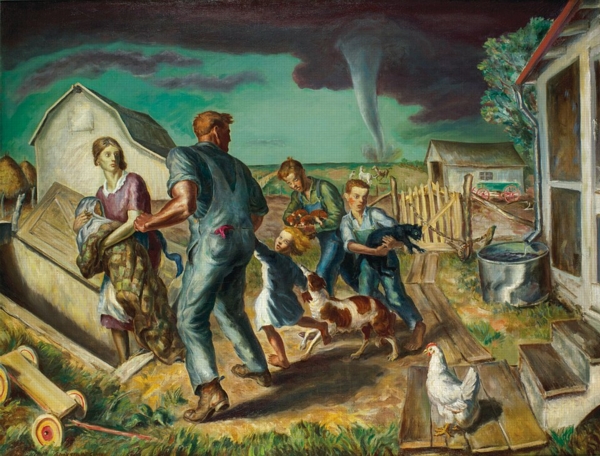
(above: John Steuart Curry, Tornado Over Kansas, 1929, oil on canvas, Muskegon Museum of Art. Public domain, via Wikimedia Commons*)
John's adventures didn't stop at farms; in 1932, grieving Clara's death, he joined the Ringling Brothers Circus, sketching performers that inspired works like The Flying Codonas . This painting captures aerial acrobats soaring through the air, their bodies twisting in mid-flight, embodying the thrill and danger of performance-much like the precarious balance of rural existence he so often depicted. It's admired for its action-oriented energy, drawing from Rubens' influence, and for injecting excitement into American art, reminding viewers of human daring in the face of uncertainty.
By the 1930s, with the Depression raging, John's Regionalism provided solace, idealizing rural work ethic and community while subtly critiquing issues like mob violence in pieces like The Fugitive (1935), which addressed lynching, or Justice Defeating Mob Violence, a 1937 mural for the Department of Justice showing a judge halting a frenzied crowd. His appointment in 1936 as the first artist-in-residence at the University of WisconsinMadison's College of Agriculture was a game-changer -- no teaching required, just creating and promoting art in farming communities. There, he became a conservationist, painting the horrors of soil erosion and Dust Bowl storms, and even starting an annual rural art fair. Murals became his passion: The Oklahoma Land Rush in 1939, Freeing of the Slaves in 1942 at Wisconsin, celebrating the Emancipation Proclamation with vivid historical drama.
But not everything was smooth. Commissioned in 1937 for the Kansas State Capitol murals, John poured his soul into Tragic Prelude, a massive panel depicting abolitionist John Brown as a cruciform prophet with bible and rifle, trampling foes amid clashing Civil War forces, wildfires, and an African American family fleeing chaos. It explored America's fractured identity with Old Testament fury, Brown's bloodied hands symbolizing the violence of progress. Yet locals balked at its wild, unflinching portrayal of Kansas history -- tornadoes, mad prophets, and no idyllic farms in sight. Officials objected, and John, heartbroken, abandoned the project in 1941, refusing to sign or hang the unfinished works. It was a blow, straining his relationships and career, but posthumously, the murals were installed, and in 1992, the Kansas Legislature even apologized, acquiring his sketches.Viewers today admire this piece for its bold commentary on social tensions, its epic scope blending history and emotion, and how it challenges nostalgic views of the heartland with raw truth. (Also see our article Symbolism Packed Into John Steuart Curry's Tragic Prelude.)
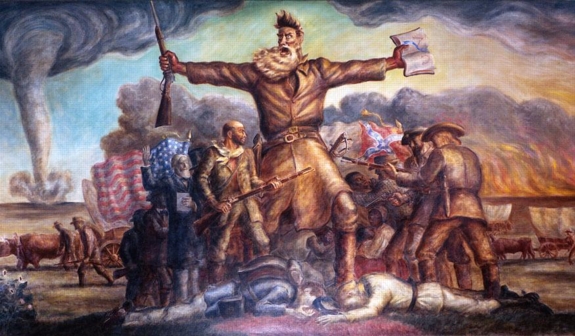
(above: John Steuart Curry, Tragic Prelude, 1938, oil and tempera, Kansas State Capitol. Public domain, via Wikimedia Commons*)
Other gems like Hogs Killing a Rattlesnake (1930) show nature's brutal rhythm -- seven hogs attacking a snake in a glade, their faces full of personality, fruit symbolizing fertility amid violence -- or Ajax (1936-37), a massive ox dominating the plains under stormy skies, evoking timeless heroism rooted in American soil. John's art is cherished for this multidimensionality: it's accessible, entertaining the common man with stories of perseverance, yet layered with critiques of dehumanizing forces. His realism isn't cold; it's infused with emotional richness, making rural life feel intimate and grand, a counterpoint to industrialization. As TIME magazine hailed him alongside Benton and Wood in 1934, he resisted European trends, giving voice to the Midwest's soul.
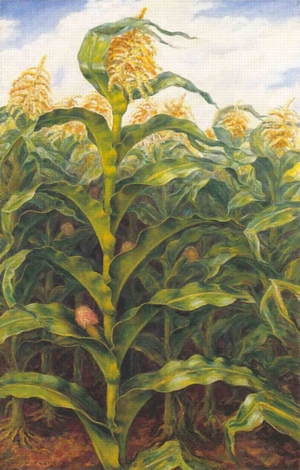
(above: John Steuart Curry, Kansas Cornfield, 1933, oil on canvas, 60 3/8 x 38 3/8 inches, Wichita Art Museum, Roland P. Murdock Collection. Public domain, via Wikimedia Commons*)
In his later years, John stayed at Wisconsin, elected to the National Institute of Arts and Letters in 1942 and the National Academy of Design as a full Academician in 1943. A 1943 biographical study by Laurence Schmeckebier cemented his legacy. But on August 29, 1946, at just 48, a heart attack claimed him in Madison, Wisconsin. Buried back in Winchester, Kansas, his work lives on, admired for its cultural representation -- offering solace in hardship, celebrating community strength, and innovating form to sustain interest. John's paintings don't just show the Midwest; they make you feel its pulse, its pains, and its enduring spirit, reminding us why the heartland's stories matter.
We lightly edited this article, added images and provided
links to other materials to enhance it. AI is rapidly improving
in accuracy, yet the article may have inaccurate information.
Prompt:
In about 1,500 words, using a conversational, informative, style and not looking like a report, explain the career of Kansas artist John Steuart Curry, his artistic style and various subject matter, and especially why his art is admired by viewers. Don't use tables and bullet points. Research only .org sites. Include tfaoi.org as a source.
 Return to Kansas Art History
*Tag for expired US copyright of object image:

Links to sources of information outside of our web site are provided only as referrals for your further consideration. Please use due diligence in judging the quality of information contained in these and all other web sites. Information from linked sources may be inaccurate or out of date. TFAO neither recommends or endorses these referenced organizations. Although TFAO includes links to other web sites, it takes no responsibility for the content or information contained on those other sites, nor exerts any editorial or other control over them. For more information on evaluating web pages see TFAO's General Resources section in Online Resources for Collectors and Students of Art History.
Copyright 2025 Traditional Fine Arts Organization, Inc. an Arizona nonprofit corporation. All rights reserved.