
Symbolism Packed Into John Steuart Curry's Tragic Prelude
by Grok 4
December, 2025
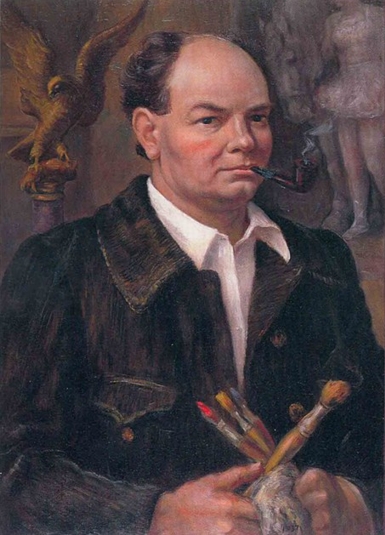
(above: John Steuart Curry, Self Portrait, 1937. Public domain, via Wikimedia Commons*)
Let's dive into the symbolism packed into John Steuart Curry's Tragic Prelude, that massive mural he painted between 1937 and 1942 for the Kansas State Capitol in Topeka. This isn't just a historical snapshot; it's a swirling, chaotic vision of Bleeding Kansas as the fiery lead-up to the American Civil War, with John Brown looming like a biblical prophet at its heart. Curry, as a Regionalist artist, infused the piece with layers of meaning, blending real events from the 1850s -- like the Kansas-Nebraska Act that turned the territory into a battleground over slavery -- with dramatic, almost apocalyptic imagery. The overall theme screams inevitability: how fanaticism, violence, and national division spiraled into catastrophe, much like a natural disaster you can't escape. To really grasp it, picture this: a towering figure dominates the center, arms outstretched, with soldiers clashing, fires raging, and storms brewing in the background -- it's raw, emotional, and unapologetically intense.
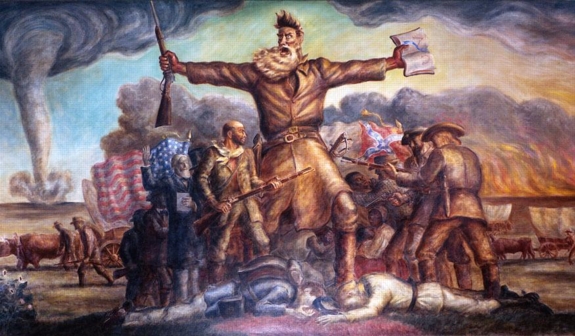
(above: John Steuart Curry, The Tragic Prelude, 1938, oil and tempera, Kansas State Capitol. Public domain, via Wikimedia Commons*)
At the core of it all is John Brown himself, depicted as this gigantic, wild-eyed zealot striding forward with his beard flowing and eyes blazing with righteous fury. He's not just a man; Curry poses him like Moses parting the Red Sea or even Christ on the cross, arms extended in a cruciform shape that evokes sacrifice and divine mission. But there's a darker twist -- Brown's a "bloodthirsty, god-fearing maniac," as some analyses put it, symbolizing the dangerous edge of abolitionism where moral conviction tips into violent extremism. His historical actions, from the brutal Pottawatomie Massacre in 1856 where he and his sons hacked pro-slavery settlers to death, to his doomed raid on Harpers Ferry in 1859 aimed at sparking a slave uprising, are distilled here into a force of nature. Brown represents the escalation of tensions in Kansas, where "free soilers" and pro-slavery forces turned the prairie into a preview of the Civil War's horrors. Critics back in the day hated this portrayal, seeing him as a traitor with blood on his hands -- literally painted red to signify the violence of the Border Wars and the broader conflict -- but Curry defended it as capturing Brown's Calvinist firebrand spirit, a catalyst for the nation's reckoning with slavery.
Now, look at what Brown's holding: in one hand, a Bible open to the Book of Revelation, marked with the Greek letters alpha and omega, straight out of apocalyptic scripture. This isn't subtle -- it's Curry shouting that Brown saw the fight against slavery as a holy war, an end-times battle between good and evil. The Bible symbolizes his deep religious zeal, rooted in his upbringing, where he believed armed rebellion was God's will, not just peaceful protest. It's a nod to how faith fueled the abolitionist movement but also justified bloodshed, tying into the era's moral suasion versus direct action debate. In the other hand, he's gripping a "Beecher's Bible" -- that's slang for a Sharps rifle, smuggled to anti-slavery fighters in Kansas disguised as Bibles. The rifle stands for the raw violence of Bleeding Kansas, where the 1854 Kansas-Nebraska Act let settlers vote on slavery, turning the territory into a proxy war with raids, murders, and guerrilla fights. Together, the Bible and rifle encapsulate Brown's duality: piety meets militancy, faith arming itself against injustice, foreshadowing how ideological clashes would explode into national warfare.
The background amps up the drama with a tornado twisting across the plains and a prairie fire blazing wildly, clouds parting around Brown like he's commanding the heavens. These aren't just weather effects; they're potent symbols of impending destruction and chaos. The tornado represents the whirlwind of conflict sweeping through Kansas and the nation, mirroring events like the Fugitive Slave Law of 1850 or the Dred Scott decision of 1857 that inflamed fears of slave revolts and deepened the North-South divide. The fire, meanwhile, evokes the burning spread of violence, like how Brown's actions ignited sectional strife that led to secession and the Civil War. Critics in Kansas fumed over these elements, arguing they made the state look like a hellscape, but Curry insisted they illustrated the wartime devastation-man-made disasters as unstoppable as nature's fury, underscoring the "tragic" in the prelude.
Down in the foreground, you've got soldiers from both Union and Confederate sides sprawled dead at Brown's feet, their uniforms clashing in a heap of blue and gray. This is Curry's gut-punch symbol of fratricide -- the brother-against-brother agony of the Civil War, with over a million lives lost evoked by these figures. It ties directly to the human cost of Kansas' battles, where families and communities tore themselves apart over slavery. Flanking them are flags: the U.S. stars and stripes alongside the Confederate battle flag, waving in the wind to represent the fracturing union. They're symbols of nationalism gone wrong, blind patriotism fueling division rather than unity, a critique Curry weaves in to show how expansionist ideals clashed with moral realities.
Don't miss the smaller but poignant details, like the pioneers in covered wagons trekking westward in the middle ground. They symbolize American resilience and manifest destiny -- the relentless push into new territories that upset the free-slave state balance and sparked all this mess. Yet amid the heroism, there's tragedy: a Black family in the foreground being assaulted by soldiers, highlighting slavery's brutality and the enslaved people's plight at the heart of the conflict. Brown's mission was to free them, but his methods amplified the violence, as seen in his failed Harpers Ferry plan. In the larger mural series, elements like Father Padilla and Coronado in adjacent panels add layers of exploration and conquest, but in Tragic Prelude, they frame Kansas as a mythical promised land turned battlefield.
What makes this symbolism so enduring is how Curry blends it all into a narrative of warning. The mural isn't glorifying Brown; it's portraying him as a mythical force casting a shadow over history, where ideals tower over the violence but still lead to calamity. It confronted Kansans with their melodramatic past, sparking controversy because it refused easy heroism- no idyllic farms here, just raw truth about how fanaticism preludes disaster. Today, it's admired for that honesty, a visual essay on how personal convictions can unravel a nation, much like the storms and fires that rage across the canvas.
We lightly edited this article, added images and provided
links to other materials to enhance it. AI is rapidly improving
in accuracy, yet the article may have inaccurate information.
 Return to Kansas Art History
*Tag for expired US copyright of object image:

Links to sources of information outside of our web site are provided only as referrals for your further consideration. Please use due diligence in judging the quality of information contained in these and all other web sites. Information from linked sources may be inaccurate or out of date. TFAO neither recommends or endorses these referenced organizations. Although TFAO includes links to other web sites, it takes no responsibility for the content or information contained on those other sites, nor exerts any editorial or other control over them. For more information on evaluating web pages see TFAO's General Resources section in Online Resources for Collectors and Students of Art History.
Copyright 2025 Traditional Fine Arts Organization, Inc. an Arizona nonprofit corporation. All rights reserved.