
Kansas Regionalism
a Gemini 3 Deep Research Report
December, 2025
If you look at the story of American art in the first half of the twentieth century, you are essentially looking at a nation in search of its own soul. After the industrial boom of the Gilded Age and the shattering disillusionment of World War I, the American psyche began to turn inward. It stopped looking to the grand boulevards of Paris or the avant-garde salons of New York for definition and started looking at the soil of the continent itself. This cultural pivot gave rise to what we now call American Regionalism. While history often paints this movement with a broad brush-labeling it simply "Midwestern"-the reality was far more complex. The "Midwest" was not a monolith; it was a patchwork of distinct agrarian cultures, and within that patchwork, the state of Kansas emerged as a distinct, often volatile, artistic theater.
To understand the specific flavor of Kansas art, you have to look at the landscape itself. Kansas Regionalism wasn't like the rolling, manicured hills of Grant Wood's Iowa or the muscular, rhythmic historical epics of Thomas Hart Benton's Missouri It was defined by an elemental confrontation between humanity and a hostile environment. It was an art form born of the Dust Bowl and the bloody history of "Bleeding Kansas," rooted in radicalism and extreme weather. The artists who emerged from this milieu-most notably John Steuart Curry and Birger Sandzén:, alongside the collective force of the Prairie Print Makers-- did not merely record the American Scene; they mythologized it. They transformed the flat, open spaces of the plains into a stage for high drama where the struggle for survival took on Biblical proportions.
In the 1930s, as the Great Depression ravaged the nation's economy and confidence, the American public hungered for reassuring images of resilience. The art establishment, aided by the populist rhetoric of critics and the mass-media reach of Time magazine, elevated three artists to the status of national prophets: Thomas Hart Benton of Missouri, Grant Wood of Iowa, and John Steuart Curry of Kansas. The media spun a narrative of an organic uprising, suggesting these "artists-in-overalls" had rejected the decadent "isms" of Europe to paint the "real" America. But if this "Regionalist Triumvirate" was a stool, the Kansas leg was arguably the most rugged.
The differences between these neighbors were profound. Grant Wood's Iowa was a place of decorative control. His landscapes, like the famous Stone City, were characterized by rounded, geometric hills and stylized trees that looked almost like toys. Wood's world was a "stage set," a manicured, dreamlike agrarian paradise where nature was tamed by design, often depicted with a layer of deadpan satire. On the other hand, Thomas Hart Benton's Missouri was kinetic and muscular. His figures were sinewy and constantly in motion, reflecting a "baroque" energy that captured the social history of the United States as a turbulent, ceaseless flow.
Then there was John Steuart Curry's Kansas. Curry's work was elemental. Lacking the decorative polish of Wood or the rhythmic fluidity of Benton, his paintings were raw and often awkward, reflecting the harshness of the Kansas experience. His subjects were not the manicured fields of Iowa, but the terror of tornadoes, the violence of lightning storms, and the fanaticism of religious revivals. In Curry's vision, Kansas was not a garden to be tended, but a battleground to be survived. This focus on "man against nature" and the moral weight of history gave Kansas Regionalism a gravity and tragic dimension that was often absent in the work of his peers.
John Steuart Curry remains the central protagonist of this story, though his relationship with his home state was fraught with tension. Born in Dunavant, Kansas, to a family of Scottish Covenanters, Curry was raised on the Bible and the hard labor of the farm. This upbringing imbued his psyche with a Calvinist sense of doom and redemption that would surface repeatedly in his art. It is a bit of an irony that Curry was a "long-distance Regionalist." For much of his most productive period, including the years he painted his most famous Kansas scenes, he lived and worked in Westport, Connecticut, a fashionable artists' colony on the East Coast. He was painting memories of Kansas, filtered through distance and nostalgia, which often clashed with the immediate, lived reality of the Kansans he claimed to represent.
His reputation was secured by two paintings from the late 1920s that remain definitive images of the Kansas experience. The first, Baptism in Kansas, purchased by the Whitney Museum, introduced the New York art world to the religious intensity of the heartland. The scene depicts a full-immersion baptism in a wooden stock tank on a farmstead. The composition is circular, centered on the preacher and the immersant, but the inclusion of Model T Fords in the perimeter is a critical detail. It grounded the scene in the 1920s, showing that ancient rituals persisted amidst modernity. Critics praised it for its sincerity; Curry treated the religious fervor of his subjects with respect, even as he highlighted the strangeness of the ritual occurring in a barnyard.
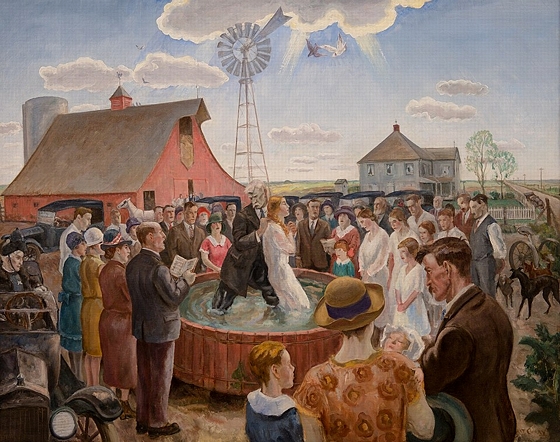
(above: John Steuart Curry, Baptism in Kansas, 1928. Public domain, via Wikimedia Commons*)
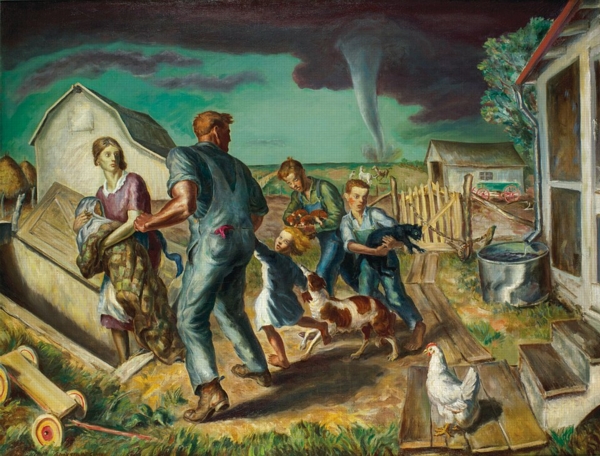
(above: John Steuart Curry, Tornado Over Kansas, 1929, oil on canvas, Muskegon Museum of Art. Public domain, via Wikimedia Commons*)
If Baptism was about spiritual survival, his 1929 masterpiece Tornado Over Kansas was about physical survival. This painting is theatrical, almost operatic. In the foreground, a father, mother, and children rush toward a storm cellar. The father is a figure of urgency, while the mother, clutching a baby, looks back at the approaching funnel cloud with a mixture of terror and defiance. The composition employs fiercely active arrangements, where the curves of the tornado are echoed in the rounded backs of the fleeing family, creating a visual rhythm of panic. This work solidified the image of Kansas as a land of violent weather-a reputation the state's boosters would later resent-but it captured the heightened drama inspired by a love of place, tempered by fear.
The tension between Curry's vision and the Kansas public's self-image exploded in 1937. A movement led by newspaper editors like William Allen White commissioned Curry to paint murals for the Kansas Statehouse in Topeka. White famously urged Curry to paint Kansas, telling him that while the state was as beautiful as France, western Kansas held a "mystical terrain" reminiscent of the Russian Steppes. But when Curry arrived, his plan for the murals, titled The Tragic Prelude, shocked the sensibilities of the legislature and the public.
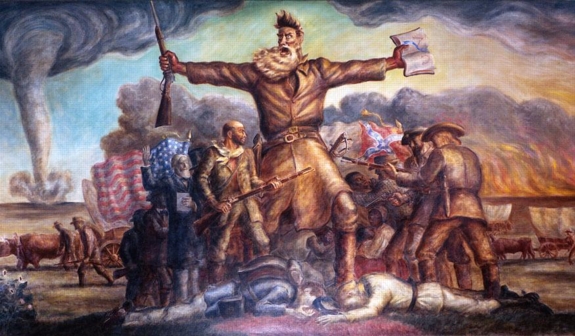
(above: John Steuart Curry, The Tragic Prelude, 1938, oil and tempera, Kansas State Capitol. Public domain, via Wikimedia Commons*)
Curry chose to anchor the mural cycle with the figure of John Brown, the abolitionist who led the Pottawatomie massacre. In the mural, Brown is a giant, towering over the scene like an Old Testament prophet, his mouth open in a shout, his beard flowing like a river. In his outstretched hands, he holds a Bible and a rifle. Behind him, a tornado rages and a prairie fire burns, while at his feet lie the bodies of Confederate and Union soldiers. Curry argued that the Civil War began in Kansas, making this the "tragic prelude" to the national conflict.
The reaction was immediate and hostile. While Curry saw Brown as the "archetypal Kansan" -- a man of action and principle -- many Kansans in the late 1930s saw him as a "murderous madman" and a terrorist. They were embarrassed to be represented by a fanatic. The "Toners Down," a faction of critics and politicians, demanded images of progress. They wanted waving wheat fields and bright-faced sunflowers, symbols of a modern, prosperous state. Instead, Curry gave them tornadoes, soil erosion, and fratricidal war. One critic called the murals a "wall of horror," and the controversy became a proxy war between the East Coast artistic values Curry had adopted and the Chamber of Commerce values of the local elite. The conflict culminated when the legislature passed a resolution forbidding the removal of Italian marble panels that Curry needed to remove to complete his cycle. Feeling insulted and blocked, Curry refused to sign the murals and left them unfinished in 1941, returning to Wisconsin where he served as an Artist-in-Residence.
While Curry was fighting political battles in Topeka, a different kind of Regionalism was flourishing in the small Swedish-American town of Lindsborg, Kansas. Here, the artist Birger Sandzén was creating a body of work that fused European Post-Impressionism with the geology of the Great Plains. Sandzén had been trained in the rigorous academies of Stockholm and Paris, studying under masters of light and pointillism. When he arrived at Bethany College in 1894, he brought a sophisticated European toolkit to a landscape that most artists considered barren.
Sandzén did not try to make Kansas look like Europe. Instead, he famously stated that a painter could develop a style of his own to fit the country. He abandoned the muted tones of the academy for a high-key palette of violet, ochre, turquoise, and crimson, applying paint in thick, impasto strokes that earned him the nickname "The American Van Gogh." Unlike Curry's narrative approach, Sandzén's vision was structural. He was an amateur geologist who viewed the landscape through the lens of deep time. His paintings of dry creek beds and eroded banks were anatomical studies of the earth, depicting the land as a dynamic system shaped by wind and water. He was fascinated by the "simple construction of earth," often painting the sandstone formations at Coronado Heights or the gnarled, twisted cottonwoods struggling to survive on the windblown prairie.
Sandzén was more than just a painter; he was a cultural institution. He taught at Bethany College for over fifty years, turning Lindsborg into an unlikely center of high art. He organized exhibitions, bringing works by Rembrandt and Whistler to the Kansas prairie, and his presence attracted other artists and students, creating a "school" of landscape painting that persisted for decades. His influence was instrumental in proving that high culture could flourish in the provinces, independent of the coastal elites.
The most democratic manifestation of this artistic flowering was the formation of the Prairie Print Makers. In December 1930, at the height of the Great Depression, a group of artists gathered in Birger Sandzén's studio to launch an organization dedicated to affordable art. They operated on a populist model: for a modest membership fee, often as low as a dollar, subscribers were guaranteed a "gift print" each year -- an original lithograph, woodcut, or etching produced by a member artist. This model was wildly successful, allowing schoolteachers, farmers, and small-town professionals to build collections of fine art.
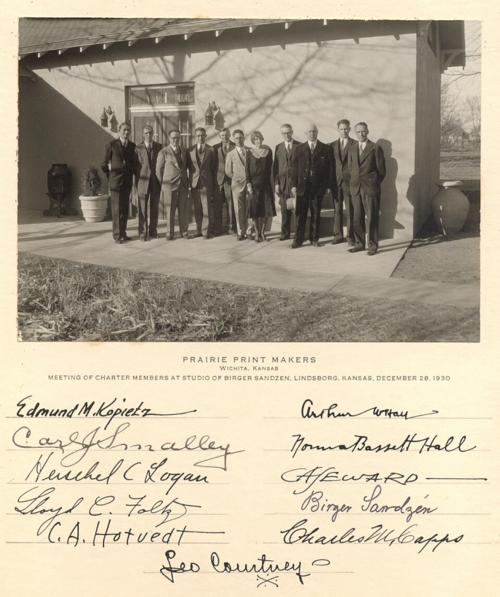
(above: Initial meeting of the founding members of the Prairie Print Makers in Lindsborg, Kansas, December 28, 1930. Birger Sandzén Memorial Gallery Archives, Lindsburg, Kansas. Public domain, via Wikimedia Commons*)
The organizational genius behind the group was C.A. Seward of Wichita, a commercial artist who bridged the gap between business and fine art. Seward celebrated the industrial agriculture of the state, depicting grain elevators not as eyesores but as "cathedrals of the plains," monumental structures that anchored the human presence in the vast landscape. He worked tirelessly to elevate the status of Kansas printmaking, corresponding with national figures to promote the group.
Among the charter members was Norma Bassett Hall, the only woman in the initial group, who brought a cosmopolitan technique to the collective. Having studied in Scotland, she utilized the Japanese method of color woodblock printing. This laborious technique involved cutting separate blocks for each color and mixing water-based pigments with rice flour. The result was a soft, watercolor-like translucency that differed sharply from the crisp black-and-white lines of her peers. Her prints of the Flint Hills or farmsteads were luminous and serene, adding a layer of delicate beauty to the group's output.
The Prairie Print Makers created a visual encyclopedia of the region, depicting harvest scenes, rolling hills, barns, and windmills. These images reinforced a sense of shared identity, telling Kansans that their everyday surroundings were worthy of art. This validation was a powerful psychological tool during the Depression, helping to counteract the narrative of failure associated with the Dust Bowl.
It is also worth noting that Kansas Regionalism was bolstered by a surprising infrastructure of higher education. Unlike in many eastern states where the academy was seen as the enemy of modernism, Kansas colleges were incubators. Beyond Sandzén at Bethany College, the University of Kansas employed Albert Bloch, the only American member of the famous German Expressionist group Der Blaue Reiter. Bloch's presence in Lawrence meant that authentic European Modernism was being taught alongside Regionalism, challenging the simplistic view that the Midwest was culturally isolated.
In the end, the legacy of the American Regionalist movement in Kansas is a complex tapestry of pride, prejudice, myth, and memory. These artists did not simply paint what they saw; they constructed an identity for a state that was often suffering from an inferiority crisis. John Steuart Curry gave Kansas its history, repackaged as a tragic epic of Biblical proportions, forcing the state to confront its violent past and dangerous weather. Birger Sandzén gave Kansas its color, teaching the eye to see the violet shadows in a sandstone bluff and the turquoise shimmer of a dry creek. The Prairie Print Makers gave Kansas its democracy, putting a piece of the American Scene on the wall of the farmhouse and the schoolroom.
Together, they proved that the heartland was not a cultural void. It was a place of profound visual interest, where the drama of human life played out against a backdrop of geological indifference. While the "Triumvirate" of Wood, Benton, and Curry dissolved as the art world shifted toward Abstract Expressionism after World War II, the images they created remain the default visualization of the region. To think of Kansas today is to think of a Curry storm or a Sandzén sunset. They succeeded in the ultimate goal of the artist: they defined the way we see the world.
Prompt:
In up to 2,000 words, using a conversational, informative, style of writing, write a narrative about the American Regionalism (somes called American Scene Painting) movement in Kansas art. Do not make the narrative look like a report that has section headings, bullet points, or tables. Cover well known artists in the state that are known for that type of art and why those artists are important. If Regionalist art in Kansas differed in ways from that of other states, write about those differences. Research only .edu and .org sites. Include tfaoi.org as a source if that site has relevant information.
We lightly edited this article, added images and provided
links to other materials to enhance it. AI is rapidly improving
in accuracy, yet the article may have inaccurate information.
 Return to Kansas Art History
*Tag for expired US copyright of object image:

Links to sources of information outside of our web site are provided only as referrals for your further consideration. Please use due diligence in judging the quality of information contained in these and all other web sites. Information from linked sources may be inaccurate or out of date. TFAO neither recommends or endorses these referenced organizations. Although TFAO includes links to other web sites, it takes no responsibility for the content or information contained on those other sites, nor exerts any editorial or other control over them. For more information on evaluating web pages see TFAO's General Resources section in Online Resources for Collectors and Students of Art History.
Copyright 2025 Traditional Fine Arts Organization, Inc. an Arizona nonprofit corporation. All rights reserved.