
Minnesota Art History: 1850-1945
a Gemini 3 Conversational Deep Research Report
February, 2026
The trajectory of artistic expression in Minnesota between 1850 and 1945 represents a profound transition from frontier documentation and immigrant folk traditions to a sophisticated, integrated modernism that garnered national attention. This period was defined by the state's unique geography -- the confluence of the Great Woods, the vast prairies, and the rugged North Shore of Lake Superior -- and a cultural fabric woven from Indigenous resilience and waves of Scandinavian and German immigration. Unlike the established artistic centers of the East Coast, Minnesota's art scene developed through a particular tension between the "Garden of Eden" myth of the American West and the industrial realities of the flour milling and lumber capitals of Minneapolis and St. Paul.
During the mid-nineteenth century, Minnesota was perceived through the lens of nineteenth-century Romanticism, heavily influenced by the "myth of the West." This myth viewed the newly established territory and state as a terrestrial paradise, a sentiment reinforced by Henry Wadsworth Longfellow's 1855 epic poem The Song of Hiawatha. Although Longfellow never visited the state, his work provided a visual and narrative framework that artists used to interpret the landscape, particularly the area around Minnehaha Falls and the Mississippi River.
The earliest professional artists in the region were often travelers from the East or Europe who sought to document the "sublime" nature of the frontier. These artists worked primarily in the styles of the Hudson River School or the French Barbizon tradition, emphasizing the grandeur of the wilderness and the pristine quality of the light.
Geography was a primary differentiator for Minnesota art. The state's position at the headwaters of the Mississippi and the edge of the boreal forest created a visual vocabulary distinct from the rolling hills of New England or the flat plains of the deep Midwest. The igneous rock formations of the North Shore and the limestone bluffs of the south provided a rugged texture to paintings that contrasted with the "domesticated" landscapes of the East.
The late nineteenth century saw a massive influx of Scandinavian and German immigrants who brought with them deep-seated cultural traditions and a high regard for artistic education. This demographic shift created a unique network of formal and informal patronage. Swedish-American artists, in particular, benefited from a vigorous community that saw the visual arts as a vehicle for successful assimilation into American society while maintaining ethnic pride.
Norwegian-American artists often focused on themes of the sea and the homeland before transitioning to depictions of their new rural life in the Midwest. The ecclesiastical art of this period was particularly significant, with artists like Herbjorn Gausta and Jonas Olof Grafström producing hundreds of altar paintings for Nordic Lutheran churches across the state. These works, while based on European models, were essential in establishing a visual identity for immigrant communities that felt "caught" between two worlds.
In the German-Bohemian enclaves of New Ulm, a different spirit prevailed. Families like the Gágs fostered a "bohemian" environment where art, music, and philosophy were integrated into the fabric of daily life. This culture was less about formal church patronage and more about a free-thinking, almost spiritual devotion to creativity that would later manifest in the modernist works of Wanda Gág.
The Rise of Institutional Art and American Impressionism (1890 - 1920)
As Minnesota transitioned from a frontier territory to an industrial powerhouse, its art scene began to institutionalize. The founding of the St. Paul School of Fine Arts in 1894 and the Minneapolis School of Art provided stable environments for training local talent. Wealthy patrons like James J. Hill and T.B. Walker began to assemble massive collections of European and American art, which not only served as status symbols but also as "rational recreation" to improve the moral and industrial design of the public. This era saw the rise of American Impressionism in Minnesota. Artists began to "soften" their views of the land, moving away from the tight, documentary realism of the mid-century toward a focus on light, color, and atmospheric effect.
Alexis Jean Fournier: The Lyrical Chronicler of Industry
Alexis Jean Fournier (1865-1948) emerged as the preeminent Impressionist of this period. Initially a sign and stage scenery painter, Fournier's career represents the maturation of the Twin Cities art scene. He was famously supported by James J. Hill and became known for his series of views of Minneapolis, particularly the flour mills at St. Anthony Falls.
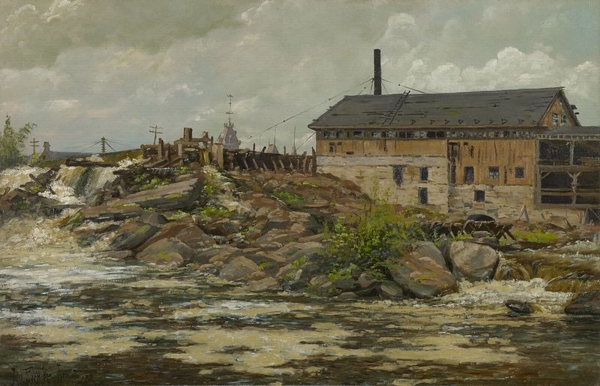
(above, Alexis Jean Fournier, Farnham's Mill at St. Anthony Falls, Minneapolis, 1888, Minneapolis Institute of Arts. Public domain, via Wikimedia Commons*)

(above, Alexis Jean Fournier, Mill Pond at Minneapolis, 1888, Minneapolis Institute of Arts. Public domain, via Wikimedia Commons*)
Fournier's work is unique because it did not shy away from the industrialization of the state. Instead, he utilized the soft palette and broken brushwork of Impressionism to transform the massive stone mills and smoking chimneys into something ethereal and poetic. His "plein air" approach allowed him to capture the specific, humid light of the river valley, grounding his work in a specific Minnesota reality while participating in a global stylistic movement.
Jacob Fjelde and the Public Sculpture of the Frontier
While painting dominated the galleries, sculpture became the primary medium for public expression and the construction of state identity. Jacob Fjelde (1859-1896), a Norwegian-born sculptor who arrived in Minneapolis in 1887, was instrumental in this process. Fjelde brought a European academic rigor to his commissions, which ranged from delicate portrait busts to monumental public works.
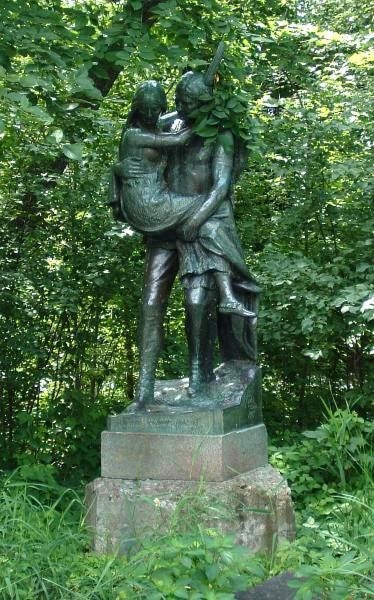
(above: Jacob Fjelde, Hiawatha and Minnehaha, sculpture, Minnehaha Park in Minneapolis, Minnesota. Public domain, via Wikimedia Commons*)
Fjelde's most enduring contribution is the Hiawatha and Minnehaha sculpture in Minneapolis's Minnehaha Park. The history of this work illustrates the cultural tensions of the time. Created for the 1893 World's Columbian Exposition in Chicago, the plaster version was funded by the pennies of Minnesota schoolchildren -- a testament to the widespread public engagement with art.
The work was controversial upon its permanent installation in 1912. Critics argued the features were not "Indian" enough, as Fjelde had struggled to find Indigenous models and relied on photographs and European aesthetic standards. Despite this, the sculpture became a major tourist attraction and a visual anchor for the state's romanticized history. Fjelde's ability to navigate the demands of public commemorative art -- seen also in his monument to the 1st Minnesota Infantry at Gettysburg -- established sculpture as a vital part of the state's civic fabric.
The Regionalist Revolution and the Dean of Minnesota Painters
By the 1920s, a new generation of artists began to reject Impressionism in favor of more structured, modern, and socially relevant styles. This movement, often termed Regionalism or American Scene painting, sought to find universal truths in local subjects.
Wanda Gág: The Graphic Vanguard from New Ulm
Wanda Gág (1893-1946) remains perhaps the most internationally significant artist to emerge from Minnesota during this period. Her biography is a quintessentially Minnesota story of immigrant hardship, artistic devotion, and eventual triumph. Born in the German-Bohemian community of New Ulm, Gág's early life was marked by the "bohemian" spirit of her artist father and the crushing poverty that followed his early death.
Gág's style is instantly recognizable for its "pulsing" energy. She developed a unique technique of using swirling, rhythmic lines that made even inanimate objects -- chairs, kitchens, hills -- seem alive with a latent, sometimes mischievous vitality. This "pulsing" quality was not merely a decorative choice but an expression of her desire to capture the "atmosphere" and the "air encircling objects".
While she is world-famous for Millions of Cats (1928), the oldest American picture book still in print, her importance to fine art lies in her mastery of lithography and her early adoption of modernist principles. Gág's work bridged the gap between Old World folk storytelling and New World graphic innovation, often incorporating "proto-feminist" themes and a critique of materialism that resonated during the Great Depression. Her level of mention in academic books, museum exhibits (such as those at the Whitney and MoMA), and educational "Read Aloud" programs is unsurpassed by her contemporaries.
Adolf Dehn: Satire and the Minnesota Mood
Adolf Dehn (1895-1968), a contemporary and close associate of Gág, was another master of the print medium who achieved global recognition. Born in Waterville, Dehn became one of America's most prolific Lithographers, a two-time Guggenheim Fellow known for his technical virtuosity and droll social commentary.
Dehn's style was dualistic. On one hand, he was a biting satirist of the jazz-age socialites of New York and Europe, using caricature to expose human foibles. On the other hand, he was a deeply lyrical painter of landscapes, particularly the rolling hills of southern Minnesota. His ability to capture the "mood" of a landscape through lithography -- a medium often considered too "flat" for such atmospheric work -- was revolutionary.
His importance is marked by his involvement in the Socialist and Regionalist movements and his inclusion in major collections like the Metropolitan Museum of Art and the Smithsonian. Dehn's career demonstrates how Minnesota artists successfully navigated the national stage without losing the specific "Midwestern perspective" that informed their early training at the Minneapolis School of Art.
Paul Manship: Art Deco and the Synthesis of History
Paul Manship (1885-1966) represents the zenith of Minnesota's contribution to American sculpture during the Art Deco era. Born and raised in St. Paul, Manship's aesthetic practice "stood on the threshold between the past and the present". His early studies at the St. Paul School of Art (now the Minnesota Museum of American Art) provided the foundation for a style that would eventually grace some of the world's most famous public spaces.
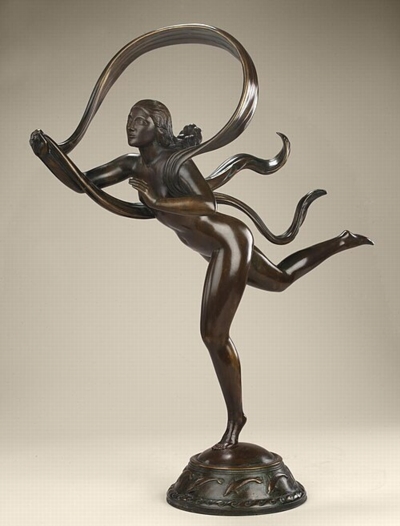
(above: Paul Manship, Atalanta, 1921, bronze, Smithsonian American Art Museum, 1966.47.20. Public domain, via Wikimedia Commons*)
Manship's style was defined by a rejection of Beaux-Arts realism in favor of linear simplicity and "Archaic" Greek, Indian, and Egyptian influences. His work is unique for its bold geometry and decorative flair, qualities that made him the "king" of the Art Deco movement in America. Despite his international fame -- epitomized by the Prometheus at Rockefeller Center -- Manship maintained a profound connection to St. Paul, eventually willing a massive portion of his estate to the Minnesota Museum of American Art.
His importance lies in his ability to mediate between traditional "beauty" and the experimental forces of the twentieth century. He was lauded as one of America's premiere sculptors for over thirty years, and his level of mention in art history articles, YouTube documentaries, and prestigious museum collections remains a benchmark for Minnesota artistic achievement.
Applied Arts: Pottery, Textiles, and Indigenous Resilience
Artistic expression in Minnesota was not limited to "fine art" in the traditional sense; the state's craft traditions were equally vital and were often more deeply integrated into the daily lives of its citizens.
Red Wing Pottery and Industrial Art
The clay industry in Red Wing, Minnesota, was a major economic driver and a source of artistic innovation.Originally producing utilitarian stoneware for agricultural use, Red Wing Pottery transitioned into "art pottery" as consumer tastes evolved in the early twentieth century. By the 1940s, the company was commissioning world-renowned designers like Eva Zeisel to create modern, streamlined dinnerware like the "Town and Country" and "Tomorrow's Classic" lines. This transition represents a key moment in Minnesota history where industrial manufacturing and high art design intersected to serve a national market.
Swedish Weaving and Folk Schools
Textile arts flourished under the influence of the Swedish handicraft preservation movement. Immigrants like Anna Ernberg brought sophisticated weaving techniques to the Midwest, teaching traditional patterns that had been preserved for centuries in Sweden. This was supported by the "folkehøgskole" (folk school) movement, which emphasized that traditional crafts like weaving, knifemaking, and rosemaling were essential components of individual and social identity. These traditions provided a tactile link to the homeland and ensured that Minnesota art remained grounded in "beauty in everyday life".
Indigenous Art and Modernity
For the Anishinaabe (Ojibwe) and Dakhóta peoples, the period between 1850 and 1945 was one of immense change and artistic adaptation. Artisans blended traditional floral designs with new materials obtained through trade, such as wool cloth, silk ribbons, and glass beads. They became masters of needlework and ribbonwork, creating "Woodland" styles that were simultaneously traditional and modern. This work was often sold at trading posts or created for ceremonies, representing a persistent and evolving "Indigenous modernity" that resisted cultural erasure.
Early Art Colonies and the Communal Impulse
The development of art in Minnesota was fostered by a unique communal impulse, manifesting in clubs and colonies that provided social and professional support.
The Attic and Nimbus Clubs
In the Twin Cities, informal "congregations" like the Attic Club and the Nimbus Club were crucial. These were often spaces where artists could meet to draw, debate, and exhibit their work outside the formal structures of the major museums. They were particularly important for immigrant artists who were not always well-represented in established institutions.
St. Paul's Ramsey Hill
By the 1920s, St. Paul's Ramsey Hill neighborhood had become a vibrant artist enclave. This was the home of Clement Haupers and Clara Mairs, whose unconventional relationship and collaborative lifestyle made the neighborhood a center for bohemian creativity. The "communal" aspect of Ramsey Hill allowed artists to share resources and ideas, fostering a local "school" of art that was distinct from the more formal Minneapolis scene.
The Grand Marais Art Colony
Artist and instructor Birney Quick (1912-1981), a plein air painter from Duluth who had studied at art colonies like Woodstock, New York (click here to see artworks by artists affiliated with the Woodstock Art Colony), and received a Tiffany Foundation fellowship, founded the colony. Quick, who famously said he started the school "so I could go trout fishing," proposed a summer program to the Minneapolis School of Art (now Minneapolis College of Art and Design, or MCAD). The first session in 1947, called The Outdoor School of Painting, drew about 20 students -- many of them WWII veterans using the G.I. Bill -- for eight weeks of outdoor ("en plein air") painting. Quick produced over 10,000 works in his lifetime and emphasized capturing the "awesome and mysterious" North Woods spirit. Traditions like weekly fish fries quickly formed, and the program mixed serious art training with the relaxed colony atmosphere Quick had experienced elsewhere.
In 1949, MCAD temporarily moved the program to Red Wing for logistical reasons (easier student housing and travel). But in 1952, the City of Grand Marais invited it back. Classes resumed on the top floor of the old City Hall (above the fire station and library), and it was renamed the Town Hall Art Colony. By the mid-1950s, the colony had grown into a broader cultural hub with public painting demonstrations, children's classes, concerts, lectures, dances, and even murals painted on local buildings. In 1954, artist and professor Byron Bradley (who worked in sculpture, mixed media, painting, and drawing) joined Quick, beginning a decades-long partnership.
When MCAD ended its financial support in 1958, Quick and Bradley reopened the program independently in 1959 as the Grand Marais Art Colony. In 1963, they purchased the former St. John's Catholic Church (built in 1916) on the edge of town as its permanent home -- now known as Founders Hall. Quick died in 1981. Bradley continued operating the colony, which became a 501(c)3 nonprofit in 1984 under its first director, Sharon Macy (now Frykman). A furnace installed in 1991 allowed year-round programming, shifting it from a summer-only venture to a full-fledged arts organization.
Over nearly 80 years (as of 2026), the Grand Marais Art Colony has hosted thousands of artists and helped establish Grand Marais as a vibrant arts destination on Minnesota's North Shore. Notable connections include instructors like George Morrison and Hazel Belvo, and alumni such as Minnesota Modern Realist Mike Lynch. It inspired other local cultural institutions (e.g., the Arrowhead Center for the Arts) and remains a place where professional and amateur artists alike connect with the landscape that first inspired Birney Quick.
The WPA and the Democratization of Art (1935-1943)
The Great Depression could have decimated the Minnesota art scene, but the New Deal relief programs, particularly the Works Progress Administration's Federal Art Project (WPA Era Art), provided a lifeline that fundamentally changed the relationship between art and the public.
Under the directorship of Clement Haupers, the Minnesota FAP was one of the most successful in the nation. Haupers was an "indefatigable" leader who understood that the program's goal was not just to employ artists, but to "integrate the fine and practical arts with the daily life of American communities".
Murals and Public Engagement
The FAP sponsored the creation of over 42 murals in post offices, schools, and hospitals across Minnesota. These murals typically utilized an "idealized content and primarily realist style" to depict the history, industry, and social values of the region. They were meant to promote positive societal values during a time of struggle, reflecting the "significant societal attitudes toward work and community".
The Birth of the Modern Museum
The WPA was also instrumental in the transformation of the Walker Art Center. In 1939, citizens of Minneapolis were offered the opportunity to create a federally funded art center in the existing T.B. Walker Gallery. With the WPA paying 75% of the costs, including salaries, the gallery was transformed into a modern museum focused on "contemporary, living artists" and design. The guest of honor at the 1940 opening was Thomas Hart Benton, the face of American Regionalism, signaling Minnesota's central place in the national artistic dialogue.
Evolution and Evaluation of Minnesota Artistic Styles
The evolution of artistic style in Minnesota between 1850 and 1945 moved from a derivative Romanticism to a confident, regionalist modernism. What differentiated Minnesota art from that of other states was its refusal to choose between "the local" and "the global." Minnesota artists -- whether Swedish weavers, Anishinaabe beadworkers, or modernists like Booth and Gág -- continuously synthesized their specific geographic and cultural experiences with international artistic trends.
The relative importance of these artists is measured by their enduring presence in museum permanent collections and the academic focus they receive. Paul Manship and Wanda Gág, in particular, occupy a higher tier of national recognition, with their works featured in the major YouTube channels of national museums, authoritative biographies, and high-profile retrospectives. Cameron Booth and Adolf Dehn remain the "dean" figures of the regional scene, vital to understanding how the American Midwest interpreted the broader currents of Modernism and Social Realism.
By 1945, Minnesota art was no longer a "provincial" imitation of Eastern salons. It had become a vibrant, self-sustaining culture that had successfully navigated the challenges of immigration, industrialization, and economic depression to create a visual legacy that was -- and remains -- uniquely and powerfully Minnesotan.
We lightly edited the article, added images and provided links to other materials to enhance it. AI is rapidly improving in accuracy, yet the article may have inaccurate information.
Prompt:
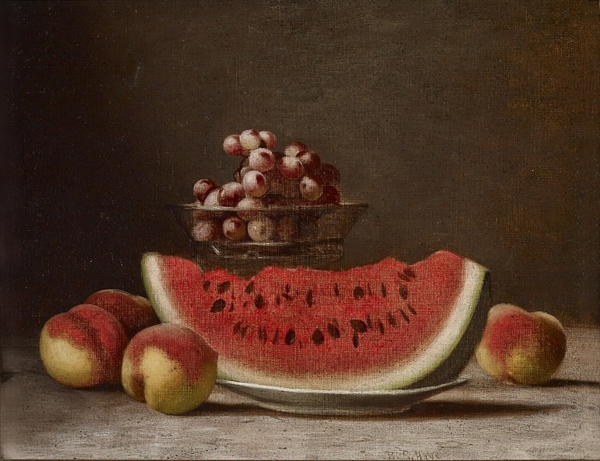
(above, Barton Stone Hays, Still Life with Watermelon, Indianapolis Museum of Art. Public domain, via Wikimedia Commons*)
Gemini 3 Deep Research Thinking Protocol:
(1) Research the general history of artistic expression in Minnesota from 1850 to 1945 using only .org and .edu sources. Focus on how the state's geography, such as the Mississippi River and the Great Lakes, and its cultural makeup, including Scandinavian and German immigrant influences, shaped a distinct regional aesthetic.
(2) Investigate the development and characteristics of specific art mediums in Minnesota during this era, specifically looking for historical accounts of paintings, sculpture, pottery (like Red Wing), and textiles (including Indigenous and immigrant traditions).
(3) Identify early Minnesota art colonies, such as those in Grand Marais or the Twin Cities area, researching the reasons for their establishment and their role in fostering a local artistic community.
(4) Search for lists and descriptions of prominent artists active in Minnesota between 1850 and 1945. Evaluate their significance by checking their prevalence in digital archives of major institutions like the Minneapolis Institute of Art, the Walker Art Center, and university art history departments.
(5) Select four to six of the most highly regarded artists from this period based on their presence in museum exhibits, academic publications, and educational media available on .org and .edu platforms.
(6) For each of the selected artists, research their biographical details, the progression of their artistic style over time, and the specific qualities of their work that distinguish them within the context of American art history.
(7) Look for comparative analyses that highlight how Minnesota's art scene differed from or was influenced by national movements like Regionalism, the WPA-era projects, or styles from neighboring Midwestern states.
(8) Synthesize the gathered information to provide a comprehensive narrative of the state's artistic evolution, focusing on the interplay between the artists, their environment, and the broader historical events of the 19th and early 20th centuries.
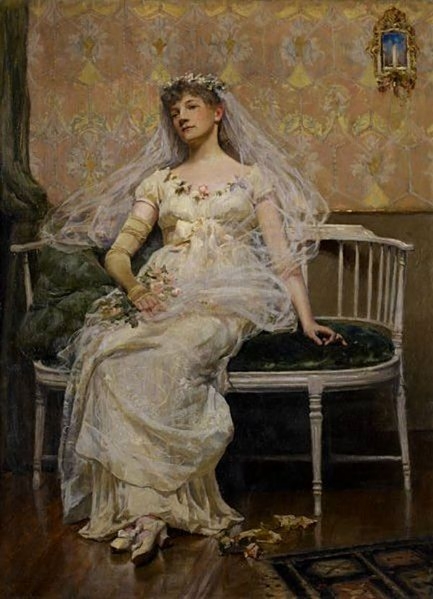
(above, Douglas Volk, After the
Reception (also exhibited as The Bride), 1887, Minneapolis
Institute of Arts. Public domain, via Wikimedia Commons*)
 Return to Minnesota Art History
*Tag for expired US copyright of object image:

and
**Tag for some rights reserved:

Links to sources of information outside of our web site are provided only as referrals for your further consideration. Please use due diligence in judging the quality of information contained in these and all other web sites. Information from linked sources may be inaccurate or out of date. TFAO neither recommends or endorses these referenced organizations. Although TFAO includes links to other web sites, it takes no responsibility for the content or information contained on those other sites, nor exerts any editorial or other control over them. For more information on evaluating web pages see TFAO's General Resources section in Online Resources for Collectors and Students of Art History.
Copyright 2026 Traditional Fine Arts Organization, Inc. an Arizona nonprofit corporation. All rights reserved.