
The Evolution of Wisconsin Art: 1850-1945
a Gemini 3 Conversational Deep Research Report
February, 2026
The evolution of art in Wisconsin between 1850 and 1945 is a story of cultural collision and synthesis. It is an account of how a rugged frontier state, defined by its glacial topography and a massive influx of European immigrants, managed to cultivate a visual language that was simultaneously anchored in the old-world academies of Munich and Berlin and the populist, soil-bound philosophy of the American Midwest. This era, stretching from 1850 to 1945, saw Wisconsin evolve from a remote outpost into a sophisticated laboratory for artistic experimentation, most notably through the implementation of the Wisconsin Idea, which argued that the university's influence should touch the lives of every citizen. This guiding principle eventually led to the creation of the nation's first artist-in-residence program, forever changing how art was perceived in rural America.
The German Athens and the Academic Foundation
To understand the art of Wisconsin, one must first look at the unique demographic character of the state in the mid-1800s. While other Midwestern territories were being settled by waves of New Englanders, Wisconsin became a primary destination for German intellectuals, craftsmen, and artists fleeing political instability in Europe, particularly after the failed revolutions of 1848. These "Forty-eighters" brought with them a deep commitment to the arts, sciences, and education, transforming Milwaukee into what was frequently called the "German Athens". This cultural foundation differentiated Wisconsin from its neighbors; rather than developing art from a purely utilitarian or folk tradition, Wisconsin benefited from an immediate infusion of rigorous European academic standards.
The central figure in this early period was Henry Vianden, a German-trained painter who arrived in Milwaukee in 1849. Vianden served as the state's first professional art teacher, bridging the gap between the formal traditions of the Dusseldorf Academy and the raw beauty of the Wisconsin wilderness. He emphasized the importance of drawing from nature, leading his students into the woods and along the lakefront to capture the specific light and texture of the region. This pedagogical approach ensured that the first generation of native-born Wisconsin artists, such as Carl von Marr, would possess a technical mastery that rivaled their European counterparts while maintaining a distinct sense of place.
The Spectacle of the Panorama: Art as Industrial Achievement
By the 1880s, Milwaukee's German character had turned it into a hub for one of the most remarkable artistic industries in American history: the production of panoramas or cycloramas. These were gargantuan, 360-degree paintings designed to be displayed in circular rotundas, providing viewers with an immersive, "IMAX-like" experience of historical battles or religious events. This industry was almost entirely a German-Wisconsin phenomenon. Entrepreneur William Wehner established the American Panorama Company on Wells Street specifically because he knew German-trained artists would feel at home in Milwaukee's German-speaking society, complete with its familiar theaters, beer gardens, and social clubs.
The technical demands of the panorama were staggering. A single canvas could weigh 18,000 pounds and measure nearly 400 feet in length and 50 feet in height. To produce these works, Wehner recruited approximately twenty-five specialists from Munich, Berlin, and Vienna, each chosen for their expertise in specific areas: landscapes, animals, or human figures. These artists worked on rolling scaffolds, using "magic lanterns" to project scale sketches onto massive sheets of Belgian linen. This period represented a unique intersection of art and industry that existed nowhere else in the United States on such a scale.
The importance of the panorama era lies not just in the spectacles themselves but in the legacy left by the painters who stayed in Wisconsin after the craze faded around 1890. Artists like Richard Lorenz and George Peter transitioned from these massive canvases to focus on the American West and natural history dioramas, respectively. Their presence created a professional artist class that elevated the standards of local exhibitions and led to the founding of organizations like the Society of Milwaukee Artists.

(above: Richard Lorenz, Solitude (or Prairie Twilight), 1904, Milwaukee Art Museum. Public domain, via Wikimedia Commons)
Carl von Marr: The Transatlantic Poetic Realist
Among the many figures who emerged from this academic environment, Carl von Marr stands as perhaps the most highly regarded artist of Wisconsin origin during this period. Born in Milwaukee in 1858, Marr's career was a constant dialogue between his Midwestern roots and his professional success in Munich. His importance is underscored by the immense volume of research and exhibition space dedicated to his work; the Museum of Wisconsin Art in West Bend holds over 300 of his works, and he is a frequent subject of scholarly articles exploring the "Munich-Milwaukee axis".
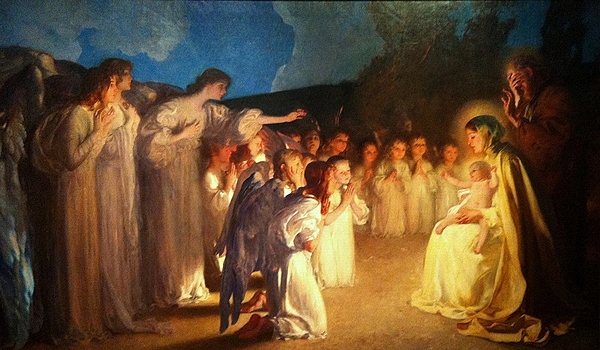
(above: Carl Von Marr, Adoration of the Christ Child, n.d., oil on canvas, Museum of Wisconsin Art. Public domain, via Wikimedia Commons)
Marr's style evolved from a rigid, dramatic academic formalism toward what critics called "poetic realism." His early masterpiece, The Flagellants (1889), is an enormous 14-by-26-foot canvas depicting a medieval religious procession with over a hundred figures. This work, which won a gold medal in Munich, was eventually purchased by a Milwaukee brewing family and gifted to the city, serving as a cornerstone of local cultural pride.However, Marr's later work, such as A Wistful Moment (1892), showed a growing interest in light, color, and psychological depth, reflecting the influence of Impressionism and the aesthetic studies of James McNeill Whistler.
What makes Marr unique is his ability to maintain an "American" identity despite being elevated to the German nobility and becoming the director of the Munich Academy. He frequently returned to Milwaukee to paint portraits of local citizens and summered in West Bend, where he mentored younger artists like Francesco Spicuzza. His work is characterized by a "warmth and fluidity" that distinguished it from the colder, more detached academic paintings of the era. His enduring relevance is evidenced by the honorary doctorate bestowed upon him by the University of Wisconsin in 1929 and the continued prominence of his works in museum permanent collections.
Helen Farnsworth Mears: The Sculptor of Progress
While painting dominated much of the state's early history, the field of sculpture was revolutionized by Helen Farnsworth Mears, a prodigy from Oshkosh. Born in 1872, Mears demonstrated such early talent that she was modeling complex figures before receiving any formal training. Her importance to Wisconsin art is multifaceted: she was a pioneering woman in a physically demanding field, a student and collaborator of the great Augustus Saint-Gaudens, and the creator of works that defined the state's political and social aspirations.
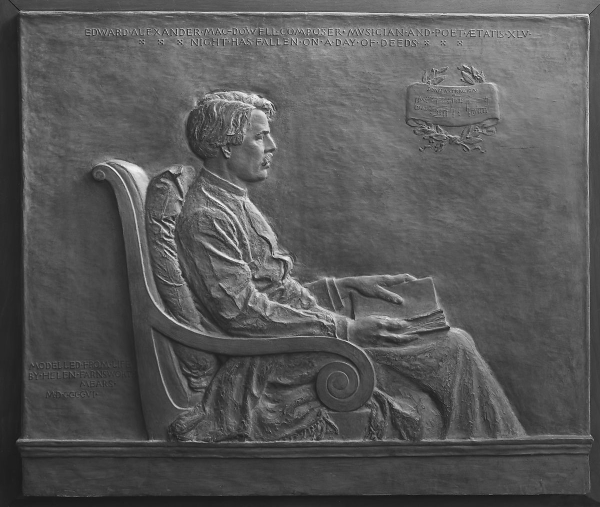
(above: Helen Farnsworth Mears, Edward Alexander MacDowell, 1906, Bronze, 33 1/2 x 40 in., The Metropolitan Museum of Art, Gift of Alice G. Chapman, 1909. Public domain, via Wikimedia Commons*)
Mears' breakthrough occurred at the 1893 World's Columbian Exposition in Chicago, where she was commissioned at the age of 21 to create a figure representing Wisconsin. The resulting nine-foot marble statue, Genius of Wisconsin, was a radical departure from traditional, static allegories; it conveyed a sense of movement and youthful optimism that captured the spirit of the state. During the fair, she was part of the "White Rabbits," a group of female sculptors who worked under Lorado Taft, proving that women could handle large-scale civic commissions.
Mears' style was noted for its "storytelling" quality, blending classical technique with a modern, expressive sensibility. Her career included a national commission for a statue of suffragist Frances Willard, which remains the first statue of a woman placed in the National Statuary Hall in Washington, D.C.. Despite her successes, her life was marked by the tragic loss of the commission for the statue atop the Wisconsin State Capitol dome -- a job eventually given to Daniel Chester French -- which many historians believe contributed to her early death in 1916. Today, her legacy is celebrated through significant museum exhibits, such as the 2023 award-winning exhibition at the Oshkosh Public Museum, and her presence in numerous books and state history articles.
John Steuart Curry and the Wisconsin Idea in Art
The 1930s ushered in a new era for Wisconsin art through the appointment of John Steuart Curry as the nation's first university-based artist-in-residence at the University of Wisconsin-Madison in 1936. This was a revolutionary implementation of the "Wisconsin Idea," which posited that the university's mission was to improve the lives of all citizens. Curry, a native of Kansas and one of the "big three" of American Regionalism along with Grant Wood and Thomas Hart Benton, was not hired to teach students in a classroom but to foster artistic production in rural communities.
Paintings by John Steuart Curry
Curry's importance lies in his democratic approach to art. From his barn-like studio on the Madison campus, he launched the Rural Art Program, which encouraged farmers, housewives, and rural workers to paint their own environments. His own style was characterized by a dramatic, narrative energy-often depicting the raw power of nature in the form of tornadoes or storms, or the historical fervor of figures like John Brown. In Wisconsin, his work took on a more social and scientific dimension, as seen in his murals for the University's biochemistry building, which depicted the health benefits of scientific research for farm families.
What differentiated Curry's work in Wisconsin from his earlier Kansas period was the institutional support he received. While Kansans often felt his depictions of their state were unflattering or focused too much on tragedy, Wisconsin embraced him as a "cultural missionary". His influence is still visible in the numerous murals he left behind and the continued tradition of rural outreach programs in the state. His high level of mention in books, articles, and documentary films -- often centering on his role as a populist icon-solidifies his place as one of the most significant artists to ever work in the state.
Aaron Bohrod: From the Ashcan to Magic Realism
Following Curry's death in 1946, the residency at the University of Wisconsin was filled by Aaron Bohrod, whose career represented the transition from the social realism of the early 20th century to a unique, mid-century style known as Magic Realism or trompe-l'il. Bohrod had already established himself as a major figure in Chicago, painting the "seamy side" of urban life in the tradition of John Sloan and the Ashcan School. However, his arrival in Wisconsin prompted a profound shift in his artistic evolution.
In the 1950s, Bohrod turned away from the sprawling urban landscapes of his youth toward intensely detailed, highly realistic still-life paintings. This transition was sparked by his observations of the rocky shores of Lake Superior, where he became fascinated by the textures of pebbles and driftwood. He developed a technique he called "Magic Realism," in which he would arrange seemingly unrelated objects -- broken toys, souvenirs, and natural artifacts -- to create visual puns and complex symbolic messages. These works were so precisely rendered that they often required "Do Not Touch" signs in galleries because they looked three-dimensional.
Bohrod's importance to Wisconsin art stems from his long tenure at the University (1948-1973) and his ability to engage with the state's industrial and rural landscapes during his travels as a supervisor for the Rural Arts Outreach program. He brought a cerebral, sophisticated modernism to the state while remaining accessible to the public. His work is extensively cataloged in books like A Decade of Still Life and is featured in major national collections, including the Metropolitan Museum of Art and the Smithsonian.
Francesco Spicuzza and the Democratization of Impressionism
While Marr and Curry focused on academic realism and regional narratives, Francesco Spicuzza became the leading exponent of Impressionism in Wisconsin. Born in Sicily in 1883 and moving to Milwaukee as a child, Spicuzza's work was a testament to the state's capacity for beauty and leisure. He is best known for his "frothy" beach scenes along Lake Michigan and his lush, monochromatic pastels.
Spicuzza was a student of both the Milwaukee academic tradition under Alexander Mueller and the Impressionistic styles of Woodstock, New York. He managed to synthesize these influences into a style that was immensely popular with collectors and the general public. What made Spicuzza unique was his dedication to teaching; he instructed hundreds of Milwaukeeans at the Milwaukee Art Institute and later at the Milwaukee Art Museum, ensuring that the techniques of Impressionism were shared beyond the elite art world.
His landscapes were particularly significant for their geographic focus. Spicuzza eventually bought a summer home near West Bend, where he painted the "kettles and moraines" -- the rolling, glacial hills and lakes of Washington County. These intimate oil sketches provided a visual identity for the region that was different from the epic narratives of the Regionalists, focusing instead on the quiet, transient beauty of the Wisconsin countryside. His high level of mention in local articles and the existence of specific museum books dedicated to his life and work testify to his enduring popularity.
Richard Lorenz and the Synthesis of Frontier and Academy
Richard Lorenz represents the crucial link between the industrial era of panorama painting and the development of a unique Midwestern genre painting. A German immigrant who arrived in Milwaukee to work for Wehner's American Panorama Company, Lorenz eventually became one of the state's most distinguished painters of the American West. His training in Munich allowed him to depict horses and frontier scenes with a level of anatomical precision and atmospheric depth that was rare in western art.
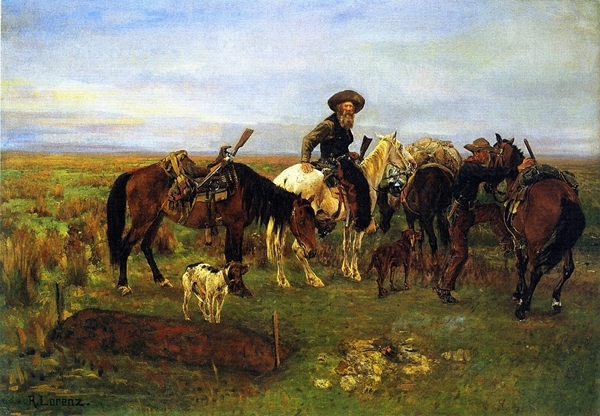
(above: Richard Lorenz, Burial on the Plains, c. 1890, Public domain, via Wikimedia Commons*)
Lorenz's importance is rooted in his role as a mentor. He taught at the Wisconsin School of Art and was a founding member of the Society of Milwaukee Artists. His students included many of the artists who would define Wisconsin's visual culture in the early 20th century. By applying European technical standards to American "frontier" subjects, Lorenz helped create a style that was neither purely academic nor purely folk, but something uniquely Wisconsonian.
Geography and the Evolution of Art Colonies
The physical landscape of Wisconsin -- its varied topography of forests, bluffs, and lakes -- directly led to the development of art colonies, which served as essential retreats for creative thought. The most prominent of these was the colony in Door County, which began to attract artists in the late 19th century due to its rugged isolation and unique light, reminiscent of maritime Europe.
The development of "The Clearing" in 1935 by the Danish landscape architect Jens Jensen was a pivotal event in this history. Jensen, who had already gained international fame for his "Prairie Style" landscape designs in Chicago, envisioned The Clearing as a "school of the soil". It was designed as a place where city people could reconnect with nature and the humanities through informal, non-competitive learning. The Clearing became a hub for artists like Schomer Lichtner and Ruth Grotenrath, who spent summers there teaching and painting. These colonies were important because they provided a structured environment where art and conservation intersected, a theme that remains central to Wisconsin's identity.
Legacy of the 1850-1945 Period
The century of artistic evolution in Wisconsin between 1850 and 1945 established a template for regional identity that remains relevant today. The transition from the "German Athens" to the populist "Wisconsin Idea" reflected a broader American movement toward democratic art, but it was executed in Wisconsin with a unique level of institutional support and technical rigor. The geography of the state -- from the sandy shores of Door County to the industrial centers of Milwaukee -- provided both the canvas and the studio for this transformation.
The artists of this era were not mere observers of their environment; they were active participants in defining what it meant to be a Wisconsinite. Whether it was Helen Farnsworth Mears sculpting the "Genius" of the state, John Steuart Curry painting the health of the rural community, or Aaron Bohrod finding symbolic depth in a Lake Superior pebble, these creators linked the soil of the state to the highest aspirations of human expression. Their legacy is found in the museums, courthouses, and capitol buildings they decorated, and in the enduring belief that art is a vital component of the civic and intellectual life of the Midwest.
We lightly edited the article, added images and provided links to other materials to enhance it. AI is rapidly improving in accuracy, yet the article may have inaccurate information.
Prompt:
In an informal manner without tables or bullet points, write an approximately 2,500 word narrative about the history of artistic expression in Wisconsin between 1850 and 1945.
Cover types of art including paintings and sculpture. Note anything special such as geography, culture, events and styles that differentiated Wisconsin art from other states.
Discuss four to six of the most highly regarded artists who created artworks in the state during the specified time period. Explain both the evolution of their artistic styles and what is unique and special about their artworks that makes them important.
To evaluate the relative importance of the specific artists mentioned above who created artworks in the state, consider the level of mention they receive in museum exhibits, YouTube videos, books and articles.
Identify any early art colonies in the state, discuss why they developed and their importance.
Research only .org and .edu sites
Gemini 3 Deep Research Thinking Protocol:
(1) Conduct a broad search using .edu and .org domains
for the history of art in Wisconsin between 1850 and 1945, focusing on the
development of painting and sculpture. (2) Research specific geographic
and cultural factors that influenced Wisconsin's art, such as the landscape
of the Driftless Area, the Great Lakes, and the heavy influence of German
and Scandinavian immigrant traditions. (3) Identify and research early art
colonies in Wisconsin, such as those in Door County, Milwaukee, or other
regional clusters, focusing on why they formed and their historical significance
to the state's identity. (4) Identify 4 to 6 of the most highly regarded
artists active in Wisconsin during this era (e.g., Carl von Marr, John Steuart
Curry, Georgia O'Keeffe, or others) based on their prominence in academic
and museum records. (5) For each identified artist, investigate the evolution
of their artistic style, the unique characteristics of their work, and their
specific connection to the state of Wisconsin. (6) Evaluate the relative
importance of these artists by searching .edu and .org sites for their presence
in museum permanent collections, frequency of exhibition, and citations
in academic journals or digital educational archives. (7) Examine the impact
of the Great Depression and New Deal era programs, like the Federal Art
Project, on Wisconsin artists and how these programs fostered a unique Regionalist
style within the state. (8) Analyze the transition from 19th-century European
academic traditions to the emergence of early 20th-century Modernism and
Regionalism within the specific socio-political context of Wisconsin.
 Return to Wisconsin Art History
*Tag for expired US copyright of object image:

and
**Tag for some rights reserved:

Links to sources of information outside of our web site are provided only as referrals for your further consideration. Please use due diligence in judging the quality of information contained in these and all other web sites. Information from linked sources may be inaccurate or out of date. TFAO neither recommends or endorses these referenced organizations. Although TFAO includes links to other web sites, it takes no responsibility for the content or information contained on those other sites, nor exerts any editorial or other control over them. For more information on evaluating web pages see TFAO's General Resources section in Online Resources for Collectors and Students of Art History.
Copyright 2026 Traditional Fine Arts Organization, Inc. an Arizona nonprofit corporation. All rights reserved.