
German-American Art in Wisconsin: 1850 - 1945
a Gemini 3 Conversational Deep Research Report
March, 2026
The artistic landscape of Wisconsin between 1850 and 1945 was defined by a profound and persistent Germanic influence, a cultural phenomenon so dominant that Milwaukee was frequently dubbed the "German Athens". This period saw the transplantation of rigorous European academic traditions into the American Midwest, creating a unique visual language that blended Old World discipline with the emerging myths and realities of the American frontier. The history of German-American art in the state is not merely a record of immigrant success but an account of how a specific cultural hegemony -- rooted in the academies of Munich, Düsseldorf, and Weimar -- established the professional standards for art education, public sculpture, and commercial panoramas that would persist well into the twentieth century.
The story begins in the wake of the failed European revolutions of 1848, which brought a wave of intellectual and artistic "Forty-Eighters" to Wisconsin's shores. These immigrants sought to replicate the cultural institutions of their homelands, viewing art not as a luxury for the elite but as a necessary component of a civilized society. Unlike the itinerant and often self-taught portraitists who had previously roamed the region, the German arrivals were trained professionals, products of the most prestigious art academies in Europe. Their commitment to representational accuracy and historical narrative would fundamentally distinguish Wisconsin's art scene from the more avant-garde or experimental developments occurring in other parts of the United States at the turn of the century.
The Academic Foundations and the Pioneer Era
The arrival of Henry Vianden in late 1849 marked a decisive shift in Wisconsin's cultural development. Before his residency, art in the state was largely the domain of amateurs. Vianden, a trained professional from Poppelsdorf, was the first German-born artist to settle permanently in Milwaukee, filling a critical void in formal instruction. His presence established a template for the "artist-teacher" that would characterize the region for nearly a century. Vianden's style was deeply rooted in the Düsseldorf Academy of Fine Arts, where he studied under Peter Cornelius, a leading figure of the Nazarene movement. This background instilled in him a commitment to a classical, "hard-edge" painting style, characterized by meticulous detail and a structured approach to nature.
Upon settling in Wisconsin, Vianden adapted these European sensibilities to the local landscape, becoming particularly famous for his depictions of oak trees, which earned him the moniker of the "oak tree artist". His work In the Dells (1880) exemplifies this transition; rather than focusing on the dramatic, rocky vistas typically sought by tourists, he chose a bucolic scene of grassy verges, utilizing a soft, glowing amber light that suggested a Romantic reverence for the land. Vianden's impact was most significantly felt through his "open-air school" and his teaching at the German and English Academy. He mentored a generation of artists who would eventually achieve international fame, including Carl von Marr and Robert Koehler, encouraging his most talented pupils to return to Germany for advanced training. This established a cultural feedback loop where Wisconsin's brightest talents were refined in the fires of European academies before returning -- or sending their work back -- to influence the state's aesthetic trajectory.
The cultural differentiation of German-American art in Wisconsin was predicated on this unwavering adherence to academic tradition. While Eastern American art began to drift toward the Ashcan School's grittiness or the early whispers of modernism, Wisconsin remained anchored in the standards of Munich and Düsseldorf. Local art dealers like Frank H. Bresler and John O. Krumbholz actively supported this, primarily stocking their galleries with works imported from the Munich school to satisfy the tastes of a patronage that valued technical virtuosity and representational fidelity over avant-garde experimentation. This resulted in a regional school that was conservative by definition but world-class in its technical execution.
The Industrialization of Art: The Panorama Era
The late nineteenth century saw Milwaukee emerge as the national center for panorama painting, a highly specialized and capital-intensive form of public entertainment. This "Golden Age" of panoramas (1885-1890) was driven by William Wehner, a German-American entrepreneur who recognized that the city's dense German population and cultural infrastructure would be hospitable to European artists. Wehner recruited approximately twenty-five artists from the academies of Düsseldorf, Munich, Berlin, and Vienna to staff the American Panorama Company. These artists worked in a specialized rotunda studio on Wells Street, measuring 60 feet in height and 130 feet in diameter.
The production process was an exercise in industrial collaboration, with artists assigned roles based on their academy-honed specialties: some painted only human figures, others horses and animals, and still others specialized in landscape and foliage. The Milwaukee-produced panoramas focused heavily on U.S. Civil War battles, such as the Battle of Atlanta and the Battle of Missionary Ridge, as well as religious subjects like Jerusalem on the Day of the Crucifixion. These works were not merely large paintings; they were immersive 360-degree environments that used meticulous realism to create a sense of presence. The German artists insisted on historical accuracy, often interviewing veterans to ensure the geography and troop positions were correct.
Friedrich Wilhelm Heine, an accomplished painter who had served as a war correspondent during the Franco-Prussian War, was hired to lead the American Panorama Company. Heine supervised the compositions and ensured that the "raw power" of battle was captured without the typical glorification of generals seen in contemporary American works. His diaries, currently a major focus of research at the Museum of Wisconsin Art, provide an invaluable record of the daily lives and technical struggles of these German artists as they navigated a new country while producing some of its most gargantuan artworks.
The decline of the panorama industry around 1890 did not mean the end of German artistic influence; rather, it dispersed these highly trained artists into the broader community. Many stayed in Milwaukee to work as muralists, teachers, and portraitists. George Peter, for instance, transitioned his skills into the creation of the famous dioramas at the Milwaukee Public Museum, while Franz Rohrbeck and Franz Biberstein provided murals for courthouses throughout the state, including the Manitowoc County Court House.
Carl von Marr and the International Stage
Carl von Marr represents the apex of the German-American cultural synthesis. Born in Milwaukee to a German engraver, Marr's career followed a unique path: rather than remaining in America, he became a central figure in the German art establishment, eventually serving as the director of the Royal Academy in Munich and receiving knighthood in three countries. Marr is best known in Wisconsin for his magnum opus, The Flagellants (1889). This colossal canvas, measuring 167 by 273 inches, depicts a grim procession of religious zealots in fourteenth-century Siena during the Black Death. The painting demonstrates Marr's technical mastery of the Munich academic style, particularly in its restricted palette of blacks and whites contrasted with rich, warm architectural tones.
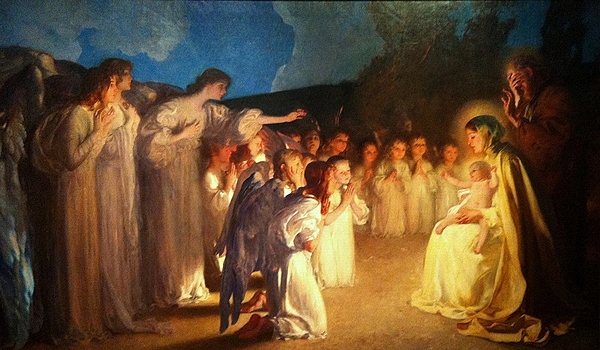
(above: Carl Von Marr, Adoration of the Christ Child, n.d., oil on canvas, Museum of Wisconsin Art. Public domain, via Wikimedia Commons)
Despite its dark subject matter -- religious hysteria and anti-Semitic scapegoating -- the painting became a sensation at the 1893 World's Columbian Exposition in Chicago, establishing Marr's reputation as a world-class history painter. As Marr's career progressed, his style evolved from the rigid academicism of his youth toward a more fluid, light-infused approach often termed "German Impressionism". His 1892 work Summer Afternoon illustrates this shift. Depicting a slice of everyday life in a Munich garden, the painting uses soft, dappled sunlight and short brushstrokes to animate the scene without completely dissolving form into the "plein-air" abstraction typical of the French school. This ability to blend German realism with Impressionist light made him one of the most popular and influential artists of his time, and his legacy is preserved in the Museum of Wisconsin Art, which was founded specifically to house his work.
Social Realism and the Industrial Body: Robert Koehler
While Marr found success in the "Old World," Robert Koehler used his German training to document the social upheavals of the "New World". Koehler's career is inextricably linked to his masterpiece, The Strike (1886) , which is considered one of the first and most significant American paintings to depict the tensions between labor and management with precise realism. Koehler painted The Strike in Munich, but his inspiration was drawn from the American railway strikes of 1877 and the growing labor unrest in Milwaukee and Chicago.
The painting depicts a confrontation between a group of workers and a factory owner. Koehler broke from Victorian sentimentality by depicting the workers as hardy, individual figures and including a middle-class woman -- possibly a social worker or feminist activist -- at the center of the action, asserting her presence in the public sphere. The timing of the painting's debut was uncanny; it was exhibited in New York just days before the Haymarket Riot in Chicago. Because German-Americans were disproportionately represented in the labor and anarchist movements of the time, Koehler's German heritage and Munich training gave the work an added layer of political urgency. Although the painting fell into obscurity for much of the early twentieth century, it was rediscovered in the 1970s and is now housed in the German Historical Museum in Berlin as a national treasure of labor iconography.
Koehler's broader body of work also reflects this interest in the working class. His 1885 painting The Socialistpresents its subject with an objective realism that was revolutionary for its time, focusing on the dignity of the political agitator rather than casting him as a caricature. This "optimistic realism" was shared by his Munich contemporary Wilhelm Leibl and became a hallmark of the German-American contribution to American social art.
Richard Lorenz and the Myth of the West
The panorama industry served as a launching pad for Richard Lorenz, who would go on to define American Western genre painting. Initially brought to Milwaukee to paint horses for panoramas, Lorenz fell in love with the American frontier, embarking on tours of California, Texas, and Oregon. Lorenz applied the rigorous anatomical training of the German academies to the mythology of the American West. He became one of the preeminent Western genre painters in the United States, famous for his depictions of horses and the harsh realities of frontier life.
His painting Woodsmen in Wisconsin (1898) offers a rare, non-idealized glimpse into the lives of lumberjacks, focusing on the human community of men resting around a fire rather than the heroic act of felling trees. Lorenz's most famous painting, Burial on the Plains, (c.1890) captures the stark vulnerability of life in the wilderness, utilizing the deep shadows and dramatic lighting of his Munich training to imbue the scene with a sense of tragic grandeur. As a founder of the Society of Milwaukee Artists and a mentor to a younger generation of painters, Lorenz helped maintain the high technical standards of the German tradition while encouraging students to find inspiration in the local environment.
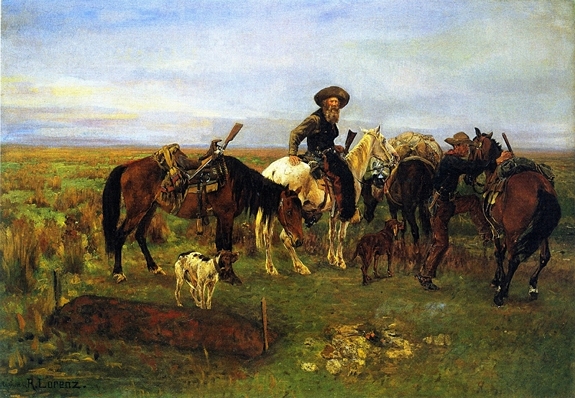
(above: Richard Lorenz, Burial on the Plains, c. 1890, Public domain, via Wikimedia Commons*)

(above: Richard Lorenz, Solitude (or Prairie Twilight), 1904, Milwaukee Art Museum. Public domain, via Wikimedia Commons)
Sculpture and the Civic Landscape: Adolph Weinman
Sculpture played a vital role in the early twentieth century, particularly through the work of Adolph Alexander Weinman. Born in Germany and moving to America at age fourteen, Weinman trained under Augustus Saint-Gaudens and Daniel Chester French before becoming a leading architectural sculptor. Weinman's most significant contribution to Wisconsin is the sculptural program of the State Capitol in Madison. He designed the south pediment, titled Virtues and Traits of Character, which adorns the wing housing the State Senate.
His work is characterized by a "lyrical neoclassical" style, where figures wear classical drapery but possess a fluidity that foreshadows the Art Deco movement. Weinman is perhaps more widely known outside of Wisconsin as a medalist, having designed the "Walking Liberty" half dollar and the "Mercury" dime. However, his monumental work at the Capitol -- alongside other European-trained sculptors like Karl Bitter and Attilio Piccirilli -- transformed the building into a museum of German-influenced civic art. His bronze statue of Abraham Lincoln at the University of Wisconsin-Madison, a replica of his original in Hodgenville, Kentucky, remains one of the most iconic pieces of public art in the state.
Style Evolution and the Rural Wisconsin Landscape
As the twentieth century progressed, the rigid "brown" tones of the Munich school began to give way to more vibrant palettes, influenced by a desire to capture the specific light of the Wisconsin seasons. Hans Stoltenberg https://www.tfaoi.org/aa/3aa/3aa83.htm represents this late-stage evolution of the German-American tradition. Stoltenberg's background was in the craft of "graining" -- the decorative art of painting wood to resemble expensive marble or oak. This trade required immense technical precision, which Stoltenberg later applied to his landscape paintings.
His early work was heavily influenced by the Munich school's preference for dark colors and heavy shadows.However, under the mentorship of Dudley Crafts Watson at the Milwaukee Art Institute, Stoltenberg's style transformed. He began to incorporate a "brilliancy of light" and more fluid brushwork, creating winter landscapes that became staples of Wisconsin collections. His work Open Stream in Winter (1924) illustrates this transition, using bright sunshine to illuminate snow-laden scenes in a way that moved beyond the somber tones of his predecessors.
Elsa Ulbricht and the WPA Legacy
The institutionalization of German-American artistic standards reached its zenith through the work of Elsa Ulbricht, a second-generation German-American whose grandparents were pioneer settlers of Milwaukee. Ulbricht was a central figure in Milwaukee's art education for decades, teaching at the Milwaukee State Teachers College and Alexander Mueller's School of Fine and Applied Arts. During the Great Depression, Ulbricht directed the Milwaukee Handicraft Project, one of the largest and most successful WPA initiatives in the country.
The history of German-American art in Wisconsin is a testament
to the power of cultural transplantation and adaptation. From Henry Vianden's
"oak trees" to Robert Koehler's factory workers and Adolph Weinman's
neoclassical sculptures, these artists created a backbone of technical excellence
and institutional stability. Their commitment to representational accuracy
and historical weight differentiated Wisconsin's art from the burgeoning
American modernism of the coast, ensuring that the "German Athens"
remained a unique bastion of European tradition in the heart of the Midwest
until the end of the Second World War. This legacy is continually reaffirmed
by the high volume of scholarship, museum exhibitions, and archival research
dedicated to their lives, solidifying their place as the architects of Wisconsin's
visual culture.
We lightly edited the article, added images and provided links to other materials to enhance it. AI is rapidly improving in accuracy, yet the article may have inaccurate information.
Prompt:
In an informal manner without using section headings, tables
or bullet points, write an approximately 1,500 word narrative about the
history of German-American Art in Wisconsin between 1850 and 1945.
Cover art types, including paintings and sculpture. Note anything special
such as culture and styles that differentiated German-American art from
other Wisconsin art. Discuss four to six of the most highly regarded German-American
artists who created artworks in the state during that period. Explain the
evolution of their artistic styles and what is unique about their artworks
that makes them important. To evaluate the relative importance of these
specific artists, consider how often they are mentioned in museum exhibits,
YouTube videos, books and articles. Research only .org and .edu sites
Gemini 3 Deep Research Plan:
(1) Search for the general history and development of German-American art in Wisconsin between 1850 and 1945 using only .org and .edu websites, specifically identifying trends in painting and sculpture. (2) Research the cultural background and specific artistic styles (such as the influence of the Munich or Düsseldorf academies) that differentiated German-American artists from other groups in Wisconsin during this period. (3) Identify a list of prominent German-American artists active in Wisconsin and evaluate their prominence by searching .org and .edu domains for mentions in museum exhibit records, scholarly bibliographies, and educational media archives. (4) Select the four to six most frequently cited and highly regarded artists from the research for in-depth analysis. (5) For each selected artist, research the evolution of their artistic style from their early career through 1945, noting significant shifts in their technique or subject matter. (6) Investigate the unique elements of these artists' works that contribute to their historical and artistic importance in Wisconsin, using academic critiques and museum descriptions. (7) Explore the institutional and social history of German-American art in Wisconsin, such as the role of Milwaukee as an art center and the influence of German-founded art schools or panoramas. (8) Gather specific details and descriptions of representative artworks by the selected artists to support the narrative of their unique stylistic contributions.
 Return to Wisconsin Art History
*Tag for expired US copyright of object image:

and
**Tag for some rights reserved:

Links to sources of information outside of our web site are provided only as referrals for your further consideration. Please use due diligence in judging the quality of information contained in these and all other web sites. Information from linked sources may be inaccurate or out of date. TFAO neither recommends or endorses these referenced organizations. Although TFAO includes links to other web sites, it takes no responsibility for the content or information contained on those other sites, nor exerts any editorial or other control over them. For more information on evaluating web pages see TFAO's General Resources section in Online Resources for Collectors and Students of Art History.
Copyright 2026 Traditional Fine Arts Organization, Inc. an Arizona nonprofit corporation. All rights reserved.