
Hopi Wood Carvings: 1880-1980
a 2026 Gemini 3 Deep Research Report
The Hopi, who identify as Hopitu Shunumu or the "peaceful people," have inhabited the three mesas of northeastern Arizona for over 1,500 years. Their culture is profoundly rooted in a matrilineal social structure and a complex religious cycle dictated by the environment of the Colorado Plateau. In this arid landscape, survival is viewed not as a matter of luck but as the result of a disciplined spiritual life characterized by constant prayers for rain and elaborate ceremonies involving the katsinam.
Katsinam are multifaceted spirits representing various aspects of the physical and spiritual worlds, including animals, natural elements, ancestors, and deities. These spirits are believed to reside on the San Francisco Peaks (Nuvatukaua'ovi) for half the year, descending to the Hopi villages between the winter solstice in December and the Niman (Home Dance) in July. During their stay, they are personified by masked men who dance and sing to bring rain, promote fertility, and ensure the growth of corn and beans. The carvings, incorrectly known to many as "kachina dolls," are the physical representations of these masked dancers.
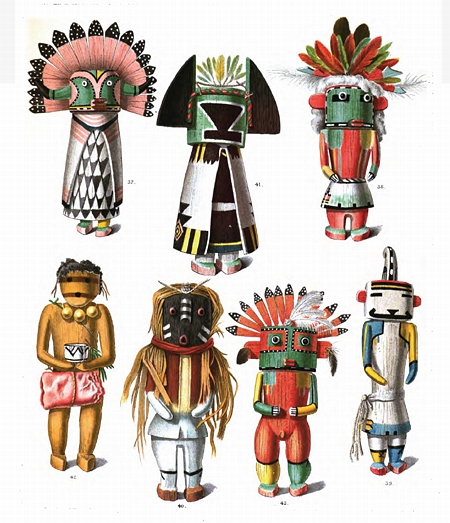
(above: Unknown artist, Drawings of Kachina Dolls, Plate 11, from 1894 anthropology book Dolls of the Tusayan Indians by Jesse Walter Fewkes)
Matrilineal Tradition
Unlike Western toys, the tihu is primarily an educational tool. Within the matrilineal framework, identity and clan membership are traced through the mother. Tithu are traditionally carved by the male relatives of young girls -- fathers, uncles, or brothers -- and are presented by the Giver Kachina during ceremonies such as the Powamuya (Bean Dance). These gifts serve a vital role in the enculturation process, helping girls recognize the characteristics, masks, and regalia of the hundreds of katsinam in the Hopi pantheon.
Following a ceremony, the tithu are not played with but are hung on the walls or rafters of the home, where they serve as constant reminders of the spirits' teachings and their role in maintaining the balance of the world.The traditional types of carvings correspond to the developmental stages of a Hopi child, ensuring that religious education begins almost at birth.
Materiality of the Tihu: The Cottonwood Root
The physical substance of the tihu is as significant as its form. All authentic carvings are made from the root of the cottonwood tree (Populus fremontii). The choice of material is symbolic; cottonwood trees grow in washes and near water sources in an otherwise parched desert. By utilizing the root of a tree that seeks out moisture, the carver creates an object that is itself a prayer for water.
Technically, cottonwood root is lightweight and porous, making it an ideal medium for the hand-carving tools used by the Hopi. In the period preceding 1880, these tools were primarily limited to stone knives and sandstone for smoothing. The surfaces were often finished with a coating of kaolin clay to fill the wood's pores before applying mineral and vegetable pigments. This traditional process was labor-intensive and resulted in a stiff, vertical figure that emphasized the symbolic attributes of the spirit over anatomical realism.
Early Traditional Period: 1850-1910
The 1880s represented a threshold in Hopi history. While the tihu had existed in some form for centuries -- with the earliest surviving slab-like examples dating to the 18th century -- it was in the late 19th century that the figures began to take on more complex, three-dimensional attributes. During the Early Traditional period, tithu were generally small, ranging from 8 to 10 inches in height.
The aesthetic of this era was one of rigidity. The arms were often carved in relief against the body or held stiffly at the sides. However, a major structural innovation occurred toward the end of the 19th century: carvers began to separate the legs, a development that allowed for a more dynamic representation of the dancer's stance. Despite this innovation, the primary purpose remained internal to Hopi society, and the dolls were designed to be hung on walls rather than stood on shelves.
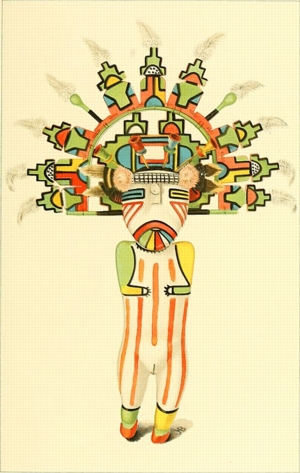
(above: Hopi Pueblo Hatsina Wood Carving, 1893, Annual report of the Bureau of Ethnology to the Secretary of the Smithsonian Institution. Public domain, via Wikimedia Commons*)
Impact of Early External Contact
The arrival of the transcontinental railroad in the 1880s brought the first wave of "Anglos" -- anthropologists, traders, and early tourists -- to the Hopi mesas. These visitors were captivated by the brightly colored wooden figures, and a commercial market began to emerge. In 1895, a missionary working on First Mesa purchased a tihu that later appraised for $10,000, illustrating the early interest in these objects as collectibles rather than just ethnographic curios.
By 1900, the influence of the "white man's trade" became evident as figures began to adopt a more naturalistic look. The price of a tihu in this period was approximately $0.75 in adjusted currency, a modest sum that nonetheless provided a vital source of cash in an increasingly commodified local economy.
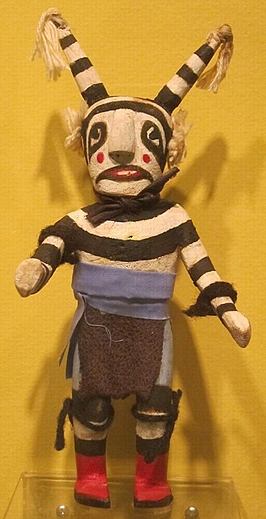
(above: Koshari (clown) Kachina, Arizona, Hopi people, Honolulu Museum of Art. Photo 2013 Hiart (talk). Public domain, via Wikimedia Commons**)
Fred Harvey Company and the Architecture of Tourism
The most profound catalyst for the transformation of the Hopi katsina carving was the partnership between the Santa Fe Railway and the Fred Harvey Company. Together, they invented the "Southwest" as a curated tourist experience, marketing the region's indigenous cultures as "primitive" and "vanishing" to appeal to the Victorian sensibility of travelers seeking authenticity in an industrial age.
In 1902, the Harvey Company opened its Indian Department in Albuquerque, New Mexico. Managed by Herman Schweizer and John Huckel, this department was instrumental in standardizing and promoting Native American arts and crafts. Schweizer and Huckel recognized that to sell Native art to Eastern tourists, they needed to bridge the gap between the "exotic" and the "domestic."
At locations like the Alvarado Hotel and later the Grand Canyon's Hopi House, the Harvey Company utilized "artist-demonstrators" to create a live, immersive experience for tourists. These demonstrations, featuring notable figures such as the Hopi-Tewa potter Nampeyo, served to validate the authenticity of the crafts and "increased sales dramatically".
Opened in 1905, Hopi House was a two-story, Pueblo-style building designed by Mary Colter to serve as a retail outlet and a stage for Hopi life. Inside, the katsina carvings were displayed in a curated setting that elevated them from educational toys to fine art objects. The Harvey Company's influence forced several stylistic and functional changes upon the tithu:
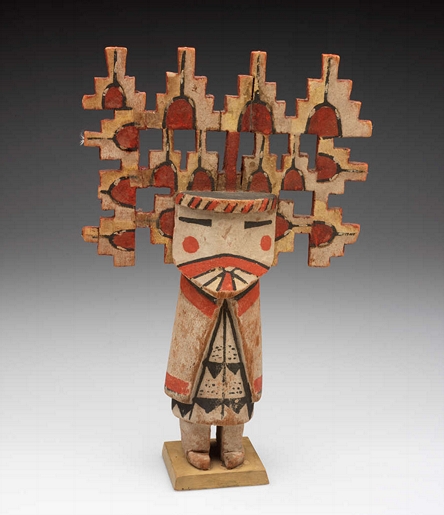
(above: Unknown Maker, Hopi, Sa'lakwmana (Shalako Maiden), figure, early 1900s, cottonwood and pigments, 38.4 x 21.9 cm (15 1/8 x 8 5/8 inches) (overall height), RISD Museum. Public domain, via Wikimedia Commons*)
Influence of the "Harveycars" and the Indian Detours
In 1926, the Fred Harvey Company expanded its reach with the "Indian Detours" program. These excursions utilized specialized "Harveycars" to ferry tourists from the rail lines directly into the heart of the Hopi mesas.This brought the "tourist gaze" directly to the village doorsteps, creating an immediate and pervasive market for crafts.
The Harveycars and their couriers -- often educated young women who served as cultural interpreters -- promised travelers "safe exoticism". For the Hopi carver, this meant that the consumer was no longer a distant stranger at a rail stop but a guest in the village. This direct contact accelerated the demand for more intricate and "action-oriented" carvings that captured the excitement of the dances tourists were now witnessing firsthand. (See Z.S. Liang, Pueblo Street Market in the 1920s, 2006, oil on canvas. The Hilbert Museum of California Art, gift of John Heckenlively, M.D.)
The marketing of the Harvey Company often relied on the narrative that Native American cultures were on the verge of extinction due to federal assimilation policies. This created a sense of urgency among collectors to purchase "authentic" items before they disappeared. This "anthropology of nostalgia" significantly drove up the prices and stylistic complexity of katsina carvings as carvers sought to meet the demand for what was perceived as an endangered craft.
Late Traditional Era: 1910-1930
The Late Traditional period was characterized by a refinement of the commercial trends established at the turn of the century. During this era, carvers had access to a wider array of industrial tools and materials. The introduction of sandpaper and steel knives allowed for a "smoother appearance," which became a hallmark of this period.
Commercial paints -- oil-based and poster paints -- began to supplement or replace traditional mineral pigments. These new paints offered a vibrancy and a spectrum of color that were highly appealing to the tourist market. Furthermore, the figures became more proportional, and carvers began to pay greater attention to the specific anatomy of the human body, moving away from the blocky, symbolic forms of the past.
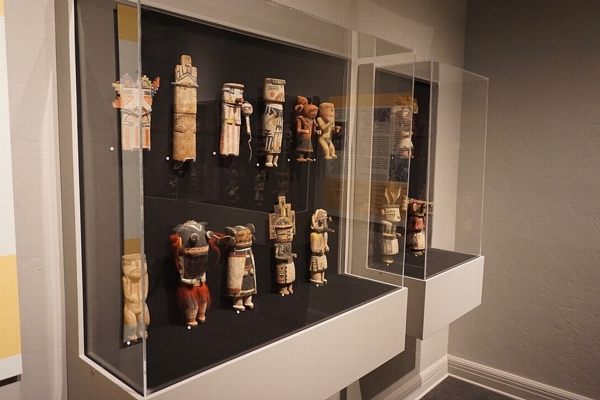
(above: The 1870-1920s display in the Hopi Katsina Dolls: Changing Styles, Enduring Meanings exhibit at the Arizona State Museum on the campus of the University of Arizona in Tucson, Arizona. Photo 2019 Michael Barera. Public domain, via Wikimedia Commons**)
Socio-Economic Struggles and the Great Depression
The economic collapse of the 1930s had a paradoxical effect on the Hopi katsina market. On one hand, the market for high-quality, expensive art effectively vanished. Herman Schweitzer noted that the Fred Harvey Company was forced to turn to lower-quality, inexpensive souvenirs and mail-order catalogs to survive the downturn.
On the other hand, this period saw the emergence of some of the most innovative stylistic changes in the history of the craft. As carvers competed for a shrinking pool of tourist dollars, they sought to make their carvings more spectacular. This led to the birth of the "Early Action" style, where figures were no longer standing still but were depicted in the middle of a dance step, with arms extended and knees bent.
Action Style Era: 1930-1960
The mid-20th century was the era of the "Action Style," a dramatic departure from the verticality of traditional tithu. This period was characterized by a high degree of physical movement and the use of separate attachments for various features.
Anatomical Realism and Movement
In the Early Action period, carvers began to portray the katsina as it appeared during a performance. Figures were carved with one leg lifted, as if in a dance stride, and arms were often carved separately and glued on to allow for more complex poses. This style was a direct response to the "tourist gaze," which valued the spectacle of the dance over the quiet symbolism of the traditional doll.
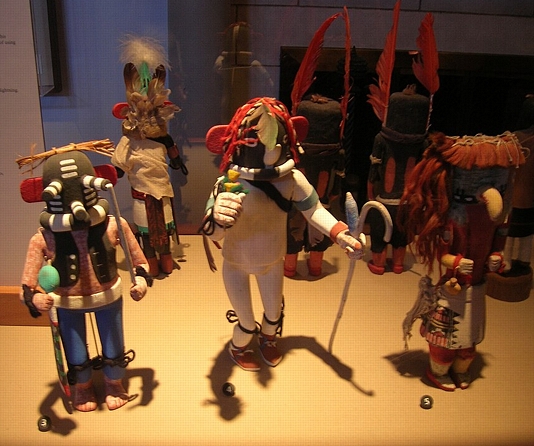
(above: Kachina Dolls, Heard Museum, Phoenix, AZ. Photo 2005 Grombo. Public domain, via Wikimedia Commons**)
Role of Named Artists
By the mid-20th century, the anonymity of the carver began to disappear. Influenced by the success of Nampeyo in pottery and Fred Kabotie in painting, individual katsina carvers began to be recognized for their unique styles. Collectors now sought out pieces by specific makers, a shift that transformed the carving from a community-based craft into an individualistic art form. This transition was supported by institutions like the Museum of Northern Arizona and the Gallup Inter-Tribal Indian Ceremonial, which provided venues for competition and exposure.
The Modern Era and the Late Action Style: 1960-1980
The period between 1960 and 1980 saw the katsina carving reach its aesthetic peak as "Action Sculpture." During this time, the separation between "commercial souvenir" and "fine art" became definitive. High-end carvers began to move away from the "doll" concept entirely, creating complex, multi-figure compositions carved from a single piece of cottonwood root.
Technical Mastery of the Late Action Period
One of the most significant innovations of the 1970s was the shift from opaque paints to the use of wood stains. This technique allowed the natural grain of the cottonwood root to remain visible, emphasizing the artistry of the carving itself.
Furthermore, carvers like Brian Honyouti and Ros George began to incise all details -- including hair, feathers, and clothing textures -- directly into the wood rather than using separate attachments like real feathers or cloth.This "all-wood" style became the gold standard for high-end collectors and museums, with some contemporary pieces fetching upwards of $50,000.
Miniature Katsina Phenomenon
During the 1970s, a new sub-genre emerged: the miniature katsina. Often created by Hopi women, these small, highly detailed figures were produced exclusively for the trade market. While they were not considered "traditional" tithu for ceremonial use, they represented an important economic avenue and a creative adaptation to the demands of a market that valued both detail and portability.
Return to Tradition: The Late 1970s Revival
In the late 1970s, a counter-movement emerged within the Hopi mesas. Some traditionalist carvers, such as Darance Chimerica and Walter Howato, felt that the high-realism of the Action Sculpture style had become too disconnected from the spiritual essence of the katsinam. This led to a conscious revival of the "Old Style" or "Traditional Style" of carving. This revival was characterized by:
This movement was not a rejection of the market, but rather a sophisticated rebranding of "authenticity." Collectors, now educated by decades of literature and museum exhibitions, began to prize these "Old Style" revivals for their perceived spiritual integrity and connection to ancestral forms.
Socio-Cultural Resilience and the Managed Gaze
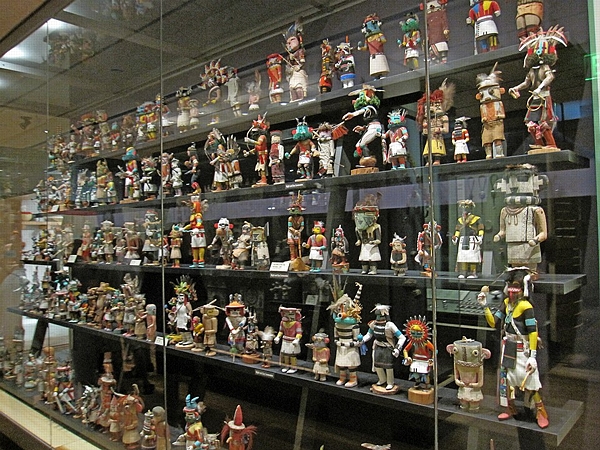
(above: A collection of Katsinas as seen at Heard Museum, which deals with the diverse Native American cultures found throughout Arizona. Photo: 2009 InSapphoWeTrust from Los Angeles, California. Public domain, via Wikimedia Commons**)
The 100-year history of Hopi katsina carving is ultimately a story of managed integration. While the Fred Harvey Company and the tourism industry significantly altered the physical form of the tihu, the Hopi people successfully utilized these changes to support their community and preserve their culture.
Throughout the 20th century, the Hopi maintained a complex relationship with the "tourist gaze." While they welcomed the economic benefits of tourism, they set up strict barriers of secrecy regarding their sacred knowledge. The carvings sold to the public were, in a sense, "diplomatic" objects -- they represented the Hopi world to the outsider while keeping the most sacred details hidden behind a veil of intentional omission and stylistic modification.
The impact of the katsina trade on the Hopi economy cannot be overstated. In a region with few natural resources or industrial opportunities, the sale of tithu, pottery, and baskets provided a path to economic self-sufficiency. By 1980, the Native art market in the Southwest had grown into a billion-dollar industry, with the Hopi at its creative forefront.
Between 1880 and 1980, the Hopi katsina wood carving underwent a metamorphosis as radical as any in the history of North American art. From the stiff, mineral-painted figures of the Early Traditional period to the dynamic, wood-stained "Action Sculptures" of the 1970s, the tihu evolved in direct response to the socio-economic pressures of the railroad, the Fred Harvey Company, and the global art market.
Yet, for all the stylistic changes -- the addition of bases, the shift to sandpaper and oil paints, the move toward anatomical realism -- the core of the tradition remained intact. Every carving continued to be fashioned from the moisture-seeking cottonwood root, and every figure remained a didactic tool, whether serving a young girl in a Hopi village or a collector in a Manhattan gallery. The resilience of the Hopi people ensured that the tihu was never merely a souvenir but a living, breathing part of a spiritual heritage that survived the onslaught of the 20th century.
Through the managed "tourist gaze" and the brilliance of individual artists, the Hopi turned a century of outside influence into a golden age of artistic innovation.
We lightly edited this report, added images and provided links to other materials to enhance it. AI is rapidly improving in accuracy, however, the report may contain inaccurate information. This presentation doesn't meet scholarly standards, yet Gemini 3 AI researched and checked it for accuracy. Sources are footnoted in the raw AI report, yet deleted here for a general audience. Please see An Evaluation Of Gemini 3 Deep Research In Replication Of Academic Peer Review, an April, 2026 Gemini 3 Deep Research Report.
Prompt:
Research plan:
(1) Search for a comprehensive overview of Hopi kachina doll (tithu) history from 1880 to 1980 using .edu and .org domains. (2) Identify and define the distinct stylistic periods of carving during this century, such as the Early Traditional, Late Traditional, and the transition to the Action style. (3) Research the Fred Harvey Company's influence on Southwestern art, specifically focusing on how Harveycars and the Santa Fe Railway promoted Hopi crafts to tourists. (4) Investigate how the Fred Harvey "Indian Department" and their hospitality venues influenced the design, size, and commercial appeal of kachina dolls for travelers. (5) Examine the evolution of materials and techniques used by Hopi carvers, including the shift from mineral pigments to commercial paints and the refinement of carving tools. (6) Look for scholarly articles or museum resources detailing the socio-economic impact of the burgeoning tourist trade on the Hopi people during the mid-20th century. (7) Explore the cultural distinction between dolls made for internal Hopi use (educational/religious) versus those produced for the external market from 1900 to 1980. (8) Gather specific historical details and anecdotes about the most influential Hopi carvers or trading posts that shaped the kachina market leading up to the 1970s and 1980s.
 Return to Arizona Art History
Return to Native American Art
Return to Wood
Carving
*Tag for expired US copyright of object image:

and
**Tag for some rights reserved:

Links to sources of information outside of our web site are provided only as referrals for your further consideration. Please use due diligence in judging the quality of information contained in these and all other web sites. Information from linked sources may be inaccurate or out of date. TFAO neither recommends or endorses these referenced organizations. Although TFAO includes links to other web sites, it takes no responsibility for the content or information contained on those other sites, nor exerts any editorial or other control over them. For more information on evaluating web pages see TFAO's General Resources section in Online Resources for Collectors and Students of Art History.
Copyright 2026 Traditional Fine Arts Organization, Inc. an Arizona nonprofit corporation. All rights reserved.