
History of Navajo Sand Paintings
a 2026 Gemini 3 Deep Research Report
.
The cultural history of the Navajo (Diné) people is fundamentally intertwined with the concept of Hózhó, a holistic philosophical framework that signifies beauty, balance, and the restoration of universal order.Within this ontological system, the practice of sandpainting, known in the Diné language as iikaah -- which translates to "the place where the gods come and go" -- is not merely an artistic endeavor but a sophisticated liturgical tool. Historically, these intricate designs were ephemeral, created as part of complex healing rituals and destroyed immediately upon the ceremony's conclusion to safeguard both the patient and the sanctity of the Holy People. The transition of these sacred, temporal manifestations into permanent, commercialized art forms represents a profound shift in Navajo material culture, driven by the intersecting influences of early ethnographers, visionary Indigenous leaders, and the economic mandates of the Southwestern trading post system.
Ritual Framework: Architecture of the Sacred Ceremony
To understand the historical evolution of Navajo sandpainting, we must first engage with its primary function: a mechanism for spiritual and physical restoration. Traditional sandpaintings are not viewed as static representations of divinity but as dynamic, living portals through which supernatural forces, known as the Yei or Yei Bei Chai (the Holy People), are summoned into the human realm. These ceremonies are conducted within a traditional hogan, a hexagonal or octagonal dwelling that serves as a microcosm of the Navajo universe.

(above: Navajo sand painting, depicting
Yei figures in symmetrical, reciprocal positions, with one elongated figure
spanning the entire painting, c. 1890-1908, Horace Swartley, Photographer.
Public domain, via Wikimedia Commons*)
The creation of an iikaah is overseen by a Hata?ii, or Singer, a traditional healer who has undergone years of rigorous apprenticeship to master the chants, herbal lore, and visual iconographies associated with specific "ways" or ceremonies. The process begins with the preparation of a clean sand bed, typically one to two inches thick, upon which the Singer trickles ground minerals with extraordinary precision. This act of "painting" is a form of physical prayer, where the accuracy of the design is directly correlated with the efficacy of the cure; any deviation from the ancestral patterns is believed to diminish the ceremony's power or even invite spiritual danger.

(above: Navajo men work on a sand painting probably in Arizona. Woven blankets and rugs are displayed nearby, c. 1890-1910, Mullarky Photo. Public domain, via Wikimedia Commons*)
Material Symbology and Mineralogical Composition
The traditional palette of the iikaah is restricted to materials sourced directly from the natural landscape of the Four Corners region, reinforcing the ontological connection between the people and their land. The primary colors are symbolic, often corresponding to the cardinal directions and the progression of the day. Black, sourced from lignite, graphite, or charcoal made from oak, is frequently associated with the North and protection. White, derived from crushed gypsum or white sandstone, signifies the East and the dawn. Yellow ochre represents the West and the twilight, while red sandstone or hematite represents the South and the vitality of life. Blue or blue-green hues, which are particularly sacred, are often created by mixing charcoal with gypsum, or in some instances, by grinding copper-based minerals like soladinite or malachite.
In addition to mineral sands, the Hata?ii may incorporate organic materials such as cornmeal, flower pollen, and powdered roots or bark, which add layers of sacramental meaning to the composition. The texture of the sand, which is applied by letting the grains flow between the thumb and forefinger with controlled vibration, creates a tactile surface that is essential for the ritual's climax.
Liturgical Function and Post-Ceremonial Destruction
The ritual utility of the sandpainting is predicated on its role as a vessel for exchange. Once the iikaah is complete and its accuracy verified, the patient is seated directly upon the painting. As the Hata?ii performs the corresponding chants and prayers, the Holy People are believed to enter the sand through their depictions. In this state of contact, the patient absorbs the strength and harmony (Hózhó) of the deities, while the deities in turn absorb the patient's illness or "evil" forces.
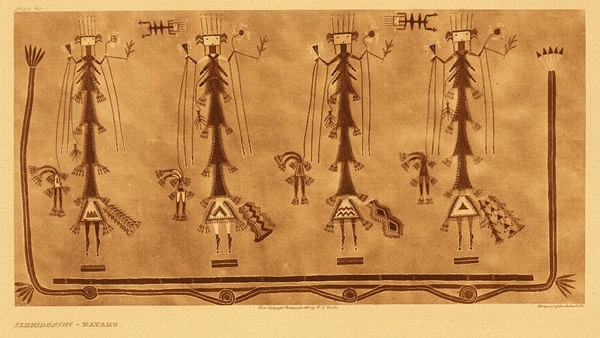
(above: Edward S. Curtis, Navajo Sand
Painting, one of the four elaborate dry-paintings or sand altars employed
in the rites of the Mountain Chant, a nine-day Navaho medicine ceremony,
1907, photograph, Public domain, via Wikimedia Commons**)
This absorption process renders the physical sand painting "toxic" or spiritually contaminated. Consequently, the Navajo believe that the painting must be destroyed before the following sunset to prevent the extracted ailment from remaining in the hogan or affecting the community. Because the ceremonies are often performed in sequences lasting nine days, at least one fresh sandpainting is created and subsequently obliterated every twelve hours. This fundamental requirement of ephemerality served as the primary cultural barrier against the creation of permanent versions for outside collectors throughout the 18th and 19th centuries.
Conflict of Permanence: Early Ethnographic Encounters
The shift toward documenting and eventually commercializing Navajo sandpainting was initially catalyzed by late-19th-century anthropological efforts to record Indigenous practices before they were supposedly lost to assimilation. Ethnographers such as Washington Matthews were among the first to witness and record these ceremonies, often encountering significant resistance from Hata?ii who viewed the recording of sacred images as a dangerous transgression.
Washington Matthews and the Recording of "Long Bodies"
Washington Matthews' work in the late 1800s focused on the intricate "long body" figures -- the elongated representations of the Yei -- which he painstakingly documented through sketches and descriptions. These early visual records provided the first glimpses of Navajo cosmology to an Anglo-American audience, yet they were fraught with cultural tension. The Navajo believed that making the Holy People permanent in a drawing or a photograph could "trap" the deity or cause the Hata?ii to lose his healing powers.
Despite these taboos, the pressures of western expansion -- including the trauma of the Long Walk and the subsequent reservation period -- led some Navajo elders to reconsider the necessity of a permanent record. They feared that as the younger generation was sent to boarding schools and disconnected from the oral tradition, the visual literacy required for the iikaah would vanish. This internal debate created a fissure that visionary artists and external traders would eventually exploit to birth a new medium of expression.
Scientific Documentation versus Spiritual Taboo
The tension between scientific "authenticity" and spiritual safety is vividly illustrated in the mid-20th-century collaboration between Robert Thom and George Bender. Commissioned by the pharmaceutical company Parke, Davis & Company, they sought to depict "Native Healing" as part of a series on the history of medicine. Although they hired a Hata?ii named Billy Norton to pose and perform a ceremony, the resulting artwork was criticized for relegating a living practice to a "timeless" and "primitive" past. This dynamic highlighted a persistent misunderstanding: while Western observers sought static, accurate representations, the Navajo were primarily concerned with the dynamic, functional life of the ritual.
Hosteen Klah and the Textile Revolution
The most radical transformation in the history of sandpainting was the move from the floor of the hogan to the vertical loom. This evolution was largely pioneered by Hosteen Klah (1867-1937), a figure whose unique social position allowed him to transcend rigid cultural boundaries. Klah was a nadleehi, an individual who embodies both male and female spirits. In Navajo society, this status granted him access to both the male domain of the Hata?ii and the female domain of the weaver.
Nadleehi Identity as a Cultural Conduit
Traditionally, Navajo weaving was a task passed from mother to daughter, while the role of the Singer was predominantly male. Klah's ability to perform both roles allowed him to synthesize the sacred iconography of the iikaah with the structural durability of the rug. In the early 1920s, Klah began weaving sandpainting designs, such as the "Whirling Logs" from the Nightway Ceremony, into wool tapestries. This act caused an uproar on the reservation, as it was considered a major sacrilege to make these images permanent, particularly in a medium intended to be walked upon. Klah's motivation was multifaceted. While there was an economic venture involved in creating high-value textiles for wealthy collectors, he was primarily driven by a desire to preserve Navajo religious knowledge. He believed that if the ceremonies were not recorded in a permanent form, they would be forgotten as the Diné people were forced into assimilation.
Collaboration with Franc Newcomb and Mary Wheelwright
Klah's work was supported and encouraged by two influential Anglo-American women: Franc Newcomb, the wife of a trader at Blue Mountain, and Mary Cabot Wheelwright, a Boston socialite and collector. Newcomb initially suggested that Klah's ritual knowledge could be preserved through tapestries, a suggestion Klah initially resisted because sacred images "could never be walked upon". To solve this, it was established that these textiles were tapestries to be hung on walls, rather than rugs to be used as floor coverings. Together, Klah and Wheelwright founded the Museum of Navajo Ceremonial Art (now the Wheelwright Museum of the American Indian) in Santa Fe. This institution became a repository for Klah's sandpainting tapestries and a center for the preservation of ceremonial lore, effectively legitimizing the permanent rendering of sacred images for educational and artistic purposes.
Commercial Catalyst: Trading Posts and the Global Market
While Hosteen Klah addressed the spiritual and ideological barriers to permanence, the trading post system provided the economic infrastructure and aesthetic direction that would shape sandpainting as a commercial commodity. Traders like John Lorenzo Hubbell and the Wetherill family acted as cultural and economic intermediaries, bridging the gap between the isolated reservation and the growing market for "Indian curios" in the Eastern United States.

(above: Hubbell Trading Post National Historic Site, Arizona, 2004. Photo courtesy of National Park Service. Public domain, via Wikimedia Commons*)
Hubbell and Wetherill Influence on Aesthetic Standardization
John Lorenzo Hubbell, who built a trading empire starting in Ganado, Arizona, had a profound influence on the aesthetics of Navajo weaving and eventually sandpainting. Hubbell and other traders recognized that for Navajo art to sell to a non-Native audience, it had to align with Western decorative tastes. This led to a process of aesthetic standardization where complex ritual symbols were simplified into motifs that were more "readable" and aesthetically pleasing to tourists. Traders often requested specific designs, most notably the Yei or Yei Bei Chai figures, because their elongated, human-like forms were visually striking and fit well within the dimensions of a rug or tapestry. The "Yei" figure became the quintessential symbol of Navajo spirituality for the consumer market, leading to a proliferation of designs that emphasized symmetry and repetition -- elements that are important in ritual but were heightened for commercial appeal.
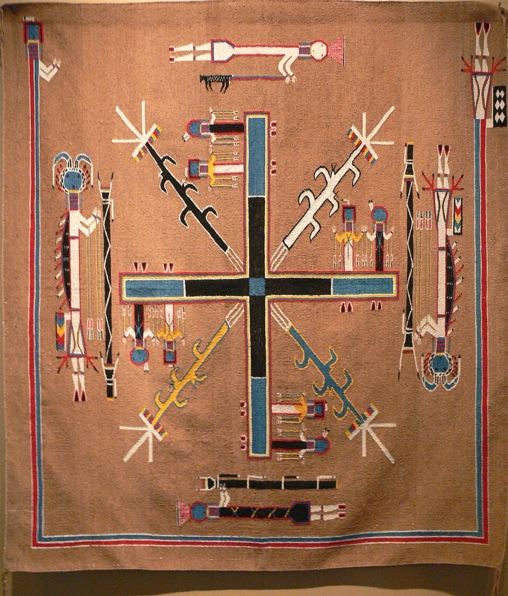
(above: Navajo sandpainting rug, 1940, Gilcrease Museum. Public domain, via Wikimedia Commons*)
Economic Imperative and the "Trinket Trade"
The emergence of the "trinket trade" in the mid-20th century further modified the production of sandpainting art. As tourism to the Southwest increased with the rise of the automobile and the development of Route 66, the demand for affordable souvenirs grew. This forced artisans to move away from the massive, time-intensive tapestries of Klah's era toward smaller, more portable objects. Traders played a crucial role in this shift by providing the materials and setting the price points that made smaller works viable. The economic reality of life on the reservation meant that Navajo families relied on these sales for survival, making them highly responsive to the feedback of traders and buyers regarding color preferences and sizes.
Technical Evolution: From Ephemeral Sand to Permanent Board
The transition from textiles to the modern "sand-on-board" technique was a technical breakthrough that allowed the art form to retain the texture and "feel" of a ritual sandpainting while being commercially durable. This process, known as "permatizing," was largely developed in the post-World War II era. The primary credit for the development of the permanent sand-on-board technique is given to Fred Stevens Jr. (also known by his ceremonial name, Grey Squirrel), a Navajo Hata?ii who began experimenting with adhesives in the late 1940s and early 1950s. Stevens sought a way to render traditional designs in sand that would not blow away or be destroyed.
His method involved applying a thin layer of commercial glue (often a white wood glue or synthetic resin) to a piece of particle board, plywood, or masonite. While the glue was still wet, the artist would trickle finely ground, naturally colored sand onto the surface using the same manual techniques used in a hogan. Once the glue dried, the excess sand was shaken off, leaving a permanent, raised image. This innovation allowed sandpainting to become a standalone art form that could be framed and hung like a painting, separate from the structural requirements of a rug.
Shifts in Media: Glue, Plywood, and Synthetic Pigments
The introduction of permatizing led to significant changes in materials. While the iikaah used purely natural minerals and pollen, commercial sandpaintings often incorporated synthetic pigments to achieve brighter, more consistent colors that would not fade over time. The use of plywood and particle board allowed for a variety of shapes and sizes that were impossible in a ritual setting. These material shifts were directly influenced by the need for durability in shipping and display. A buyer in New York or Chicago required an object that could withstand temperature changes and physical handling, prompting artists to refine their glue mixtures and wood selection.
Miniaturization and Portability in the Tourist Era
In a ritual context, sandpaintings can vary in size from small one-foot squares to massive compositions spanning twenty feet in width. These large paintings are often communal efforts, with several young men working under the direction of the Hata?ii. However, the commercial market prioritized portability and affordability. By the mid-20th century, the "miniature" sandpainting became a staple of Southwest curio shops. These pieces, often 6.5 cm or smaller, were attached to the lids of wooden boxes, turned into magnets, or sold in small frames. This radical reduction in scale required a corresponding simplification of design. Complex theological narratives were distilled into single figures, often stripped of their surrounding landscape symbols to fit the tiny format.
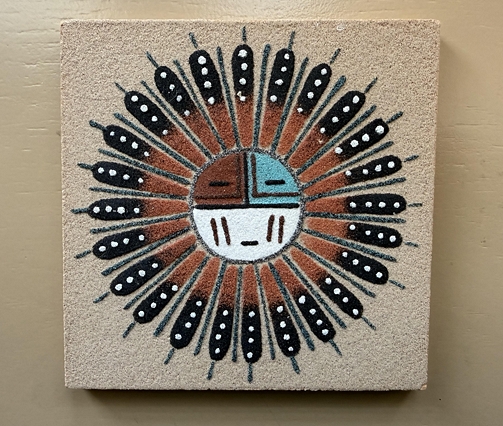
(above: Wayne Tom, Sand Painting, 2014, sand on wood, 4" x 4". Private Collection)

(above: Wayne Tom, Sand Painting (verso), 2014, sand on wood, 4" x 4". Private Collection)
From Communal Liturgy to Individual Artistry
The production process itself shifted from a group activity to a solitary one. In a healing ceremony, the creation of the iikaah is a collective prayer where the energy of multiple participants contributes to the cure. Commercial production, driven by the need for efficiency and the identification of "named" artists for collectors, became the work of individual artisans. The use of stencils also became common in lower-priced commercial works. To meet the high volume demanded by trading posts, artists developed stencils of common figures like the Yei Bei Chai or the "Rainbow Man". This allowed for the rapid production of consistent designs, though it was often criticized by purists as a move away from the "flow" and skill inherent in traditional sand trickling.
Navigating the Profane: Intentional Error and Cultural Preservation
Perhaps the most ingenious aspect of the transition to commercial sandpainting is how Navajo artists resolved the conflict between economic necessity and spiritual taboo: the "intentional error". To avoid the curse or the spiritual danger associated with making a sacred image permanent, Navajo artisans deliberately alter the designs. These alterations are often subtle and invisible to the untrained eye. They may involve changing a single color, omitting a specific feather from a deity's headdress, or reversing the orientation of a figure. By making these "respectful changes," the artist ensures that the resulting object is not a "true" sandpainting and therefore lacks the power to summon or offend the Holy People. This practice allows Navajo sandpainters to participate in the global economy while maintaining their cultural and religious integrity. It represents a form of "codeswitching" where the visual language of the sacred is translated into a secular dialect.
The Contemporary Landscape of Navajo Visual Sovereignty
The history of Navajo sandpainting is a testament to the adaptability and resilience of the Diné people. What began as a strictly temporal, ritualized act of healing has evolved into a globally recognized art form that supports thousands of families and preserves a visual record of a complex cosmology. While traders and buyers undeniably commercialized the practice, their influence also spurred technical innovations, such as Hosteen Klah's textiles and Fred Stevens Jr.'s permatizing, saving many designs from obscurity. Today, the market continues to evolve, with contemporary Navajo artists using sandpainting techniques to express modern identity, high fashion, and even political resistance. Yet, at its heart, the permanent sandpainting remains a bridge: a way for the outside world to glimpse the beauty of Hózhó while the true, sacred iikaah continues its ephemeral life in the sanctity of the hogan.
We lightly edited this report, added
images and provided links to other materials to enhance it. AI is
rapidly improving in accuracy, however, the report may contain inaccurate
information. This presentation doesn't meet scholarly standards, yet Gemini 3 AI researched and checked it
for accuracy. Sources are footnoted in the raw AI report, yet deleted
here for a general audience. Please see An Evaluation Of Gemini 3 Deep Research In Replication
Of Academic Peer Review, an April, 2026 Gemini 3 Deep Research Report.
Prompt:
Research Plan:
(1) Research the traditional origins and ceremonial purpose of Navajo sandpaintings (Diné drypaintings) within the context of healing rituals and the 'Way' ceremonies using .edu and .org resources. (2) Investigate the historical transition in the late 19th and early 20th centuries from ephemeral ritual art to permanent commercial objects, specifically looking for the roles of early trading posts. (3) Identify influential traders and collectors who encouraged the preservation of sandpaintings on boards and analyze their specific requests regarding aesthetics and themes. (4) Examine the evolution of materials used in sandpaintings, comparing traditional crushed minerals and rocks to the introduction of commercial glues, plywood, and synthetic pigments for the tourist market. (5) Analyze how the physical sizing of sandpaintings changed from large-scale floor compositions to smaller, portable formats tailored for home decor and gallery sales. (6) Research the impact of direct buyers and the art market on design choices, including the secularization of sacred imagery and the intentional modification of traditional motifs to respect cultural taboos. (7) Explore changes in production methods and demographics, such as the shift from communal ritual creation by medicine men to individual artistic production for commercial gain. (8) Find specific case studies or historical accounts of Navajo artists who pioneered commercial sandpainting to understand the personal narratives behind this cultural and economic shift.
 Return to Arizona Art History
Return to Figurative and Portrait Art: 19-20th Century,
Return to Native American Art
*Tag for expired US copyright of object image:

TFAO Museum of American Art is proudly sponsored by Traditional Fine Arts Organization, Inc., an Arizona nonprofit corporation. All rights reserved. © 2024
Links to sources of information outside of this website are provided only as referrals for your further consideration. Please use due diligence in judging the quality of information contained in these and all other web sites. Information from linked sources may be inaccurate or out of date. TFAO neither recommends or endorses these referenced organizations. Although TFAO includes links to other web sites, it takes no responsibility for the content or information contained on those other sites, nor exerts any editorial or other control over them. For more information on evaluating web pages see TFAO's General Resources section in Online Resources for Collectors and Students of Art History.
 Search Resource Library
Copyright 2026 Traditional Fine Arts Organization, Inc., an Arizona nonprofit corporation. All rights reserved.