
History of Navajo Textiles
a 2026 Gemini 3 Deep Research Report
.
The history of Navajo weaving is a profound testament to the resilience of the Diné, representing a complex intersection of Indigenous spirituality, colonial disruption, and global market forces. While often categorized as a "craft," Navajo weaving -- particularly in its ceremonial and regional rug forms -- functions as a sophisticated visual language that has successfully navigated the transition from utilitarian garment to sacred archive and international art object. This report examines the technical, social, and spiritual evolution of Navajo textiles, with a specific focus on the role of traders and collectors in reshaping the material and aesthetic boundaries of the tradition.
The Mythological and Historical Genesis of the Loom
The origins of Navajo weaving are rooted in a duality of perspectives: the archaeological evidence of cultural diffusion and the sacred narratives of the Diné. According to Navajo cosmology, the art of weaving was not a human invention but a divine gift. The Holy People led the Diné into the Southwest from the underworld. Spider Man taught the people how to construct the first loom using elements of the cosmos -- sunshine for the frame, lightning for the batten, and rain for the comb. Spider Woman then taught the people the actual techniques of weaving, instilling the concept of hózhó (harmony, beauty, and balance) into every thread. This spiritual foundation establishes weaving as a sacred act of creation, where the weaver integrates her spirit into the textile, often leaving a "spirit outlet" or intentional imperfection to ensure her soul is not trapped within the finished work.
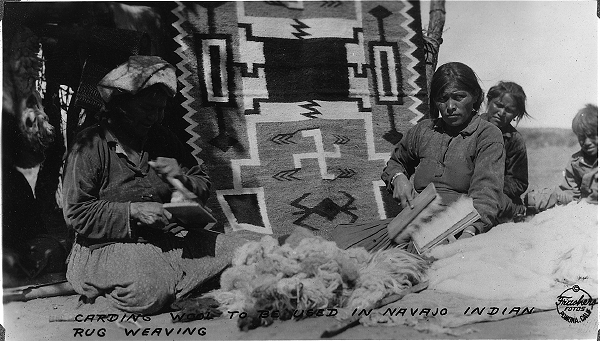
(above: Carding wool to be used in Navajo Indian rug weaving. Southern Navajo Agency, 193, National Archives and Records Administration. Public domain, via Wikimedia Commons*)
Archaeological and ethnographic records offer a complementary narrative of cultural synthesis. It is widely accepted that the Navajo learned to weave from their Pueblo neighbors -- likely the Hopi and Zuni -- after migrating to the Four Corners region between AD 1000 and 1200. This interchange intensified in the late 17th century following the Pueblo Revolt of 1680, as many Pueblo people sought refuge with the Navajo to escape Spanish reprisals. From their Pueblo mentors, the Navajo adopted the vertical upright loom, a technology remarkably suited to a semi-nomadic lifestyle as it could be easily disassembled, rolled up with a work-in-progress, and transported.
Initially, the material for these weavings was wild cotton, which the Puebloans had cultivated for centuries. However, the arrival of the Spanish in the 1500s introduced the Churra sheep, which the Navajo adapted into the Navajo-Churro breed. This biological introduction fundamentally shifted the trajectory of the art form, as wool replaced cotton as the primary fiber. The Navajo-Churro produced a long-staple, low-grease wool that was exceptionally easy to hand-clean and spin, allowing for the production of fine, weather-resistant blankets that would become the hallmark of the Classic Period (1700-1850).
The Impact of the "Long Walk" and the Bosque Redondo Incarceration
The year 1863 marked a rupture in Navajo history. Following a campaign by the U.S. Army, the Navajo were forced on a 300-mile march to an internment camp at Bosque Redondo, New Mexico. This four-year period of incarceration decimated the Navajo-Churro herds and stripped the people of their traditional pastoral economy. However, the experience also exposed weavers to new materials and motifs that would catalyze the transition from blankets to rugs.
While imprisoned, weavers were issued commercial yarns and pre-woven "Rio Grande" blankets by the military. These blankets featured Hispanic and Mexican Saltillo designs, characterized by serrated diamonds and the eight-pointed Vallero star. The loss of their own wool supply forced weavers to unravel commercial cloth (bayeta) or use 3-ply "Saxony" yarns to continue their craft. Upon their return to the reservation in 1868, the Navajo faced a world where their traditional utilitarian garments were increasingly replaced by mass-produced American clothing. This economic necessity, combined with the arrival of the railroad in 1881, created a new market: the non-Native tourist and the Eastern Victorian homeowner.
The Rise of the Trading Post and the Professionalization of the Rug
By the late 19th century, the Navajo trading post became the primary nexus for economic and artistic exchange. Traders such as Juan Lorenzo Hubbell and J.B. Moore functioned as early "curators" or "art directors," recognizing that the survival of Navajo weaving depended on its marketability to outsiders who viewed the blankets not as clothing, but as floor rugs and wall hangings.
Juan Lorenzo Hubbell: The Traditionalist Visionary
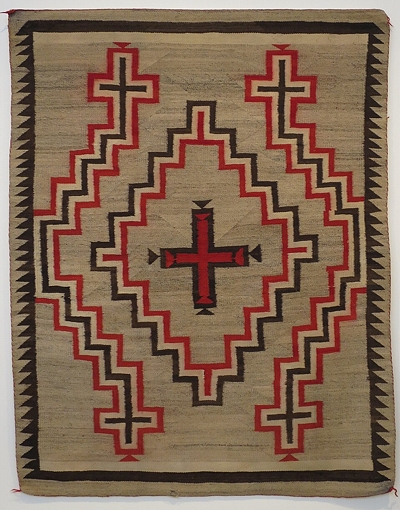
(above: Ganado Rug, Navajo, Honolulu Museum of Art accession
4689. Public domain, via Wikimedia Commons*)
Juan Lorenzo Hubbell, who established the Ganado Trading Post in 1878, is arguably the most influential figure in the development of the "modern" Navajo rug. Hubbell was a proponent of craftsmanship and sought to revitalize the designs of the Classic Period, which he felt were being lost to the "garish" excesses of the Eye Dazzler era. Hubbell's influence was systemic, affecting design, color, and sizing:
J.B. Moore: Innovation and Global Marketing
While Hubbell looked to the past, J.B. Moore at the Crystal Trading Post (1896-1911) looked to global markets. Moore was a master of marketing, publishing mail-order catalogs in 1903 and 1911 that allowed customers across the United States to order rugs by "plate" number. Moore's influence introduced several critical shifts:
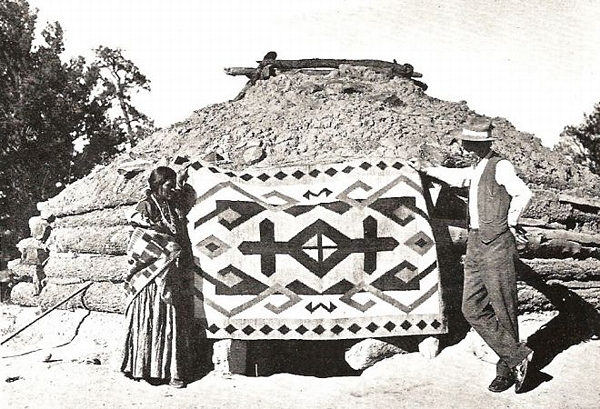
(above: J. B. Moore and Weaver at Crystal Trading Post with a Navajo Rug, 1911, photograph. Catalog for Crystal Trading House Navajo blankets. Public domain, via Wikimedia Commons*)
Technical Evolution: From Handspun to Germantown and Aniline
The shift from blankets to rugs was as much a chemical and structural revolution as it was an aesthetic one. The introduction of Germantown yarns and aniline dyes in the 1870s provided weavers with a palette that was previously impossible to achieve with native vegetal dyes. Germantown yarns, manufactured in Pennsylvania, were 3-ply and later 4-ply commercial wool yarns pre-dyed with vivid aniline colors. These yarns allowed for a level of detail and color contrast that led to the Eye Dazzler style https://statemuseum.arizona.edu/online-exhibit/19-century-navajo-weaving-asm/eye-dazzlers -- characterized by sharp-toothed, serrated zigzags that appear to vibrate visually. However, the use of these materials had long-term structural implications. Many "Eye Dazzlers" used commercial cotton twine for the warp instead of handspun wool. While this facilitated finer weaving, the cotton warp is less durable than wool, leading to a high rate of breakage in surviving 19th-century pieces.
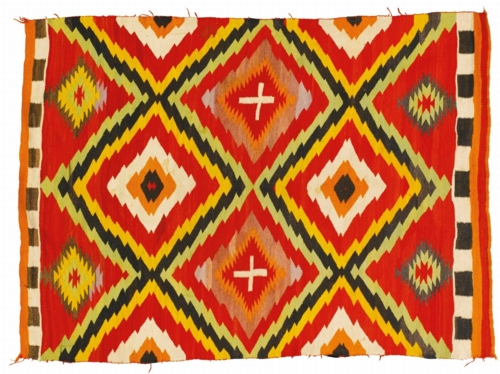
(above: Navajo Eyedazzler Rug, n.d., woven in handspun wool, in natural ivory and dark brown, and numerous aniline colors, with a pair of crosses enclosed by an overall concentric diamond pattern, measuring 72 x 53 inches. Exhibited: Saint Louis Art Museum, "Navajo Weavings from the Andy Williams Collection," October 26, 1997 - January 4, 1998. Literature: Ann Lane Hedlund, Navajo Weavings from the Andy Williams Collection, 1997, p. 71, no. 39, Catalogue Note. Public domain, via Wikimedia Commons*)
Furthermore, the introduction of prepackaged aniline dyes allowed weavers to dye their own handspun wool. However, without the proper water for rinsing or the correct chemical mordants (such as the native alum known as almogen), many early aniline-dyed rugs suffered from "bleeding" or "fugitive" colors. Traders like Hubbell eventually intervened by providing higher-quality dyes and working with chemists like Dr. Karl Schlatter to ensure colorfastness, further centralizing the trader's role in the production process.
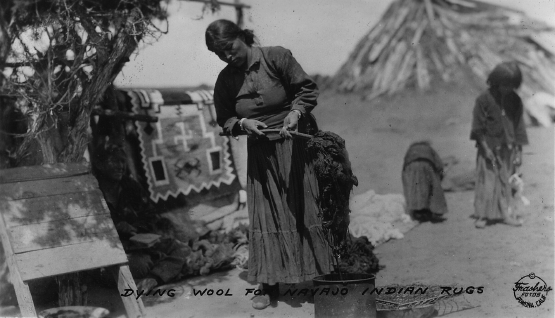
(above: Dyeing wool for Navajo Indian rugs. Southern Navajo Agency, c. 1930-38, National Archives and Records Administration. Public domain, via Wikimedia Commons*)
The Spiritual Frontier: Hosteen Klah and the Sandpainting Rug
The most controversial development in Navajo weaving history was the introduction of ceremonial imagery into textiles. Traditionally, Navajo sandpaintings -- sacred designs depicting Holy People and cosmology -- were ephemeral, created for healing rituals and destroyed within twenty-four hours to release the spirits and avoid trapping sacred power in a permanent form. Hosteen Klah (1867-1937) was a pivotal figure in breaking this taboo. Klah was a nádleeh (or nadleehi), a third-gendered individual who embodied both male and female essences. In Navajo society, this status granted Klah the unique authority to bridge two traditionally separate worlds: the masculine role of the medicine man (hataa?ii) and the feminine role of the weaver.
Klah was deeply concerned about the erosion of Navajo culture due to the deaths of medicine men and the influence of government boarding schools. Believing that the only way to preserve the complex imagery of ceremonies like the Nightway (Yeibichai) was to make them permanent, he began weaving sandpainting textiles around 1919. Klah's collaboration with the Boston anthropologist Mary Cabot Wheelwright led to the creation of the Wheelwright Museum, where his massive ceremonial tapestries -- some as large as 12 feet square -- are preserved.
Cultural Resistance and Rationalization
The creation of these permanent sacred images caused an "uproar" on the reservation. Traditionalists believed that capturing the Holy People in wool would lead to blindness, physical illness, or spiritual disharmony (hóchx??) for the weaver. To reconcile this, weavers developed a process of "rationalization":
Production Dynamics: The Architecture of the Large Rug
The demand for rugs rather than blankets necessitated changes in the physical mechanics of the loom. As collectors sought rugs to fill Victorian rooms, the scale of Navajo weaving expanded dramatically.The production of oversized rugs, such as the famous Staples rug (18 feet long), required weavers to work on looms that were sometimes built outdoors and strung between trees. These large rugs were physically taxing, as the weaver had to stand or sit on tables to reach the upper sections of the warp. The transition to these massive formats was driven almost entirely by trader commissions and the architectural requirements of Anglo-American homes.
The "Lazy Line" as Technical Signature
A unique technical feature of Navajo weaving that persists across all periods is the "lazy line." Because Navajo looms are wide and weavers often sit in one position, they weave only a segment of the rug within their reach before moving to the next section. This creates a diagonal join where the two segments meet. While outsiders sometimes viewed this as a flaw, it is actually a characteristic technical signature that distinguishes Navajo weaving from Pueblo or Hispanic textiles.
The Modern Renaissance: From Craft to Fine Art
In the contemporary era (1950-Present), Navajo weaving has shifted from a trader-dominated "curio" industry to a globally recognized fine art. Individual weavers, once anonymous in the catalogs of Hubbell and Moore, are now known by name and celebrated for their technical virtuosity.
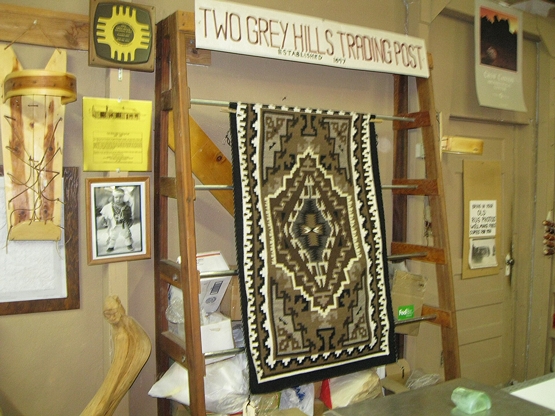
(above: Two Grey Hills Trading Post, Navajo Nation (NM). Photo: MPSharwood. Public domain, via Wikimedia Commons**)
The Chinle Vegetal Revival
In the 1930s, a movement known as the "Chinle Vegetal Revival" sought to undo the perceived aesthetic damage of the aniline-dyed era. Encouraged by reformers and traders like Leon "Cozy" McSparron, weavers began experimenting with native plants -- such as rabbitbrush for yellow and wild walnut for brown -- to create rugs in soft, earth-toned bands. This movement appealed to a new class of collectors who valued "authenticity" and naturalism over the bold graphics of the 19th century.
Contemporary Innovation and Pictorials
Modern Navajo weaving continues to adapt. Pictorial rugs, which became popular in the late 19th century, now depict everything from traditional farm scenes to Wrigley's gum wrappers and Texaco signs, reflecting the lived experience of the Diné in a globalized world. Specialized styles such as "Raised Outline" and "Two-Faced" weaving demonstrate a level of technical complexity that far exceeds the utilitarian requirements of the past.
The evolution of Navajo ceremonial and regional rugs is not a story of cultural loss, but one of strategic adaptation. The "influence" of traders and collectors was indeed profound -- shaping the materials (Germantown yarn, aniline dyes), the designs (Oriental motifs, Ganado Red), and the physical scale of the work. However, the Navajo weaver remained the primary agent of this transformation. By weaving their spiritual narratives into commercial objects, and by negotiating the taboos of the sacred through technical innovation, the Diné have ensured that their weaving tradition remains a living, breathing archive of their history.
The Navajo rug is a structural marvel where the "warp" of ancient tradition and the "weft" of colonial influence have been beaten together into a single, cohesive fabric. Whether in the massive sandpainting tapestries of Hosteen Klah or the fine-spun geometrics of contemporary masters, the Navajo rug continues to embody hózhó -- maintaining balance and beauty in a world of constant change.
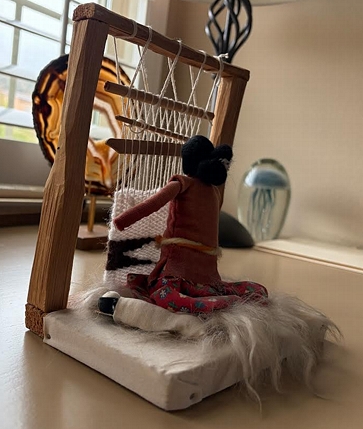
(above: Miniature Navajo Loom,
c. 1960-1970, 8 h x 7 w x 5 d inches, wood, cloth, fur, "Hubbell Trading
Post" sticker on bottom of loom. Private Collection)
We lightly edited this report, added images and provided
links to other materials to enhance it. AI is rapidly improving in
accuracy, however, the report may contain inaccurate information.
This presentation doesn't meet scholarly standards, yet
Gemini 3 AI researched and checked it for accuracy. Sources are footnoted
in the raw AI report, yet deleted here for a general audience. Please
see An Evaluation Of Gemini 3 Deep Research In
Replication Of Academic Peer Review, an April, 2026 Gemini 3 Deep Research
Report.
Prompt:
Research Plan:
(1) Research the traditional origins and ceremonial purpose of Navajo sandpaintings (Diné drypaintings) within the context of healing rituals and the 'Way' ceremonies using .edu and .org resources. (2) Investigate the historical transition in the late 19th and early 20th centuries from ephemeral ritual art to permanent commercial objects, specifically looking for the roles of early trading posts. (3) Identify influential traders and collectors who encouraged the preservation of sandpaintings on boards and analyze their specific requests regarding aesthetics and themes. (4) Examine the evolution of materials used in sandpaintings, comparing traditional crushed minerals and rocks to the introduction of commercial glues, plywood, and synthetic pigments for the tourist market. (5) Analyze how the physical sizing of sandpaintings changed from large-scale floor compositions to smaller, portable formats tailored for home decor and gallery sales. (6) Research the impact of direct buyers and the art market on design choices, including the secularization of sacred imagery and the intentional modification of traditional motifs to respect cultural taboos. (7) Explore changes in production methods and demographics, such as the shift from communal ritual creation by medicine men to individual artistic production for commercial gain. (8) Find specific case studies or historical accounts of Navajo artists who pioneered commercial sandpainting to understand the personal narratives behind this cultural and economic shift.
 Return to Arizona Art History
Return to Textiles
Return to Native American Art
*Tag for expired US copyright of object image:

TFAO Museum of American Art is proudly sponsored by Traditional Fine Arts Organization, Inc., an Arizona nonprofit corporation. All rights reserved. © 2024
Links to sources of information outside of this website are provided only as referrals for your further consideration. Please use due diligence in judging the quality of information contained in these and all other web sites. Information from linked sources may be inaccurate or out of date. TFAO neither recommends or endorses these referenced organizations. Although TFAO includes links to other web sites, it takes no responsibility for the content or information contained on those other sites, nor exerts any editorial or other control over them. For more information on evaluating web pages see TFAO's General Resources section in Online Resources for Collectors and Students of Art History.
 Search Resource Library
Copyright 2026 Traditional Fine Arts Organization, Inc., an Arizona nonprofit corporation. All rights reserved.