
Pomo Basketry: 1850-1950
a Gemini 3.1 Pro Deep Research Report
The period between 1850 and 1950 represents a transformative arc for the Pomo-speaking peoples of Northern California , during which their basketry transitioned from a foundational survival technology to a globally recognized fine art. This evolution was not merely an aesthetic shift but a complex response to the pressures of settler colonialism, environmental degradation, and the emergence of a speculative art market. The Pomo, a group of approximately seventy-two autonomous communities or "tribelets" speaking seven distinct but related languages, occupied a diverse landscape spanning Mendocino, Sonoma, and Lake Counties. Their homelands, characterized by the riparian corridors of the Russian, Garcia, and Navarro Rivers and the lacustrine environment of Clear Lake, provided the raw materials and the spiritual inspiration for what many ethnographers consider the most complex basketry tradition in the world.
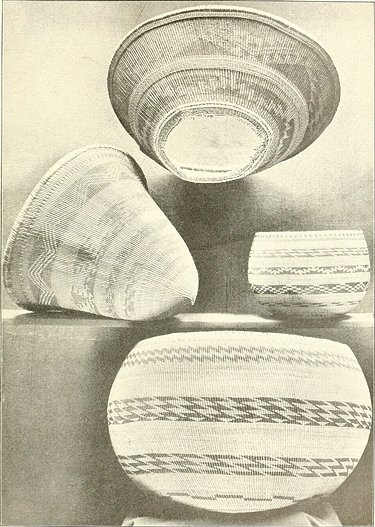
(above: Pomo People, Milling Mason. Plate 97.
Text Appearing After Image:Baskets, Annual report of the Board of
Regents of the Smithsonian Institution, 1902. Text Appearing Before Image:
Report of U. S. National Museum, 1902. - PoMo Milling Baskets. Collection
of c. p. wilcomb. see page 350. Public domain, via Wikimedia Commons**)
Before the mid-nineteenth century, baskets were the primary vessels of life for the Pomo. They served as cradles for infants, traps for fish and birds, storage for acorns, and vessels for cooking via stone boiling. The natural fertility of these lands was not accidental but was the result of astute indigenous environmental management, including cultural burning, pruning, and the intentional cultivation of sedge beds. This deep connection between the weaver and the landscape meant that the evolution of the craft was intrinsically tied to the weaver's ability to access and manage ancestral gathering sites.
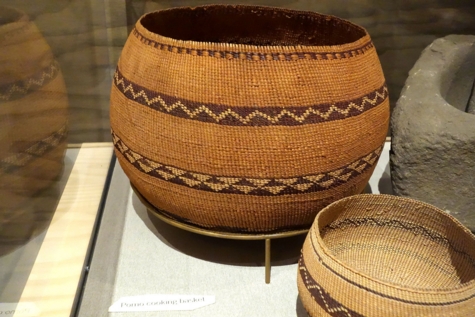
(above: Pomo People, Cooking Basket,
Oakland Museum of California. Photo by Daderot. Public domain, via
Wikimedia Commons**)
Historical Disruptions and the Shift to Commodity Art (1850-1880)
The onset of the California Gold Rush in 1848 and the subsequent influx of white settlers brought catastrophic change to Pomo communities. As settlers claimed fertile valleys and riparian zones for agriculture and mining, the Pomo's access to traditional basketry materials like sedge and willow became severely restricted.
During this era of trauma, basketry began to evolve from purely utilitarian objects into symbols of cultural persistence. By the 1870s, as traditional hunting and gathering became increasingly untenable due to fenced boundaries, Pomo women recognized that their weaving held cash value in the burgeoning settler economy. This realization catalyzed a shift toward "fancy baskets" -- elaborately decorated pieces specifically designed for sale to non-Native collectors. This transition was facilitated by the high technical standards already present in Pomo culture, where even a simple burden basket or seed sifter was crafted with geometric precision and structural integrity.
Comparison of Regional Basketry Traditions
To understand the uniqueness of Pomo basketry during this transition, it is necessary to contrast it with the traditions of neighboring tribes. While California is noted for diverse basketry, the Pomo repertoire was uniquely exhaustive in its technical range.
Unlike Northwestern California tribes like the Yurok and Karuk, who almost exclusively used twining techniques, the Pomo mastered both coiling and twining. Pomo weavers employed eight distinct twining strategies, including the "tee" or lattice-twining method, which utilized a third horizontal element to provide unparalleled structural rigidity for large storage baskets. This technical diversity allowed Pomo weavers to produce a wider variety of shapes and textures than any other group in North America.
Technical Mastery: Twining, Coiling, and Decoration
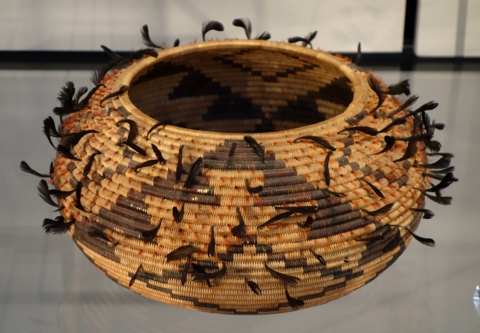
(above: Pomo People, Northwestern California, Basket, c. 1900, willow, sedge, bulrush roots, glass beads, quail feathers, Chazen Museum of ArtP Photo by Daderot. Public domain, via Wikimedia Commons**)
The technical evolution of Pomo basketry between 1850 and 1950 is best illustrated by the refinement of their coiling methods. Coiled baskets were created by wrapping fibers around a horizontal foundation of one or three willow rods. One-rod coiling produced smooth-walled, delicate vessels, while three-rod coiling created a more robust foundation that was ideal for the incorporation of bird feathers.
The incorporation of feathers is perhaps the most famous hallmark of Pomo artistry. While other tribes like the Wappo or Coast Miwok made feathered baskets, none reached the level of total surface encrustation achieved by the Pomo. These "jewel baskets" featured the vibrant plumage of various birds: red from the acorn woodpecker, green from the mallard duck, yellow from the meadowlark, and black from the quail topknot. Every feather was meticulously woven into the stitch, requiring the weaver to clip and align them with extreme precision to create a shimmering, iridescent surface.
Decorative elements also included clam shell disc beads and abalone pendants, which were often used to edge the baskets or dangle from the sides as "fancy" accents. These materials were traditionally symbols of wealth and status within Pomo society, used in ritualized gift exchanges during marriages or funerals. As the market for these items expanded, weavers adapted these traditional signifiers of value to appeal to the "aesthetic" and "exotic" tastes of Euro-American collectors.
Era of "Basket Fever" and the Collector Market (1890-1920)
The turn of the twentieth century saw the peak of "basket fever," a period of intense speculative interest in Native American arts. Wealthy collectors and museums sought to amass large collections of "authentic" baskets before the perceived "vanishing" of Native cultures. This era empowered individual weavers to achieve celebrity status while simultaneously binding them to the tastes of an outside market.
Prominent collectors like John and Grace Hudson in Ukiah, and Henry Deisher in Pennsylvania, were instrumental in this process. The Hudsons collected over 320 Pomo baskets, using their ethnographic interest to promote the weavers while also documenting the technical nuances of the craft. Henry Deisher, a textile manufacturer, purchased over 400 baskets through various vendors, ensuring that the names of individual weavers were preserved -- a rarity in early ethnographic collections.
Dealer Grace Nicholson of Pasadena played a particularly significant role as a "taste-maker." She established long-term business relationships with weavers, maintaining detailed diaries, photographs, and correspondence that cataloged the life and work of her "artists". Nicholson's efforts helped elevate Pomo basketry from the category of "curio" to that of "fine art," a distinction that commanded higher prices and prestigious museum placements.
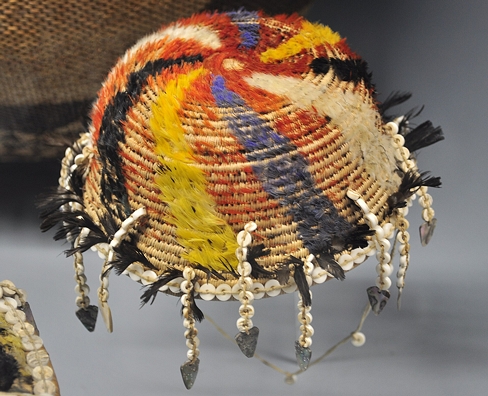
(above: Pomo People, Northwestern California, Basket, c. 1900, willow, sedge, bulrush roots, glass beads, quail feathers, Chazen Museum of ArtP Photo by Daderot. Public domain, via Wikimedia Commons**)
Leading Weavers and the Individualization of the Craft
The recognition of individual weavers was a pivotal development in the evolution of Pomo basketry. Prior to 1890, most baskets were collected anonymously. However, the artistry of certain individuals was so profound that they became internationally recognized.
Ethnobotany and the Materiality of Resistance
The preparation of materials was as critical as the weaving itself. Pomo weavers maintained that one could not call themselves a weaver until they had mastered the art of root collection. The primary sewing element was the root of the sedge plant (Carex mendocinoensis), which required digging in specific riparian environments to obtain long, straight fibers. This process was essentially a form of cultivation; by digging and aerating the soil, weavers encouraged the health and growth of the plant population.
However, the period of 1850-1950 saw increasing difficulty in accessing these materials. The encroachment of private property meant that weavers often had to trespass or negotiate with white landowners to reach their traditional sedge beds. The story of Elsie Allen (1899-1990) is particularly emblematic of this struggle; she recalled being chased off a gathering site by a shotgun-wielding property owner, an event so traumatizing it nearly caused her to abandon the craft. This environmental restriction forced a shift in the evolution of the basket: when traditional materials were unavailable, weavers had to travel further or rely on existing stores of materials, leading to a focus on smaller, less material-intensive works like the miniature.
Traditional management techniques also faced suppression. Cultural burning, used for centuries to encourage the growth of straight willow shoots and redbud stems free of insects and moss, was largely outlawed by settler authorities. This lack of access to fire-managed stems directly impacted the quality of the "warp" or structural rods of the baskets, forcing weavers to spend more time preparing and cleaning inferior materials.
The Great Depression and Market Decline (1930-1950)
The economic collapse of the late 1920s and the subsequent Great Depression had a profound impact on Pomo basketry. As collectors lost their wealth, the vigorous trade in "fancy" baskets dwindled. Many weavers were forced to return to domestic labor or agricultural work to survive, as basketry could no longer provide a primary income. This period also saw the peak of assimilationist policies, where boarding schools discouraged younger generations from learning Native traditions.
Despite these setbacks, the 1930s and 40s were a time of quiet resilience. Weavers continued to produce baskets for internal community use and for a smaller, more dedicated group of collectors. The Michael Harrison collection, for instance, notes purchases of feathered baskets from weavers like Lydia Fought and Carrie Davis as late as 1941. These mid-century baskets remained technically superb. Harrison documented a "fully feathered" basket by Lydia Fought measuring 4.5 inches in diameter that utilized green mallard duck and yellow meadowlark feathers on a 3-stick coiled foundation.
Enduring Legacy of the Pomo Stitch
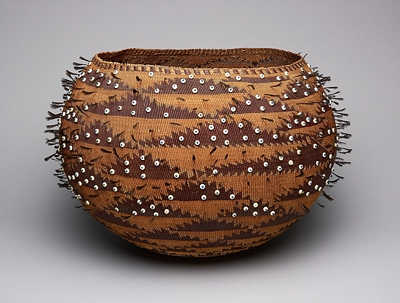
(above: Pomo People, Wedding Basket, c. 1890-1900, plant fibers, feathers, and glass and clamshell beads, 17 ? 25 ? 25 inches, Art Institute of Chicago, Mrs. Leonard S. Florsheim Jr. Fund; African and Amerindian Art Purchase Fund, 2000.323. Public domain, via Wikimedia Commons**)
By 1950, Pomo basketry had survived a century of near-total upheaval. It had moved from the utilitarian sphere into the global art market and finally into the realm of cultural heritage and education. The evolution was characterized by an increasing individualization of the weaver, a technical expansion into miniature and highly decorated forms, and a persistent struggle for environmental access.
The Pomo basket remains the most technically complex in North America because of this century-long resilience. The ability to maintain eight twining types and two coiling methods -- while under the duress of displacement and poverty -- is a testament to the Weaver's role as both artist and cultural steward. The names of the Bensons, Mary Posh, Joseppa Dick, and Elsie Allen stand not just as masters of a craft, but as leaders who wove the survival of their people into every stitch. As the Pomo continued to care for the plants and the land that provided their materials, the basket became more than a vessel; it became the very essence of Pomo identity, a shimmering repository of a history that refused to be forgotten.
We lightly edited this report, added images and provided links to other materials to enhance it. AI is rapidly improving in accuracy, however, the report may contain inaccurate information. This presentation doesn't meet scholarly standards, yet Gemini 3 AI researched and checked it for accuracy. Sources are footnoted in the raw AI report, yet deleted here for a general audience. Please see Art History Reports Using Gemini 3.1 Pro Deep Research, an April 2006 Gemini 3 Pro Deep Research Report and An Evaluation Of Gemini 3 Deep Research In Replication Of Academic Peer Review, an April, 2026 Gemini 3 Pro Deep Research Report.
Sources:
We lightly edited this report, added images and provided
links to other materials to enhance it. AI is rapidly improving in
accuracy, however, the report may contain inaccurate information.
This presentation doesn't meet scholarly standards, yet
Gemini 3 AI researched and checked it for accuracy. Sources are footnoted
in the raw AI report, yet deleted here for a general audience. Please
see An Evaluation Of Gemini 3 Deep Research In
Replication Of Academic Peer Review, an April, 2026 Gemini 3 Deep Research
Report.
Prompt:
Research Plan:
(1) Research the historical context of Pomo basketry from 1850 to 1950 using .edu and .org domains, focusing on the shift from utilitarian use to the commercial art market during the California Basket Craze. (2) Investigate the technical distinctions of Pomo basketry, specifically looking for information on their unique use of both twining and coiling methods, and the application of feathers and shells, contrasting these with the styles of neighboring California tribes. (3) Identify key materials used by Pomo weavers such as willow, sedge root, and bulrush, and how their preparation and usage evolved as land access changed during the 1850-1950 period. (4) Profile prominent Pomo weavers active between 1890 and 1950, specifically researching the lives and works of Mary Benson, William Benson, Joseppa Dick, and Mary Posh. (5) Analyze the significance of the Benson family in bridging the gap between traditional Pomo culture and the Western art world, and how their collaborations with ethnographers influenced the documentation of the craft. (6) Examine the role of early 20th-century collectors and anthropologists, such as J.W. Hudson and Grace Nicholson, in shaping the demand and stylistic evolution of Pomo baskets on .org and .edu museum sites. (7) Explore the latter part of the era (1930s-1950s), focusing on how weavers like Elsie Allen worked to sustain the tradition through periods of cultural assimilation and limited resources. (8) Synthesize anecdotes and descriptive details regarding the social and ceremonial importance of baskets in Pomo life to provide depth for an informal narrative spanning a century of change.
 Return to California Art History
Return to Basketry
Return to Native American Art
Return to Topics in American Representational
Art
*Tag for expired US copyright of object image:

and
**Tag for some rights reserved:

TFAO Museum of American Art is proudly sponsored by Traditional Fine Arts Organization, Inc., an Arizona nonprofit corporation. All rights reserved. © 2024
Links to sources of information outside of this website are provided only as referrals for your further consideration. Please use due diligence in judging the quality of information contained in these and all other web sites. Information from linked sources may be inaccurate or out of date. TFAO neither recommends or endorses these referenced organizations. Although TFAO includes links to other web sites, it takes no responsibility for the content or information contained on those other sites, nor exerts any editorial or other control over them. For more information on evaluating web pages see TFAO's General Resources section in Online Resources for Collectors and Students of Art History.
 Search Resource Library
Copyright 2026 Traditional Fine Arts Organization, Inc., an Arizona nonprofit corporation. All rights reserved.