
Native American Basketry: A Regional Analysis of Form, Material, and Cultural Significance
a Gemini 3.1 Pro Deep Research Report
The development of basketry among Native Americans represents a profound intersection of botanical science, mathematical precision, and spiritual cosmology. For millennia, these woven vessels served as the primary technological framework for survival, facilitating the gathering, processing, storage, and preparation of food resources in diverse environments. As historical events and European contact forever altered traditional lifestyles, the function of these objects transitioned from utilitarian necessity to highly valued works of art, a shift driven by both internal cultural resilience and external market demands. This report provides an examination of the tribes' most renowned for their basketry, analyzing the technical idiosyncrasies, material dependencies, and symbolic lexicons that define their respective traditions.
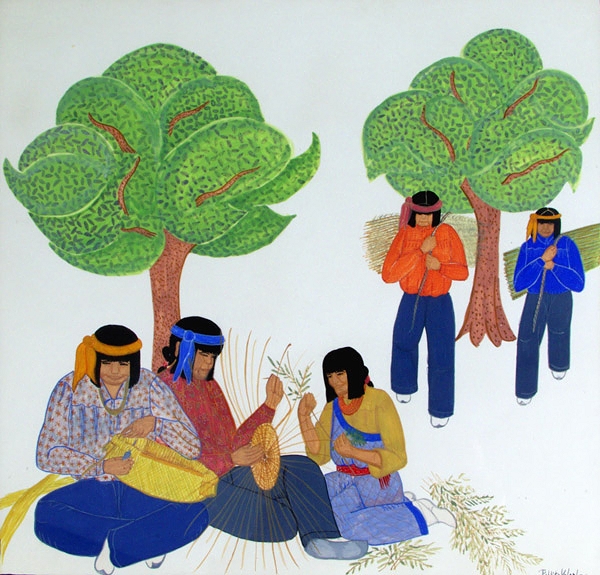
(above: Pablita Velarde, Basketmaking, c. 1940. Source: National Park Service)
Pacific Northwest and California Tribes
The Northwest Coast, extending from southeastern Alaska through British Columbia to the Columbia River, is a region defined by its temperate rainforests and proximity to the Pacific Ocean. The Tlingit and Haida tribes are the preeminent basket makers of this area, utilizing Sitka spruce roots and Western red cedar bark to create vessels that are as durable as they are aesthetically striking.
The differentiation between Tlingit and Haida basketry lies in the technical orientation of the weave and the method of decoration. Tlingit weavers traditionally work in an upright position, resulting in a "jog down" at the termination point of each row -- where the row on the left is higher than the row on the right. In contrast, Haida weavers work in an inverted position, which creates a "jog up".
Decoration techniques also vary significantly. The Tlingit are famous for "false embroidery," where dyed grasses or maidenhair fern are wrapped around the horizontal weft as it is woven, making the pattern visible only on the exterior. This technique allows for Technicolor geometric forms and realistic portrayals of animals like whales and eagles. Haida weavers typically rely on structural decoration, dyeing the spruce root wefts themselves or using "skip-stitches" (twill twining) to create raised geometric designs along the rim.
These baskets often function as crests, proclaiming the identity and history of the weaver's clan. The "Mother Basket" (Kuhk-claw) of the Chilkat Tlingit, measuring nearly three feet in height, attained the status of a ceremonial crest through its repeated use in potlatches to hold massive quantities of food. Similarly, basketry rings on crest hats, known as sgil (wealth spirit) in the Haida language, symbolize the high status of the wearer and the number of potlatches they have hosted.
The Pomo peoples of Northern California are among the most celebrated basket makers in North America, recognized for an unparalleled range of techniques and the exquisite beauty of their "fancy baskets". Pomo basketry is characterized by the adept use of both coiling and twining, often employing multiple variations of these techniques within a single vessel. The older tradition of twining was utilized for both staple utilitarian objects, such as conical burden baskets for harvesting acorns, and highly decorative pieces. Pomo weavers mastered plain, diagonal, three-strand, and lattice twining, using willow or hazel for the warp and sedge rhizome or baked pine root for the light-colored weft.
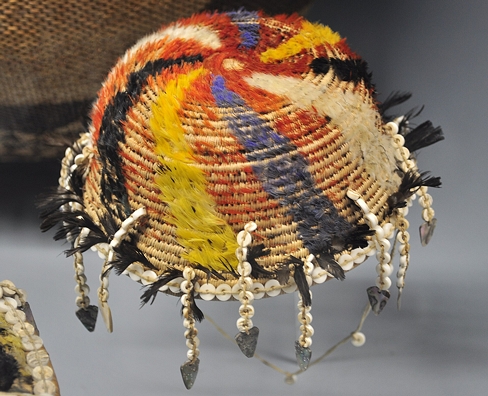
(above: Pomo People, Northwestern California, Basket, c. 1900, willow, sedge, bulrush roots, glass beads, quail feathers, Chazen Museum of ArtP Photo by Daderot. Public domain, via Wikimedia Commons**)
One of the most profound elements of Pomo basketry is the incorporation of bird feathers and shell beads."Jewel" or "gift" baskets were often fully feathered, with the iridescent plumage of the mallard duck, the vivid red of the woodpecker, and the yellow of the meadowlark inserted between stitches of sedge root. These baskets were not merely decorative; they were living entities guided by spirits through the dreams of the weavers. The "Dau," or spirit door, is a deliberate break in the pattern's continuity, serving as a portal for spirits to enter or exit the basket, reflecting the deep philosophical integration of the weaver's spiritual life with the physical object.
The legacy of Pomo basketry is inextricably linked to the figure of Mabel McKay (1907-1993) , a renowned weaver and "dream doctor" who wove her first basket at age eight. McKay was guided by the Spirit through dreams, which instructed her in the creation of baskets used for healing and ritual. She did not sell her baskets as commodities; instead, she produced them as gifts and spiritual conduits. Her work, noted for its tight stitches and perfect spacing, is now preserved in the Smithsonian Institution and other major museums, serving as a link between ancestral knowledge and contemporary cultural sovereignty.
The Washoe people, primarily associated with the Lake Tahoe region and western Nevada, are famously represented by the legacy of Louisa Keyser, known as Dat So La Lee (c. 1829-1925) . She is credited with innovating the "degikup" form -- a spherical, incurving basket with a small base and a small opening -- which became the quintessential symbol of high-art basketry. Dat So La Lee's work was characterized by an extraordinary stitch density, often exceeding thirty stitches per inch, and the introduction of redbud into Washoe coiled basketry, which traditionally utilized only the black of the bracken fern against a willow background.
The commercial success of Washoe basketry was heavily influenced by the patronage of Abe and Amy Cohn, who documented every basket produced by Dat So La Lee from 1895 until her death, providing her with room and board in exchange for her work. This highlights a critical theme in Native American basketry history: the evolution of traditional forms in response to external economic pressures and the creation of a "fine art" market. Although this market was sometimes based on fabricated narratives -- such as Amy Cohn's manufactured names for baskets like "The Chief's Compact" -- it ensured the craft's survival and elevation.
Southwest Tribes
Apache basketry is renowned for its durability and iconic shapes, most notably the burden basket and the "olla," a vase-shaped storage jar. Historically, the Western Apache, Jicarilla, and Mescalero bands produced baskets that reflected their migratory lifestyles. Western Apache baskets are typically coiled on a three-rod foundation, often featuring intricate pictorial designs of humans, animals, and lightning symbols rendered in the black seed pod of the devil's claw. The Jicarilla Apache favored a five-rod foundation of sumac, producing sturdier, thicker-coiled vessels decorated with bright aniline dyes.
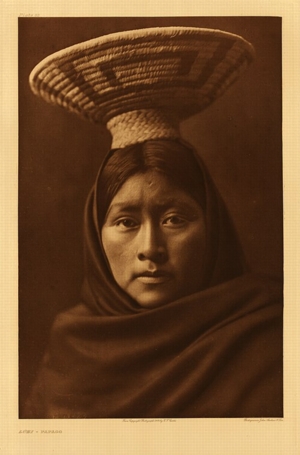
(above: Edward S. Curtis, Luzi - Papago (The North American Indian; v.02, c. 1907, photogravure, brown ink, 45 x 30 cm. Description by Edward S. Curtis: "The Papago women always carry their burdens on, or supported from, their heads. When the burden - be it a basket, pottery, or a box - has a flat or a rounded bottom, the ring of the woven yucca is placed on the head in order to give the load a firm position for carrying, and to relieve the bearer of pressure." Public domain, via Wikimedia Commons*)
The Akimel O'odham (Pima) and Tohono O'odham (Papago) are desert dwellers whose basketry traditions have shifted in response to environmental changes. Historically, the Akimel O'odham utilized willow and cattail from riverbanks to create watertight vessels. As river systems like the Santa Cruz ceased to flow, weavers transitioned to using yucca and beargrass, materials more readily available in the arid landscape. The "Man in the Maze" design, or Se:he'e Ki, is a signature motif of the O'odham, representing the journey of life and the attainment of one's dreams through the guidance of the Sun God.
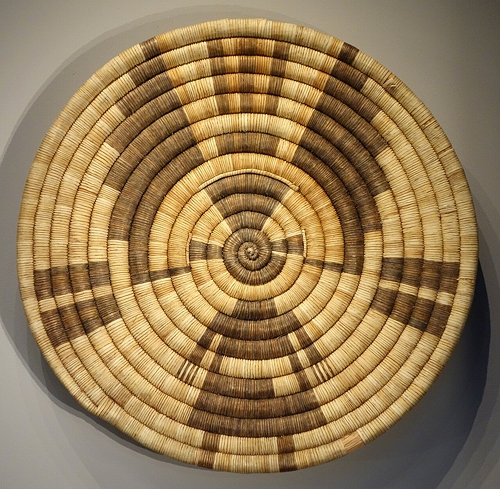
(above: Meal Tray, Hopi People, Arizona, n.d., coiled yucca and grass, Chazen Museum of Art. Public domain, via Wikimedia Commons*)
A unique development within Tohono O'odham basketry is the introduction of horsehair. These extremely fine and intricate baskets, often ranging from the size of a coin to a small bowl, demonstrate the adaptability of weavers to new materials introduced after European contact. Contemporary weavers like Joseph Lopez have expanded the craft to include woven figures, breaking traditional gender roles while maintaining the spiritual essence of the art.
Hopi basketry is characterized by geographical specialization across the three mesas. Weavers on the Second Mesa are known for coiled baskets using galleta grass and yucca, while those on the Third Mesa produce wicker plaques from rabbit brush and sumac. These items remain central to Hopi ceremonial life, including the use of wicker wedding plaques and baskets depicting katsina imagery.
The Navajo (Diné) are perhaps most famous for their "wedding baskets," which feature a standardized design of red bands and a central star that opens to the east. Interestingly, due to cultural taboos regarding the production of ceremonial items, Navajo weavers historically procured many of these baskets from the San Juan Paiute, a tribe with whom they share deep cultural and geographic ties.
Midwest and Southern Tribes
The Midwest and Southern States are home to the Cherokee, Choctaw,and Chitimacha tribes. Both the Cherokee are masters of the "double weave," a technique that produces a two-walled basket, effectively one basket inside another. This method provides exceptional strength and durability, as the weaver begins at the base of the inside basket, works upward to the rim, and then bends the cane downward to weave the outside wall from rim to base. For the Cherokee, the double weave was nearly lost before being revitalized by weavers such as Lottie Stamper, who studied a 1720s Cherokee basket in the British Museum to reconstruct the pattern.
Choctaw baskets, or tvpishuk, often feature patterns like the "diamondback rattlesnake," which symbolizes reverence for nature and the environment. Following the Trail of Tears, Choctaw weavers continued their tradition in Oklahoma, where rivercane remained available along local streams. Today, both men and women practice the craft -- a shift from the traditional female-only role -- necessitated by the need to protect ancestral knowledge.
The Chitimacha Tribe of Louisiana holds a unique position in basketry history, having used their craft as a tool for political survival. In the early 1900s, Chitimacha women, led by weaver Christine Paul and medicine woman Delphine Stouff, formed an alliance with the McIlhenny family to market their baskets nationally. This "basket diplomacy" provided critical income during a time of extreme hardship and helped secure federal recognition and the protection of tribal lands by 1916.
Chitimacha http://www.chitimacha.gov/history-culture/chitimacha-baskets basketry is remarkably conservative; the designs used today, such as "alligator entrails," "muscadine rind," and "little trout," are virtually identical to those produced over a century ago. Master weavers from the Darden family continue to serve as stewards of this tradition, ensuring that the split-cane techniques passed down through generations remain a visible expression of Chitimacha identity.
The history of Florida's Seminole and Miccosukee basket weavers is a narrative of persistence. The baskets they produced were -- and are -- more than just containers; they are physical manifestations of the "persistence to exist, the strength of endurance to be faithful to Native intelligence". Florida's weaving tradition's continuity is perhaps best understood through the lens of material science and cultural protocol. The use of beeswax to preserve thread, the specific handedness of the coil, and age-based restrictions on closing a basket lid all indicate a culture that values the process as much as the product. The Florida Native American basket weaver is not a figure of the past, but a contemporary agent of cultural preservation, ensuring that the spirit of the Everglades continues to be held within the golden spirals of their craft. The integration of historic research, museum preservation, and community-led teaching has created a robust framework for this art form's survival well into the 21st century.
Material Science and Botanical Stewardship
The diversity of Native American basketry is a direct reflection of the intimate relationship between the weaver and the local ecosystem. The preparation of materials often takes as long as the weaving itself, involving precise timing for harvest and labor-intensive processing.
Harvest Dynamics and Processing
Plants like willow, sedge, and spruce root must be harvested during specific seasons when the sap is running or the fibers are most pliable. Tlingit and Haida weavers harvest spruce roots in the spring and summer, heating them over coals to remove the bark before splitting them into warps (foundation) and wefts (weaving strands). In California, Pomo weavers might bury bulrush roots in mud mixed with ashes to achieve a deep black color, a process that requires a profound understanding of organic chemistry and material properties.
The physical demands of gathering materials are significant. Tohono O'odham weavers describe the "sturdy hands" required to harvest and clean the coarse leaves of the yucca and the strength needed to "tame" the devil's claw. This connection to the land is a recurring theme among weavers, many of whom have become vocal advocates for sustainable land use and the protection of traditional gathering sites from development and environmental degradation.
Institutional Legacies and the Contemporary Renaissance
The transition of basketry from a utilitarian medium to a collectible art form was accelerated by the expansion of railroad lines in the late 1800s, which brought a flood of tourists and anthropologists to Native communities. Major museum collections, such as the Phoebe A. Hearst Museum's 8,000-basket archive and the Smithsonian's Cole-Ware collection preserve these works not merely as artifacts, but as living records of cultural change.
Contemporary Mastery and the Santa Fe Indian Market
Today, the tradition of basketry is thriving through a new generation of artists who blend ancient techniques with modern sensibilities. The Santa Fe Indian Market (SWAIA) remains the most prestigious venue for recognizing this excellence. Recent winners like Theresa Secord (Penobscot), whose ash wood and sweetgrass baskets utilize her great-grandmother's 1800s forms, demonstrate the enduring power of generational transmission. Other contemporary weavers, such as Linda Yamane (Ohlone), have successfully revived techniques -- like the Ohlone walaheen winnower -- that had not been practiced for nearly 200 years.
The enduring legacy of weavers like Dat So La Lee, Mabel McKay, and the Darden family ensures that these "living" objects continue to bridge the temporal gap between the ancestors and the future. As collectors and institutions increasingly recognize these works as pinnacle achievements in global art history, the preservation of the delicate ecosystems that provide the raw materials for these vessels remains the most critical imperative for the continued survival of the craft. Through the synthesis of ancestral patterns and contemporary ingenuity, Native American basketry remains a vital conduit for cultural storytelling and environmental stewardship.
We lightly edited this report, added images and provided links to other materials to enhance it. AI is rapidly improving in accuracy, however, the report may contain inaccurate information. This presentation doesn't meet scholarly standards, yet Gemini 3 AI researched and checked it for accuracy. Sources are footnoted in the raw AI report, yet deleted here for a general audience. Please see An Evaluation Of Gemini 3 Deep Research In Replication Of Academic Peer Review , an April, 2026 Gemini 3 Deep Research Report.
Prompt:
Research Plan:
 Return to Basketry
Return to Native American Art
Return to Topics in American Representational
Art
*Tag for expired US copyright of object image:

and
**Tag for some rights reserved:

TFAO Museum of American Art is proudly sponsored by Traditional Fine Arts Organization, Inc., an Arizona nonprofit corporation. All rights reserved. © 2024
Links to sources of information outside of this website are provided only as referrals for your further consideration. Please use due diligence in judging the quality of information contained in these and all other web sites. Information from linked sources may be inaccurate or out of date. TFAO neither recommends or endorses these referenced organizations. Although TFAO includes links to other web sites, it takes no responsibility for the content or information contained on those other sites, nor exerts any editorial or other control over them. For more information on evaluating web pages see TFAO's General Resources section in Online Resources for Collectors and Students of Art History.
 Search Resource Library
Copyright 2026 Traditional Fine Arts Organization, Inc., an Arizona nonprofit corporation. All rights reserved.