
Canyon de Chelly's Artistic Legacy
a 2026 article by TFAO and Gemini AI
Tucked away in the northeastern reaches of Arizona, Canyon de Chelly has a unique artistic allure unlike other red rock chasms of the American Southwest. Natural wonders like the Grand Canyon overwhelm the senses with sheer, unfathomable scale and a sense of empty, geological antiquity. Canyon de Chelly offers an intimacy that is intertwined with human history.
The mouth of the canyon is a short distance from the Navajo Nation community of Chinle, which in Navajo means 'flowing out'. This name refers to the place where a stream flows out of the Canyon de Chelly. From that mouth of the canyon, the smooth, crossbedded walls of De Chelly sandstone slowly ascend as one travels deeper into the labyrinthine gorge, eventually soaring one thousand feet near the iconic, needle-like spire of Spider Rock.
Over the course of countless centuries, wind and water have carved intricate, sweeping erosion patterns into the stone, exposing fossilized sand dunes and creating a rich, vibrant palette of fiery reds, deep maroons, and soft pinks that contrast brilliantly against the startlingly blue desert skies and the verdant greens of the cottonwood and tamarisk trees lining the canyon floor.
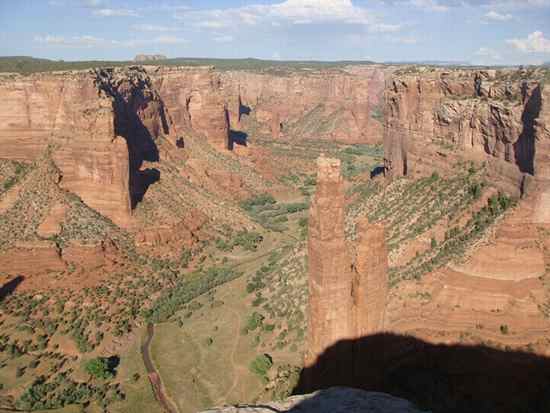
(above: Spider Rock, Canyon de Chelly, in Morning #2, 2011. Photo by John Hazeltine)
Yet, what truly separates Canyon de Chelly from other majestic natural monuments across the nation is its timeline of continuous human occupation, casting a spell on artists who seek to capture the soul of a place rather than just its physical dimensions. For maybe thousands of years, this sheltered enclave has served as a home, making it among the longest continuously inhabited landscapes on the Colorado Plateau. Tucked inside the dark, yawning alcoves of the soaring cliffs are spectacularly preserved masonry villages of the Ancestral Puebloans, such as the famous White House Ruin, Mummy Cave, and Antelope House, which sit silently like ancient sentinels.
The canyon walls are adorned with an ancient gallery of petroglyphs and pictographs, chronicling everything from prehistoric hunts by nomadic gatherers to the arrival of Spanish conquistadors on horseback. Below these ancient dwellings, modern Navajo, or Diné, families continue to farm the sandy washes, raising sheep, riding horses, and tending to summer crops of corn, squash, and peach orchards, just as their ancestors did for generations before them. For the visiting artist, Canyon de Chelly is not an empty wilderness awaiting discovery; it is a profoundly inhabited sanctuary echoing with millennia of memory, offering a canvas where the human spirit is visibly etched into the stone.
For the early artists and photographers seeking to capture this transcendent beauty, simply reaching the canyon was an exhausting odyssey of endurance that tested their resolve. In the late nineteenth and early twentieth centuries, Canyon de Chelly was fiercely isolated and stubbornly unforgiving to outsiders. When the pioneering expedition photographer Timothy O'Sullivan arrived in 1873 to capture his haunting, high-contrast albumen prints of the ancient ruins, he had to haul massive, fragile glass plates, toxic chemicals, and heavy wooden cameras by wagon and horseback through an uncharted wilderness. Early travel meant agonizing days in the saddle, navigating unmapped terrain, enduring intense desert heat, and braving sudden, violent storms. As the new century dawned, the expansion of the Atchison, Topeka & Santa Fe railroad brought waves of adventurous painters and illustrators closer to the region, heavily promoted by railway executives seeking to entice eastern tourists with romanticized visions of the West. The railway deposited these eager creatives at railheads in Gallup, New Mexico, or Santa Fe, but the journey from the bustling train depot to the quiet mouth of the canyon remained a brutal, bone-rattling undertaking.
The introduction of the automobile promised speed and convenience but ultimately delivered its own unique brand of misery for those trying to reach the canyon. The routes stretching from the train depots toward Chinle were little more than deeply rutted dirt tracks, unpredictable sandy washes, and unmarked clay trails that turned into impassable slicks of mud during the seasonal monsoon rains. Artists brave enough to make the drive faced the constant threat of getting hopelessly lost in the sprawling desert or bogged down in the treacherous landscape. Sudden desert downpours could transform dry washes into raging flash floods within a matter of minutes, sending walls of water crashing down the canyons with waves reportedly reaching six feet high, nearly drowning unwary travelers. Even in perfectly dry weather, the sandy riverbeds were perilous. Vehicles easily bogged down in the thick, shifting sand, and the terrifying prospect of quicksand was a very real, ever-present danger; in some areas of the canyon, entire jeeps and wagons were known to be swallowed up right to their rooftops. To navigate the deep, powdery sands of the canyon floor, seasoned locals knew they had to drastically deflate their vehicle's tires, a necessary trick that early touring artists usually had to learn the hard way after spending hours digging their cars out of the wash.
Upon finally surviving the trek and arriving at the mouth of Canyon de Chelly, exhausted artists were met with another significant challenge: a near-total lack of accommodations. In the earliest days of the twentieth century, the tiny trading outpost of Chinle offered absolutely no formal lodging, restaurants, or hospitality for weary travelers. Visiting painters, photographers, and writers were often forced to unroll their bedrolls directly on the wooden counters or the dusty floor of the local trading post, making do with whatever meager provisions were available on the shelves. This stark, uncomfortable reality changed dramatically with the arrival of Leon Hugh McSparron affectionately known as Cozy, and his wife, Inja. Cozy, an accomplished amateur boxer who spoke fluent Navajo and had an innate talent for hospitality, purchased the Chinle trading post in 1919 after returning from military service. Over the next decade, the McSparrons transformed the modest trading post into the Thunderbird Ranch, which would later become known as the Thunderbird Lodge. By constructing charming stone guest rooms and a highly coveted bathhouse, they created the very first, and only, formal lodging facility within the boundaries of what would eventually become the national monument.
Thunderbird Ranch quickly blossomed into a legendary oasis and a vibrant intellectual hub for the era's most prominent creatives. Cozy and Inja were famous for hosting warm, family-style dinners in their living room, which were frequently followed by magical evenings where traditional Navajo singers would cast their voices against the echoing canyon walls, and dancers would perform for the mesmerized tourists. Inside their dining room, Inja set up a traditional loom, complete with spun, vegetal-dyed wool, to educate visiting artists and tourists about the intricate, painstaking art of Navajo weaving. The McSparrons were fierce advocates for the local artisans, actively working with famous weavers to preserve traditional geometric designs and convincing them to return to the use of natural vegetal dyes instead of the harsh commercial dyes that had flooded the market.
For the artistic community, Thunderbird Ranch was an absolute godsend. Cozy would personally load painters, their heavy wooden easels, and bulky camera equipment into his convertible Ford, serving as an expert guide to navigate the treacherous sand dunes of the canyon floor so they could paint en plein air. Recognizing the financial struggles of many traveling creatives, the McSparrons frequently allowed broke artists and photographers to camp on the property, utilizing the bathhouse and joining the family dinners in exchange for a finished painting, a portrait photograph, or a simple favor. Through this remarkable, open-hearted hospitality, the ranch's guestbook became a veritable who's who of Western American art history, filled with the signatures of titans like the renowned photographer Ansel Adams, modernist painter Georgia O'Keeffe, the geometric landscape master Maynard Dixon, Edgar Payne, and the meticulous illustrator William Robinson Leigh.
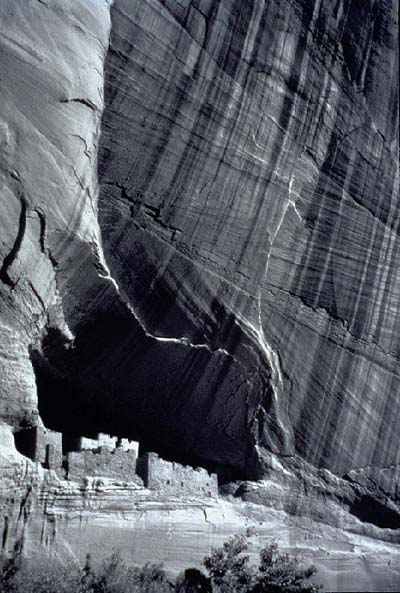
(above: Ansel Adams (1902-1984), White House Ruin, Canyon de Chelly National Monument, Arizona, 1962, gelatin silver print, CORBIS/Ansel Adams Publishing Rights Trust) from our article In Praise of Nature: Ansel Adams and Photographers of the American West (10/24/99)
While these artists were endlessly eager to set up their easels beneath the towering red cliffs, they soon learned that Canyon de Chelly was not a public playground open for unlimited exploitation. Unlike most national parks established during that era, the 1931 authorization of Canyon de Chelly as a National Monument by President Herbert Hoover was forged through a highly unique cooperative agreement that left the landscape entirely as the property of the Navajo Nation. From the very beginning, the Navajo inhabitants established strict, non-negotiable rules regarding who could wander the canyon floor. To protect the privacy and daily lives of the dozens of families living, farming, and raising livestock in the washes, as well as to safeguard the fragile, millennia-old antiquities from looting and vandalism, unguided exploration was strictly prohibited. The only exception was the steep, winding two-and-a-half-mile White House Trail leading from the canyon rim down to the White House Ruin; everywhere else required the mandatory presence of an authorized Navajo guide.
Denying unfettered, casual access to tourists and artists was a deeply necessary measure to protect the sanctity of the land, honor the ancestors who perished there, and maintain the dignity of the living community. Over the years, as the cooperative management agreement with the National Park Service matured, the Navajo slightly relaxed these rigid barriers, allowing for structured, guided tours via customized four-wheel-drive vehicles, horseback riding, and guided hiking. These authorized tours provided a vital economic lifeline for the local community, creating jobs and supporting local vendors, while ensuring that all visitors interacted with the sacred landscape respectfully and under the watchful eye of a Diné guide.
For visual artists specifically, the Navajo established clear, uncompromising boundaries regarding cultural and artistic representation. Seeking to paint or photograph the Diné people, their homes, or their flocks without asking for explicit, prior permission was, and remains, a severe breach of etiquette and respect. Formal permits are legally required for commercial photography, extensive filming, and special artistic use projects within the tribal park locations. Beyond just the legal permits, artists are expected to carefully navigate complex spiritual boundaries. Certain traditional imagery, such as the intricate sand paintings used in specific healing ceremonies, is considered spiritually potent and inherently curative. The production of these images requires exact attention to pictorial and iconographic detail, and reproducing these sacred designs on canvas or film outside of their intended ceremonial context is viewed by many Navajo as highly dangerous, disrespectful, and culturally appropriative. Through these steadfast rules, the Navajo ensured that the generations of artists who came to capture the sweeping beauty of the canyon did so on terms that honored the indigenous worldview and protected the spiritual integrity of the people.
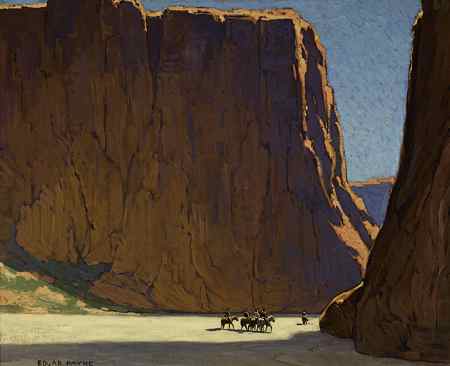
(above:: Edgar Payne, Sunset, Canyon de Chelly, 1916. Oil on canvas, 28 x 34 inches. Mark C. Pigott Collection) from our article Edgar Payne: The Scenic Journey (2/26/12)
Today, more than a century after the first adventurous painters and expedition photographers braved the sandy washes and rutted clay roads, Canyon de Chelly remains a powerful, undeniable magnet for artists from across the globe. In modern times, artists are still compelled to capture its features for the exact same reasons that drew the early masters, but their approaches are now coupled with a newly evolving, nuanced understanding of the landscape's immense cultural weight. For contemporary plein air painters like Amery Bohling, the canyon presents an irresistible technical and emotional challenge. It requires an artist to capture the ephemeral, transcendent quality of the high desert light as it plays across the timeless, monumental rocks, illuminating the fiery reds, deep purples, and brilliant blues of the sandstone walls. The landscape lends itself perfectly to a style described as romantic naturalism, allowing modern artists to portray the infinite, seemingly indifferent scale of the natural world while leaving a subtle undercurrent of human emotion and historical significance. The sweeping panoramic views from the rim, the deep, mysterious shadows of the alcoves, and the soaring arcs of the canyon walls offer a visual drama that simply cannot be replicated anywhere else in the nation.
Ultimately, the rich artistic history of Canyon de Chelly is a profound testament to the power of place. From the early photographers lugging fragile glass plates on horseback, to the mid-century modernists seeking creative refuge at Cozy McSparron's Thunderbird Ranch, to today's contemporary visionaries redefining the American landscape, the canyon has never been just a passive subject waiting to be painted. With its soaring sandstone walls, its ancient, whispering cliff dwellings, and the protective, guiding hand of the Navajo people, Canyon de Chelly remains an active, demanding collaborator in the creative process -- a landscape that insists on being seen, respected, and remembered on its own terms.
Prompt:
We lightly edited this text and provided links to other materials to enhance it. AI is rapidly improving in accuracy, however, the text may contain inaccurate information. This presentation doesn't meet scholarly standards, yet Gemini AI researched and checked it for accuracy. Sources are footnoted in the raw AI report, yet deleted here for a general audience
Prompt:
 Return to Arizona Art History
Links to sources of information outside of our web site are provided only as referrals for your further consideration. Please use due diligence in judging the quality of information contained in these and all other web sites. Information from linked sources may be inaccurate or out of date. TFAO neither recommends or endorses these referenced organizations. Although TFAO includes links to other web sites, it takes no responsibility for the content or information contained on those other sites, nor exerts any editorial or other control over them. For more information on evaluating web pages see TFAO's General Resources section in Online Resources for Collectors and Students of Art History. Individual pages in this catalogue will be amended as TFAO adds content, corrects errors and reorganizes sections for improved readability. Refreshing or reloading pages enables readers to view the latest updates.
 Search Resource Library for everything about American
art.
Search Resource Library for everything about American
art.
Copyright 2026 Traditional Fine Arts Organization, Inc., an Arizona nonprofit corporation. All rights reserved.