
Visualizing The Sublime: Five Artistic Interpretations of Canyon de Chelly
a 2026 article by TFAO and Gemini AI
The American Southwest has long functioned as a crucible for artistic endeavor, offering a landscape where geological majesty intersects with deep cultural history. Among the region's most profound natural cathedrals is Canyon de Chelly, a towering labyrinth of sheer red sandstone cliffs located in northeastern Arizona. For generations, this site has captivated visual artists seeking to translate its overwhelming scale and color intensity into two-dimensional mediums.
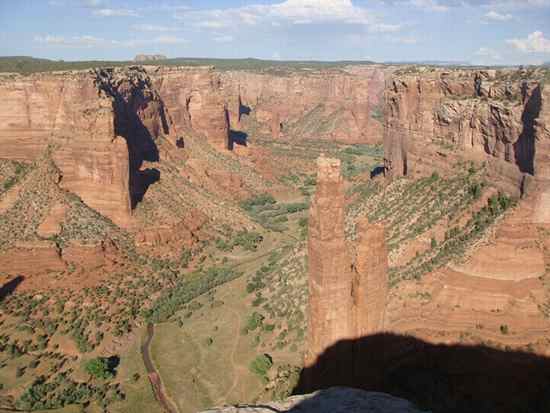
(above: Spider Rock, Canyon de Chelly, in Morning #2, 2011. Photo by John Hazeltine)
By analyzing the works of Ansel Adams, Georgia O'Keeffe, Maynard Dixon, Edgar Payne, and William Robinson Leigh, a complex dialogue emerges regarding how to properly capture the magnitude of the canyon. These five practitioners approached the exact same geography armed with vastly different aesthetic philosophies, ranging from strict photographic documentation and modernist geometric reframing to Impressionist bravura and academic realism. Through their distinct methodologies, they did not merely record a physical location; they actively constructed the visual legacy of the American West, projecting onto its ancient cliff faces their own ideological visions of nature, time, and human resilience.
Ansel Adams, one of the foremost champions of American landscape photography, approached Canyon de Chelly with a reverent awareness of the medium's history and a deep commitment to environmental preservation. His work at the canyon was heavily influenced by Timothy O'Sullivan's 1873 documentation of the same site which Adams famously lauded as one of the most extraordinary photographs ever produced in America. In 1941, Adams embarked on a monumental project commissioned by the National Park Service to create a photo mural for the Department of the Interior Building in Washington, D.C.. This mural was specifically designed to exemplify the pristine nature protected within the United States national parks. Although the full mural project was halted by the onset of World War II and never resumed, the resulting images remain iconic artifacts of American environmental photography. One such image is the gelatin silver print Canyon de Chelly National Monument, Arizona (1942) which can be viewed online in the collection of The Museum of Modern Art. A second essential piece from this era is White House Ruin, Morning, Canyon de Chelly National Monument, Arizona (1949, printed 1950), also held by MoMA.
The online commentary surrounding Adams's pieces highlights his immaculate technical quality and his profound ability to capture the monumental scale of the towering sandstone walls, especially as they dwarf the ancient ruins nestled at their base. Critics frequently note how Adams utilized the stark black-and-white contrast of the photographic medium to make the layers of sedimentary rock far more dramatic than they would appear to the naked eye. The artistic merit of these photographs lies in their tonal perfection, leveraging deep shadows and brilliant highlights to convey the sublime immensity of the natural world. By deliberately returning to the exact locations and times of day that O'Sullivan utilized decades earlier, Adams was not simply mimicking his predecessor; he was establishing a temporal baseline of the American wilderness to demonstrate its enduring majesty. These photographs fit seamlessly into Adams's broader body of work, echoing the dramatic lighting and immense depth of field seen in his Yosemite masterpieces. Ultimately, his Canyon de Chelly images reinforce his lifelong crusade to use the camera not just as a recording device, but as a persuasive tool for environmental advocacy and wilderness preservation.
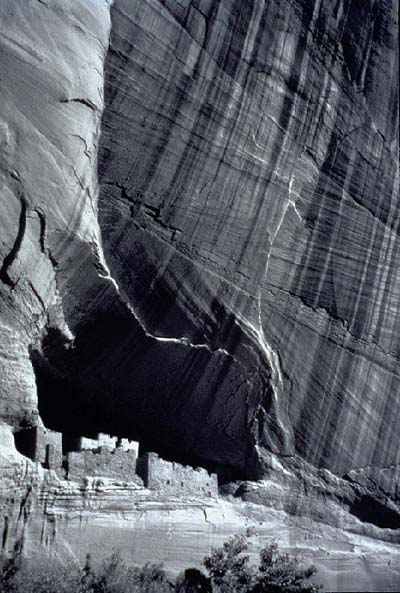
(above: Ansel Adams (1902-1984), White House Ruin, Canyon de Chelly National Monument, Arizona, 1962, gelatin silver print, CORBIS/Ansel Adams Publishing Rights Trust) from our article In Praise of Nature: Ansel Adams and Photographers of the American West (10/24/99)
While Ansel Adams utilized photography to capture the objective, majestic grandeur of the canyon, Georgia O'Keeffe employed the camera to dissect and reassemble the landscape's underlying formal geometry. Although primarily celebrated worldwide for her modernist paintings, O'Keeffe's photographic endeavors reveal the rigorous cognitive processes that informed her abstract canvases. In July 1957, she traveled to Canyon de Chelly and produced a fascinating series of images from the canyon's rim. One notable photograph from this excursion is White House Overlook (1957), accessible through the Georgia O'Keeffe Museum's digital archives. Another striking image from the same vantage point is Spider Rock (1957), also available in the museum's online collection.
Online commentary from the museum networks notes that O'Keeffe captured a sweeping, horizontal vista through a sequence of three vertical photographs, moving the viewer's eye from a starburst crag across the winding canyon floor to the towering spire of Spider Rock. The artistic merit of these photographs is found in their highly experimental reframing of space. By intentionally constraining a vast horizontal panorama into narrow vertical slices, O'Keeffe compressed three-dimensional depth into flattened planes of form. The commentary suggests that this choice to test the limitation of a single film frame allowed her to reorganize shapes within the picture, exploring the visual ambiguity between two and three dimensions. This photographic technique directly mirrors her approach to painting, wherein she sought to organize natural environments into what she called "singing shapes," emphasizing the relational dynamics of forms over strict, objective realism. These canyon photographs are integral to understanding her broader oeuvre, proving that her method of intuitive abstraction -- identifying the geometry hidden within organic geology -- was a consistent visual philosophy applied equally across both painting and photography.
Maynard Dixon offered yet another distinct visual paradigm, moving away from the romanticized realism of his early commercial illustration career toward a bold, modernist interpretation of the West. Dixon was captivated by the stark realities of the desert and its indigenous inhabitants, famously believing that the raw beauty of Canyon de Chelly surpassed even that of Zion National Park, leading him to paint over forty canvases in the canyon region. An example of his work in this locale is the painting Navajo Women in the Canyon de Chelly, Arizona (1944).
Critical commentary on Dixon's work emphasizes his conscious departure from the purely illustrative "pictorial horse opera" aesthetics favored by many of his peers. Instead, he embraced a simplified, almost cubist approach, systematically minimalizing extraneous details and exaggerating strong, structural lines to convey a sense of primitive purity and simplicity. The artistic merit of Dixon's Canyon de Chelly works lies precisely in this elemental stylization. By reducing the figures of Native Americans and the surrounding cliffs to massive, unyielding geometric forms, Dixon drew a direct, ideological parallel between the endurance of the Navajo people and the profound permanence of the earth itself. This structural severity fits perfectly within his later, broader portfolio, which increasingly prioritized the emotional intensity of space, sky, and human resilience over picturesque sentimentality. As the online commentary highlights, Dixon's goal was never just to record the landscape, but to use his canvases as a testimony to life, capturing the grandeur and monumentality of the region in a way that resonated on a deeply human level.
In sharp contrast to Dixon's geometric modernism, Edgar Payne brought the vibrating energy and broken brushwork of plein-air Impressionism directly to the canyon's sheer walls. Payne, a largely self-taught artist who became a foundational figure in the California Impressionist movement, was first commissioned by the Atchison, Topeka and Santa Fe Railroad in 1916 to paint the American Southwest as a means to promote railway tourism. During this pivotal year, he spent four months living and painting among the red rock formations of Canyon de Chelly, securing his legacy as a premier landscape artist. A striking example of this period is Sunset, Canyon de Chelly (1916). Additionally, a closely related oil painting simply titled Canyon de Chelly (1916-1919) is detailed in the online collections blog of the Bowers Museum.
Synthesis of online commentary underscores Payne's highly unique application of Impressionist techniques. Whereas his contemporaries often utilized broken color to render idyllic, peaceful coastal scenes or tranquil gardens, Payne aggressively applied these methods to subjects of monumental, rugged beauty. The Bowers Museum commentary specifically notes the detailed precision of his canyon paintings, where riders coolly navigate the immense, imperious rock faces that entirely dwarf human presence. The artistic merit of Payne's work resides in his ability to translate the blinding light and oppressive heat of the desert into dynamic, pulsating brushstrokes, effectively transforming static sandstone rock into a vibrating, atmospheric force. These paintings fit perfectly into Payne's lifelong artistic quest to capture what he termed the "unspeakably sublime," a thematic obsession that would later drive him to paint the towering peaks of the Sierra Nevada and the Swiss Alps with the exact same kinetic reverence and vibrant palette. His Canyon de Chelly works represent a critical evolution in his career, bridging his early commercial sign-painting background with the masterful, epic landscape impressionism for which he is most remembered today. Also see Edgar Payne's, Riders in Canyon de Chelly from the Scottsdale Art Auction.
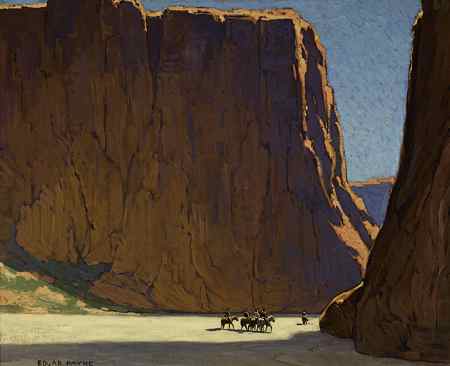
(above:: Edgar Payne, Sunset, Canyon de Chelly, 1916. Oil on canvas, 28 x 34 inches. Mark C. Pigott Collection) from our article Edgar Payne: The Scenic Journey (2/26/12)
Finally, William Robinson Leigh approached the canyon through the lens of rigorous academic realism, serving as a meticulous documentarian of a frontier he viewed with deep, romantic affection. Trained extensively at the Royal Academy in Munich, Leigh leveraged his sophisticated understanding of draftsmanship and color theory to earn the moniker "America's Sagebrush Rembrandt". Leigh seized an opportunity to travel west in 1906 through a commission with the Santa Fe Railroad, and he subsequently visited the Southwest numerous times between 1912 and 1926, frequently living among and painting the Navajo and Hopi peoples. An excellent representation of his approach is the painting Canyon de Chelly, Arizona Navajo (1913) , held in the online collection of the Gilcrease Museum. A later work, Canyon de Chelly (1937) also located at the Gilcrease Museum, demonstrates his sustained, multi-decade fascination with the region.
Online synthesis of Leigh's career reveals an artist fundamentally committed to the narrative and anthropological weight of his subjects. Reviewers, museum commentators, and historians consistently commend his highly detailed draftsmanship and his unparalleled attention to the shifting, luminous quality of Southwestern light. The artistic merit of Leigh's work stems from his ability to seamlessly fuse sophisticated European academic painting techniques with authentically raw American subject matter. By doing so, he created paintings that function simultaneously as highly dramatic storytelling and precise ethnological records of Native American life. His Canyon de Chelly paintings are perfectly emblematic of his wider portfolio, standing as a staunch defense of traditional representational art during an era that was becoming increasingly dominated by modernism. Leigh famously asserted that what a person paints is far more important than how they paint it, and his meticulous, loving renderings of the canyon and its inhabitants cement his legacy as a master of the romanticized Western narrative.
Ultimately, the varied depictions of Canyon de Chelly by
Adams, O'Keeffe, Dixon, Payne, and Leigh reveal that the landscape itself
is only half of the artistic equation; the other half is the philosophical
lens of the observer. Ansel Adams used the camera to freeze the canyon in
a state of eternal, monumental purity, advocating for its physical preservation
through flawless tonal contrast. Georgia O'Keeffe fragmented the exact same
geography, using her camera lens to distill the overwhelming expanse into
flattened, abstract geometries that directly informed her modernist painting
aesthetic. Maynard Dixon stripped away illustrative romanticism, utilizing
massive, simplified forms to equate the cultural endurance of the native
inhabitants with the geological permanence of the towering cliffs. Edgar
Payne weaponized the delicate, vibrating brushstrokes of traditional Impressionism
to capture the violent, sublime scale of the desert, transforming quiet
geological vistas into arenas of pulsating light. Finally, William Robinson
Leigh applied rigorous European academic standards to immortalize the canyon
in precise detail, acting as a romantic anthropologist preserving the visual
memory of a fading frontier. Together, these five visionary artists did
not merely document a geographical location in the American Southwest; they
synthesized a complex, multi-faceted mythology of the American West, ensuring
that Canyon de Chelly remains a foundational pillar in the pantheon of American
art history.
We lightly edited this text and provided links to other materials to enhance it. AI is rapidly improving in accuracy, however, the text may contain inaccurate information. This presentation doesn't meet scholarly standards, yet Gemini AI researched and checked it for accuracy. Sources are footnoted in the raw AI report, yet deleted here for a general audience
Prompt:
 Return to Arizona Art History
Links to sources of information outside of our web site are provided only as referrals for your further consideration. Please use due diligence in judging the quality of information contained in these and all other web sites. Information from linked sources may be inaccurate or out of date. TFAO neither recommends or endorses these referenced organizations. Although TFAO includes links to other web sites, it takes no responsibility for the content or information contained on those other sites, nor exerts any editorial or other control over them. For more information on evaluating web pages see TFAO's General Resources section in Online Resources for Collectors and Students of Art History. Individual pages in this catalogue will be amended as TFAO adds content, corrects errors and reorganizes sections for improved readability. Refreshing or reloading pages enables readers to view the latest updates.
 Search Resource Library for everything about American
art.
Search Resource Library for everything about American
art.
Copyright 2026 Traditional Fine Arts Organization, Inc., an Arizona nonprofit corporation. All rights reserved.
