
Spider Rock and the Artists of the American Southwest
a 2026 article by TFAO and Gemini AI
Hidden within the vast, arid expanses of the Navajo Nation in northeastern Arizona lies Canyon de Chelly , a breathtaking labyrinth of sheer cliffs and meandering waterways that has captivated the human imagination for millennia. From a visual perspective, entering the monument feels like stepping into the deep, exposed heart of the earth itself. Unlike the broad, expansive and distant vistas of the Grand Canyon, Canyon de Chelly offers an intimate, sheltering environment where the canyon floor is lush with cottonwood trees, fragrant junipers, meandering spring snowmelt streams, and the active farmlands of the Diné families who still call the gorge home. The towering sandstone walls, carved over millions of years by the patient forces of water and wind erosion, present a dramatic, inescapable verticality.
Depending on the time of day, the flat face of the stone acts as an immense natural canvas, catching the changing light and shifting through a mesmerizing spectrum of deep earthen reds, rusted oranges, and vibrant ambers. Tucked securely into the alcoves of these towering walls are the ancient, silent cliff dwellings of ancestral people, adding a profound layer of human history and architectural geometry to the natural surroundings. It is an environment where the sky feels like a narrow river of blue above, and the earth below feels deeply alive and intimately close.
Rising abruptly and dramatically from the flat, green floor of the canyon is the monument's most iconic geological feature: Spider Rock. This striking natural monolith consists of twin sandstone spires, the taller of which pierces the sky at an astonishing height of approximately 750 feet. Formed of Permian-age De Chelly Sandstone, the spire is a remnant of ancient desert sand dunes that dominated the North American continent toward the end of the Paleozoic era. Over countless millennia, the surrounding rock was entirely washed away by the relentless forces of erosion, leaving only these stubborn, vertically striated columns standing in isolated defiance.
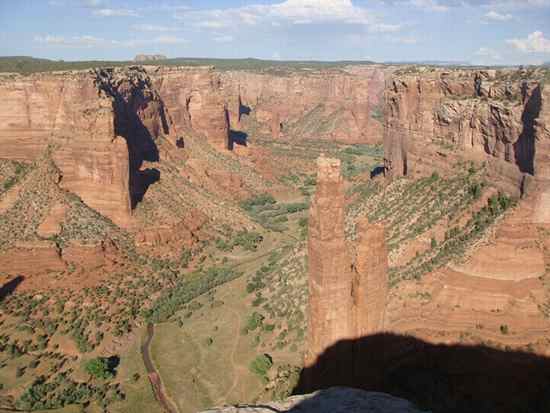
(above: Spider Rock, Canyon de Chelly, in Morning #2, 2011. Photo by John Hazeltine)
For artists, the physical characteristics of Spider Rock are overwhelmingly compelling. The sheer, towering scale of the monolith provides an unparalleled focal point that commands the eye and anchors the sprawling landscape. The stark contrast between the vertical thrust of the spire and the horizontal spread of the canyon floor creates a natural, dynamic tension in any composition. Furthermore, the texture of the rock -- weathered, fractured, and deeply striated -- allows painters to experiment endlessly with the interplay of light and shadow, particularly during the golden hours of sunrise and sunset when the stone appears to glow from within, shifting from deep red to amber.
Beyond its geological grandeur, Spider Rock carries an immense spiritual weight that artists have long sought to translate onto canvas. In Navajo tradition, the spire is the sacred home of Spider Woman (Na'ashjé'ii Asdzáá), a revered deity who serves as a protector and benefactor. According to the creation narratives, it was Spider Woman who first taught the Diné people the intricate art of weaving, using a legendary loom constructed of sky cords, earth cords, and sun rays. To paint Spider Rock is therefore to paint a subject that is simultaneously a geological wonder and a living, sacred monument pulsing with cultural history and ancient mythology.
Long before modern highways made the region easily accessible, a pioneering generation of American painters ventured into the unforgiving desert to capture its unspeakably sublime beauty. Among the earliest and most influential of these artists to reach the deep Navajo territory were Edgar Payne and Maynard Dixon. Their journeys to Canyon de Chelly in the early twentieth century were not mere tourist excursions, but rigorous expeditions driven by a thirst for primitive purity and grand, untouched landscapes.
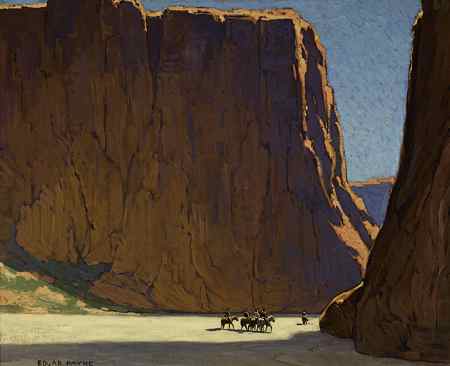
(above:: Edgar Payne, Sunset, Canyon de Chelly, 1916. Oil on canvas, 28 x 34 inches. Mark C. Pigott Collection) from our article Edgar Payne: The Scenic Journey (2/26/12)
Both Payne and Dixon were drawn to the Southwest through a unique intersection of artistic longing and corporate expansion. In the late nineteenth and early twentieth centuries, the Atchison, Topeka & Santa Fe railroad under the direction of advertising chief William H. Simpson, initiated a brilliant marketing campaign. Simpson sought to entice Eastern and Midwestern tourists to ride the newly laid rails into the remote desert. To achieve this, he bartered with prominent artists, offering them free train travel, lodging at railway hotels, and meals in exchange for their romantic paintings of the landscape and its Native inhabitants.
Hearing tales of dramatic, poetic motifs awaiting them in the virgin country, artists enthusiastically accepted. However, to reach the isolated depths of Canyon de Chelly, the train was only the first step. After disembarking at remote desert stations, artists like Payne and Dixon had to secure horses, burros, or rugged early motorcars to traverse the rutted, dusty trails that led across the Navajo Nation and eventually to the canyon rim. They were inspired to undertake these arduous journeys by a deep-seated desire to escape the suffocating commercial demands and the "stale-air existence" of urban centers, seeking to immerse themselves in an environment where the sheer scale of nature dwarfed the human ego.
Payne, a largely self-taught master of California Impressionism, first traveled to Canyon de Chelly in 1916 alongside his wife, Elsie. He spent four months living in and exploring the canyon, completely captivated by the rugged beauty and immense scale of the sandstone walls and towering spires. One of his most celebrated works from this era, which perfectly captures the looming presence of the canyon's monolithic formations, is the magnificent Sunset, Canyon de Chelly (1916).
In Sunset, Canyon de Chelly, Payne captures the sheer, unyielding faces of the canyon's red sandstone as they are bathed in the fading, dramatic light of dusk. Art critics and historians of his era were profoundly moved by his ability to render the monumental weight of the landscape, frequently praising him as a "poet who sings in colors". Reviewers noted that unlike many of his contemporaries who favored idyllic, peaceful scenes, Payne boldly utilized the animated brushwork and vibrant palette of Impressionism to convey an active dynamism, a rugged beauty, and a deep reverence for the natural world. Modern critics continue to praise his dramatic skies and compositional scale, noting how his impressionist strokes evoke a sense of immediacy and movement within the static stone.
Payne himself was deeply humbled by the landscapes he painted, recognizing that the towering spires were the true masters of his art. In his widely respected instructional book, Composition of Outdoor Painting, he wrote that regardless of a painter's immense talent or noble concepts, the artist remains entirely subservient to the landscape. He insisted that "he is dependent to a great extent upon Nature. To her he must always go to for ideas to be translated," approaching the canvas not with ego, but with a pure "love of beauty and enjoyment in its translation".
Similarly compelled by the raw grandeur of the Southwest, Maynard Dixon left his illustration career in the early 1920s to dedicate himself to capturing the authentic spirit of the desert. Fascinated by the intersection of the dramatic geography and the rich spiritual traditions of the Navajo people, Dixon found the modernistic emphasis on simplifying lines and minimizing details perfectly suited to the stark, vertical thrust of Canyon de Chelly's monoliths. A stunning example of his dedication to this landscape and the spiritual weight of its ancient spires is his painting The Ancients (1922). Critics of Dixon's work frequently praised his ability to strip away the unnecessary, focusing entirely on the monumental scale and the deep cultural resonance of the land. His paintings of Canyon de Chelly were lauded by historians for successfully leaving a vital historical record of "primitive purity and simplicity" before the heavy footprint of modernization changed the West forever. Reviewers recognized that his modernistic approach allowed the raw power of the sandstone monuments to speak for themselves. Dixon possessed a deep respect for the canyon, demanding that it be treated with reverence rather than exploitation. He added that he saw the landscape as "something more than a source of astonishment for tourists, and a background for pictoral horse opera," viewing it instead as a sacred space where the ancient stones and the people who lived in their shadows were fundamentally intertwined.
We lightly edited this text and provided links to other materials to enhance it. AI is rapidly improving in accuracy, however, the text may contain inaccurate information. This presentation doesn't meet scholarly standards, yet Gemini AI researched and checked it for accuracy. Sources are footnoted in the raw AI report, yet deleted here for a general audience
Prompt:
 Return to Arizona Art History
Links to sources of information outside of our web site are provided only as referrals for your further consideration. Please use due diligence in judging the quality of information contained in these and all other web sites. Information from linked sources may be inaccurate or out of date. TFAO neither recommends or endorses these referenced organizations. Although TFAO includes links to other web sites, it takes no responsibility for the content or information contained on those other sites, nor exerts any editorial or other control over them. For more information on evaluating web pages see TFAO's General Resources section in Online Resources for Collectors and Students of Art History. Individual pages in this catalogue will be amended as TFAO adds content, corrects errors and reorganizes sections for improved readability. Refreshing or reloading pages enables readers to view the latest updates.
 Search Resource Library for everything about American
art.
Search Resource Library for everything about American
art.
Copyright 2026 Traditional Fine Arts Organization, Inc., an Arizona nonprofit corporation. All rights reserved.
