
West Virginia Art History

with an emphasis on representational art
Introduction
This section of our catalogue Topics in American Art is devoted to the topic "West Virginia Art History." Articles and essays specific to this topic published in our Resource Library are listed at the beginning of the section. Clicking on titles takes readers directly to the articles and essays.
Following the links to Resource Library articles and essays are a listing of museums in the state which have provided materials to Resource Library for this or any other topic.
Listed after museums are links to online resources outside our website. Following these resources is information about offline resources including DVDs, paper-printed books, journals and articles. Our goal is to present complete knowledge relating to this section of Topics in American Art.
We recommend that researchers always search within Resource Library for additional material. Please see our page How to research topics not listed for more information.
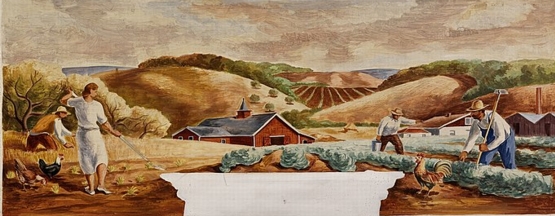
(above: Richard Zoellner, West
Virginia Landscape, 1941, tempera on paperboard, Smithsonian American
Art Museum, Transfer from the General Services Administration. Public domain,
via Wikimedia Commons*)
Resource Library essays listed by author name in alphabetical order, followed by articles:
Resource Library contains no articles or essays specific to the state.
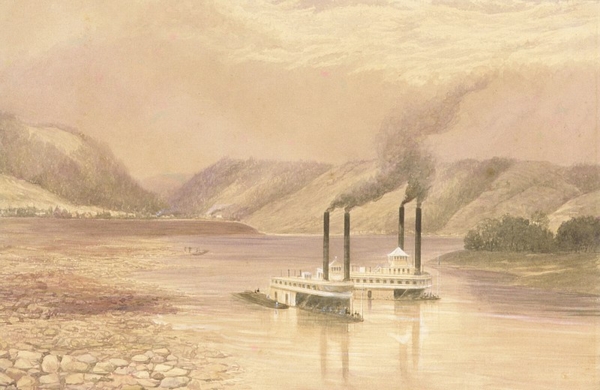
(above: Lefevre J. Cranstone, The Ohio River near Wheeling, West Virginia, c. 1859-1860, watercolor, 12 x 17.9 inches, Metropolitan Museum of Art, Purchase, Gifts of Mrs. Louise Lamson and Mrs. Alfred N. Lawrence, by exchange, 1984. Public domain, via Wikimedia Commons*)
Museums and other non-profit sources of Resource Library articles and essays:
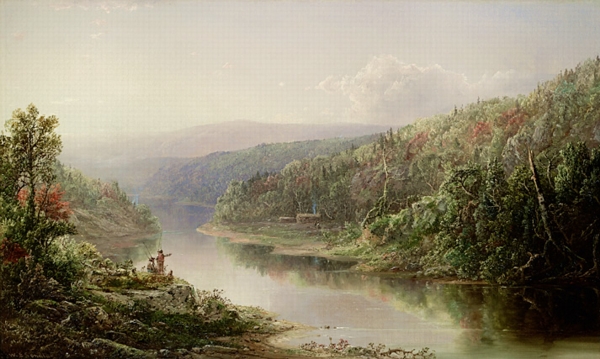
(above: William Louis Sonntag, Sr., Fishing on the Potomac, Eastern Panhandle, West Virginia, c. 1855, Hawthorne Fine Art. Public domain, via Wikimedia Commons*)
Other online information:
Augustus Kollner in Western Virginia is a 2018 exhibit at the Huntington Museum of Art which says: "One artist who visited the state to paint and sketch was Augustus Kollner, a German immigrant who had settled in Philadelphia in the 1840s....Among his travels was a trip through what is now West Virginia in 1845, resulting in many drawings and watercolors that feature the area's natural attractions." Accessed 6/18
Artists from West Virginia in Wikipedia. Accessed August, 2015.
Allied Artists of West Virginia website. Accessed August, 2015.
For the Joy of Light: The Paintings of Robert Singleton is a 2017 exhibit at the Huntington Museum of Art which says: " For nearly 40 years, Singleton, a "West Virginian by choice" has sought privacy and uninterrupted time to work and be introspective, and the space to breathe freely and search for life's answers in this remote location." Also see artist's website Accessed 9/17
The Evolving Canvas: A History of Art in West Virginia, 1800-1940 is a 2025 article by Gemini AI which says: "The period from 1800 to 1940 reveals a vibrant and evolving artistic landscape in West Virginia, extending far beyond a singular folk tradition. Art in the state progressed from its utilitarian beginnings and the demand for commissioned portraiture to embrace complex landscape narratives, monumental public commemoration, and eventually, the bold experiments of modernism and the widespread reach of commercial illustration. This trajectory mirrors and contributes to the broader currents of American art history.
The lives and works of artists like David Hunter Strother, Thomas P. Anshutz, William Robinson Leigh, William Rudolf O'Donovan, Fred Martin Torrey, Blanche Lazzell, and Leslie Thrasher demonstrate that West Virginia's artists were not isolated. They were active participants and significant contributors to national and international artistic movements, often blending their strong regional identity with universal artistic concerns. Their stories highlight the enduring influence of West Virginia's landscapes, history, and communities on their creative output, even as many achieved national or international renown. The establishment of institutions like the West Virginia State Museum during this period underscores a growing and enduring commitment to preserving and celebrating the state's cultural and artistic heritage. The works of these artists, whether captured in paint on canvas or sculpted in enduring stone and bronze, continue to tell the compelling story of West Virginia's past, its resilient people, and its undeniable place within the rich tapestry of American art." Accessed 6/25
Books, listed by year of publication, with most recently published book listed first:
Early Art and Artists in West Virginia: An Introduction and Biographical Directory, By John A. Cuthbert. Published by West Virginia University Press, 2000. ISBN 093705853X, 9780937058534. 301 pages. Review by WVU Magazine.
West Virginia Quilts and Quiltmakers: Echoes from the Hills, by Valentine, Fawn. Athens: Ohio University Press, 2000. 282 pp.
Articles:
Bartlett, Larry. 1998 "Rural Murals: New Deal Art in West Virginia" [sidebar lists 16 Post Office Art sites]. Goldenseal: West Virginia Traditional Life 24 (Fall): 36-41.
Six, Dean. 2003. "Stained Glass in West Virginia: A Brief History" [early 1900s]. Goldenseal: West Virginia Traditional Life 29 (Spring): 15.
Musical accompanyment:
Take Me Home, Country Roads, song by John Denver available on YouTube
Appalachian Spring, musical
composition by Aaron Copland available on YouTube
 Return to Individual States Art History Project
TFAO catalogues:
TFAO's Distinguished Artists catalogue provides online access to biographical information for artists associated with this state. Also, Search Resource Library for online articles and essays concerning both individual artists associated with this state's history and the history of art centers and museums in this state. Resource Library articles and essays devoted to individual artists and institutions are not listed on this page.
Links to sources of information outside of our web site are provided only as referrals for your further consideration. Please use due diligence in judging the quality of information contained in these and all other web sites. Information from linked sources may be inaccurate or out of date. TFAO neither recommends or endorses these referenced organizations. Although TFAO includes links to other web sites, it takes no responsibility for the content or information contained on those other sites, nor exerts any editorial or other control over them. For more information on evaluating web pages see TFAO's General Resources section in Online Resources for Collectors and Students of Art History.
*Tag for expired US copyright of object image:

 Search Resource Library
Copyright 2022 Traditional Fine Arts Organization, Inc., an Arizona nonprofit corporation. All rights reserved.