
AI Curiosities
An Evaluative Analysis of TFAO for American Art History Scholarship
a 2025 report by Grok 3 AI
I. Introduction: Situating TFAO in the Digital Art History Landscape
Defining the Object of Study
The Traditional Fine Arts Organization (TFAO), an Arizona-based 501(c)(3) non-profit corporation established on August 5, 2003, operates the website TFAOI.org with the stated mission of furthering education in American art through advocacy, publication, and research. The organization positions its website not merely as a collection of pages but as a "digital library," a term that implies a structured and preserved collection of resources intended for long-term access. This self-characterization invites a rigorous evaluation based on the standards of library science and academic research, particularly concerning the collection's scope, the authority of its materials, and its utility for scholarly inquiry.
The genesis of the site's core content lies in the 2003 acquisition of Resource Library Magazine, an online publication founded in 1997. This publication was renamed Resource Library in 2004 and forms the foundational archive of the TFAOI.org digital library. A pivotal moment in the site's development occurred in late 2016, when TFAO announced a significant strategic shift. The organization moved away from its previous practice of actively soliciting and publishing new articles and essays, instead choosing to concentrate its efforts on curating and linking to external resources through its Topics in American Art catalogue. This evolution has created a resource with a dual identity that is crucial for any researcher to understand: it is simultaneously a static archive of texts published before 2017 and a dynamic, curated portal to information housed elsewhere.
The Digital Ecosystem
To properly assess its value, TFAO must be situated within the broader ecosystem of digital art history resources. This landscape includes a wide spectrum of platforms, each with distinct levels of scholarly rigor and intended purpose. At one end are peer-reviewed academic databases such as JSTOR, Project MUSE, and Artstor, which serve as the gold standard for citable secondary scholarship. At the other end are institutional repositories, including the online collections and publications of major museums (e.g., Metropolitan Museum of Art the Art Institute of Chicago) and university digital commons, which provide access to primary documents and institution-specific research. Between these are aggregators and commercial databases that provide different levels of access to information and images. TFAO occupies a unique niche within this ecosystem, sharing characteristics with several of these categories but fully belonging to none.
Hybrid Identity
The central argument of this analysis is that TFAO is best understood as a hybrid entity. It functions as a digital archive by preserving and providing access to a significant body of ephemeral or out-of-print material, primarily from museum sources. Concurrently, it functions as a curated portal, guiding users toward a vast collection of external links related to its specific area of focus. This hybrid nature is reflected in its own frequent, though unsubstantiated, marketing claim of being the "world's most valued and visited site devoted to American representational art". While the site's traffic metrics are self-reported and lack the comparative context of formal analytics against other major art history platforms, the persistence of this claim speaks to the organization's ambition and self-perception. However, the available evidence from academic sources does not validate this claim of being the "most valued" in a scholarly sense. Academic papers and university library guides cite TFAO functionally-as a source for a specific text or piece of exhibition information-rather than reviewing it as a premier research destination. This discrepancy between the site's self-promotion and its actual academic footprint requires the researcher to approach it not as a universally acclaimed authority, but as a specialized tool with a distinct agenda and a complex, evolving relationship with the scholarly community.
II. The Curatorial Lens: Defining "American Representational Art"
A critical evaluation of TFAO must begin with a deep analysis of its foundational curatorial principle: its focus on "American representational art." This is not merely a descriptive category but a prescriptive one, shaping the entirety of the site's collection and introducing a significant and explicit bias that researchers must understand to use the resource responsibly.
A. The Official Definition and its Boundaries
TFAO provides a clear, if broad, definition of its core subject matter. "American representational art" is defined as visual art that is "easily recognizable by the vast majority of people as depicting objects in the natural world". This definition is inclusive of styles ranging from classical realism and impressionism to surrealism and figurative modernism. The scope is further delineated by artist nationality, covering works by "United States citizens, American colonists or Native Americans" from the pre-colonial era to the present day.
Just as important as what is included is what is explicitly de-emphasized. The organization states that disciplines such as architecture, broadcast media, film, and digital media are not a focus of Resource Library. This immediately limits the site's utility for scholars engaged in interdisciplinary studies or research into new media, fields that are increasingly central to contemporary art historical practice. The collection's boundaries are thus drawn around a fairly traditional conception of the fine arts-primarily painting and sculpture-that privileges a direct, mimetic relationship with the observable world.
B. The Ideological Filter: Bias as Stated Policy
The most significant aspect of TFAO's curatorial framework is its open and unapologetic ideological stance. The organization makes the extraordinary statement that it "seeks to advance its particular bias". This bias is alluded to in its grants activity by a focus on "human traits of love, wonder, kindness, good will, constructive work and charity." Conversely, art that is deemed to be "lacking civility towards religious beliefs, racial or ethnic groups, social classes, sexual orientation and nationality" is declared "not of interest."
This philosophy extends beyond content selection and into the organization's philanthropic activities. Its grant-making preferences are justified with a collection of quotes from figures like Pierre-Auguste Renoir and Robert Henri that champion art as "pleasant, cheerful and pretty" and emphasize beauty's power to "revitalize us amidst it all," while avoiding the "unpleasant things in life".
This framework functions as an active ideological filter, constructing a specific and highly sanitized canon of American art. It is a worldview that implicitly, and at times explicitly, favors art that is affirmative and aesthetically pleasing over art that is critical, challenging, or disruptive. While the site does contain extensive resources on topics that involve significant social struggle, such as its large collection of articles on African-American Art and the Civil Rights movement", there is a fundamental tension between this content and the organization's stated philosophy of avoiding "unpleasantness."

(above: Henry Ossawa Tanner, Christ and His Mother Studying the Scriptures, 1909, oil on canvas, 48.7 x 40 inches, Dallas Museum of Art. Public domain, via Wikimedia Commons*)
The implications of this filter are profound. A researcher relying on TFAO would encounter a version of American art history that systematically de-emphasizes or entirely omits many of the most influential and historically significant movements of the 20th and 21st centuries. The confrontational energy of Abstract Expressionism, the raw urbanism of the Ashcan School (which is covered, but sits uneasily with grants philosophy ), the critical and often unsettling work of feminist artists, and the vast field of postmodern and contemporary art that engages directly with political dissent, trauma, and social critique are all likely to be marginalized within this curatorial vision. What remains is a canon that heavily favors movements like the Hudson River School, Impressionism, Luminism, Folk Art, and Regionalism.
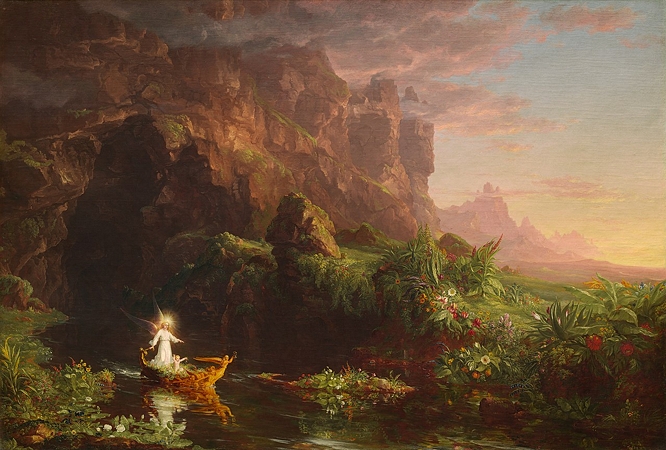
(above: Thomas Cole, The Voyage of Life Childhood, 1842. Picture from National Gallery of Art (Washington, D.C.) Source: Wikimedia Commons - public domain*)

(above: Edgar Alwin Payne, High Sierra, 1921, Steven Stern Fine Arts. Public domain, via Wikimedia Commons*)

(above: Sanford Gifford, A Gorge in the Mountains (Kauterskill Clove), 1862, oil on canvas, 48 x 39 7/8 inches, Metropolitan Museum of Art, Bequest of Maria DeWitt Jesup, from the collection of her husband, Morris K. Jesup, 1914. Public domain, via Wikimedia Commons*)
Therefore, a scholar using TFAO is not viewing a comprehensive survey of American art history, but rather "A History of American Representational Art as Curated and Defined by the Traditional Fine Arts Organization." For a researcher whose topic aligns perfectly with this canon-for instance, studying the plein-air landscapes of William Wendt -the site can be an exceptionally rich resource. However, for any scholar attempting to understand the broader, more contentious, and more diverse narratives of American art, the site's ideological filter renders it incomplete and potentially misleading if used without critical awareness and significant supplementation from other sources. The site itself becomes an object of study for the historiography of American art, offering a clear window into a conservative canon-building project.
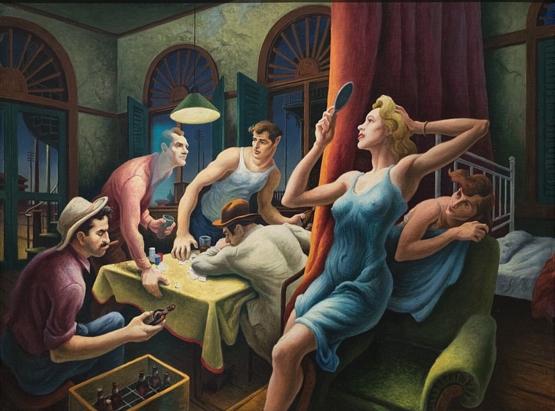
(above: Thomas Hart Benton, Poker Night (from A Streetcar Named Desire), Whitney Museum of American Art. Source: Sharon Mollerus. Public domain, via Wikimedia Commons*)
III. Anatomy of a Digital Resource: Deconstructing the TFAO Archives
The structure of TFAO is complex, reflecting its evolution over more than two decades. For the researcher, it is essential to deconstruct the site into its primary components, as each has a different function, history, and level of authority. The 2016 strategic pivot, in particular, created two distinct "eras" of content that must be navigated differently.
A. Resource Library: The Static Archive (Pre-2017)
The heart of TFAO's historical collection is publication Resource Library. This section comprises over 1,300 articles and essays attributed to hundreds of named authors, supplemented by thousands of other texts and over 24,000 images. The content is sourced "almost exclusively by nonprofit art museums, galleries and art centers" and consists largely of exhibition-related materials. This includes full or partial reprints of exhibition catalogues, scholarly essays, brochures, gallery guides, wall texts, object labels, and even audio tour scripts.
A primary value of Resource Library is its function as a repository for texts that are otherwise difficult to access. This includes essays from out-of-print exhibition catalogues and scholarly articles from paper-printed journals, most notably American Art Review. Through a dedicated project, TFAO secured permissions to digitize and republish these valuable texts, making them freely available to a global audience.
Crucially, Resource Library is now a closed, static archive. In late 2016, TFAO officially ceased inviting or accepting new submissions for publication. This means its contents represent a fixed snapshot of museum publishing and art historical writing up to that point. Its value is therefore historical and archival; it will not be updated with new scholarship.
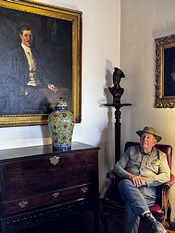
(above: J. P. Hazeltine, Editor of Resource Library and Founder, Traditional Fine Arts Organization. Photo 2024 by Tracey Hazeltine)
B. Topics in American Art: The Dynamic Portal (Post-2016)
Following the 2016 pivot, the organization's strategic priority shifted entirely to the development of its Topics in American Art catalogue. This section is a vast, human-curated collection of over 200 thematic pages, covering subjects from "African-American Art" to "Utah Art History"
Unlike Resource Library, which hosts content directly, the Topics pages function as research portals. Each page aggregates a variety of resources on a given subject, including:
* Direct links to relevant articles and essays within its internal Resource Library.
* Deep links to external online materials, such as exhibition pages on museum websites, articles, and other web resources.
* Links to online video and audio recordings.
* Bibliographic references to offline materials, including paper-printed books, journal articles, and videos in DVD/VHS format.
The content for these pages is gathered and maintained by seasoned volunteers who conduct ongoing searches of museum websites and other sources for relevant past, current, and future exhibitions and materials. This makes the Topics section a dynamic, ever-expanding finding aid, reflecting the current state of online resources in the field.
C. Finding Aids and Other Catalogues
To help users navigate its vast holdings, TFAO provides several key indexes and catalogues:
* America's Distinguished Artists: This is a comprehensive alphabetical index of deceased American representational artists. Each entry provides links to biographical information found within Resource Library texts and, importantly, to external websites such as Wikipedia, gallery pages, or archives. The process for maintaining this index is documented and relies on the subjective judgment of volunteers to select the "best" external links based on criteria like source quality and author credentials.
* National Calendar of Exhibitions: This catalogue lists past, present, and future exhibitions at American art museums. It serves a dual purpose: as a resource for users and as a primary source of new citations for the Topics in American Art catalogue.
* Art History of Each State This finding aid organizes resources geographically, providing a dedicated page for each state that aggregates relevant articles, museum information, and other materials. This structure is particularly useful for researchers focusing on regional art histories.
The 2016 strategic shift effectively created two different resources under a single domain, and a researcher must approach them with distinct methodologies. The pre-2017 Resource Library is a primary source archive; its authority is tied directly to the credibility of its original publishers, which are predominantly museums and established journals. In contrast, the post-2016 Topics in American Art section is a tertiary-level finding aid; its authority rests on the curatorial judgment and diligence of TFAO's anonymous volunteers. A link to an essay in Resource Library represents a direct republication of a source document, whereas a link in the Topics section is a referral to an external resource. This bifurcation is a critical structural feature of the site. The sophisticated researcher will learn to leverage the Resource Library for its unique and stable archival content while using the Topics section as a powerful, if unvetted, starting point for discovery that requires subsequent independent verification.
IV. Authority and Scholarly Rigor: An Assessment of Trustworthiness
The central question for any academic researcher evaluating a digital resource is that of authority and trustworthiness. In this domain, TFAO presents a complex and challenging case. Its publication model diverges sharply from traditional academic standards, placing a significant burden of critical evaluation on the end-user. However, when understood correctly, this model reveals the site's most unique value proposition.
A. The Provenance of Content: The Museum-to-Web Pipeline
The overwhelming majority of content within the TFAOI.org digital library, particularly in its foundational Resource Library, is not generated by TFAO itself but is provided by external, non-profit institutions. These sources are primarily American art museums, galleries, and art centers. The materials they provide consist largely of what can be termed "paratextual" or ephemeral content related to exhibitions: press releases, wall panels, extended object labels, gallery guides, checklists, and audio tour scripts.
TFAO's role in this pipeline is explicitly that of a publisher and archivist, not a creator or editor of content. The organization states clearly that it does not "inject its own critique or opinions into published texts". Texts from institutions are typically provided by media relations personnel, curators, or executive directors and are published largely as-is, with edits only for formatting and style. This direct pipeline from the museum to the web is a defining feature of the resource.
B. The Question of Peer Review: "Post-Publication Criticism"
TFAO is transparent about its departure from the standard academic model of pre-publication peer review. The site explicitly contrasts its process with that of academic journals, which employ single or double-blind review to vet scholarship before it is published. In its place, TFAO proposes a model of "world-wide, permanent, post-publication criticism by all persons". The organization offers what it calls a "free and fair mechanism for criticism of facts in all published texts," effectively crowdsourcing the verification process to its global readership after the fact.
The site's internal editorial process is focused on technical fidelity rather than scholarly assessment. The organization strives for a high degree of accuracy in transcribing paper texts into a digital format, aiming for a 99.995% character accuracy rate, and ensures that content is presented according to its internal formatting guidelines. While commendable for its commitment to preservation, this process does not involve any form of scholarly vetting or critique of the arguments or claims made within the texts themselves.
C. Authorial Voice and the Burden of Verifiability
The authorship of content on TFAO is highly varied. At one end of the spectrum are essays and articles by named scholars, curators, and experts, many of whom hold advanced degrees, teach at universities, or are directors of museums. At the other end are the thousands of texts-such as press releases and wall labels-that are written by anonymous museum staff and have no named author.
To its credit, TFAO is remarkably forthcoming about this variance and the challenges it poses. The site includes dedicated pages advising researchers to "carefully consider the credentials of the biographer" and to be critical of the source. It acknowledges that online biographies can be motivated by commercial interests (e.g., art dealers) or familial sentiment, and that texts may be influenced by patron support. The organization explicitly places the responsibility for judging the quality and veracity of information on the user. When author biographies are provided by the source institution, TFAO includes them to help readers "gauge the depth and quality of the author's scholarship." Ultimately, however, the site functions on the principle of caveat lector: let the reader beware.
This approach leads to a crucial reframing of the site's value. If judged as a collection of authoritative secondary scholarship, TFAO is flawed due to its lack of peer review and inconsistent authorial credentials. However, if it is instead understood as a primary source archive of museum discourse, its value becomes immense. The press releases, wall texts, and gallery guides it preserves are not secondary analyses; they are primary documents that reveal how museums frame art, artists, and art movements for public consumption. They are invaluable source material for researchers studying museology, the history of collecting, public art education, and the institutional reception of artists.
From this perspective, the lack of traditional peer review is not a flaw in the archive but an intrinsic feature of the archived material itself. A scholar should therefore not cite a piece of wall text from TFAO as an authoritative fact about an artwork. Instead, the correct and more powerful citation method would be to frame it as a primary source: "Wall text from the exhibition Masterpieces of American Art, 1770-1920 at the Milwaukee Art Museum, 2005, as archived by the Traditional Fine Arts Organization". This methodological shift transforms the site from a potentially unreliable secondary resource into a uniquely valuable primary one, which represents its most significant, if often misunderstood, contribution to the field.
V. The Researcher's Toolkit: Navigational and Bibliographic Utility
Beyond the quality of its content, the utility of any digital resource depends on its functionality. A researcher must be able to efficiently find, access, and cite information. In this regard, TFAO presents a study in contrasts, combining frustratingly outdated search mechanisms with remarkably forward-thinking preservation practices.
A. Information Retrieval: A Flawed System
One of the most significant drawbacks of TFAO for the modern researcher is its lack of a robust, integrated internal search engine. The site's architecture, likely reflecting its origins in the late 1990s and early 2000s, does not support sophisticated keyword searching across its vast repository. Instead, the organization explicitly and repeatedly instructs users to employ external search engines like Google or Yahoo, using the site:tfaoi.org operator to limit the search to the TFAO domain.
This reliance on an external tool is a major usability flaw. It prevents users from performing faceted searches, filtering results by date or author, or leveraging any internal metadata that might exist. It is a workaround, not a feature, and indicates a technical infrastructure that has not kept pace with the standards of contemporary digital libraries.
In lieu of a powerful search tool, navigation depends on a series of manually curated, hierarchical indexes. Users can browse content by:
* Topic: via the Topics in American Art catalogue.
* Author: via the Author Study and Index.
* Source Institution: via the Art Museum, Gallery and Art Center.
* Chronology: via Chronological Index, an index of articles listed by publication date.
While these indexes can be powerful for a researcher whose query aligns neatly with one of these categories (e.g., "show me all articles sourced from the Westmoreland Museum of American Art"), they are cumbersome for more nuanced or cross-cutting inquiries that rely on specific keywords or concepts.
B. Citation Practices and Link Persistence: A Unique Strength
In terms of bibliographic output, TFAO is rudimentary. The site does not provide standardized, machine-readable citations in formats like RIS or BibTeX, which are common in academic databases and allow for easy import into reference management software. Researchers must construct all citations manually, a time-consuming and error-prone process.
However, this weakness is offset by a major and unique strength: the site's sophisticated and principled approach to handling "link rot." In the dynamic environment of the web, external links frequently break as institutions redesign their websites or remove old content. Most websites simply delete these dead links, erasing the bibliographic record of the original resource. TFAO has adopted a contrary and highly commendable policy. When a volunteer discovers that an external link to an exhibition page has died, the reference is not deleted. Instead, the defunct URL is removed, but the essential metadata-the exhibition title, the name of the hosting museum, and TFAO's descriptive text-is preserved. The entire entry is then colored gray to signal to the user that the direct link is broken.
This practice demonstrates a profound understanding of the challenges of digital scholarship and preservation. By preserving the "bibliographic scent" of the original resource, TFAO empowers a determined researcher to track down the lost information. Using the preserved metadata, a scholar can search for the content on the Internet Archive's Wayback Machine or contact the museum's library or archives directly to request the material. This commitment to the permanence of the scholarly record is a pioneering best practice from which many larger and better-funded institutions could learn.
The site's architecture thus reveals a clear, if likely unintentional, hierarchy of values. It prioritizes the long-term permanence of content over the short-term convenience of navigation. The user experience is consequently bifurcated: the initial discovery phase can be inefficient and frustrating due to the primitive search tools. However, the data persistence and recovery phase is remarkably robust due to the thoughtful handling of link decay. This makes TFAO a poor choice for quick lookups or casual browsing, but a potentially invaluable tool for deep, forensic research aimed at recovering information about past exhibitions and the discourse surrounding them.
VI. Synthesis and Recommendations for the Academic Researcher
A. Final Verdict: A High-Risk, High-Reward Niche Resource
The Traditional Fine Arts Organization's website is a complex, idiosyncratic, and ultimately valuable resource for the study of American art history, provided it is used with a high degree of critical awareness. It is not, and should not be treated as, a substitute for peer-reviewed scholarly databases or comprehensive museum archives. Rather, it is a supplemental tool with a unique collection and a specific, self-proclaimed ideological mission.
Its primary strengths lie in its free and open access, its function as a permanent archive for rare and ephemeral museum-generated texts, its deep coverage of lesser-known artists who fall within its "representational" purview, and its pioneering approach to digital preservation through its handling of link persistence. These attributes make it an indispensable resource for certain types of scholarly inquiry.
Conversely, its weaknesses are significant from a traditional academic standpoint. Its curatorial scope is narrow and ideologically driven, presenting a sanitized and incomplete version of American art history. It completely lacks a pre-publication peer-review process, and the authority of its content varies dramatically from established scholars to anonymous institutional authors. This, combined with a primitive and outdated search functionality, places a heavy burden of verification and critical labor on the researcher. TFAO is therefore a high-risk, high-reward tool: used naively, it can lead to flawed or biased conclusions; used critically, it can unlock avenues of research and provide access to primary source materials unavailable elsewhere.
B. Recommendations for Use
To leverage TFAO effectively and ethically, the academic researcher should adhere to the following guidelines:
Use for:
* Preliminary Research: The site is an excellent starting point for identifying artists, key exhibitions, and relevant museums and institutions related to the study of American representational art. The Topics in American Art and America's Distinguished Artists catalogues are particularly useful for initial exploration.
* Primary Source Retrieval: The site's greatest strength is its archive of museum ephemera. Researchers studying museology, art reception, public art education, or the institutional history of a specific museum will find the collection of press releases, wall texts, gallery guides, and checklists to be an invaluable primary source repository.
* Research on Lesser-Known Artists: For artists who fit the "traditional" or "representational" mold but are not well-covered in canonical art historical surveys, TFAOI.org may be one of the few places to find consolidated biographical information, exhibition histories, and reprinted essays.
* Historiographical Analysis: The website itself is a rich object of study. Its explicit bias, its definition of "representational art," and its collection choices provide a clear case study in conservative canon formation and the history of taste in 21st-century America.
Use with Caution:
* Never as a Sole Source: All information obtained from TFAOI.org, especially interpretive claims and biographical facts, must be rigorously cross-verified against scholarly monographs, peer-reviewed journal articles, catalogues raisonnés, or other authoritative sources.
* Maintain Critical Awareness of Bias: The researcher must remain constantly aware of the site's ideological filter. When using the site, one should actively ask what artists, movements, and viewpoints are being excluded or marginalized by its focus on "positive" and "civil" themes.
* Cite with Precision: When citing materials from TFAO it is crucial to be specific about the nature of the source. Do not cite a press release as if it were a scholarly article. Clearly identify the source type (e.g., "wall text," "exhibition brochure," "essay by named author") to accurately reflect its level of authority.
Please don't rely on this AI-generated text for accuracy. It is intended to be a base for further inquiry. Text was lightly edited by us.
About us:
 Tens of thousands of individuals,
including students, scholars, teachers and others, view educational and
informative materials every month on our site, which is structured as a
digital library.
Tens of thousands of individuals,
including students, scholars, teachers and others, view educational and
informative materials every month on our site, which is structured as a
digital library.
 Return to AI Curiosities
Return to Research Projects, Reports and Studies
*Tag for expired US copyright of object image:

TFAO Museum of American Art is proudly sponsored by Traditional Fine Arts Organization, Inc., an Arizona nonprofit corporation. All rights reserved. © 2024
Links to sources of information outside of this website are provided only as referrals for your further consideration. Please use due diligence in judging the quality of information contained in these and all other web sites. Information from linked sources may be inaccurate or out of date. TFAO neither recommends or endorses these referenced organizations. Although TFAO includes links to other web sites, it takes no responsibility for the content or information contained on those other sites, nor exerts any editorial or other control over them. For more information on evaluating web pages see TFAO's General Resources section in Online Resources for Collectors and Students of Art History.