
Pennsylvania Art Colonies: A Comparative History of Landscape, Craft, and Community
by Gemini 2.5 Pro
The American Art Colony Phenomenon and Pennsylvania's Unique Contribution
At the turn of the twentieth century, as America grappled with rapid industrialization and burgeoning urban centers, a counter-movement emerged among its artists. Seeking respite from the grit and pace of city life, they established creative enclaves in rural settings, forming what became known as art colonies. This phenomenon was driven by a confluence of romantic ideals and practical needs: a reaction against the perceived soullessness of the machine age, a desire for affordable living and studio space, and a quest for authentic, "unspoiled" American subject matter. Within this national trend, the Commonwealth of Pennsylvania emerged as a particularly fertile ground, nurturing at least four distinct and historically significant colonies that would leave an indelible mark on American art history.
The state's appeal was multifaceted. For artists in the southeast, it offered picturesque, bucolic landscapes-from the rolling hills of Bucks County to the sylvan Brandywine Valley -- all within easy reach of the critical art markets, galleries, and educational networks of Philadelphia and New York. This strategic proximity allowed artists to immerse themselves in nature without sacrificing professional visibility. Furthermore, Pennsylvania's rich historical and architectural heritage provided both inspiration and tangible assets. The decline of early water-powered industry left a landscape dotted with disused grist mills, textile factories, and farmhouses, which offered artists affordable, spacious, and character-rich real estate for homes and studios.
This article examines the four most significant of these historic enclaves: the Impressionist hub at New Hope, the illustration-focused Brandywine School in Chadds Ford, the utopian Arts and Crafts experiment at Rose Valley, and the Realist painting retreat at Scalp Level. These colonies were not a monolithic movement but a series of parallel experiments in art and life, each founded on a distinct philosophical basis. When viewed collectively, they represent a microcosm of the major artistic and social debates consuming the American art world at the time. They were the physical manifestations of competing ideologies: the struggle between traditional European realism and the radical new light of French Impressionism; the debate over the artistic legitimacy of commercial illustration; and the profound conflict between creating art for aesthetic purposes and art as a vehicle for social reform. By examining the formation, artistic output, key figures, and eventual fate of each colony, this article will illuminate not only the rich history of art in Pennsylvania but also the broader cultural currents that shaped the identity of American art in the modern era.
Chapter 1: The New Hope School and the Rise of Pennsylvania Impressionism
Centered in and around the Bucks County town of New Hope, the art colony that flourished there became the nexus of a vigorous and distinctly American brand of Impressionism. Often called the "New Hope School" or the "Pennsylvania School" of landscape painting, it was less a formal institution and more an organic convergence of artists drawn to the region's natural beauty and the camaraderie of their peers.
Formation and Founding: A Serendipitous Gathering
The colony's genesis was largely serendipitous, traced to the nearly simultaneous arrival of two painters, William Langson Lathrop and Edward Redfield, in 1898. They were attracted by the spectacular rolling hills and the picturesque scenery along the Delaware River and its canal, as well as the availability of affordable real estate. The specific catalyst was an abandoned 18th-century grist mill property, Phillips' Mill, which Lathrop's childhood friend, Dr. George Morley Marshall, had recently acquired. In 1897, Dr. Marshall invited Lathrop to the area to paint, and Lathrop and his wife, Annie, rented the miller's house on the property before purchasing it outright in 1899.
While the artists were the public face of the colony, its social cohesion and growth were profoundly shaped by the community infrastructure they built. A crucial, though often overlooked, element of this was the role played by William Lathrop's wife, Annie Sarah Burt Lathrop. She became a beloved and central figure in the community, hosting legendary Sunday afternoon teas on the lawn of their home beside the canal. These gatherings were not mere social events; they were vibrant intellectual forums for the discussion of aesthetics, philosophy, and politics, fueled by homemade food and Annie's warm, maternal encouragement of the artists and students. This supportive social fabric, woven by a non-artist, provided the emotional and intellectual network necessary for creative work to flourish, standing in contrast to the more solitary, individualistic practice of artists like Edward Redfield.
The colony grew organically as the national reputations of Lathrop and Redfield attracted other professional artists to Bucks County. The 1907 arrival of Daniel Garber, another painter who would become a leading light of the school, further solidified the colony's importance. Pragmatically, the colony's success was bolstered by its strategic location. Situated just forty miles from Philadelphia and seventy from Manhattan, it provided artists with crucial access to the galleries, educational institutions, and exhibition opportunities of these metropolitan centers. Many of the artists, including Garber, maintained strong ties to the Pennsylvania Academy of the Fine Arts (PAFA), creating a vital link between the rural colony and the urban art establishment.
The Apex of a Movement: Defining Pennsylvania Impressionism
The artistic style that emerged from New Hope was a unique and powerful variant of American Impressionism. While its practitioners emulated the French Impressionists in their dedication to painting en plein air (outdoors) and their close attention to the qualities of light and atmosphere, their approach was distinctly American. Key characteristics included a vigorous, masculine brushwork, often with a thick application of paint known as impasto, and an unwavering focus on the local landscape.
A signature of the school was its commitment to depicting the Delaware River Valley in all seasons and all weather, with a particular fondness for winter scenes. Edward Redfield became the master of this genre, developing a legendary reputation for painting outdoors in the harshest conditions, sometimes lashing his enormous canvases to trees during blizzards to complete a work in a single, frenzied session, or "one go." This robust, direct engagement with nature distinguished the school's work from the more genteel Impressionism of New England or the urban scenes of the Ashcan School.
The Pennsylvania Impressionists created a hybrid style that integrated the innovations of European modernism with a deep-seated American realism. Many of the artists had trained at PAFA and retained a strong commitment to solid draftsmanship and compositional structure, which grounded their experiments with light and color. This fusion of ideas led the critic Guy Pène du Bois to characterize their work in 1915 as America's "first truly national expression."
The movement reached its zenith in 1915 at the Panama-Pacific International Exposition in San Francisco. This event served as a national showcase for the New Hope School, where Redfield was honored with an entire gallery for 21 of his paintings, and both Daniel Garber and William Lathrop were awarded gold medals. This national acclaim cemented the colony's reputation and drew even more artists, collectors, and students to the region.
Notable Artists of the New Hope School
The colony was defined not by a single, unified style, but by the emergence of many mature, distinctive artistic voices. Among the most influential were:
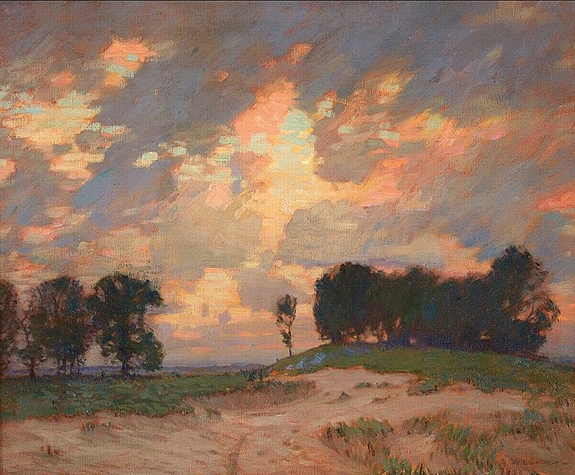
(above: William Langson Lathrop, The Bonfire, 1921. Public domain, via Wikimedia Commons)

(above: Edward Redfield, Bucks County: Winter, c. 1910, oil on canvas, 25 x 30 inches, Private collection, Internet Archive. Public domain, via Wikimedia Commons*)
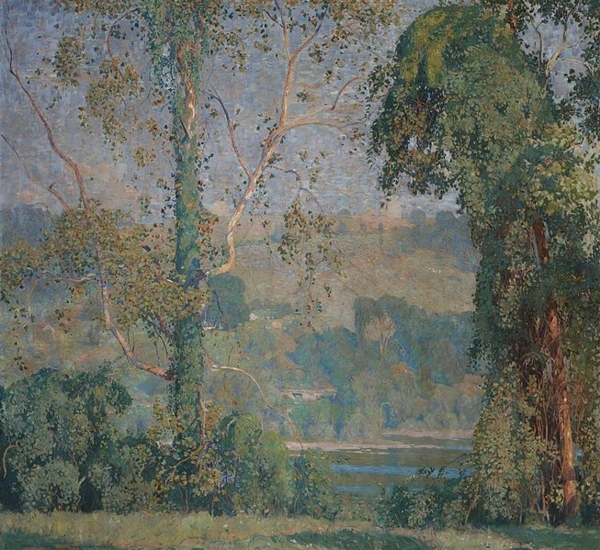
(above: Daniel Garber, Vineclad Trees, 1916, oil on canvas, 51.7 x 55.9 inches, Detroit Institute of Arts, Detroit Museum of Art Purchase, Lizzie Merrill Palmer Fund. Public domain, via Wikimedia Commons*)
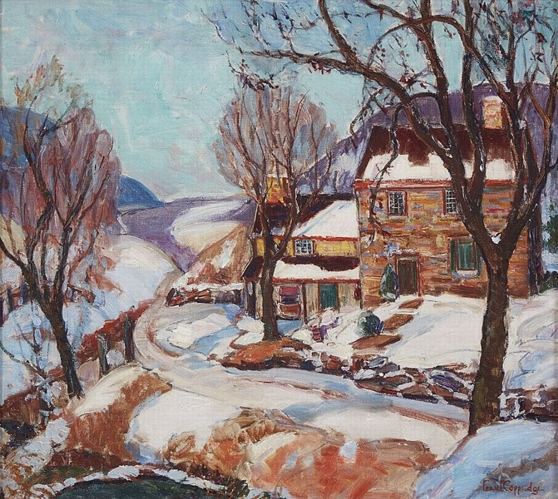
(above: Fern I. Coppedge, Lumberville House in Winter, c.1935, oil on canvas, 18 x 20 inches. Public domain, via Wikimedia Commons*)

(above: Robert Spencer, The White Tenement, c. 1913, oil on canvas, 30 x 36.1 inches, Brooklyn Museum, John B. Woodward Memorial Fund. Public domain, via Wikimedia Commons*)
Decline and Transformation: The Paradox of Success
The dominance of the New Hope School as a leading force in American art began to wane in the 1930s and 1940s. The primary cause was a fundamental shift in aesthetic tastes. The 1913 Armory Show in New York had introduced European modernism -- Cubism, Fauvism, and abstraction -- to an American audience, and over the subsequent decades, these new styles gradually supplanted Impressionism as the avant-garde. The vigorous realism of the Pennsylvania Impressionists, once seen as a progressive national expression, began to look conservative and dated to a new generation of artists and critics.
The colony's very success paradoxically contributed to its decline as a center of innovation. By the 1920s, artists like Redfield and Garber were the celebrated establishment, their style codified and highly sought after by collectors. This success tended to ossify the movement, making it a style to be emulated rather than a frontier to be explored. Younger artists, seeking to make their own mark, naturally rebelled against this established aesthetic.
As the original creative impetus faded, the community of New Hope underwent a transformation. It evolved from a working artists' colony into a popular tourist destination and a commercialized arts hub, a process that continues today. However, the colony's legacy did not disappear; it was institutionalized. In 1929, the artists themselves, including Lathrop and Garber, founded the Phillips' Mill Community Association to purchase the historic mill and establish a permanent venue for exhibitions. This organization, along with the later establishment of the Michener (James A.) Art Museum in nearby Doylestown, has ensured the preservation and continued celebration of the Pennsylvania Impressionists' significant contribution to American art history.
Chapter 2: The Brandywine School: Forging an American Identity Through Illustration
Unlike the organic gathering at New Hope, the Brandywine School was a purpose-built institution, the direct result of the singular vision of one of America's most influential artists and educators, Howard Pyle. It was both an artists' colony and a style of illustration, with its heart in Wilmington, Delaware, and its soul in the historic landscape of Chadds Ford, Pennsylvania.
Howard Pyle's Visionary School
The formation of the Brandywine School was a direct response to what its founder, Howard Pyle (1853-1911), saw as the shortcomings of formal art education. A preeminent illustrator at the height of his fame, Pyle began teaching at the Drexel Institute in Philadelphia in 1894 but grew dissatisfied with its institutional confines. He dreamed of creating his own school, one that could train a new generation of illustrators to be both artistically and financially successful.
His purpose was explicitly nationalistic. Pyle believed America lacked its own distinct artistic voice and sought to cultivate one that could challenge the cultural supremacy of Europe. To achieve this, he championed imagination over rote technique and originality over imitation, famously advising his students to "tell the truth and do not make the work merely clever". In 1900, he left Drexel and opened the Howard Pyle School of Art in his Wilmington studios.
A crucial component of his educational philosophy was immersion in the American landscape and its history. Beginning in 1898, he established a summer school at the old Turner's Mill in Chadds Ford, Pennsylvania, along the Brandywine River. He used the scenic and historically rich valley -- the site of a major Revolutionary War battle -- as an outdoor classroom. There, he would regale his students with stories of American history while they painted, convinced that an artist must personally experience and "live" their subject matter to depict it with authentic feeling. Admission to Pyle's school was highly selective; in its first year, only twelve students were chosen from over 500 applicants, ensuring a small, dedicated group that could fully absorb his teachings.
The Brandywine Style: Illustration as High Art
Pyle's central mission was to elevate the status of illustration from a commercial craft to a fine art. The style that he and his students forged is defined by its powerful narrative quality, dramatic and action-filled compositions, and a deep concern for historical accuracy and emotional authenticity. Pyle's own work, particularly his iconic depictions of pirates and colonial figures, established a visual vocabulary that combined meticulous research with a vibrant, romantic imagination, creating images that still shape popular conceptions today.
The school's rise coincided perfectly with the "Golden Age of American Illustration" (roughly 1880 to 1925), a period when technological advancements in printing and a burgeoning, literate population created an enormous demand for high-quality illustrations in magazines and books. Publishers like Scribner's, Harper's Monthly, and The Saturday Evening Post provided a vast platform for the Brandywine artists, whose work came to define the visual culture of the era. Pyle's teaching method was famously immersive. He urged his students to "jump into their paintings," a maxim that pupils like N.C. Wyeth and Frank Schoonover took literally, undertaking arduous journeys to the American West and the Canadian wilderness to gain firsthand knowledge of the worlds they depicted.
Note: Tables within AI reports formatted
in a manner incompatible with functionality of our page editing software
have been deleted. Please don't
rely on this AI-generated text for accuracy. It has been lightly edited,
yet may be laden with inaccurate information. Consider it a base for further
inquiry.
 Return to Pennsylvania
Art History
Return to Pennsylvania
Art History
Return to Individual States Art History Project
*Tag for expired US copyright of object image:

Links to sources of information outside of our web site are provided only as referrals for your further consideration. Please use due diligence in judging the quality of information contained in these and all other web sites. Information from linked sources may be inaccurate or out of date. TFAO neither recommends or endorses these referenced organizations. Although TFAO includes links to other web sites, it takes no responsibility for the content or information contained on those other sites, nor exerts any editorial or other control over them. For more information on evaluating web pages see TFAO's General Resources section in Online Resources for Collectors and Students of Art History.
 Search Resource Library
Copyright 2025 Traditional Fine Arts Organization, Inc., an Arizona nonprofit corporation. All rights reserved.