
Zuni Silversmithing: 1855-1955
a 2026 Gemini 3 Deep Research report
The evolution of Zuni silversmithing between 1855
and 1955 represents one of the most significant periods of cultural adaptation
and artistic refinement in the American Southwest. This era saw the Zuni
people transform from masters of ancient lapidary traditions into world-renowned
silversmiths, navigating the complex pressures of colonial expansion, the
rise of industrial tourism, and the shifting demands of a global art market.
To understand this trajectory, one must first recognize the Zuni as a linguistic
and cultural isolate, possessing a heritage that reflects deep physical
and cultural rootedness in the Colorado Plateau. While their neighbors -- the
Navajo (Diné) and the Hopi -- engaged in frequent exchange,
the Zuni maintained a core identity that eventually manifested in a style
of jewelry entirely distinct from surrounding traditions.
The Pre-Silver Era and the Foundations of Metallurgy (1855-1872)
In the mid-nineteenth century, the technological landscape of the Zuni Pueblo was defined not by silver, but by the practicalities of iron and copper working. By 1855, Zuni men had already begun to experiment with blacksmithing, a skill introduced through sporadic contact with Spanish and Mexican smiths. This early period was characterized by the fabrication of utilitarian items -- bits, tools, and basic ornaments -- forged from scrap iron and steel. The Zuni's proficiency in these metals served as a vital precursor to their later success with silver, as it allowed them to master the physics of heat, annealing, and hammering in a less precious medium.
During this same period, the Navajo were also beginning their journey into silversmithing. In 1853, the arrival of a Mexican silversmith at Washington Pass under the auspices of Lieutenant Henry Dodge provided the spark for Navajo metalwork. Atsidi Sani, often credited as the first Navajo silversmith, learned the craft by observing these Mexican artisans. For nearly two decades, the Navajo developed a style of jewelry that emphasized the strength and presence of the metal itself, using heavy ingots hammered into thick bracelets and belts. The Zuni, meanwhile, focused on copper and brass, utilizing these materials to create ornaments that remained largely consistent with their ancient lapidary aesthetics.
It is essential to note that while silversmithing was a foreign introduction, the Zuni had been master lapidarists for over a millennium. As early as 600 AD, Zuni traders were exchanging bison hides for shell, coral, and other exotic materials from the Pacific and Gulf coasts. Their pre-contact jewelry consisted of multi-strand necklaces of stone, shell, and bone beads, and sophisticated mosaic earrings that symbolized "blue corn stacked up". This historical context is critical: the Zuni did not come to silversmithing as novices in adornment; they came as experts in stonework seeking a more durable and prestigious framework for their ancestral lapidary arts.
Lanyade and the Birth of Zuni Silversmithing (1872-1890)
The formal transition to silverwork at Zuni occurred in 1872, following a pivotal encounter between a Navajo smith named Atsidi Chon and a Zuni man named Lanyade. Atsidi Chon, who had mastered the art of setting turquoise into silver with a serrated bezel as early as 1878, visited Zuni to trade. Lanyade hosted the Navajo smith, and in exchange for hospitality, Atsidi Chon taught him the fundamental techniques of silversmithing, including casting, hammering, and the use of simple stamps. Lanyade thus became the first A:shiwi silversmith, initiating a chain of knowledge that would spread through the village.
For the first twenty years, Zuni silverwork was almost indistinguishable from Navajo work. Lanyade and his early students produced heavy, wrought silver pieces made from melted Spanish and Mexican pesos or American silver dollars. The aesthetic was characterized by large, bold forms with extensive stamping and rocker engraving -- a technique using a flat-edged tool pushed in a zigzag motion over the silver surface.During this era, silver was a marker of wealth and status, and the metal itself was the primary focus of the artisan.
As Lanyade began to teach others, the inherent Zuni preference for lapidary work began to influence the design. While the Navajo viewed turquoise as a central accent for a silver piece, the Zuni began to envision silver as a structural necessity that allowed them to create more complex stone arrangements. This subtle shift in philosophy -- from silver-dominant to stone-dominant -- eventually became the defining characteristic of Zuni jewelry.
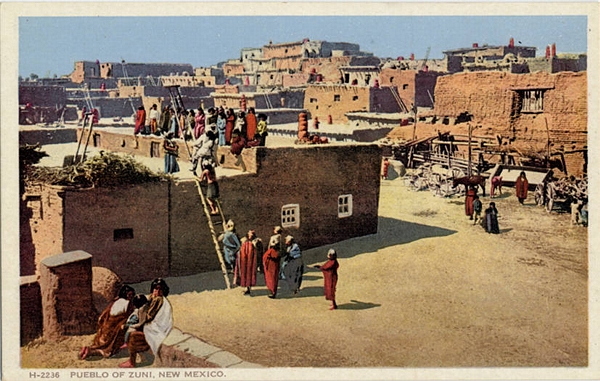
(above: Pueblo Of Zuni, New
Mexico, c. 1900s, photographic print, Fred Harvey Postcard Series,
the Newberry. Public domain, via Wikimedia Commons*)
Fred Harvey Company and the Transformation of the Marketplace (1890-1920)
The late nineteenth and early twentieth centuries introduced a powerful new variable into the Zuni artistic equation: the commercial tourist trade. The expansion of the Atchison, Topeka, and Santa Fe Railway brought an influx of Eastern travelers who were captivated by the "primitive" allure of the Southwest. Central to this development was the Fred Harvey Company, which established a network of hotels, restaurants, and curio shops along the railroad line.
The Harvey Company recognized that the traditional jewelry worn by the Navajo and Zuni -- often weighing several pounds and costing significant amounts -- was impractical for the average tourist. To accommodate this new market, traders and the Harvey Company encouraged the production of "tourist silver," which was lighter, thinner, and often featured more stereotypical "Indian" motifs such as arrows, thunderbirds, and swastikas (the whirling log symbol). This commercial pressure forced Zuni smiths to move away from heavy coin-silver ingots and toward commercial sheet silver, which was easier to manipulate into the delicate forms desired by visitors.
The Harvey House museums, such as the Indian Building at the Alvarado complex in Albuquerque, acted as living exhibits where travelers could watch weavers and silversmiths at work. This "railway flânerie" created a feedback loop where the preferences of the tourists directly influenced the artistic output of the artisans.However, this period also saw the emergence of clear tribal brand identities. Traders realized that to maximize sales, they needed to differentiate Zuni work from Navajo work. They began to promote Zuni jewelry as the choice for those who appreciated intricate stonework, while Navajo jewelry was marketed for its bold metalwork.
The Era of the Harveycars and the Indian Detours (1926-1940)
The most intensive period of differentiation and stylistic evolution occurred during the 1920s and 1930s, fueled by the "Indian Detours" program. Introduced in 1926, these excursions utilized tan and brown Studebaker or Cadillac "Harveycars" to take tourists "off the beaten track" and directly into the pueblos, including Zuni. These tours were led by well-educated women known as "couriers," who were trained in Native American history and culture to provide an authentic-seeming ethnographic experience. (See Z.S. Liang, Pueblo Street Market in the 1920s, 2006, oil on canvas. The Hilbert Museum of California Art, gift of John Heckenlively, M.D.)
The Harveycars made each pueblo a "grand scale ethnographic exhibit," where the visitor was no longer just a spectator but a participant in the economy of the village. For Zuni silversmiths, this meant a direct and constant demand for jewelry that could be easily identified as "Zuni." During this time, the iconic Zuni styles of cluster work and petit point began to flourish.
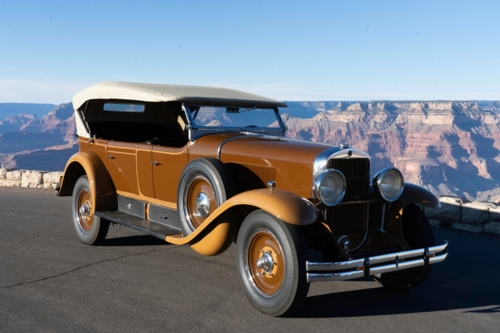
(above: 1929 Cadillac 341-B, the last remaining Harvey Car, on display at the New Mexico History Museum, 2025. Image: Courtesy of the NMHM Photo Archives)
The Technological Evolution: Petit Point and Needlepoint
As the tourist trade grew, Zuni artists reached for greater technical complexity. Around 1920, the style known as "petit point" emerged. This technique involved hand-cutting hundreds of tiny, uniform stones -- usually turquoise -- and setting each into an individual serrated bezel. The sheer labor involved in creating a single petit point squash blossom necklace or bracelet set Zuni work apart from the simpler settings used by Navajo smiths.
The evolution from petit point to "needlepoint" followed a similar logic of refinement. Needlepoint stones are cut even thinner, into needle-like shapes, requiring a level of lapidary skill that was unprecedented in the region. This stylistic trajectory was supported by the availability of commercial silver wire and sheet, as well as the transition from primitive tools to more specialized equipment. The physical properties of turquoise, specifically its relative softness on the Mohs scale, allowed for this minute shaping. The chemical formula of turquoise indicates a mineral that is hydrous and thus susceptible to the cooling effects of water during the grinding process -- a technique Zuni lapidarists perfected using sandstone and later, electric wheels.
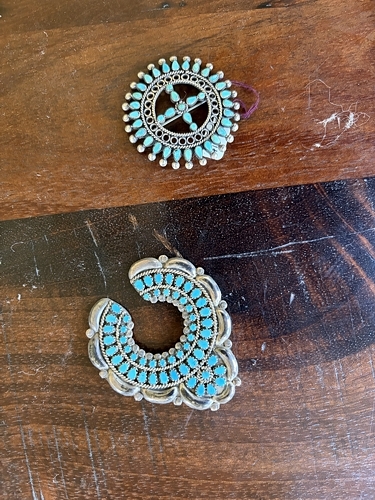
(above: Zuni Petit Point Brooches, n.d., turquroise and silver, Harry and Dorothy Hazeltine Collection)
Differentiation and the Zuni Artistic Philosophy
What made Zuni jewelry unique during the Harveycars era was its profound connection to Zuni cosmology and the environment. While Navajo jewelry often featured abstract stamping, Zuni work was increasingly representational and symbolic. The "Sunface" (Tawa) became a quintessential Zuni motif, typically crafted through mosaic inlay of turquoise, shell, jet, and coral. This symbol represents the Sun Father and is integral to the Zuni migration story from the Grand Canyon to the "Middle Place"
The Zuni also integrated their ancient tradition of fetish carving into their jewelry. Fetishes are small animal figures carved from stone that are believed to hold the spirit of the animal they represent. Under the influence of traders like C.G. Wallace, who arrived at Zuni in the 1920s, these fetishes were incorporated into multi-strand necklaces. The animals typically represent the six directions: the mountain lion (North/Yellow), the bear (West/Blue), the badger (South/Red), the wolf (East/White), the eagle (Above/Multicolored), and the shrew (Below/Black). This directional color system, also seen in the Sufi cosmology studied by some scholars for its parallels in spiritual light theory, manifests in the Zuni choice of materials: turquoise for blue, coral for red, and jet for black.
Role of C.G. Wallace
C.G. Wallace was perhaps the most influential trader in Zuni history during this period. Operating from the 1920s through the 1950s, Wallace acted as a patron and director for many of the most famous Zuni artists, including Leekya Deyuse and Teddy Weahkee. Wallace provided high-quality materials and encouraged artists to experiment with larger-scale inlay and mosaic work that could compete with European fine jewelry. His collection, which eventually numbered over 500 works, documented the shift from traditional village-use items to high-end commercial art.
The Mid-Century Transition: Electrification and Modernization (1940-1955)
The decade following 1940 brought the most significant technological change to Zuni silversmithing: the introduction of electricity to the Pueblo. This allowed for the use of electric-powered lapidary saws and grinders, which radically increased the speed and precision with which stones could be cut. Previously, every stone in a petit point necklace had to be laboriously shaped by hand on sandstone slabs. With electric tools, Zuni artists could achieve a level of uniformity and thinness -- seen in the needlepoint style -- that was previously impossible.
This era also saw the rise of "channel inlay," a technique where stones were fitted into silver partitions and then the entire surface was ground flat to a high polish. This resulted in a sleek, modern look that appealed to post-war American tastes. While the Navajo continued to favor the rugged look of tufa casting and heavy stamping, and the Hopi were developing their signature "silver overlay" technique (a style developed post-WWII to differentiate their work from Zuni and Navajo styles), the Zuni remained the unchallenged masters of the lapidary surface.
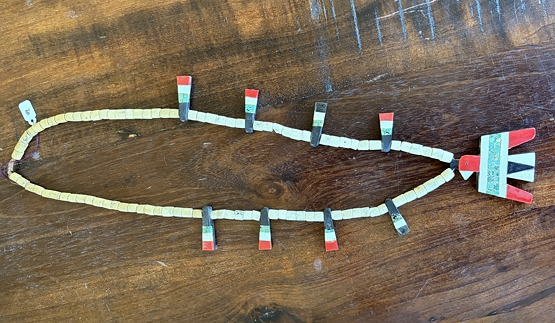
(above: Zuni Necklace, c.1940s, coral, turquoise, bone and mother of pearl on battery casing. Harry and Dorothy Hazeltine Collection)
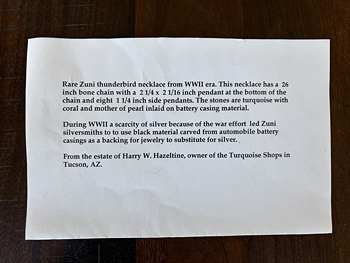
(above: Didactic text accompanying above jewelry. Harry and Dorothy Hazeltine Collection)
The post-war period was also a time of economic transition. The "trader dominance" that had defined the Harvey era began to decline as Native artists gained more direct access to markets and as the Indian Arts and Crafts Act of 1935 began to be more rigorously enforced to protect against imitations. Zuni jewelry became a standardized mark of quality, recognized internationally for its technical perfection and vibrant use of color.
A Century of Resilience and Refinement
Between 1855 and 1955, Zuni silversmithing evolved from a fledgling experiment in ironwork into a sophisticated and globally recognized art form. This history is not merely one of economic adaptation, but of cultural resilience. The A:shiwi took a foreign medium -- silver -- and used it to preserve and promote their most ancient traditions of lapidary work and spiritual symbolism.
The influence of the Fred Harvey Company and the Harveycars was profound, providing the economic impetus for differentiation and technical refinement. Yet, the Zuni artists never lost the "essence of Zuni". Whether in the tiny stones of a 1920s petit point necklace or the bold mosaic of a 1950s Sunface, the jewelry of the Zuni remains a testament to a people who successfully navigated the pressures of the modern world while remaining anchored in their "Middle Place." The differentiation from Navajo and Hopi styles -- once a marketing necessity -- became a source of tribal pride and a permanent record of Zuni's unique artistic vision. In the end, the history of Zuni silver is the history of the stone, with the silver serving only as the frame for a thousand years of A:shiwi memory.
We lightly edited this report, added images and provided links to other materials to enhance it. AI is rapidly improving in accuracy, however, the report may contain inaccurate information. This presentation doesn't meet scholarly standards, yet Gemini 3 AI researched and checked it for accuracy. Sources are footnoted in the raw AI report, yet deleted here for a general audience. Please see An Evaluation Of Gemini 3 Deep Research In Replication Of Academic Peer Review, an April, 2026 Gemini 3 Deep Research Report.
Prompt:
Research Plan:
(1) Research the origins of Zuni silversmithing from 1855 to the 1890s using .edu and .org sites, focusing on the introduction of the craft by Navajo smiths like Atsidi Sani and the work of the first Zuni smith, Lanyade. (2) Investigate the transition from plain silver metalwork to the development of Zuni-specific lapidary skills, such as turquoise setting and channel inlay, between 1890 and 1920 through academic and museum archives. (3) Explore the impact of the Fred Harvey Company and the "Harveycars" tourist trade on Zuni jewelry production between 1900 and 1955, specifically looking for how commercial demands influenced design, weight, and motifs. (4) Use .edu and .org sources to identify the technical and aesthetic differences between Zuni jewelry (focus on lapidary, needlepoint, and petit point) and the styles of the Navajo (heavy silver, sandcast) and Hopi (silver overlay). (5) Analyze the evolution of specific Zuni techniques like needlepoint, petit point, and mosaic inlay during the 1920s through 1955, noting the introduction of diverse materials like shell, coral, and jet. (6) Research the unique artistic philosophy and cultural significance of Zuni lapidary work, exploring why the emphasis on stone over metal distinguishes it from other Southwestern tribes. (7) Gather detailed historical anecdotes and descriptions from scholarly publications and non-profit cultural organizations to support a long-form, 2,500-word narrative structure.
 Return to Arizona Art History
Return to Jewelry Art
Return to Native American Art
Return to Topics in American Representational Art
*Tag for expired US copyright of object image:

TFAO Museum of American Art is proudly sponsored by Traditional Fine Arts Organization, Inc., an Arizona nonprofit corporation. All rights reserved. © 2024
Links to sources of information outside of this website are provided only as referrals for your further consideration. Please use due diligence in judging the quality of information contained in these and all other web sites. Information from linked sources may be inaccurate or out of date. TFAO neither recommends or endorses these referenced organizations. Although TFAO includes links to other web sites, it takes no responsibility for the content or information contained on those other sites, nor exerts any editorial or other control over them. For more information on evaluating web pages see TFAO's General Resources section in Online Resources for Collectors and Students of Art History.
 Search Resource Library
Copyright 2026 Traditional Fine Arts Organization, Inc., an Arizona nonprofit corporation. All rights reserved.