
American Jewelry Art
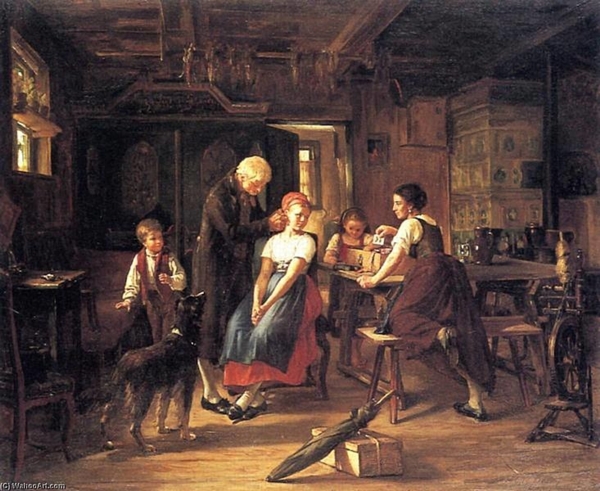
(above: Henry Bacon, Her First Earrings, c. 1886, oil on canvas, 24 1/4 x 29 3/4 inches, WahooArt. Public domain, via Wikimedia Commons*)
Introduction
This section of our catalogue Topics in American Art is devoted to the topic "American Jewelry Art." Articles and essays specific to this topic published in our Resource Library are listed at the beginning of the section. Clicking on titles takes readers directly to these articles and essays. The date at the end of each title is the Resource Library publication date.
After articles and essays from Resource Library are links to valuable online resources found outside our website. Links may be to museums' articles about exhibits, plus much more topical information based on our online searches. Following online resources may be information about offline resources including museums, DVDs, and paper-printed books, journals and articles.
We recommend that readers search within our website to find detailed information for any topic. Please see our page How to research topics not listed for more information.
Articles and essays from Resource Library in chronological order:
Loloma: Expressions in Metal, Ink and Clay (4/2/15)
Elegant Armor: The Art of Jewelry (12/11/08)
Native Couture: A History of Santa Fe Style (4/22/08)
Gems of Generations; with article by Twig Johnson (3/3/05)
The Jewelry of Robert Ebendorf: A Retrospective of Forty Years (6/24/03)
Elegant Fantasy: The Jewelry of Arline Fisch (2/16/00)
From other websites:
American Indian Jewelry from Native Languages of the Americas. Accessed August, 2015.
Art Jewelry, Favrile Metalwork & Precious Glass by Louis Comfort Tiffany is an ongoing exhibit at the Charles Hosmer Morse Museum of American Art. The museum says: "Unlike the extravagant jewelry produced under the direction of Charles Lewis Tiffany (18121902) at Tiffany & Co., Louis Comfort Tiffany's jewelry was distinguished by design and color. He executed his innovative creations using largely semiprecious stones and enamels." The article includes a 2-page exhibit object guide. Accessed August, 2016.
Be Dazzled! Masterworks of Jewelry and Beadwork from the Heard Museum is an online exhibit of the Heard Museum. Includes texts and images. Accessed January, 2015
Continued Artistry is a 2023 exhibit at the University of Mississippi Museum which says: "Choctaw basket weaving is and important traditional artistry that has been practiced for centuries. Baskets were first created primarily for utilitarian use and came in a myriad of shapes and sizes to serve different functions. While production and common use has dwindled in the past century, native weavers continue the tradition, passing their skill to the next generation. Most contemporary Choctaw basket weavers are still based in Mississippi, though a few are based in Oklahoma. Indigenous artisans of the southwest have practiced silversmithing and jewelry making since the mid-19th century. Spanish and Mexican people first taught Navajo artists the foundational skills that would later lead to their iconic artform. While initial Navajo designs were chunky pieces of silver with etched designs, the Navajo people soon began setting stones into the silver creating the style best known today." Accessed 1/24
The Cutting Edge: Contemporary Southwestern Jewelry and Metalwork is an online exhibit of the Heard Museum. Includes texts and images. Accessed January, 2015.
FORCE OF NATURE: Highlights from the Myrna B. Palley Art Jewelry Collection is a 2021 exhibit at the Lowe Art Museum, University of Miami which says: "FORCE OF NATURE: Highlights from the Myrna B. Palley Art Jewelry Collection is a testament to Mrs. Palley's indomitable spirit and her keen eye as a collector. It also pays homage to the special relationships Palley forged with the artists whose beautiful works she so proudly wore, including Pierre Cavalan, Kat Cole, Giselle Courtney, Steven Ford, David Forlano, Karen Gilbert, Tzuri Gueta, Chris Hentz, Mirjiam Hiller, Linda MacNeil, Julie Milhalisin, Sabine Müller, Maryanne Petrus-Gilbert, Joyce Scott, Luca Tripaldi, and Jazmin Winters. Each worked in a dynamic range of techniques and media, all of which are highlighted in this small but compelling exhibition." Accessed 10/21
Henry "Hank" Katzwinkel (1926-2015) is a 2016 exhibit at the Erie Art Museum which says: "He drew inspiration from his travels and experiences and used materials from the places he visited, including stones and wood, in his designs." Accessed 8/18
Hopi Silversmithing: 1850-1945 is a 2026 Gemini 3 Deep Research Report which says; "The evolution of Hopi jewelry between the mid-nineteenth century and the conclusion of World War II represents a profound narrative of cultural survival, artistic re-invention, and the strategic navigation of global economic forces. For the Hopi people, whose ancestral lands in northern Arizona comprise some of the most geologically and spiritually significant terrain in the American Southwest, the journey from traditional lapidary work to the world-renowned "silver overlay" technique was not an inevitable progression but a deliberate response to the pressures of tourism, colonial intervention, and the material scarcities of total war. While the neighboring Navajo and Zuni established their silversmithing traditions earlier and with greater commercial visibility, the Hopi path was characterized by a prolonged period of stylistic experimentation that eventually culminated in a unique aesthetic identity mirroring the intricate cosmology of the Hopi mesas. Accessed 4/26
Jana Brevick: This Infinity Fits in My Hand was a 2015 exhibit at the Bellevue Art Museum which says: "In Jana Brevick's hands, the prosaic household object or tool is transformed into a gem. The resulting work juxtaposes a high level of metal craftsmanship with a droll tongue-in-cheek delivery. With a nod to Man Ray, these wry "chance meetings" are often accompanied by twists on scale and proportion that challenge conventions of wearability.... Brevick is insatiably curious about the world and beyond. Her ongoing research into mathematics and the natural sciences forms the basis for many of her pieces. In her work, an awe for the history of scientific discovery and innovation is offset by her fascination with the beauty of obsolete technologies. Also see artist website. Accessed 1/17
Jewelry for America is a 2019 exhibit at the Metropolitan Museum of Art which says: "Spanning three hundred years, Jewelry for America explores the evolution of jewelry in this country, from the early eighteenth century to the present day." Also see 8/11/19 article in Introspective Magazine Accessed 11/19
J. Mark Sublette of Medicine Man Gallery, Inc. has secured permission to reprint online numerous articles concerning Western and Native American art from publishers of several paper-printed magazines. Included are articles on Native American jewelry. The gallery has posted several videos on Navajo jewelry and turquoise on its YouTube channel. Accessed August, 2015.
Nadine Kariya: The Hammer And The Peony is a 2017 exhibit at the Bainbridge Island Museum of Art which says: "Seattle metalsmith Nadine Kariya presents elegant designs and stories in jewelry and small functional objects." - To read more after exhibit closes, go to "Past Exhibitions" section of museum website. Accessed 12/17
Navajo Silversmithing: 1855-1955, is a 2026 Gemini 3 Deep Research report which says: "The history of Navajo silversmithing between 1850 and 1945 represents one of the most significant cultural and economic transformations in the history of the American Southwest. This period encompasses the transition of the Navajo people, from a semi-nomadic society experiencing the trauma of internment and displacement to an internationally recognized community of master artisans. The art form was not born in isolation but emerged through a complex synthesis of pre-existing metalworking traditions, colonial encounters, and the eventual pressures of a burgeoning global tourism market. By examining the technical evolution from early ironwork to the sophisticated silver-and-turquoise compositions of the mid-20th century, a portrait emerges of a craft that is simultaneously traditional and remarkably adaptive to the shifting geopolitical and economic realities of the United States." Accessed 4/26
Ron Ho - A Jeweler's Tale is a 2019 exhibit at the Bellevue Art Museumwhich says: "Building off of Ho's 2006 retrospective at BAM and the recent Northwest Designer Craftsmen Living Treasures film Ron Ho: Becoming Chinese, A Jeweler's Tale, the exhibition highlights the artist's creative explorations, the deep influence of his heritage, and his masterful ability to tell a story. Selected works from Ho's decades-long career, as well as artifacts from his personal collection, will be displayed alongside drawings and notes that illuminate his creative process." Also see Ron Ho: Becoming Chinese, A Jeweler's Tale 28 minute video Accessed 9/19
Symmetry in Stone: The Jewelry of Richard I. Chavez is a 2018 exhibit at the Heard Museum which says: "For the first time in his more than 40-year career, Richard Chavez's jewelry will be featured in a retrospective exhibition. Since his early years of jewelry design and execution, Chavez has continued to painstakingly make each item by hand." Accessed 3/18
Zero Waste: Jewelry is a 2024 exhibit at the Racine Art Museum which says: "While Western jewelry historically had a popular association with precious metals and gemstones -- excepting, perhaps, less expensive fashion jewelry -- many contemporary art jewelers have found interest in and formed a practice incorporating non-precious materials into their work. Frequent visitors to RAM see contemporary jewelry made of a wide variety of media, including hair curlers, US currency, candy, newspaper, and zippers... this exhibition highlights art jewelry made from repurposed materials originally intended for a use other than adornment." Accessed 10/24
Zero Waste: Objects is a 2024 exhibit at the Racine Art Museum which says: "Artists gravitate towards using found objects for numerous reasons: the objects may suggest another time or space; encourage a reconsideration of something familiar; reflect concerns with consumption and the environmental effects of mass production; and/or draw on personal, historical, political, social, or pop culture references." Accessed 10/24
Zuni Silversmithing: 1855-1955 is a 2026 Gemini 3 Deep Research report which says: "The
evolution of Zuni silversmithing between 1855 and 1955 represents one of
the most significant periods of cultural adaptation and artistic refinement
in the American Southwest. This era saw the Zuni people transform from masters
of ancient lapidary traditions into world-renowned silversmiths, navigating
the complex pressures of colonial expansion, the rise of industrial tourism,
and the shifting demands of a global art market. To understand this trajectory,
one must first recognize the Zuni as a linguistic and cultural isolate,
possessing a heritage that reflects deep physical and cultural rootedness
in the Colorado Plateau. While their neighbors -- the Navajo (Diné)
and the Hopi -- engaged in frequent exchange, the Zuni maintained
a core identity that eventually manifested in a style of jewelry entirely
distinct from surrounding traditions." Accessed 4/26
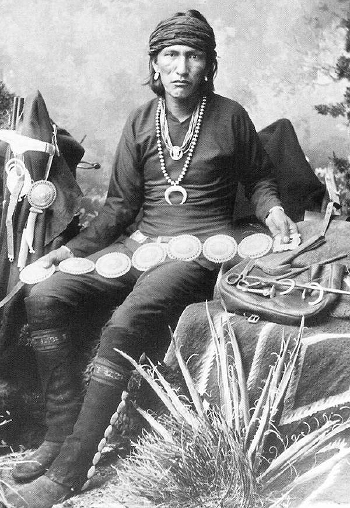
(above: Bai-De-Schluch-A-Ichin or Be-Ich-Schluck-Ich-In-Et-Tzuzzigi ("Metal Beater" Slender Silversmith, Navajo) with silver necklaces, concho belts, and tools, 1883, Palace of the Governor Archives. Photo: Ben Wittick. Public domain, via Wikimedia Commons**)
Books:
The Beauty of Navajo Jewelry,
By Theda Bassman, Ph.D., Gene Balzer. Preview this book. Published 1997
by Kiva Publishing. 79 pages.  ISBN:1885772025. Google Books
says: "An elegant array of museum quality pieces are showcased illustrating
the marvelous creativity and artistry of Navajo jewelers. The book features
the fine photography of noted photographer Gene Balzer. Detailed descriptions
accompany each piece photographed." Note: Google
Books offers a Limited Preview of this book. For more information on
this and other digitizing initiatives from publishers please click here and here.
(right: front cover, The Beauty of Navajo Jewelry. Photo courtesy
Google Books)
ISBN:1885772025. Google Books
says: "An elegant array of museum quality pieces are showcased illustrating
the marvelous creativity and artistry of Navajo jewelers. The book features
the fine photography of noted photographer Gene Balzer. Detailed descriptions
accompany each piece photographed." Note: Google
Books offers a Limited Preview of this book. For more information on
this and other digitizing initiatives from publishers please click here and here.
(right: front cover, The Beauty of Navajo Jewelry. Photo courtesy
Google Books)
Be Dazzled!: Masterworks of Jewelry and Beadwork from the Heard Museum, By Gail Bird, Heard Museum. Published by Heard Museum, 2002. ISBN 0934351651, 9780934351652. 80 pages. Google Books says: "Series of 3 catalogs published to accompany a series of 3 exhibitions organized by and held at the Heard Museum in 2001-2003, and tour internationally under the title Masterworks from the Heard Museum."
Encyclopedia of Native American Jewelry: A Guide to
History, People, and Terms, By Paula A. Baxter,
Allison Bird-Romero. Published 2000 by Oryx  Press. 296 pages.
ISBN:1573561282. Google Books says: "This new guide is the first to
explore all facets of Native American jewelry -- its history, variety, and
quality -- in one convenient resource. With coverage beginning in the mid-nineteenth
century, this resource includes artists, techniques, materials, motifs,
and more. The encyclopedia opens with a helpful introductory essay to acquaint
the reader with the subject. More than 350 entries and over 80 photos make
this new encyclopedia an exceptional value." (right: front cover, Encyclopedia
of Native American Jewelry: A Guide to History, People, and Terms. Photo
courtesy Google Books)
Press. 296 pages.
ISBN:1573561282. Google Books says: "This new guide is the first to
explore all facets of Native American jewelry -- its history, variety, and
quality -- in one convenient resource. With coverage beginning in the mid-nineteenth
century, this resource includes artists, techniques, materials, motifs,
and more. The encyclopedia opens with a helpful introductory essay to acquaint
the reader with the subject. More than 350 entries and over 80 photos make
this new encyclopedia an exceptional value." (right: front cover, Encyclopedia
of Native American Jewelry: A Guide to History, People, and Terms. Photo
courtesy Google Books)
 A Guide to Indian Jewelry of the Southwest,
By Georgiana Kennedy Simpson. Published 1999 by Western National Parks Association.
48 pages. ISBN:158369000X. Google Books says: "The third in our series
of best-selling guides to collectible Indian crafts. Features bright, clear
photographs of work by Navajo, Zuni, Hopi, and Santo Domingo artists. Brief
text details the meticulous tasks these artists perform to create a southwestern
style of wearable art."Note: Google
Books offers a Limited Preview of this book. For more information on
this and other digitizing initiatives from publishers please click
here and here.
(left: front cover, A Guide to Indian Jewelry of the Southwest. Photo
courtesy Google Books)
A Guide to Indian Jewelry of the Southwest,
By Georgiana Kennedy Simpson. Published 1999 by Western National Parks Association.
48 pages. ISBN:158369000X. Google Books says: "The third in our series
of best-selling guides to collectible Indian crafts. Features bright, clear
photographs of work by Navajo, Zuni, Hopi, and Santo Domingo artists. Brief
text details the meticulous tasks these artists perform to create a southwestern
style of wearable art."Note: Google
Books offers a Limited Preview of this book. For more information on
this and other digitizing initiatives from publishers please click
here and here.
(left: front cover, A Guide to Indian Jewelry of the Southwest. Photo
courtesy Google Books)
Hopi Silver: The History and Hallmarks of Hopi Silversmithing, by Margaret Nickelson Wright. 160 pages. University of New Mexico Press; 1998 revision edition (August 30, 2003) ISBN-10: 0826333826. ISBN-13: 978-0826333827
 Southwestern Indian Jewelry, By
Dexter Cirillo. Photographs by Stephen Northup, Michael Monteaux. Contributor
Steven Northup, Michael Monteaux. Published 1992 by Abbeville Press. Abbeville
says: "Spectacular photographs of the breathtaking beautiful objects
and sensitive portraits of the artists combine with an insightful, informative
text to capture the spirit of this work and the vital cultures from which
it springs. This ground-breaking volume opens by surveying the vividly colored
necklaces, earrings, and pins made in shell and stone from prehistoric times
to the present, particularly in the Santo Domingo and Zuni pueblos. The
focus then shifts to the much-admired and avidly collected work in silver
-- often set with turquoise and other stones -- by Navajo, Hopi, and Zuni
artists. The book culminates in an exploration of striking contemporary
work in which many artists have adapted traditional approaches to create
original designs. A collector's guide offers invaluable advice as well as
an illustrated glossary of materials, techniques, objects, and designs.
A nationwide directory of sources concludes the book." (right: front
cover, Southwestern Indian Jewelry. Photo courtesy Google Books)
Note: the Introduction to this book may be read at the Abbeville
Press web site.
Southwestern Indian Jewelry, By
Dexter Cirillo. Photographs by Stephen Northup, Michael Monteaux. Contributor
Steven Northup, Michael Monteaux. Published 1992 by Abbeville Press. Abbeville
says: "Spectacular photographs of the breathtaking beautiful objects
and sensitive portraits of the artists combine with an insightful, informative
text to capture the spirit of this work and the vital cultures from which
it springs. This ground-breaking volume opens by surveying the vividly colored
necklaces, earrings, and pins made in shell and stone from prehistoric times
to the present, particularly in the Santo Domingo and Zuni pueblos. The
focus then shifts to the much-admired and avidly collected work in silver
-- often set with turquoise and other stones -- by Navajo, Hopi, and Zuni
artists. The book culminates in an exploration of striking contemporary
work in which many artists have adapted traditional approaches to create
original designs. A collector's guide offers invaluable advice as well as
an illustrated glossary of materials, techniques, objects, and designs.
A nationwide directory of sources concludes the book." (right: front
cover, Southwestern Indian Jewelry. Photo courtesy Google Books)
Note: the Introduction to this book may be read at the Abbeville
Press web site.
White Metal Universe: Navajo Silver from the Fred Harvey Collection, By Heard Museum of Anthropology and Primitive Art, E. W. Jernigan, Gary Witherspoon. Published by Heard Museum, 1981. ISBN 0934351201, 9780934351201. 53 pages
DVD/VHS video:
Charles Loloma & Helen Hardin. Presents the world famous Hopi jeweler Charles Loloma displays some of his work and discusses his heritage, and presents Helen Hardin painting sophisticated geometric patterns and traditional Indian motifs while exploring her attempt to integrate the Indian and artist parts of her self. 1988. 60 min. Video/C 1579. Available from Media Resources Center, Library, University of California, Berkeley.
 Return to Topics in American Representational Art
.
Links to sources of information outside of our web site are provided only as referrals for your further consideration. Please use due diligence in judging the quality of information contained in these and all other web sites. Information from linked sources may be inaccurate or out of date. TFAO neither recommends or endorses these referenced organizations. Although TFAO includes links to other web sites, it takes no responsibility for the content or information contained on those other sites, nor exerts any editorial or other control over them. For more information on evaluating web pages see TFAO's General Resources section in Online Resources for Collectors and Students of Art History.
 Search Resource Library
Copyright 2026 Traditional Fine Arts Organization, Inc., an Arizona nonprofit corporation. All rights reserved.