
Navajo Silversmithing: 1855-1955
a 2026 Gemini 3 Deep Research report
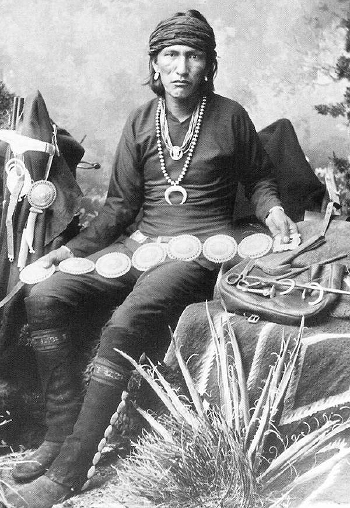
(above: Bai-De-Schluch-A-Ichin or Be-Ich-Schluck-Ich-In-Et-Tzuzzigi ("Metal Beater" Slender Silversmith, Navajo) with silver necklaces, concho belts, and tools, 1883, Palace of the Governor Archives. Photo: Ben Wittick. Public domain, via Wikimedia Commons**)
The history of Navajo silversmithing between 1850 and 1945 represents one of the most significant cultural and economic transformations in the history of the American Southwest. This period encompasses the transition of the Navajo people, from a semi-nomadic society experiencing the trauma of internment and displacement to an internationally recognized community of master artisans. The art form was not born in isolation but emerged through a complex synthesis of pre-existing metalworking traditions, colonial encounters, and the eventual pressures of a burgeoning global tourism market. By examining the technical evolution from early ironwork to the sophisticated silver-and-turquoise compositions of the mid-20th century, a portrait emerges of a craft that is simultaneously traditional and remarkably adaptive to the shifting geopolitical and economic realities of the United States.
The Genesis of Navajo Metalwork and the Mexican Influence
The official history of Navajo silversmithing is generally traced to the mid-19th century, although the cultural context for metal use existed long before the first smith struck a silver coin. Records as early as 1795 indicate that the governor of New Mexico observed Navajo individuals wearing silver jewelry, likely obtained through trade or battle with Spanish and Mexican settlers. However, the actual practice of manipulating metal was initially rooted in blacksmithing rather than jewelry making. In the 1830s and 1840s, Navajo men began to seek instruction from Mexican blacksmiths, such as Ramon Sena and José Castillo, to learn the rudiments of working with iron. These early skills were primarily utilitarian, focusing on the production of knives, bridle bits, and agricultural tools made from scrap iron.
Atsidi Sani, a Navajo headman also known by the Spanish name Herrero (meaning "smith"), is historically credited as the first Navajo silversmith. His career began in ironwork, where he crafted bridle bits out of scrap iron featuring decorative jingles called zarcillos, a term borrowed from the Spanish word for earrings. Around 1850, during a brief cessation of hostilities between the Navajo and Mexican populations in the upper Rio Grande valley, Atsidi Sani observed the work of Mexican plateros (silversmiths) and began to apply his blacksmithing techniques to silver. This transition from iron to silver was facilitated by the shared mechanics of the two crafts; the heavy files, punches, and chisels used to shape iron were easily repurposed for the softer medium of silver.
The early "Classic Period" of Navajo silversmithing was characterized by the use of silver ingots and coins. Because the Navajo were an impoverished nation returning from the forced internment at Bosque Redondo in 1868, they had little access to raw silver ore. Instead, they relied on melting down Mexican pesos and U.S. silver coins to obtain their material. Mexican pesos were particularly prized for their high silver content and malleability, whereas U.S. coins were often harder and more difficult to forge. The practice of defacing currency was technically illegal, yet it persisted out of necessity, as traders encouraged the craft as a means of establishing a viable economic base for the returning Navajo.
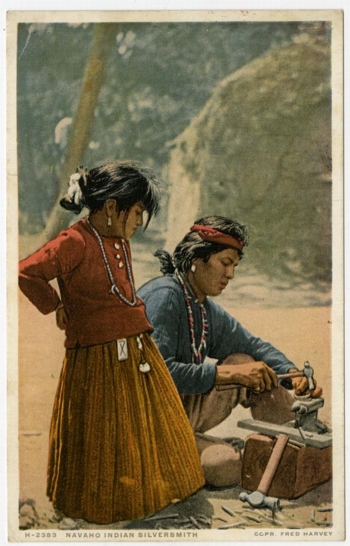
(above: Navajo Indian Silversmith,
c. 1900s, photographic print, Fred Harvey Postcard Series, the Newberry.
Public domain, via Wikimedia Commons*)
The technical sophistication of this early period relied on the manual labor of the smith. To create a piece of jewelry, the smith would melt coins into a rectangular or disk-formed ingot, which was then hammered and forged into the desired shape. This process was fraught with difficulty; uneven forging often led to cracked silver, which necessitated repairs and patches that are now considered hallmarks of early authentic pieces.Techniques like sand casting, learned from the Mexican plateros, allowed for more complex shapes. This involved packing a frame with finely grained sand, carving a negative image of the jewelry into the sand, and pouring molten silver into the cavity.
Artistic Evolution: From Horse Trappings to Personal Adornment
As the Navajo settled back into their traditional territories after 1868, the stylistic vocabulary of their silverwork began to expand. The earliest forms were heavily influenced by the Spanish and Plains Indian aesthetics. For example, the Navajo bridle -- a central piece of status for a horse-riding culture -- was a direct adaptation of designs used by Southern Plains tribes, which were themselves based on Spanish-Mexican models produced at sites like Bent's Fort in Colorado. These bridles were initially made of German silver or brass and featured large, flat patterns with uncomplicated border designs.
A defining element that emerged during this period was the naja, a crescent-shaped pendant that has its origins in Moorish designs that traveled from Spain to the Americas. Navajo smiths initially added the naja to the frontlet of horse bridles, but by the 1870s, it began to transition into an article of personal dress, appearing on necklaces and clothing. Similarly, the concho belt -- derived from the Spanish word concha for shell -- evolved from the hair-plates worn by Plains Indians. Early conchos were simple, large silver disks with a slot in the center through which a leather belt could be passed, often decorated with rocker engraving -- a method where a flat-edged tool is rocked continually across the silver surface to create a zigzag line.
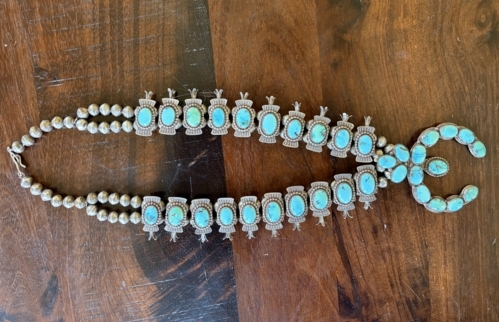
(above: Navajo Squash Blossom Necklace, n.d, silver and turquoise, Harry and Dorothy Hazeltine Collection)
The integration of turquoise, which occurred around 1880, fundamentally altered the aesthetic of Navajo jewelry. Prior to this, the beauty of a piece resided entirely in the weight and surface decoration of the silver. Because turquoise sources were initially limited, early smiths often repurposed old beads from necklaces for use as settings. This transition from "pure silver" to the "silver and turquoise" paradigm was encouraged by traders who recognized that the colorful stone appealed to the sensibilities of both tribal members and burgeoning outside markets. By the late 19th century, turquoise was being set into every form of jewelry, from rings and bracelets to the increasingly iconic squash blossom necklace.
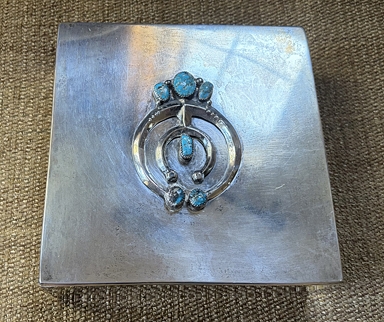
(above: Navajo Naja on Silver Box, n.d, silver and turquoise, Harry and Dorothy Hazeltine Collection)
The Fred Harvey Company and the Commercialization of Authenticity
The most significant shift in Navajo silversmithing occurred not within the tribe, but at the railroad stations. At the turn of the 20th century, the Atchison, Topeka & Santa Fe Railway partnered with the Fred Harvey Company to revolutionize Southwest tourism. In 1902, the Fred Harvey Company established its Indian Department in Albuquerque, under the direction of Herman Schweizer and John Huckel. Their mission was to commodify Native American crafts for a national audience, which required a radical reimagining of what Navajo jewelry should look and feel like.
The Harvey Company understood that Eastern tourists were drawn to "authenticity," but only if that authenticity was portable and comfortable. Traditional Navajo jewelry of the 19th century was often too heavy and cumbersome for the average traveler. To solve this, the Harvey Company began supplying smiths with commercial sheet silver and pre-cut turquoise. This led to the creation of the "Fred Harvey style," which utilized thinner silver and featured stamps of "Indian symbols" like arrows and thunderbirds -- designs that were often suggested by the company rather than the smiths themselves to satisfy the tourist's desire for exotic meaning.
The Harvey Company's marketing strategy relied on "staged authenticity." Buildings like the Alvarado Hotel's Indian Building or the Hopi House at the Grand Canyon were designed by Mary Colter to resemble indigenous architecture. Inside, Navajo weavers and silversmiths were hired as "demonstrators" to perform their craft before the tourists. This performance reassured the buyer that the item was "authentic," even if it was made from factory-supplied materials and specifically designed for the tourist market.
Harveycars and the Indian Detours: A New Frontier of Sales
In 1926, the Fred Harvey Company expanded its reach into the remote Southwest through the introduction of the "Indian Detours". These tours utilized "Harveycars" -- high-end Studebaker and Cadillac automobiles -- to transport tourists from the railroad lines directly into the heart of Navajo and Pueblo lands. These excursions were marketed as a way to see "oldest America" in luxury, moving the ethnographic experience from the hotel gift shop into the physical landscape of the indigenous people. (See Z.S. Liang, Pueblo Street Market in the 1920s, 2006, oil on canvas. The Hilbert Museum of California Art, gift of John Heckenlively, M.D.)
The "Indian Detours" were led by Couriers, often college-educated young women who were trained in the history, geography, and customs of the region. To enhance the "picturesque" nature of the experience, the Couriers were required to wear Navajo-style blouses, silver concho belts, and squash blossom necklaces.These garments served as a "conversational springboard," allowing the Couriers to educate tourists on the intricacies of the jewelry and encouraging them to buy directly from the artisans in the pueblos. This direct contact between the tourist and the smith created a feedback loop that further solidified the demand for jewelry that was recognizable as "Native American" but tailored to the aesthetics of the modern traveler.
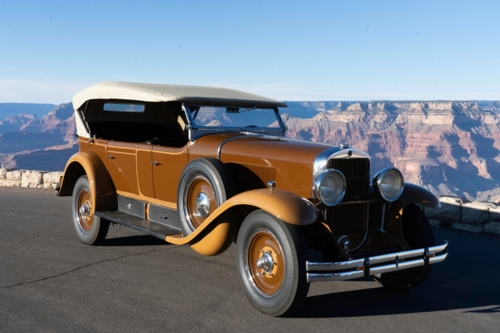
(above: 1929 Cadillac 341-B, the last remaining Harvey Car, on display at the New Mexico History Museum, 2025. Image: Courtesy of the NMHM Photo Archives)
The Harveycars themselves were dubbed "road Pullmans," featuring swiveling chairs and large windows that allowed tourists to view the landscape as a grand exhibition. This mobility changed the nature of the jewelry trade; smiths living in remote areas now had a consistent, high-spending audience brought to their doorsteps. This period saw the proliferation of small, whimsical items -- such as silver spoons and tiny butterfly pins -- that were easy to transport in the limited space of a Harveycar or a train suitcase.
Differentiating Tribal Styles: Navajo, Zuni, and Hopi
As the tourist trade boomed, it became necessary for collectors and dealers to differentiate between the silverwork of the Navajo, Zuni, and Hopi. While the Navajo were the first to adopt the craft, they shared their knowledge with neighboring tribes, who then developed their own distinct artistic identities based on their pre-existing cultural traditions.
The Scarcity of Crisis: The Depression and World War II
The prosperity of the early 20th-century tourist trade was sharply curtailed by the Great Depression and the onset of World War II. These global events had a profound impact on the availability of materials and the economic survival of Navajo silversmithing. As the 1930s progressed, silver became increasingly expensive and difficult to source, leading to the emergence of "Depression jewelry".
During this period, smiths began to look beyond traditional materials. In place of silver, they used non-precious metals and low-cost alternatives. One of the most notable innovations was the use of battery casings and phonograph records. The hard, black rubber or plastic from car battery cases could be carved and polished to resemble jet or used as a backing for mosaic inlay. Similarly, old phonograph records were melted down and reshaped into jewelry components. These items were often decorated with turquoise scraps and gypsum, creating a unique aesthetic of resilience that is now highly sought after by collectors.
World War II brought even greater challenges. Silver was declared a strategic metal necessary for the war effort, leading to extreme scarcity for artisans. Many Navajo smiths were forced to substitute silver with copper and brass. Copper jewelry, particularly stamped butterfly pins, became a staple of the craft during the war years. These pieces were often made by smiths who remained on the reservation while others moved to urban centers for defense work or joined the military.
The economic impact of the war was dual-edged. Many experts feared that the craft would disappear or move toward assembly-line production in factories to survive the post-war era.
Technical Resilience and the Stylistic Legacy
The history of Navajo silversmithing from 1850 to 1945 is a testament to the technical resilience of the Diné. Despite being forced into an alien economy, Navajo smiths successfully incorporated foreign materials -- from Spanish bits and Mexican coins to Harveycar souvenirs and wartime battery casings -- into a coherent artistic tradition. The uniqueness of Navajo jewelry lies in this ability to absorb influence without losing its structural identity.
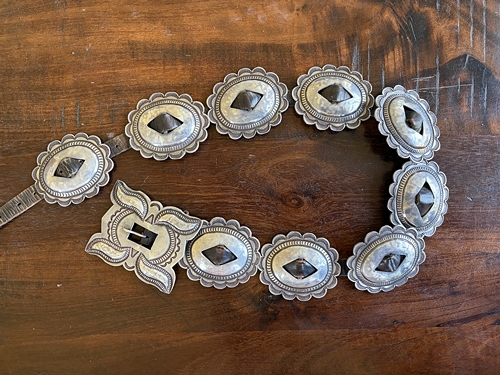
(above: Concho Belt, n.d, silver and leather, Harry and Dorothy Hazeltine Collection)
Navajo jewelry remains unique because it is "sculptural" rather than just decorative. The weight of the silver in a traditional concho belt or a sand-cast naja provides a physical presence that is unmatched by the more delicate styles of European or even neighboring Pueblo traditions. This led to a resurgence of quality and a new market for "excellence" in silverwork that moved beyond the cheap souvenirs of the Harvey era. The sourcing of turquoise, the use of charcoal fires for casting, and the inspiration drawn from desert flora (like the squash blossom) created a product that was inseparable from the Southwest.
As the craft entered the post-war period, the influence of the GI Bill allowed returning Navajo veterans to receive formal education in silversmithing, often using more modern tools and techniques. Whether it was Atsidi Sani looking over the shoulder of a Mexican platero or a WWII-era smith carving a butterfly out of a battery casing, the Navajo silversmith has always been a figure of adaptation, turning scarcity into beauty and trade into tradition. However, the foundational period of 1850-1945 remains the bedrock of the art form, establishing the techniques, materials, and stylistic paradigms that define Southwest jewelry to this day.
The story of the Navajo silversmith is ultimately one of
"incorporation" -- a model of cultural change where the tribe
took the tools of their oppressors and the demands of their tourists and
forged them into a symbol of tribal sovereignty and artistic genius. Whether
it was Atsidi Sani looking over the shoulder of a Mexican platero or a WWII-era
smith carving a butterfly out of a battery casing, the Navajo silversmith
has always been an figure of adaptation, turning scarcity into beauty and
trade into tradition.
We lightly edited this report, added images and provided links to other materials to enhance it. AI is rapidly improving in accuracy, however, the report may contain inaccurate information. This presentation doesn't meet scholarly standards, yet Gemini 3 AI researched and checked it for accuracy. Sources are footnoted in the raw AI report, yet deleted here for a general audience. Please see An Evaluation Of Gemini 3 Deep Research In Replication Of Academic Peer Review, an April, 2026 Gemini 3 Deep Research Report.
Prompt:
Research Plan:
(1) Search .edu and .org domains for the origins of Navajo silversmithing between 1850 and 1880, focusing on Atsidi Sani, the influence of Mexican plateros, and the early use of silver coins and slugs. (2) Research the evolution of Navajo jewelry artistic styles from 1880 to 1910 on .edu and .org sites, detailing the introduction of sand casting, hand-stamping, and the integration of turquoise, and identifying what makes these styles unique. (3) Investigate the Fred Harvey Company and the Harveycars tourist trade (1900-1940) using .edu and .org sources to understand the commercial shift toward lightweight, mass-market jewelry designs. (4) Use .edu and .org resources to compare and contrast Navajo jewelry with Hopi and Zuni jewelry during the early 20th century, specifically looking for technical differences like Navajo bold silverwork versus Zuni inlay or Hopi overlay. (5) Research the impact of World War II (1941-1945) on silver availability for Navajo silversmiths via .edu and .org sites, focusing on wartime restrictions and the documented use of alternative materials such as battery casings, copper, or melted scrap. (6) Synthesize the gathered information to construct a cohesive historical narrative covering 1850 to 1945, ensuring the tone is informal and lacks formal structural elements like headings or bullet points.
 Return to Arizona Art History
Return to Jewelry Art
Return to Native American Art
Return to Topics in American Representational Art
*Tag for expired US copyright of object image:

TFAO Museum of American Art is proudly sponsored by Traditional Fine Arts Organization, Inc., an Arizona nonprofit corporation. All rights reserved. © 2024
Links to sources of information outside of this website are provided only as referrals for your further consideration. Please use due diligence in judging the quality of information contained in these and all other web sites. Information from linked sources may be inaccurate or out of date. TFAO neither recommends or endorses these referenced organizations. Although TFAO includes links to other web sites, it takes no responsibility for the content or information contained on those other sites, nor exerts any editorial or other control over them. For more information on evaluating web pages see TFAO's General Resources section in Online Resources for Collectors and Students of Art History.
 Search Resource Library
Copyright 2026 Traditional Fine Arts Organization, Inc., an Arizona nonprofit corporation. All rights reserved.