
Hopi Basketry: 1880-1980
a 2026 Gemini 3 Deep Research Report
Page 2
Santa Fe Railway and 1880s Transition
The arrival of the Atlantic and Pacific Railroad (the precursor to the Santa Fe Railway) in the 1880s shattered the isolation of the Hopi mesas. Travelers from the East, often referred to as "dudes" by the locals, began to arrive in increasing numbers, seeking tangible connections to what they perceived as a vanishing primitive world. This period saw the first significant shift from utilitarian production to "curio" production. Walter Hough, writing in the early twentieth century, noted that Hopi life was changing with "increasing rapidity" as families moved away from traditional cliff dwellings to modern houses near their fields, and weaving techniques adapted to the availability of new tools, such as wire cards for combing fibers.
The commercialization of the 1880s and 1890s was characterized by a loss of some "ancient touches" as weavers experimented with synthetic aniline dyes. Prior to this contact, Hopi colors were derived from a limited but stable palette: blue from indigo or sunflower seeds, yellow from rabbitbrush flowers, and black from a mixture of sunflower seeds and ochre. The introduction of vibrant, easily applied chemical dyes allowed for a proliferation of new colors, which initially appealed to the Victorian sensibilities of Eastern tourists. However, this trend would eventually be reversed by the professional curators of the Fred Harvey Company, who sought to "re-authenticate" the craft by encouraging a return to natural dyes.
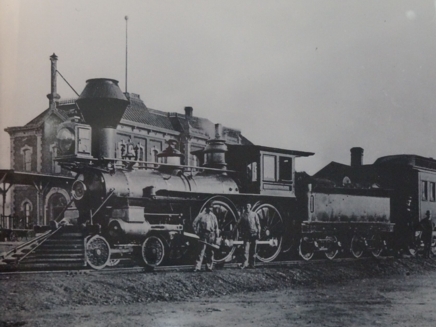
(above: Sherlock locomotive # 5, Topeka, Kansas, c. 1890, Mohave Museum of History and Arts. Public domain, via Wikimedia Commons*)
Mary Colter's Hopi House
The year 1905 marked a watershed moment in the commercial history of Hopi basketry with the construction of Hopi House at the Grand Canyon. Designed by Mary Colter, the Fred Harvey Company's lead architect, Hopi House was a meticulously researched recreation of the traditional pueblo at Oraibi on Third Mesa. Colter, who was deeply influenced by the "indigenous style" of the Southwest, used local sandstone and adobe to create a building that appeared to belong to the landscape.
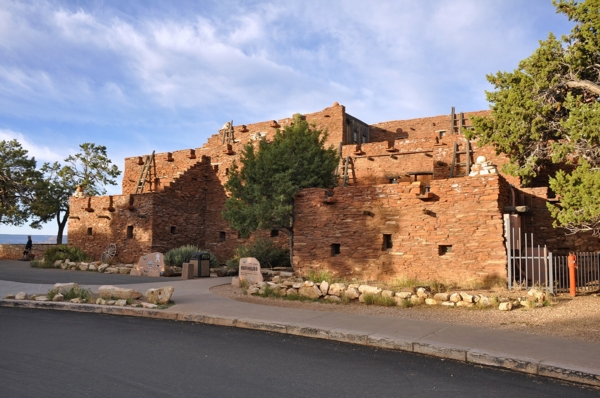
(above: Grand Canyon National Park's Hopi House, 2010. Photo credit: Grand Canyon National Park. Public domain, via Wikimedia Commons**)
Hopi House was more than a retail space; it was a living exhibit. Colter and the Harvey Company contracted Hopi artists to live and work in the building, weaving baskets and carving katsina dolls in full view of the tourists. This performance of labor was essential to the Harvey branding strategy, which focused on "catching archaeology alive". The presence of active weavers validated the "authenticity" of the products sold in the shop, creating a premium market for baskets that could be directly associated with a specific maker.
The Harveycar Era and the Transformation of Scale: 1926-1940
The launch of the "Indian Detours" in 1926 by Ford Harvey introduced a new dynamic to the basketry market.These all-expense automobile tours utilized "Harveycars" to ferry affluent travelers from rail-side hotels, such as the Alvarado in Albuquerque or La Fonda in Santa Fe, directly to the remote mesas. These tourists were accompanied by college-educated female guides, known as "Couriers," who acted as cultural intermediaries, explaining the complexities of Hopi religion and the symbolic meanings behind basketry designs. (See Z.S. Liang, Pueblo Street Market in the 1920s, 2006, oil on canvas. The Hilbert Museum of California Art, gift of John Heckenlively, M.D.)
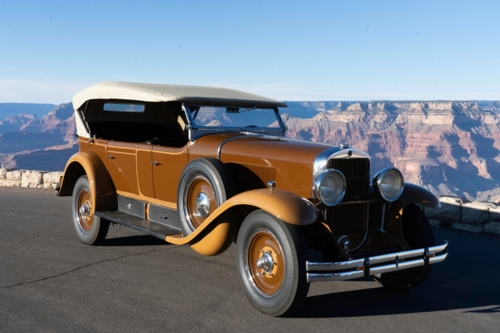
(above: 1929 Cadillac 341-B, the last remaining Harvey Car, on display at the New Mexico History Museum, 2025. Image: Courtesy of the NMHM Photo Archives)
The arrival of Harveycars at the pueblos forced a strategic shift in the physical form of the baskets. Unlike the large storage vessels used in the villages, the baskets intended for tourists needed to be portable and easily packed into suitcases or the limited storage space of an automobile. This led to a period of "miniaturization," where weavers produced small, high-quality plaques and deep bowls specifically for the luxury market. The iconography also shifted; whereas traditional baskets often featured abstract geometric representations of natural elements like rain or clouds, the Harveycar trade favored more explicit "figurative" imagery. Weavers increasingly depicted recognizable katsinam (spirit helpers), such as the Sun (Taawakatsina), the Hiilili, or the Shalako Maiden (Sa'lakwmana).
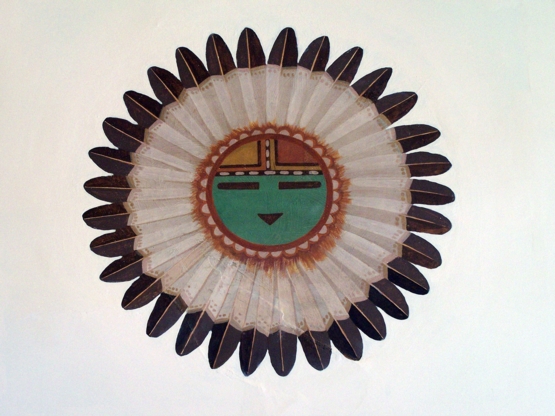
(above: Fred Kabotie, Mural Depicting Tawa, Sun Spirit and Creator in Hopi mythology. Painted Desert Inn, Petrified Forest National Park, Arizona. Public domain, via Wikimedia Commons*)
Iconographic Shift in Hopi Basketry (1900-1945)
The Finger Collection at the Arizona State Museum https://statemuseum.arizona.edu/online-exhibit/finger-collection-hopi-basketry provides a chronological record of this iconographic evolution. Pieces from the early 1900s show a transition from traditional geometric patterns to highly detailed representations of the katsina religion, which archaeological research dates back to at least the fourteenth century.
The "Novelty Hat" from circa 1920 is a particularly salient example of this hybridity; it utilized the ancient coiling technique of Second Mesa to create a Western-style hat, demonstrating the weaver's ability to adapt traditional skills to the aesthetic whims of the tourist market.
Differentiation from Kewa and Santa Clara Traditions
A core component of the Fred Harvey marketing strategy was the differentiation of Southwest tribes into distinct "brands" to encourage repeat tourism and collection. During the period of 1850-1945, Hopi basketry became clearly demarcated from the traditions of the Rio Grande Pueblos, specifically Kewa (Santo Domingo) and Santa Clara. These differences were not merely stylistic but were rooted in gender, environment, and material science.
Kewa basketry, during this era, was characterized by its rigid, utilitarian nature. Unlike the Hopi tradition, which was exclusively the domain of women, Kewa baskets were traditionally woven by men. The primary material was Red Willow (Salix laevigata), a riparian plant native to the moist soils along the Rio Grande. The construction method utilized an "eight-rod start," where heavy willow rods provided a structural skeleton for the weft. This resulted in a heavy, durable basket that lacked the delicate surface area required for the intricate katsina mosaics found on Hopi plaques. While Kewa jewelers were gaining international fame for their turquoise work, their basketry remained focused on functional forms for carrying and storing food.
Santa Clara Pueblo, meanwhile, was undergoing a revolution in ceramic arts that largely overshadowed its basketry traditions during the early twentieth century. Under the influence of master potters like Maria Martinez (from neighboring San Ildefonso) and the subsequent development of Santa Clara's own black-on-black techniques, the focus shifted toward polished pottery.
The Persistence of the Ceremonial: Social Reciprocity and the Plaque
Despite the intense commercial pressures of the 1920s and 30s, the heart of Hopi basketry remained firmly rooted in the concept of poota and yungyapu -- the coiled and wicker plaques used for social and ceremonial exchange. These objects served as a vital link between families and clans, functioning as a form of currency within the Hopi social structure.
The wedding ceremony remained the primary driver of high-quality weaving throughout the 1850-1945 period. A bride's wedding trousseau traditionally included multiple plaques, which were used to present cornmeal to the groom's family as a reciprocal payment for the wedding robes woven by the men. These "wedding baskets" followed strict traditional designs: a star or floral pattern on Second Mesa, using a palette of white, green, and black. On Third Mesa, the wedding plaques often featured blue rectangles symbolizing the couple's union. The ceremonial requirement for these items meant that even as weavers adapted their styles for the "Harveycars," they maintained a deep repository of traditional knowledge and technical precision that was never intended for sale.
Cultural Continuity and the Threshold of Modernity
By 1945, at the conclusion of World War II, Hopi basketry had traversed a century of unprecedented change. From the first meeting in Santa Fe in 1850 to the height of the Harveycar era, the weavers of the three mesas demonstrated an extraordinary ability to navigate the "encroaching influences of modern civilization". They successfully transformed their ancient techniques -- plaiting, coiling, and wickerwork -- into a sophisticated artistic language that could speak simultaneously to their own ancestors and to a global audience.
The commercial interventions of the Fred Harvey Company and the architectural visions of Mary Colter, while undeniably commodifying Hopi heritage, provided a platform that allowed these crafts to remain economically viable in a world where metal pots and plastic containers were replacing traditional utilitarian baskets. The differentiation from Rio Grande traditions -- Kewa's willow-work and Santa Clara's pottery -- was not a loss of identity but a strategic positioning that celebrated the unique desert-adapted materials of the Hopi environment.
Ultimately, the baskets produced during this era, such as those preserved in the Finger Collection, are more than just souvenirs of a bygone tourist trade. They are "footprints" of Hopi history, embodying the stories, iconography, and technology of a people who have survived as farmers on a barren, dry plateau for over fifteen centuries. As the Hopi entered the post-war era, the basket remained a symbol of cultural persistence, a vessel for prayer, and a tangible manifestation of the "Circle of Life" that continues to sustain the people of the mesas.
We lightly edited the article, added images and provided links to other materials to enhance it. AI is rapidly improving in accuracy, yet the article may have inaccurate information.
Prompt:
Research plan:
(1) Research the historical evolution of Hopi basketry between 1850 and 1945, focusing on the cultural significance and traditional techniques used during this era using only .org and .edu sources. (2) Identify the specific materials and construction methods (such as wicker and coiled techniques) unique to the First, Second, and Third Mesas of the Hopi during the late 19th and early 20th centuries. (3) Investigate the impact of the Fred Harvey Company and the "Harveycars" tourist trade on the production and design of Hopi baskets, including how it transitioned from utilitarian use to commercial art. (4) Locate information on the basketry traditions of the Santo Domingo (Kewa) and Santa Clara Pueblos during the same 1850-1945 timeframe, specifically looking for their preferred materials and styles. (5) Contrast Hopi basketry with that of Santo Domingo and Santa Clara, focusing on distinguishing features such as weave density, color palettes, and symbolic motifs that would have been evident to collectors in the Harvey trade. (6) Examine how the "Indian Detours" and tourist demand specifically influenced the portability, size, and aesthetic choices made by Hopi weavers to cater to visitors traveling by car or train. (7) Search for narratives or biographical accounts of Hopi weavers from this period to provide an informal, human-centered perspective on the transition to a cash economy through craft. (8) Synthesize the gathered information to trace the shift in Hopi basketry from 1850 to 1945, highlighting the external economic pressures versus the internal preservation of cultural identity.
 Return to Arizona Art History
Return to Native American Art
Return to Basketry
*Tag for expired US copyright of object image:

and
**Tag for some rights reserved:

Links to sources of information outside of our web site are provided only as referrals for your further consideration. Please use due diligence in judging the quality of information contained in these and all other web sites. Information from linked sources may be inaccurate or out of date. TFAO neither recommends or endorses these referenced organizations. Although TFAO includes links to other web sites, it takes no responsibility for the content or information contained on those other sites, nor exerts any editorial or other control over them. For more information on evaluating web pages see TFAO's General Resources section in Online Resources for Collectors and Students of Art History.
Copyright 2026 Traditional Fine Arts Organization, Inc. an Arizona nonprofit corporation. All rights reserved.