
AI Curiosities
Two Colonies, Two Visions: A Century of Art in Ogunquit and Monhegan
by Gemini 2.5 Pro
The Call of the Coast
For over a century, the coast of Maine has been a magnet for American artists. Its "primal drama of the ocean" and rugged shores offered more than just picturesque scenery; they provided a crucible where new ideas about American identity and art were forged. As the 19th century progressed, the New England coast transformed in the cultural imagination from a purely economic resource into a "therapeutic shelter," a place where a growing middle class could escape the pressures of industrialization and reconnect with a mythic, pre-industrial past. Artists were at the forefront of this migration, banding together for "camaraderie, creativity, and commerce".
Within this broader movement, two communities emerged as pivotal centers of artistic innovation: the accessible fishing village of Ogunquit and the remote, wild island of Monhegan. Though separated by only a few dozen miles of sea, they developed into distinct artistic ecosystems, attracting different kinds of artists and fostering radically different approaches to painting. Ogunquit became a bustling center for instruction, defined by a spirited debate between traditional Impressionism and emerging Modernism. Monhegan, by contrast, became a rugged outpost for rebels, a place where artists sought elemental truths and forged a powerful, distinctly American modernism. The story of these two colonies is the story of American art in transition, charting a course from the genteel light of the 19th century to the bracing realities of the 20th.
Ogunquit: A Civilized Canvas
Located in southern Maine, the picturesque village of Ogunquit was more easily accessible by rail and steamer, making it an ideal summer destination. Since the 1890s, it drew artists seeking relief from the city heat and the company of their peers. The colony's development, however, was largely shaped by two towering figures with competing artistic visions: Charles H. Woodbury and Hamilton Easter Field.
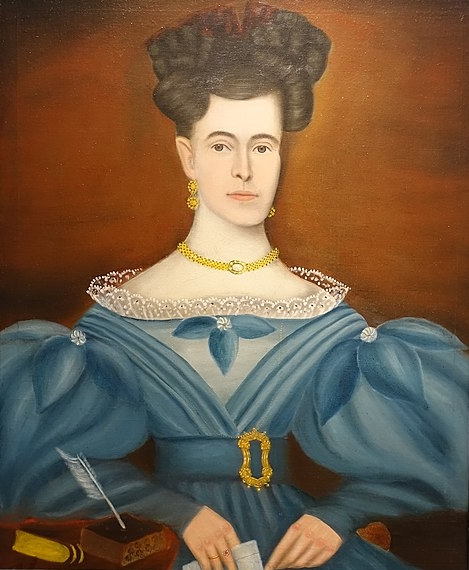
(above: Erastus Salisbury Field, Portrait of a Young Woman, c. 1830, oil on canvas, Portland Art Museum - Portland, Oregon. Photo by Daderot. Public domain, via Wikimedia Commons*)
This ideological clash became Ogunquit's defining feature. It was a place of dialogue and debate, where the regionalist image of "old" New England met the cosmopolitan worldview of New York modernism. This creative tension, played out in its schools and studios, made Ogunquit a vital hub that influenced the course of American art history for decades.
Monhegan: A Rugged Muse
Twelve miles off the coast, the island of Monhegan offered a starkly different experience. A mere square mile of granite and spruce, its "remoteness and rugged landscape" attracted a more adventurous type of artist from its earliest days. The first painter to document a visit was Aaron Draper Shattuck in 1858, who described a place of "grand cliffs rising high out of the sea" and "surf dashing terribly on the Eastern shore". For decades, only a trickle of artists followed, willing to sacrifice middle-class comfort to paint its wild beauty.
The island's transformation into a "painter's paradise" began in earnest in the 1890s, but its identity as a modernist outpost was cemented by one man: Robert Henri. The charismatic leader of the Ashcan School, Henri visited in 1903 and saw in Monhegan's elemental character the perfect antidote to the academic art he despised. He urged his students from New York -- a group that included Rockwell Kent, George Bellows, and Edward Hopper -- to join him there, to escape the "grittiness of the city" and paint with a new honesty and vigor.
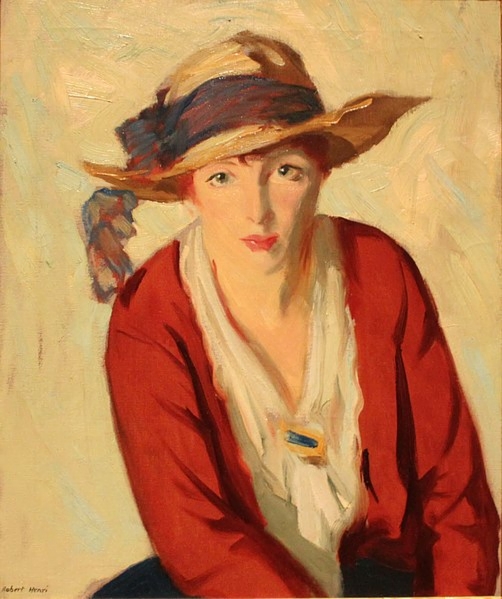
(above: Robert Cozad Henri, The Beach Hat, 1914, oil on canvas, 43.82 x 54.93 cm, Detroit Institute of Arts. Public domain, via Wikimedia Commons*)
For these artists, Monhegan was not a place of gentle leisure but a battleground of natural forces. Their goal was to capture the "relentless struggle between sea and shore" with a raw, energetic style that was wholly American. Unlike in Ogunquit, where artists were often summer visitors, many Monhegan painters bought homes and stayed year-round, immersing themselves in the community and capturing the island's stark winter beauty. This deep, year-round commitment gave the art produced there a profound sense of authenticity and power, establishing Monhegan as a vital forge for American Modernism.
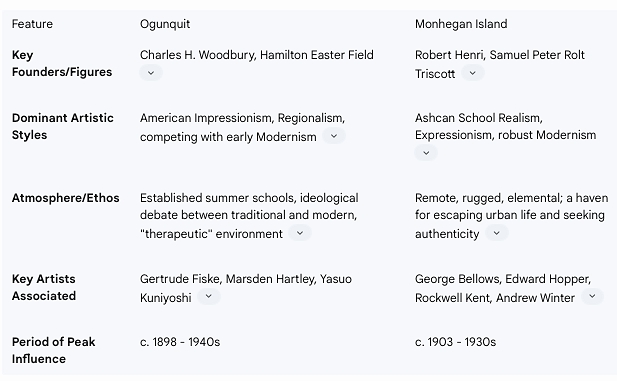
Key Artists of the Colonies
Ogunquit
Charles Herbert Woodbury (1864-1940)
Charles Herbert Woodbury is recognized as the founder of Ogunquit's first and most important art colony. Born in Massachusetts, he graduated from MIT with a degree in mechanical engineering, a background that profoundly shaped his artistic vision. After marrying Marcia Oakes of South Berwick, Maine, he settled in Ogunquit in 1896 and, two years later, opened the Ogunquit Summer School of Drawing and Painting. The school was an immediate success, training over 4,000 students over nearly four decades and single-handedly putting Ogunquit "on the map as an art colony".
Woodbury was a marine painter obsessed with the sea, but his engineering mind sought to depict not static scenes but the forces of nature in motion. His famous maxim, taught to legions of students, was to "Paint in verbs, not nouns". His own paintings, rendered with quick, sure brushstrokes, were analytical yet expressive studies of the ocean's dynamic energy.His immense influence as a teacher, through his school and his books, disseminated his educational philosophy across America, making him one of the most sought-after instructors of his generation.
The Cliff (1929): This powerful oil painting exemplifies Woodbury's mature style and core philosophy. It depicts the dramatic, rocky coast of Ogunquit, but its true subject is the relentless action of the sea upon the land. The energetic brushwork visualizes the forces of collision and erosion, making the viewer feel the weight and motion of the water. It is the culmination of a lifetime spent observing and deconstructing the mechanics of the ocean, a perfect fusion of scientific analysis and artistic expression. ·
The Eclipse Series (1932) (See Charles H. Woodbury and the 1932 Solar Eclipse in Ogunquit, Maine): Perhaps the most brilliant demonstration of his principles, this series was created during the total solar eclipse visible from Ogunquit. While other artists painted the spectacle in the sky, Woodbury turned his back on the sun. Instead, he set up six small canvases and, in a burst of rapid-fire painting, captured the otherworldly changes in light and color on the cliffs and sea at various stages of the event. The series is a radical and innovative study of light's effect on the landscape, a testament to his keen observation and his unique, analytical approach to his subject. ·
Hamilton Easter Field (1873-1922)
If Woodbury gave Ogunquit its foundation, Hamilton Easter Field gave it its modernist soul. An artist, critic, collector, and patron from New York, Field was a passionate supporter of modern art. In 1911, he founded the Summer School of Graphic Arts in Perkins Cove, establishing a progressive, avant-garde alternative to Woodbury's more traditional school.Field further cemented the colony's infrastructure by buying and renting old fishing shacks inexpensively to artists and students, making Ogunquit a viable and vital place for modernism to develop.
Field's importance to Ogunquit lies in the creative tension he fostered. His school and his circle of artists -- which included figures like Yasuo Kuniyoshi, Robert Laurent, and Marsden Hartley -- represented a modernist worldview that stood in direct contrast to Woodbury's regionalist ethos. This "ideological contrast" transformed Ogunquit from a simple summer painting destination into a focal point for the evolution of American modernism. His life was intertwined with this development, and his legacy is preserved in the Hamilton Easter Field Art Foundation Collection, a body of work that documents the rise of modernism in the early 20th century.
Monhegan Island
Robert Henri (1865-1929)
Robert Henri was the single most influential artist to work on Monhegan, the catalyst who transformed it from a remote destination for landscape painters into a vital outpost of the modernist rebellion. As a leader of the Ashcan School and a revered teacher, Henri advocated for a new American art, one rooted in the American experience rather than derivative of European traditions. He saw Monhegan's raw, untamed landscape as the ideal subject for this new vision.
Henri first visited in 1903 and was captivated by the "elemental drama of the Maine coast, the relentless struggle between sea and shore". He encouraged his most promising students -- including Rockwell Kent and George Bellows -- to join him, seeking in Maine's simplicity and honesty a counterpoint to the complexity of modern urban life. His presence and that of his circle laid the foundation for the art colony, establishing its character as a place of strength and vitality. While he did not stay year-round, his influence was profound, setting the tone for the robust, expressive, and unflinchingly direct art that would become Monhegan's hallmark.
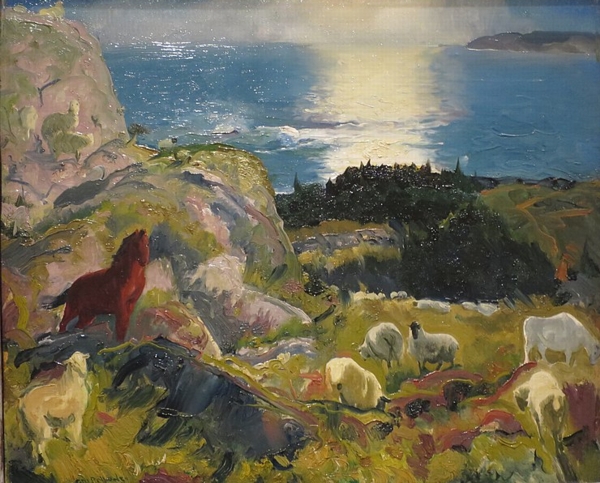
(above: George Wesley Bellows, Romance of Criehaven, 1916, oil on wood panel, De Young Museum, oil on panel, De Young Museum. Public domain, via Wikimedia Commons*)
Rockwell Kent (1882-1971)
Rockwell Kent was the artist who most fully realized the artistic potential that Henri saw in Monhegan. Encouraged by his teacher, Kent arrived in 1905 and, unlike most visitors, made the island his year-round home until 1910. He built his own house and studio, immersing himself in the island's life by working as a carpenter and lobsterman. This deep engagement with the place and its people became the "foundation of his lasting reputation as an early American modernist".

(above: Rockwell Kent, Toilers of the Sea, 1907, oil on canvas, 37.9 ? 44 inches, New Britain Museum of American Art. Public domain, via Wikimedia Commons*)
Kent's style was a powerful synthesis of his teachers' influences. From Robert Henri, he took the energetic realism of the Ashcan School; from Abbott Handerson Thayer, he absorbed a profound, almost mystical reverence for nature. On Monhegan, he forged these into a signature style that pared the landscape down to its essential, monumental forms, which he rendered with a clean, dramatic light that evoked the sublime. His inspiration was the island itself: its "rockbound shores, its towering headlands, the thundering surf". Monhegan was the first of many remote, forbidding landscapes Kent would seek out in a lifelong quest to confront the wilderness and find humanity's place within it.
Winter, Monhegan Island (1907): A landmark work of early American modernism, this painting depicts the stark, snow-covered view of neighboring islands from Kent's studio window. The composition is bold and simplified, with broad masses of icy blues and whites applied with the energetic brushwork favored by the Henri circle. A brilliant fusion of his influences, it has the bleak power of a Winslow Homer seascape, the robust realism of his Ashcan training, and the spiritual awe for nature instilled by Thayer. The painting was the standout of his first solo exhibition and announced the arrival of a major new voice in American art. ·
Maine Coast, Winter (1909): Part of a series of four paintings depicting Monhegan's dramatic headlands, this work is considered the most abstract of the group. Here, Kent pushes representation to its limits, reducing the snow-laden cliffs and sea to powerful, simplified shapes and fields of color. The work demonstrates his genius for distilling a landscape to its emotional and structural core. In its raw power and bold forms, the painting solidifies Kent's position in the vanguard of American modernism and reveals the profound influence of Monhegan's rugged character on the development of his art.
Please don't rely on this AI-generated text for accuracy. It has been edited, yet may have inaccurate information. Links are ours. Nonessential parts of the report were deleted.
Also see:
 Return to Maine Art History
Return to AI Curiosities
*Tag for expired US copyright of object image:

Links to sources of information outside of our web site are provided only as referrals for your further consideration. Please use due diligence in judging the quality of information contained in these and all other web sites. Information from linked sources may be inaccurate or out of date. TFAO neither recommends or endorses these referenced organizations. Although TFAO includes links to other web sites, it takes no responsibility for the content or information contained on those other sites, nor exerts any editorial or other control over them. For more information on evaluating web pages see TFAO's General Resources section in Online Resources for Collectors and Students of Art History.
 Search Resource Library
Copyright 2025 Traditional Fine Arts Organization, Inc., an Arizona nonprofit corporation. All rights reserved.